Manufyn manufactures POM / Delrin parts in-house — molding & precision machining
POM (polyoxymethylene, also called acetal — Delrin is DuPont/Celanese’s brand name for it) is a highly crystalline engineering thermoplastic used for injection molding and CNC machining. It combines exceptional stiffness, near-zero moisture absorption, a low friction coefficient, and the best dimensional stability of any mainstream engineering plastic — which is why POM is the default material for precision gears, snap-fit mechanisms, pump and valve components, and any part that must hold size in wet or humid service.
This POM / Delrin material guide covers everything an engineer or buyer needs before specifying it:
- Exact properties — and why POM barely changes with humidity, unlike nylon
- The homopolymer vs copolymer distinction — what “Delrin” actually means vs generic POM
- Which manufacturing process suits which application
- How POM compares with nylon, ABS, and polycarbonate
- The safety rule every shop must know before touching this material
At Manufyn, we manufacture POM parts in-house — plastic injection molding and CNC machining — with a free DFM review on every quote and dispatch to 30+ countries.
What Is POM (Delrin) Made Of?
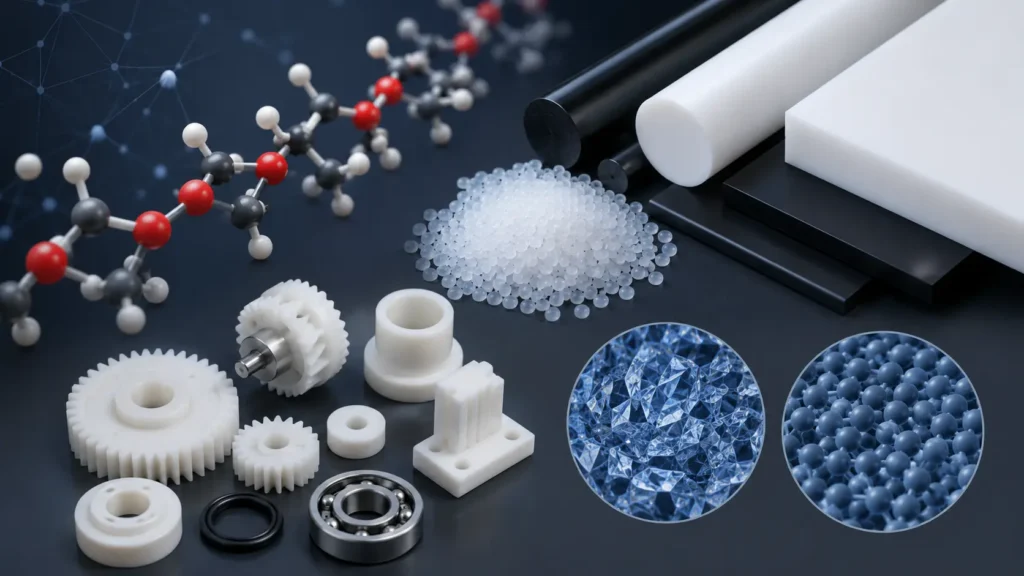
POM’s chemistry is disarmingly simple: a repeating –CH₂–O– backbone (formaldehyde units linked into long chains), nothing else. That simplicity is the whole story of the material.
- A short, symmetric backbone with no bulky side groups packs into a very high degree of crystallinity (70–80%) — far higher than nylon or polyethylene. This is the direct cause of POM’s stiffness, spring-back, and the glossy, low-friction surface it machines and molds to.
- No hydrogen-bonding groups to attract water — unlike nylon’s amide groups, POM’s backbone has nothing for water molecules to grab onto, which is why it absorbs only ~0.2% moisture versus nylon’s 2.5–3%. This single structural fact is the reason POM exists as a separate material category from nylon at all.
POM is semi-crystalline like nylon, so it has a true, sharp melting point (165–175 °C) rather than the gradual softening of amorphous plastics like ABS and PC.
What Are the Properties of POM?
POM offers high stiffness, excellent fatigue resistance, a low, humidity-independent friction coefficient, and dimensional stability unmatched by any other mainstream engineering plastic. The table below gives typical values for unfilled homopolymer grade (Delrin-type) POM.
POM / Delrin Property Table
| Property | Typical Value | What It Means in Practice |
|---|---|---|
| Density | 1.41–1.42 g/cm³ | Denser than nylon or ABS — parts feel solid and premium |
| Tensile strength | 62–70 MPa (homopolymer higher end) | Stronger than unfilled nylon and well above ABS/PC unfilled |
| Flexural modulus | 2.6–3.1 GPa | Stiff, springy — humidity-independent, unlike nylon’s shifting modulus |
| Izod impact (notched) | 60–110 J/m | Good, but more brittle than conditioned nylon under shock |
| Melting point | 165–175 °C (true, sharp — semi-crystalline) | Lower than nylon — the trade-off for POM’s other advantages |
| Continuous service temp | ~90–100 °C | Good for most mechanisms; not for under-hood or motor-adjacent duty |
| Coefficient of friction | 0.15–0.35, self-lubricating | Runs dry against metal and itself — no grease needed |
| Mold shrinkage | 1.8–2.2% | High — the molding trade-off for POM’s crystallinity; needs experienced tool sizing |
| Water absorption (24 h / equilibrium) | ~0.2% at both — near zero | The defining trait: dimensions barely move regardless of environment |
| Fatigue / spring-back | Excellent — the best of the engineering plastics | Ideal for snap-fits, living hinges, and parts flexed thousands of cycles |
Which POM / Delrin Grades Are Available?
The single most important grade decision in POM is homopolymer vs copolymer — a distinction most buyers never hear explained, and one that decides whether a part survives hot water or develops porosity.
POM / Delrin Grade Selection Guide
| Grade | Key Trait | Choose It For |
|---|---|---|
| Homopolymer POM (Delrin brand) | Slightly higher strength, stiffness & surface finish | Precision gears, springs, snap-fits — where every % of stiffness matters and hot water isn’t a factor |
| Copolymer POM (Celcon, Hostaform, generics) | Better hot-water & chemical resistance, porosity-free thick sections | Food machinery, plumbing fittings, hot-water valves, thick machined parts |
| Glass-filled POM (GF20–GF30) | Higher stiffness and HDT, reduced shrinkage | Structural parts and housings needing more rigidity than unfilled POM |
| PTFE / low-friction POM | Coefficient of friction cut further (to ~0.1–0.2) | High-speed gears, bearings, and sliding mechanisms with minimal wear |
| UV-stabilized POM | Resists chalking outdoors | Exterior mechanisms, outdoor fittings, irrigation components |
| FDA / food-contact POM (copolymer) | Certified for food and potable water contact | Conveyor parts, dispensing valves, food-processing machinery |
Practical note: “Delrin” is used loosely across the industry to mean any acetal, but true Delrin-brand material is homopolymer. Much of what ships as generic “Delrin” from stock distributors is actually copolymer POM. Manufyn states the exact grade — homopolymer or copolymer, and brand where relevant — on every quote so there’s no ambiguity for hot-water or food-contact applications.
How Is POM Manufactured into Parts?
POM is primarily a molding-and-machining material — it is not a 3D printing or thermoforming plastic in any mainstream sense, which simplifies the process decision considerably.
POM Injection Molding — for Production Volumes
POM molds well at 190–220 °C, but its high crystallinity means high shrinkage (1.8–2.2%) that must be built into the tool from the start — this is where experienced tooling separates a first-shot-approved part from a rework cycle. Its fast, clean flow gives excellent surface finish and short cycles once the tool is sized correctly. Manufyn’s in-house plastic injection molding covers tooling, molding, and finishing under one roof — see the injection molding design guide and shrinkage rates for fundamentals.
CNC Machining POM — the Machinist’s Favourite Plastic
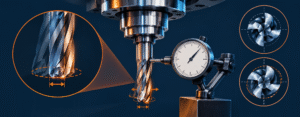
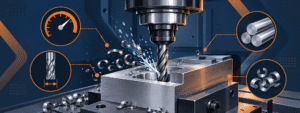
POM is widely regarded as the best-machining engineering plastic: it chips cleanly like brass, holds tolerances of ±0.05 mm or tighter without special technique, and leaves a glossy finish straight off the tool. This is why POM rod and plate are the default choice for prototype gears, precision fixtures, and one-off mechanisms. Feeds, speeds, and workholding are in the CNC machining plastics guide, and the tolerance capability behind this is demonstrated in Manufyn’s micron-tolerance CNC machining with live tooling case study. Prototype and low-volume POM parts ship in 5–10 days via Manufyn’s rapid prototyping service.
One critical safety rule: POM must never be laser cut. Laser heat decomposes the polymer’s formaldehyde backbone and releases formaldehyde gas — hazardous to operators and equipment. CNC routing and machining are the only safe subtractive processes for this material, covered fully in the limitations section below.
Ready to prototype or produce in POM?
Machined or molded POM parts in 5–10 days. Quote in 24 hours. No minimum order.
POM vs Nylon, ABS, and Polycarbonate — Which Should You Choose?
POM’s closest rival is nylon — both dominate gears and wear parts, and the full head-to-head is in Manufyn’s Nylon vs Delrin comparison. ABS and PC enter the shortlist only for housings, where POM rarely competes. The table below settles all four at once.
POM Comparison Table
| Criterion | POM (Delrin) | Nylon (PA6/PA66) | ABS | Polycarbonate |
|---|---|---|---|---|
| Dimensional stability | Excellent — the best of the four | Fair — moisture swell | Very good | Very good |
| Moisture absorption | ~0.2% — near zero | 2.5–3% | Low | Low |
| Stiffness | High, humidity-independent | High but shifts with moisture | Moderate | High |
| Impact toughness (as supplied) | Good | Excellent (conditioned) | Very good | Excellent |
| Continuous service temp | ~90–100 °C | ~100–150 °C | ~85 °C | ~115 °C |
| CNC machinability | The best of all engineering plastics | Good | Good | Good, polishes clear |
| Bonding / painting | Very poor — low surface energy | Good with preparation | Excellent | Good |
| Resin price (indicative, 2026) | $2.00–3.50/kg | $2.00–4.00/kg | $1.50–2.50/kg | $2.50–4.00/kg |
| Choose it when… | Precision gears, snap-fits, wet/humid dimensional stability | Shock loads, heat, cost-driven mechanical parts | Indoor housings on a budget | Clear, impact- and heat-resistant parts |
Resin prices above are indicative global commodity ranges as of 2026 and move with market conditions. Part price depends far more on tooling, cycle time, and machining time than on resin cost. Manufyn quotes exact part pricing in 24 hours.
Rule of thumb: POM when a mechanism must hold precise dimensions regardless of humidity; nylon when the part takes shock loads or runs hot; ABS and PC when the job is a housing, not a mechanism. For the full plastic-and-metal selection framework, see Manufyn’s prototyping material guide.
Design Guidelines for POM Parts
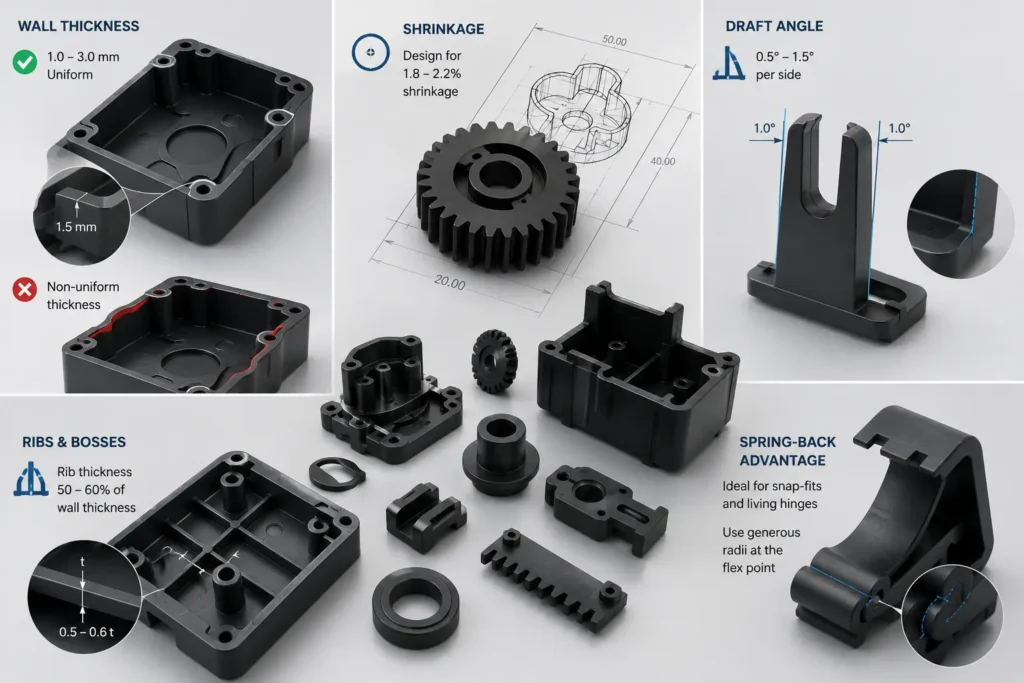
POM is precise and forgiving in machining but demanding in molding — five rules separate a first-shot-approved part from a warped or sink-marked reject:
- Wall thickness 1.0–3.0 mm, kept strictly uniform — POM’s high crystallinity amplifies thickness variation into sink marks and warp; see the wall thickness design guide
- Design the tool for 1.8–2.2% shrinkage from the start — this is POM’s largest molding challenge; see shrinkage rates
- Draft angle 0.5–1.5° per side — POM’s low friction against steel means it releases easily, often needing less draft than other plastics; rules in the draft angles guide
- Ribs at 50–60% of wall thickness — covered in ribs and bosses design
- Exploit the spring-back — POM is the best mainstream material for snap-fits and living-hinge-style clips that get cycled thousands of times; design generous root radii to avoid stress concentration at the flex point
Have a drawing ready?
Send it to Manufyn’s engineers for a free DFM review — we flag shrinkage, sink-mark, and homopolymer-vs-copolymer grade questions before tooling is cut, and respond within 4 hours.
What Is POM Used For? Applications by Industry
Wherever a part must hold precise dimensions while sliding, meshing, or flexing, POM appears. Across the industries Manufyn serves, the most common POM applications are:
POM Applications by Industry
| Industry | Typical POM Parts |
|---|---|
| Industrial machinery | Precision gears, cams, rollers, bushings, conveyor components — anywhere dimensional accuracy matters over decades of cycles |
| Plumbing & fluid handling | Valve components, pump impellers, fittings, water-meter internals — copolymer grades for hot-water resistance |
| Consumer products | Zipper components, lighter bodies, aerosol valves, buckles, snap-fit clips |
| Automotive | Seatbelt components, window regulator gears, fuel-system parts, door-handle mechanisms |
| Electronics & precision instruments | Camera and printer mechanisms, switch and connector internals, precision guide rails |
| Food & medical (FDA grades) | Conveyor components, dispensing valve bodies, medical device housings and mechanisms |
Two Manufyn contexts: POM precision components feature in precision linear guide rail CNC machining, and mechanism-grade parts serve clients across robotics where dimensional consistency drives reliability.
The Honest Limitations of POM
No material guide is complete without the drawbacks. POM has five you must design around:
- Never laser cut it. POM decomposes into formaldehyde gas under laser heat — one of the few common plastics that must not go anywhere near a laser cutter. CNC routing and machining are the only safe subtractive processes, and adequate ventilation is required during molding and hot machining too.
- It barely bonds. Low surface energy defeats most adhesives and paints without aggressive surface treatment. Design mechanical joints — snap-fits, press-fits, fasteners — instead of glued ones.
- Homopolymer struggles with hot water and strong acids/bleach. Copolymer grades handle both far better — specify copolymer for any hot-water, cleaning-chemical, or washdown environment.
- UV degradation. Unstabilized POM chalks and embrittles outdoors. Specify UV-stabilized grades for exterior mechanisms.
- Lower heat capacity than nylon. POM’s 165–175 °C melting point and ~90–100 °C service limit rule it out of under-hood and motor-adjacent duty — that territory belongs to PA66.
On sustainability: POM is recyclable and mechanically reprocessed at industrial scale, though it is less commonly recycled than commodity plastics due to its narrower application base. Industrial regrind at controlled percentages is standard practice at Manufyn for non-critical parts and reduces both cost and waste.
How Much Does POM / Delrin Cost?
POM resin trades at roughly USD 2.00–3.50 per kg for standard homopolymer or copolymer grade, broadly in line with nylon and moderately above ABS. Glass-filled, PTFE-modified, and FDA-certified grades run toward the top of that range or slightly above. Resin is rarely the cost driver for molded parts — tooling amortization (especially shrinkage-corrected tooling) and cycle time dominate; the full breakdown logic is in our guide to injection molding vs 3D printing cost. For machined POM, material cost is often a small fraction of total part price — machine time and tolerance requirements dominate instead.
This is exactly where sourcing from India changes the math: Manufyn’s in-house tooling, molding, and precision machining typically deliver 40–60% savings against US, UK, and EU suppliers at identical ISO 9001 quality — the economics are detailed in the plastic injection parts guide.
Get Your POM / Delrin Parts Quoted in 24 Hours
Manufyn is India’s ISO 9001 certified in-house manufacturer for POM parts. We confirm:
Homopolymer vs copolymer grade for your environment
FDA / food-contact certification where needed
Shrinkage-corrected tooling & sink-mark DFM
Molding vs machining route for your volume
40–60% cost savings vs US/UK/EU suppliers
Frequently asked questions
What is POM / Delrin in simple terms?
POM (polyoxymethylene, also called acetal) is a stiff, low-friction engineering plastic that holds its exact dimensions regardless of humidity. Delrin is DuPont/Celanese’s brand name for POM homopolymer. It is the material of precision gears, snap-fit mechanisms, and pump components — chosen when a part must hold size and slide smoothly for years.
Is Delrin the same thing as POM?
Delrin is a specific brand of POM homopolymer; POM (acetal) is the general material family, which also includes copolymer grades (Celcon, Hostaform, and generics). In everyday industry speech “Delrin” is often used loosely to mean any acetal, but true Delrin-brand material is homopolymer specifically.
What is the difference between homopolymer and copolymer POM?
Homopolymer POM (true Delrin) is slightly stronger and stiffer with a better surface finish, but can develop centerline porosity in thick machined sections and is weaker in hot water. Copolymer POM trades a few percent of stiffness for better hot-water and chemical resistance and porosity-free stock — the usual choice for food machinery and plumbing.
What is the melting point of POM?
165–175 °C — a true, sharp melting point since POM is semi-crystalline. Its continuous service limit is roughly 90–100 °C, lower than nylon, which is the main trade-off for POM’s dimensional stability and machinability.
Why can't POM / Delrin be laser cut?
Laser heat decomposes POM’s formaldehyde-based backbone and releases formaldehyde gas — hazardous to operators and equipment. CNC routing and machining are the only safe subtractive processes for this material, and it happens to be one of the best-machining plastics available.
Does POM absorb water?
Almost none — about 0.2%, versus nylon’s 2.5–3%. This is POM’s defining engineering trait: parts hold their molded or machined dimensions in essentially any humidity or wet-service environment, which is why it dominates precision mechanisms and pump/valve components.
Is POM stronger than nylon?
POM is stiffer and holds its properties more consistently (nylon’s shift with moisture); conditioned nylon is tougher under shock and impact. Neither is universally “stronger” — POM wins on precision and consistency, nylon wins on impact resistance and heat. Full comparison in the Nylon vs Delrin guide.
Can POM be glued or painted?
Barely — its low surface energy defeats most adhesives and coatings without aggressive surface treatment (plasma or chemical etch). Design mechanical joints — snap-fits, press-fits, fasteners — instead, which is exactly where POM’s stiffness and spring-back excel.
Is POM food safe?
FDA/EU-compliant copolymer POM grades are widely used in food and beverage machinery — conveyor components, dispensing valves, water-contact parts — chosen for their hot-water and cleaning-chemical resistance. Standard industrial grades are not automatically food-certified; state the requirement on your drawing.
What is the minimum order for POM parts from Manufyn?
There is no minimum order. Manufyn quotes POM parts from a single CNC-machined prototype up to high-volume injection molding runs, with a quote returned in 24 hours.