Manufyn manufactures nylon PA6 parts in-house — molding, machining & printing
Nylon PA6 (polyamide 6) is a semi-crystalline engineering thermoplastic used for injection molding, CNC machining, 3D printing, and extrusion. It combines high strength, outstanding wear and fatigue resistance, and a low friction coefficient — which is why PA6 is the default material for gears, bearings, bushings, and the toughest snap-fits in engineering.
This nylon PA6 material guide covers everything an engineer or buyer needs before specifying it:
- Exact properties — dry-as-molded AND conditioned (nylon’s numbers move with moisture)
- The grades available, including glass-filled GF30 — the industry workhorse
- Which manufacturing process suits which application
- How PA6 compares with PA66, POM (Delrin), ABS, and polycarbonate
- The moisture behaviour that surprises first-time nylon users — and how to design for it
At Manufyn, we manufacture PA6 parts in-house — plastic injection molding, CNC machining, and 3D printing — with a free DFM review on every quote and dispatch to 30+ countries.
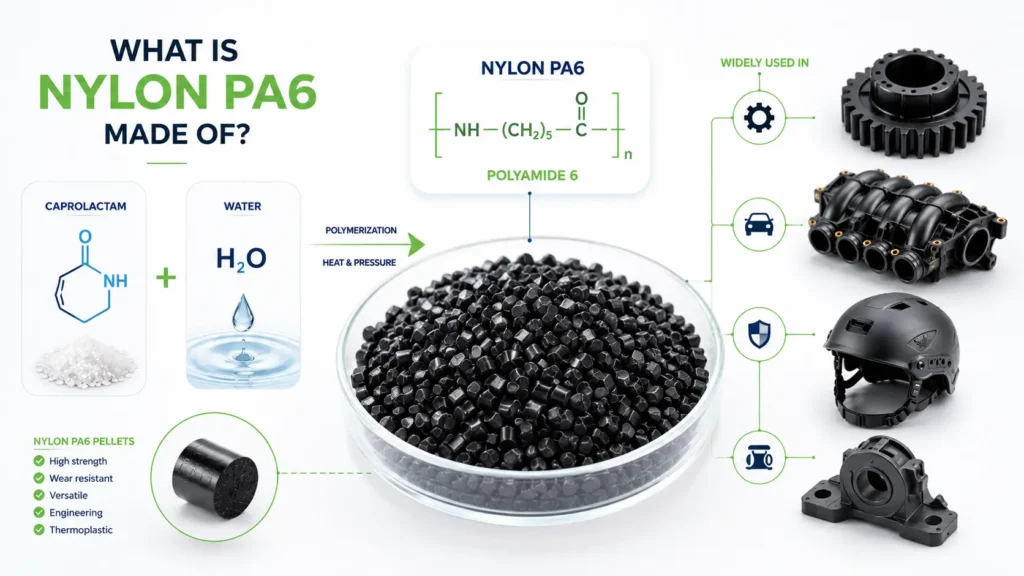
What Is Nylon PA6 Made Of?
PA6 is polymerized from a single monomer — caprolactam, a six-carbon ring that opens and links into long chains. The “6” in PA6 refers to those six carbons. Its close sibling PA66 (nylon 6,6) is instead built from two monomers of six carbons each, which packs its chains slightly tighter — the source of PA66’s higher melting point and stiffness.
Two features of the polyamide chain explain how all nylons behave:
- Amide groups that hydrogen-bond between chains — this internal “velcro” gives nylon its strength, fatigue resistance, and abrasion resistance far beyond commodity plastics.
- Those same amide groups attract water — nylon absorbs moisture from the air, which softens it, toughens it, and swells it. This is not a defect; it is the defining engineering trait of the material, covered in its own section below.
PA6 is also semi-crystalline — unlike amorphous ABS and polycarbonate, it has a true, sharp melting point (~220 °C) and stays usefully stiff well above its ~50 °C glass transition because the crystalline regions hold the structure together.
What Are the Properties of Nylon PA6?
Nylon PA6 offers high strength, exceptional toughness when conditioned, outstanding wear resistance, and a genuine melting point that keeps it working at temperatures where ABS softens. The table below gives typical values for unfilled injection molding grade PA6 — dry-as-molded, with conditioned values noted where they differ meaningfully.
Nylon PA6 Property Table
| Property | Typical Value (Dry) | What It Means in Practice |
|---|---|---|
| Density | 1.13–1.15 g/cm³ (GF30: ~1.36) | Light for its strength — good strength-to-weight in mechanical parts |
| Tensile strength | 60–80 MPa (GF30: 150–180 MPa) | Stronger than ABS and PC unfilled; glass-filled rivals die-cast zinc |
| Izod impact (notched) | 50–110 J/m dry; 3–5× higher conditioned | Brittle-ish when bone dry, extremely tough at normal humidity |
| Elongation at break | 30–100%+ (conditioned) | Yields and deforms rather than shattering — ideal for snap-fits |
| Melting point | ~220 °C (true, sharp — semi-crystalline) | Unlike ABS/PC, PA6 genuinely melts; short excursions near it are fatal to parts |
| Glass transition temp (Tg) | ~50 °C | Stiffness drops above this, but crystallinity keeps parts functional to ~120 °C+ |
| Continuous service temp | ~100–120 °C (GF grades higher) | Handles under-hood and near-motor duty that kills ABS |
| Coefficient of friction | 0.15–0.40 (lower with MoS2/oil fill) | Self-lubricating behaviour — why gears and bushings run without grease |
| Mold shrinkage | 0.8–1.5% unfilled (GF30: 0.3–0.7%) | High and crystallinity-driven — warp control is the molding challenge |
| Water absorption | ~1.6% in 24 h; ~2.5–3% at 50% RH equilibrium; up to ~9% immersed | The defining trait — see the moisture section below |
How Does Moisture Change Nylon PA6?
This is the section that saves first-time nylon users from failed parts. PA6 absorbs moisture from ordinary air until it reaches equilibrium — typically 2.5–3% by weight at 50% relative humidity. Three things happen as it does:
- It gets tougher and less stiff. Water plasticizes the amide bonds: impact strength rises 3–5×, tensile strength and modulus drop 30–50%. A datasheet quoting only “dry-as-molded” numbers describes a part that will not exist after two weeks on a shelf.
- It grows. Dimensions increase roughly 0.2–0.3% per 1% of absorbed moisture. A 100 mm PA6 part can grow 0.25–0.75 mm between molding and equilibrium — fatal to a press-fit or a tight bearing bore that was not designed for it.
- It stabilizes. Once conditioned, the part’s properties and dimensions are steady in its service environment.
The design rules that follow: specify whether critical dimensions apply dry-as-molded or conditioned; condition parts (or design in clearance) before precision assembly; and choose glass-filled PA6 or POM instead where dimensional stability is the top requirement. Manufyn flags moisture-sensitive dimensions during every nylon DFM review.
Is your PA6 part moisture-critical?
Send your CAD — Manufyn flags dimensions that will move with conditioning and recommends the right grade before tooling.
Which Nylon PA6 Grades Are Available?
Unfilled PA6 is only the starting point — in industrial practice, filled and modified grades do most of the work. These are the six PA6 grades Manufyn most commonly molds and machines:
Nylon PA6 Grade Selection Guide
| Grade | Key Trait | Choose It For |
|---|---|---|
| Unfilled PA6 | Maximum toughness and elongation | Snap-fits, cable ties, wear pads, general mechanical parts |
| Glass-filled PA6 (GF15–GF50, GF30 standard) | 2–3× stiffness and strength, halved shrinkage, higher HDT | Structural brackets, housings, intake manifolds, metal replacement — the industry workhorse |
| Impact-modified PA6 | Rubber-toughened, tough even bone dry | Parts hit hard in dry or cold environments — power tools, sports gear |
| MoS2 / oil-filled PA6 (incl. cast nylon) | Lowest friction, best wear life | Gears, bushings, sheaves, wear strips, guide rails |
| Flame retardant PA6 (UL94 V-0) | Passes vertical burn tests | Electrical connectors, contactors, appliance internals |
| Cast PA6 plate & rod (extruded/cast stock) | Large cross-sections, low internal stress | CNC-machined gears, rollers, and wear parts too big to mold economically |
Sibling material note: PA66 (nylon 6,6) offers a higher melting point (~260 °C), more stiffness, and slightly lower moisture uptake at a higher price and a harder molding window; PA12 absorbs far less water and dominates SLS 3D printing. The comparison section below settles PA6 vs both.
How Is Nylon PA6 Manufactured into Parts?
PA6 spans all four mainstream processes, with one universal rule: the resin must be dried before melting (below 0.2% moisture, typically 80 °C for 4–6 hours) or hydrolysis degrades the polymer and parts turn brittle.
PA6 Injection Molding — for Production Volumes
Injection molding is how most PA6 parts are made — from cable ties at millions per day to GF30 structural brackets. PA6 molds at 240–270 °C with fast crystallization giving short cycles; the challenge is its high, direction-sensitive shrinkage (0.8–1.5% unfilled), which demands uniform walls and balanced cooling to control warp. Glass-filled grades cut shrinkage to 0.3–0.7% but add fibre-orientation warp of their own. Manufyn’s in-house plastic injection molding covers drying, tooling, molding, and conditioning under one roof — see the injection molding design guide for fundamentals.
CNC Machining PA6 — for Gears, Rollers, and Large Wear Parts
Cast PA6 plate and rod machine beautifully — clean chips, good finishes, no chatter — which is why machined nylon gears, sheaves, rollers, and guide rails are an industry standard for low volumes and large sizes. Two cautions: machine conditioned stock (not bone-dry) for dimensional honesty, and keep cuts sharp to avoid smearing. Feeds, speeds, and workholding are covered in the CNC machining plastics guide.
Nylon 3D Printing — for Functional Prototypes
Printed nylon is the toughest mainstream prototyping option: SLS (usually PA12, PA6 variants emerging) needs no supports and delivers production-like mechanical parts, while carbon-filled PA6 FDM filaments print stiff, strong brackets — with aggressive drying before printing being non-negotiable. For technology selection see Manufyn’s 3D printing guides. Manufyn’s rapid prototyping service delivers printed, machined, or molded nylon prototypes in 5–10 days — quote in 24 hours, no minimum order.
Extrusion — for Profiles, Rod, and Sheet
PA6 extrudes into the rod, plate, tube, and profile stock that feeds the machining route above, plus wear strips and guide profiles used as-extruded in conveyors and textile machinery.
Ready to prototype or produce in nylon PA6?
Printed, machined, or molded PA6 parts in 5–10 days. Quote in 24 hours. No minimum order.
PA6 vs PA66, POM, ABS, and Polycarbonate — Which Should You Choose?
PA6’s real rivals are its sibling PA66 and acetal (POM/Delrin) — the three fight over every gear, bushing, and wear part. ABS and PC enter the shortlist for housings. The table settles it.
Nylon PA6 Comparison Table
| Criterion | PA6 | PA66 | POM (Acetal) | ABS | PC |
|---|---|---|---|---|---|
| Wear / friction | Excellent | Excellent | Excellent (best dimensional wear) | Poor | Poor |
| Toughness (conditioned) | Excellent | Very good | Good | Very good | Excellent |
| Melting / service temp | 220 °C / ~100–120 °C | 260 °C / ~120–150 °C | 165–175 °C / ~90–100 °C | Amorphous / ~85 °C | Amorphous / ~115 °C |
| Moisture absorption | High (~3% at 50% RH) | Moderate-high | Very low (~0.2%) | Low | Low |
| Dimensional stability | Fair (moisture swell) | Fair | Excellent | Very good | Very good |
| Ease of molding | Good (drying + warp control) | Harder (narrow window) | Good | Very easy | Demanding |
| Choose it when… | Tough gears, bushings, snap-fits, GF structural parts | Higher heat + stiffness than PA6 | Precision wear parts in wet/humid service | Indoor housings on a budget | Clear + impact + heat |
Rule of thumb: PA6 for tough, hard-working mechanical parts and glass-filled structures; PA66 when you need 30–40 °C more heat and extra stiffness and will pay for it; POM when the wear part must hold precise dimensions in humid or wet service; ABS and PC stay in the housing world. For the full plastic-and-metal selection framework, see Manufyn’s prototyping material guide, plus the companion ABS and polycarbonate guides.
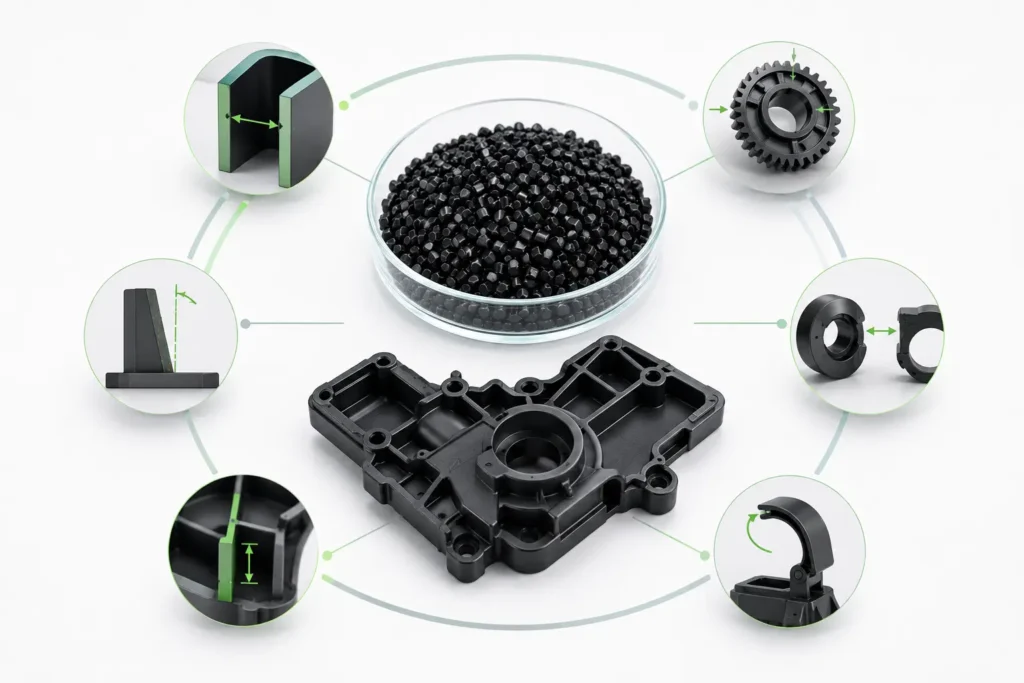
Design Guidelines for Nylon PA6 Parts
PA6 is a rewarding material to design with — its toughness forgives a lot — but six rules separate a first-shot-approved part from warped rejects:
- Wall thickness 1.0–3.0 mm, kept strictly uniform — PA6’s crystallization amplifies any thickness variation into warp; see the wall thickness design guide
- Design for the real shrinkage — 0.8–1.5% unfilled, 0.3–0.7% glass-filled, and direction-dependent with glass fibre; see shrinkage rates
- Budget for moisture growth — add clearance of ~0.2–0.3% per 1% expected moisture uptake on press-fits, bores, and gear meshes, or specify conditioned-dimension inspection
- Draft angle 1–2° per side (more on GF grades and textured surfaces) — rules in the draft angles guide
- Ribs at 50–60% of wall thickness — and orient gates so glass fibres align with the main load path; covered in ribs and bosses design
- Exploit the toughness — PA6 is the best mainstream snap-fit material: longer, thinner snap arms than ABS would allow, with generous root radii
Have a drawing ready?
Send it to Manufyn’s engineers for a free DFM review — we flag warp risks, moisture-critical dimensions, and fibre orientation before tooling is cut, and respond within 4 hours.
What Is Nylon PA6 Used For? Applications by Industry
Wherever parts slide, mesh, flex, or wear, PA6 appears. Across the industries Manufyn serves, the most common PA6 applications are:
Nylon PA6 Applications by Industry
| Industry | Typical PA6 Parts |
|---|---|
| Automotive | Air intake manifolds (GF30), engine covers, radiator end tanks, cable ties, clips and fasteners |
| Industrial machinery | Gears, sprockets, bushings, sheaves, conveyor wear strips, guide rails, rollers |
| Textile machinery | Bobbins, thread guides, loom components, tension parts — nylon’s original industrial home |
| Electrical | Connectors, contactor housings, cable glands — FR-PA6 (UL94 V-0) |
| Robotics & automation | Gripper fingers, cable carriers, low-friction slides, lightweight structural brackets |
| Consumer & sports | Power-tool housings and gears, ski bindings, chair bases, casters, zip ties |
Two Manufyn contexts: nylon wear and drive components feature in projects like the rapid prototyping and assembly of a robotic conveyor, and PA6 machine parts serve clients across textile manufacturing — the industry nylon was invented for.
The Honest Limitations of Nylon PA6
No material guide is complete without the drawbacks. PA6 has four you must design around:
- Moisture movement. The property and dimension shifts described above are permanent facts of the material. If your part needs precision bores in variable humidity, specify POM or glass-filled PA6 instead.
- UV degradation. Natural PA6 chalks and embrittles outdoors. Specify carbon-black-stabilized grades (the standard fix — most black nylon outdoors is exactly this) or UV packages for exterior parts.
- Acids and some chemicals. PA6 shrugs off oils, fuels, and hydrocarbons — but strong acids, oxidizers, and some chlorides attack it. Verify chemical exposure during material selection.
- Molding warp. High, anisotropic shrinkage makes flat, thin PA6 parts hard to keep flat. Uniform walls, balanced gating, and honest flatness tolerances are the fix — not tighter drawings.
On sustainability: PA6 is recyclable and mechanically reprocessed at industrial scale — and it is one of the few plastics with commercial chemical recycling, depolymerizing back to caprolactam (the basis of recycled fishing-net nylons). Industrial regrind at controlled percentages is standard practice at Manufyn and reduces both cost and waste.
How Much Does Nylon PA6 Cost?
PA6 resin trades at roughly USD 2.00–3.00 per kg for unfilled grade, with GF30 in a similar band (glass is cheap; compounding adds a little) and specialty grades (FR, impact-modified, MoS2) running 1.5–2.5× that. PA66 typically costs 20–50% more than PA6 — one reason PA6 wins the volume applications. As always, resin is rarely the cost driver: tooling amortization, cycle time, drying, and conditioning dominate part price — the full breakdown logic is in our guide to injection molding vs 3D printing cost.
This is exactly where sourcing from India changes the math: Manufyn’s in-house tooling, molding, and machining typically deliver 40–60% savings against US, UK, and EU suppliers at identical ISO 9001 quality — the economics are detailed in the plastic injection parts guide.
Get Your Nylon PA6 Parts Quoted in 24 Hours
Manufyn is India’s ISO 9001 certified in-house manufacturer for nylon parts. We confirm:
Grade selection — unfilled, GF30, impact-modified, FR, cast stock
Moisture-critical dimensions & conditioning plan
Warp, wall & fibre-orientation DFM
Molding vs machining route for your volume
40–60% cost savings vs US/UK/EU suppliers
Frequently asked questions
What is nylon PA6 in simple terms?
PA6 (polyamide 6) is a tough, wear-resistant engineering plastic made from caprolactam. It is the material of gears, bushings, cable ties, and power-tool internals — chosen when a part must slide, mesh, flex, or take abuse for years without lubrication.
What is the difference between PA6 and PA66?
Both are nylons with similar wear behaviour. PA66 melts at ~260 °C versus PA6’s ~220 °C, is somewhat stiffer, absorbs slightly less moisture, and costs 20–50% more with a narrower molding window. PA6 wins most applications on cost and processability; PA66 wins when the extra 30–40 °C of heat capability is genuinely needed.
What is the melting point of nylon PA6?
About 220 °C — and unlike amorphous ABS or polycarbonate, PA6 is semi-crystalline, so this is a true, sharp melting point. Its continuous service limit is roughly 100–120 °C (higher for glass-filled grades).
Does nylon absorb water?
Yes — this is PA6’s defining trait. It equilibrates at roughly 2.5–3% moisture in ordinary air, which makes it tougher and less stiff and grows dimensions by about 0.2–0.3% per 1% absorbed. Precision fits must be designed for the conditioned state, or a low-absorption material like POM chosen instead.
Is PA6 stronger than ABS?
Yes — unfilled PA6’s 60–80 MPa tensile strength beats ABS’s 40–50 MPa, and glass-filled PA6 (150–180 MPa) is in a different league entirely. PA6 also vastly outperforms ABS in wear, fatigue, and friction. ABS wins on dimensional stability, surface finish, and price.
When should I use glass-filled PA6 (GF30)?
When a part needs 2–3× the stiffness and strength of unfilled nylon, halved shrinkage, and higher heat deflection — structural brackets, intake manifolds, pump housings, and metal replacement. Trade-offs: more abrasive on tooling, direction-dependent shrinkage, and rougher surface finish.
PA6 or POM (Delrin) — which is better for gears?
Both are excellent. PA6 gears are tougher, quieter, and cheaper; POM gears hold dimensions better because acetal absorbs almost no moisture. Rule: PA6 for shock-loaded or budget drives, POM for precision meshes in humid or wet environments.
Should my nylon part be molded or CNC machined?
Volume decides. Injection molding wins from a few hundred pieces up; CNC machining from cast PA6 plate or rod wins for prototypes, low volumes, and parts too large or thick-sectioned to mold well — machined nylon gears and rollers are an industry standard. Manufyn quotes both routes so the numbers decide.
Is nylon PA6 food safe?
Only specific FDA/EU-compliant PA6 grades are approved for food contact — standard industrial grades are not. State the compliance requirement on your drawing and the correct grade is specified at quoting.
What is the minimum order for PA6 parts from Manufyn?
There is no minimum order. Manufyn quotes nylon PA6 parts from a single CNC-machined or 3D-printed prototype up to million-piece injection molding runs, with a quote returned in 24 hours.