
Brass CNC
Machining
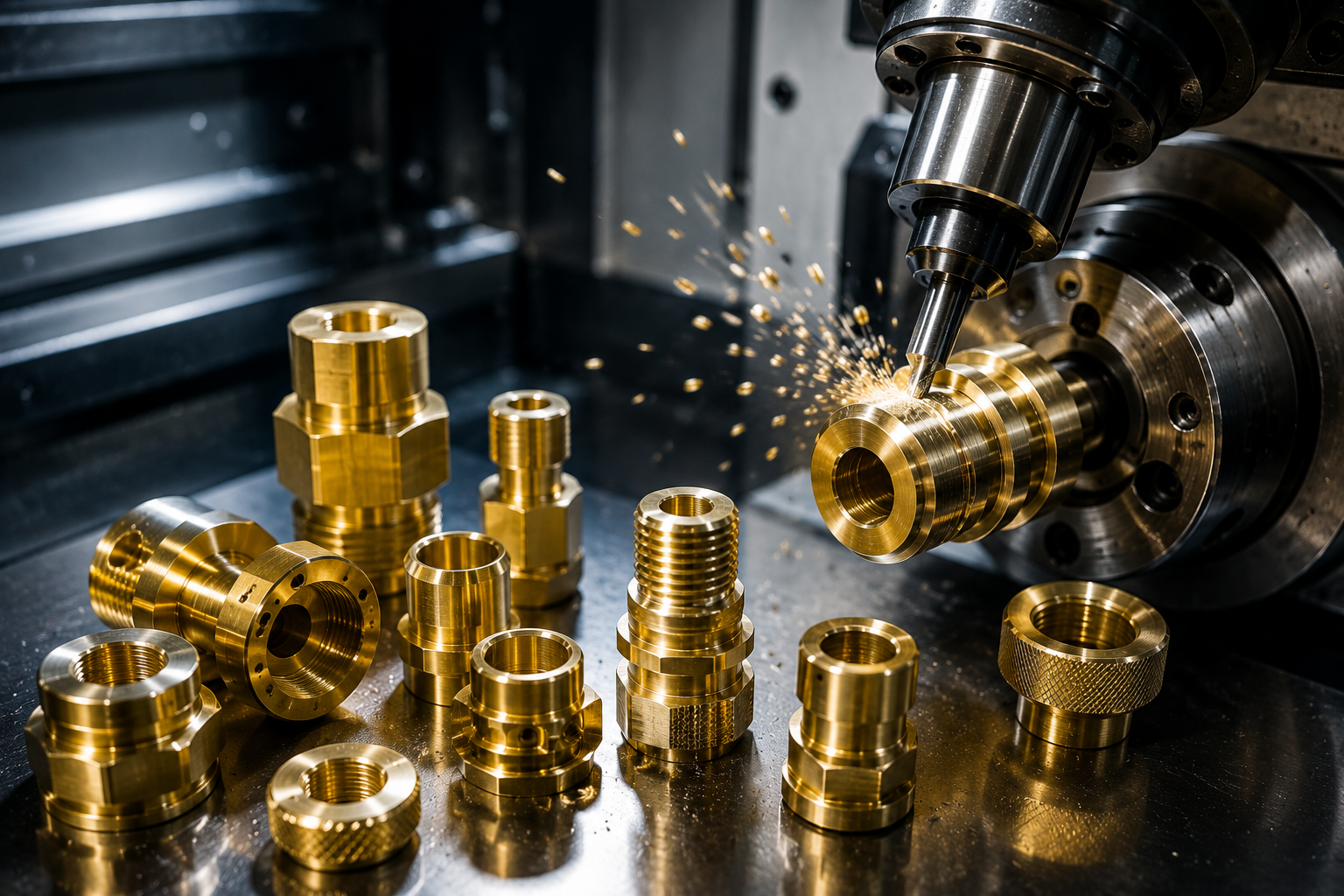
Brass is easy to machine. Getting consistent parts isn’t.
Brass is one of the most widely used materials for precision machined components because of its excellent machinability, corrosion resistance, electrical conductivity and dimensional stability.
For a global buyer, however, the real challenge is not simply finding a CNC machine shop. It is finding a manufacturing partner that can repeatedly produce the required component, maintain tolerances, control quality and meet delivery commitments.
What can we manufacture?
We support custom brass CNC components manufactured from your engineering drawings, 3D CAD models or existing samples.
- Precision brass turned components
- Brass bushings and sleeves
- Brass pins, shafts and spacers
- Brass fittings and adapters
- Electrical terminals and connectors
- Threaded brass components
- Custom CNC milled brass components
- Complex components manufactured to drawing
Choosing the right brass grade
starts with the application.
Different brass grades offer different combinations of machinability, strength, corrosion resistance, conductivity and formability. The correct material should be selected according to the component’s function and manufacturing requirements.
| Brass Grade | Key Characteristics | Typical Applications | Machinability |
|---|---|---|---|
| C360 / Free-Cutting Brass | Excellent machinability, good strength and efficient chip formation. | Precision turned parts, fittings, bushings, fasteners and hardware. | Excellent |
| C260 / Cartridge Brass | Good formability, corrosion resistance and balanced mechanical properties. | Electrical components, industrial hardware and formed components. | Very Good |
| C464 / Naval Brass | Higher strength with good corrosion resistance, particularly for demanding environments. | Marine components, industrial fittings and engineering applications. | Good |
| Custom Brass Grades | Material selected according to specific mechanical, electrical or environmental requirements. | Special-purpose engineering and custom industrial components. | Application Dependent |
A controlled process for consistent brass parts.
Brass CNC machining starts long before the cutting tool touches the material. The drawing, material, machining strategy, inspection requirements and production plan all influence the final component. Manufyn coordinates these steps with the manufacturing partner in India.
Drawing & RFQ Review
We review drawings, quantities, tolerances, material and delivery requirements.
Supplier Selection
The requirement is matched with a suitable CNC manufacturing capability.
CNC Production
Turning, milling, drilling, threading and other operations are performed to drawing.
Inspection
Critical dimensions and specified quality requirements are verified before dispatch.
Dispatch
Parts are prepared for shipment and coordinated for delivery to the customer.
What happens before production?
For production quantities, selecting the right supplier is critical. We consider machine capability, previous experience, material availability, inspection capability and the complexity of the component.
Where required, the drawing can also be reviewed for manufacturability before production begins. This can help identify unnecessary machining, difficult tolerances or features that may increase manufacturing cost.
Our approach is aligned with Design for Manufacturability (DFM) principles.
What do we control?
- Material specification and availability
- Drawing revision and manufacturing requirements
- CNC machine capability
- Critical dimensions and tolerances
- Thread and hole requirements
- Surface finish requirements
- Quantity and production schedule
- Pre-dispatch quality verification
Have a brass component ready for production?
Send your drawing, quantity and delivery requirement. We will review the RFQ and coordinate the manufacturing requirement in India.
Brass CNC machining for different part requirements.
Different brass components require different machining strategies. Manufyn works with manufacturing partners equipped for turning, milling and secondary machining operations, depending on the geometry, tolerance and production volume of the component.
Brass CNC Turning
Precision turned brass components including pins, bushings, shafts, sleeves, fittings, threaded parts and other rotational components.
Explore CNC Turning →Brass CNC Milling
Milled components with pockets, slots, holes, threads and complex profiles manufactured from engineering drawings and CAD models.
Explore CNC Machining →Multi Axis Machining
Components requiring multiple machining orientations can be produced using suitable 3 axis, 4 axis and 5 axis CNC equipment.
Precision Design Rules →Holes & Threads
Internal and external threads, drilled holes, counterbores, countersinks and other detailed features can be incorporated into the component.
Hole & Thread Guide →Secondary Operations
Depending on the application, components can undergo deburring, cleaning, surface treatment and other required finishing operations.
Turning vs Milling →Tight Tolerance Components
Critical dimensions can be manufactured and inspected according to the tolerances specified on the engineering drawing.
Understand Tolerances →From prototype to production quantities
Your requirement may start with a handful of prototype components and eventually move into recurring production. The manufacturing approach should change with the volume.
Manufyn can coordinate procurement requirements across the product development and production stages, helping you avoid repeatedly searching for a new supplier as your volumes increase.
Need a brass CNC machining supplier in India?
Send your drawing, quantity and specifications. We can review the requirement and identify a suitable manufacturing route.
Brass components for real engineering applications.
Brass CNC machining is used across electrical, industrial, plumbing, instrumentation, automation and other engineering applications. Manufyn helps global buyers procure custom components manufactured to their drawings and specifications.
Brass Bushings & Sleeves
Brass Fittings & Adapters
Electrical Components
Brass Pins & Shafts
Threaded Brass Components
Precision Brass Hardware
Industries we can support
The right manufacturing partner depends on the component, material, tolerances and production requirements. Our supplier network allows us to support requirements across multiple engineering sectors.
Looking for a reliable brass CNC machining partner?
Share your drawings and production requirements. Manufyn can coordinate supplier selection, procurement and quality oversight in India.
Quality control shouldn’t start after the parts arrive.
For overseas procurement, quality problems become expensive very quickly. A dimensional issue discovered after shipment can mean rework, replacement parts, production delays and additional freight costs. Manufyn coordinates quality checks as part of the procurement process.
Drawing Review
Critical dimensions, tolerances, material, threads and other drawing requirements are reviewed before production.
Process Control
Production progress and critical manufacturing requirements can be monitored according to the project.
Dimensional Verification
Critical dimensions and specified inspection requirements are checked before dispatch.
Final Quality Check
Parts are reviewed against the agreed requirements before shipment to the customer.
Don’t just find a CNC supplier. Build a reliable procurement channel.
Buying directly from an overseas machine shop can create another layer of work for your engineering and purchasing team. Supplier identification, RFQs, commercial negotiations, production follow-up, quality checks and logistics all have to be coordinated. Manufyn acts as your India based procurement partner for engineering components.
Understand Your Requirement
Review drawings, quantities, material, tolerances and delivery expectations.
Identify Suitable Suppliers
Match the requirement with appropriate manufacturing capabilities in India.
Manage Production & Quality
Coordinate production, communication and agreed quality requirements.
Coordinate Delivery
Support dispatch and procurement coordination through the order cycle.
Why global buyers work with Manufyn
India has a large engineering manufacturing base, but finding the right supplier for a specific component can take significant time. The lowest quoted price is also not necessarily the lowest total procurement cost.
Manufyn helps bridge this gap by combining supplier identification with procurement coordination and quality follow-up.
- One point of contact in India
- Supplier identification based on the actual manufacturing requirement
- RFQ coordination and quotation comparison
- Commercial and production follow-up
- Quality and inspection coordination
- Support for recurring production procurement
What does Manufyn manage?
Instead of your purchasing team managing every supplier interaction directly, Manufyn can coordinate the India side of the procurement process.
- Supplier Identification Find manufacturing partners suited to the component and production requirement.
- RFQ Management Coordinate enquiries, quotations and commercial comparisons.
- Production Follow-up Maintain communication around production status and delivery requirements.
- Quality Coordination Coordinate inspection and pre-dispatch quality requirements where required.
- Procurement Continuity Support repeat orders and ongoing engineering procurement requirements.
Whether you need a small prototype batch or recurring production quantities, the objective is to create a dependable procurement process rather than a one-time supplier transaction.
Have a brass CNC requirement you are considering moving to India?
START A CONVERSATIONWhat determines the cost of brass CNC machining?
There is no single price for a CNC machined brass component. Two parts made from the same brass grade can have very different costs depending on geometry, tolerances, machining time, quantity and finishing requirements.
Brass Grade
Material grade and availability affect the raw material cost, machinability and manufacturing approach.
Part Geometry
Complex profiles, deep pockets, small features and difficult-to-access areas generally require more machining time.
CNC Turning or Milling
Simple rotational components may be produced efficiently on CNC turning equipment, while complex components may require milling or multiple operations.
Tolerances
Tight dimensional tolerances can increase machining, inspection and process control requirements.
Production Quantity
Larger production quantities can distribute setup and programming costs across more components and improve production efficiency.
Finishing & Secondary Operations
Additional operations such as deburring, polishing, plating, threading or special surface requirements can affect the final component cost.
Inspection Requirements
First article inspection, dimensional reports, material documentation and customer-specific quality requirements may add to the overall procurement cost.
Packaging & Logistics
Packaging method, shipment quantity, destination and delivery terms influence the landed cost of imported components.
Want an accurate quotation?
A drawing and a few basic production details are usually enough to start an RFQ review. Instead of estimating from a generic price range, Manufyn can evaluate the actual manufacturing requirement.
- 2D drawing or 3D CAD file
- Brass grade or material specification
- Required quantity
- Annual production volume, if applicable
- Required tolerances
- Surface finish requirements
- Target delivery requirement
From part drawing to final procurement cost
For international buyers, the machining price is only one part of the equation. A useful quotation should consider the complete procurement requirement.
For recurring production, supplier capability, quality consistency, communication, delivery reliability and total logistics cost can have a significant impact on the real cost of procurement. Manufyn evaluates the requirement beyond the initial piece price.
Which brass grade is right for CNC machining?
Brass is not a single material. Different brass alloys provide different combinations of machinability, strength, corrosion resistance, conductivity and application performance. The right grade depends on what the component needs to do.
| Brass Grade | Machinability | Typical Characteristics | Common Applications |
|---|---|---|---|
| C360 | Excellent | Excellent free-machining characteristics and suitable for high-volume precision machining. | Fittings, valves, connectors, fasteners and precision turned parts. |
| C464 | Good | Naval brass with good strength and corrosion resistance, particularly suited to marine environments. | Marine components, shafts, fittings and industrial hardware. |
| C385 | Excellent | Free-machining brass suitable for components requiring efficient turning and threading. | Architectural hardware, fittings, screws and turned components. |
| C260 | Good | Cartridge brass with good ductility and forming characteristics. | Electrical components, hardware, terminals and formed components. |
Don’t specify brass by name alone
A drawing that simply states “Brass” may leave important material requirements open to interpretation. For production procurement, the material specification should be clear before the RFQ is released.
The selected grade can affect machining performance, component properties and ultimately the consistency of the finished parts.
- Specify the alloy Example: C360 rather than simply specifying “Brass”.
- Confirm the applicable standard Use the material standard required by your engineering specification.
- Consider the application Machinability is important, but so are strength, conductivity, corrosion resistance and service conditions.
- Confirm material documentation If material certification is required, include it in the RFQ requirements.
Not sure which grade to use?
If your drawing or existing component does not clearly identify the brass grade, share the requirement with Manufyn. We can review the specification with the manufacturing partner before the quotation is finalized.
- Review existing material specification
- Confirm supplier material capability
- Check material availability
- Align material requirements with the RFQ
- Coordinate required documentation
Have a brass component drawing ready?
Send the drawing and required quantity. We can start with the manufacturing review.
Which brass grade is right for CNC machining?
Brass is not a single material. Different brass alloys provide different combinations of machinability, strength, corrosion resistance, conductivity and application performance. The right grade depends on what the component needs to do.
| Brass Grade | Machinability | Typical Characteristics | Common Applications |
|---|---|---|---|
| C360 | Excellent | Excellent free-machining characteristics and suitable for high-volume precision machining. | Fittings, valves, connectors, fasteners and precision turned parts. |
| C464 | Good | Naval brass with good strength and corrosion resistance, particularly suited to marine environments. | Marine components, shafts, fittings and industrial hardware. |
| C385 | Excellent | Free-machining brass suitable for components requiring efficient turning and threading. | Architectural hardware, fittings, screws and turned components. |
| C260 | Good | Cartridge brass with good ductility and forming characteristics. | Electrical components, hardware, terminals and formed components. |
Don’t specify brass by name alone
A drawing that simply states “Brass” may leave important material requirements open to interpretation. For production procurement, the material specification should be clear before the RFQ is released.
The selected grade can affect machining performance, component properties and ultimately the consistency of the finished parts.
- Specify the alloy Example: C360 rather than simply specifying “Brass”.
- Confirm the applicable standard Use the material standard required by your engineering specification.
- Consider the application Machinability is important, but so are strength, conductivity, corrosion resistance and service conditions.
- Confirm material documentation If material certification is required, include it in the RFQ requirements.
Not sure which grade to use?
If your drawing or existing component does not clearly identify the brass grade, share the requirement with Manufyn. We can review the specification with the manufacturing partner before the quotation is finalized.
- Review existing material specification
- Confirm supplier material capability
- Check material availability
- Align material requirements with the RFQ
- Coordinate required documentation
Have a brass component drawing ready?
Send the drawing and required quantity. We can start with the manufacturing review.
Brass CNC machining for prototype to production
Manufyn works with qualified manufacturing partners in India to support CNC machined brass components across prototype, low-volume and recurring production requirements. The manufacturing route is selected according to the component geometry, quantity, tolerance and application.
CNC Turning
Suitable for rotational brass components such as bushes, fittings, connectors, pins, threaded parts, valve components and other turned geometries.
CNC Milling
Used for prismatic and complex brass components requiring pockets, slots, drilled features, profiles and multiple machining operations.
Turned & Milled Components
For parts requiring both turning and milling, multiple machining operations can be coordinated to produce the complete component.
Threaded Components
Internal and external threaded features can be machined according to the drawing and applicable engineering specification.
Precision Small Components
Small brass components can be produced for applications where repeatability, dimensional control and consistent production are important.
Production Components
Recurring production programs can be supported with supplier coordination, production follow-up and quality requirements.
Typical brass CNC requirements
The manufacturing route depends on the actual component rather than simply the material. During RFQ evaluation, the drawing, quantity and required features are reviewed together.
This helps determine the appropriate machining process and avoid unnecessary manufacturing operations.
- Part Type Turned / Milled / Turn-mill
- Production Stage Prototype / Low Volume / Production
- Material Specified brass alloy
- Features Threads / Holes / Slots / Profiles
- Quality Dimensional & visual requirements
What can be coordinated through Manufyn?
For international buyers, CNC machining is only one part of the procurement process. Manufyn can coordinate the India side of the requirement from supplier identification through production and delivery.
- Supplier capability assessment
- RFQ preparation and quotation coordination
- Technical clarification with manufacturing partners
- Production follow-up
- Quality and inspection coordination
- Packaging and dispatch coordination
- Support for recurring procurement requirements
From drawing to finished brass component
A structured procurement process helps reduce communication gaps and gives the buyer better visibility through the order.
Have a brass CNC component ready for production?
SEND YOUR DRAWINGWhere are CNC machined brass parts used?
Brass CNC machining is used across industries where a combination of machinability, corrosion resistance, conductivity, appearance and dimensional consistency is required. The appropriate brass grade and manufacturing process depend on the component’s operating environment and application.
Industrial Valves & Fittings
Brass is widely used for valve bodies, adapters, connectors, fittings, bushes and other fluid handling components where machinability and corrosion resistance are important.
Electrical & Electronic Components
CNC machined brass is suitable for terminals, connectors, contacts, threaded inserts and other components where electrical conductivity and reliable mechanical interfaces are required.
Plumbing Components
Custom machined brass components can be produced for plumbing fittings, adapters, couplings and other precision components used in fluid systems.
Automotive Components
Brass machined components can be used in selected automotive assemblies, connectors, fittings, sensor components and other engineered applications.
Industrial Automation
Precision brass components can be used for machine hardware, pneumatic fittings, connectors, bushings, spacers and other automation equipment components.
Instrumentation & Controls
Brass is useful for precision fittings, connectors, bodies, threaded components and small machined parts used in instrumentation systems.
Marine & Corrosion Sensitive Applications
Selected brass alloys can be considered for components where corrosion resistance and mechanical performance are important, subject to the application requirements.
Hardware & Commercial Products
Custom brass CNC machining is also used for handles, fasteners, decorative hardware, architectural components and other products requiring a precise metallic finish.
Typical brass CNC components
The same manufacturing capability can support a wide range of component geometries. Some common examples include:
- Bushes and spacers
- Threaded adapters
- Connectors and terminals
- Valve components
- Fittings and couplings
- Pins and precision turned parts
- Sensor and instrumentation components
- Custom machined housings
- Small production hardware
Your component doesn’t need to fit a standard category
For custom manufacturing, the important question is not whether the component matches a predefined product category. It is whether the required geometry, material, tolerance, quantity and quality requirements can be manufactured consistently.
- Share your existing drawing or CAD model
- Define the required brass grade
- Confirm prototype or production quantity
- Specify critical tolerances and features
- Identify required inspection documentation
- Review the appropriate manufacturing route
Looking for a supplier for custom brass CNC parts?
Send your drawing, material requirement and quantity for a manufacturing review.
Quality inspection for brass CNC machined parts
For international buyers, consistent quality is just as important as the machining price. Manufyn coordinates quality requirements with manufacturing partners and can support inspection and documentation according to the customer’s requirements.
Drawing Review
Critical dimensions, tolerances, material and special requirements are reviewed before production begins.
Process Follow-up
Production status and important manufacturing requirements can be coordinated with the supplier.
Inspection
Dimensional, visual and other agreed inspection requirements can be coordinated before shipment.
Quality Records
Inspection reports and other agreed documentation can be provided as part of the procurement requirement.
What can be inspected?
The inspection plan should be based on the drawing and the actual application. Not every dimension needs the same level of control.
Critical-to-function characteristics can receive additional attention during the inspection process.
-
Dimensional Inspection Critical dimensions, lengths, diameters, depths and geometric requirements can be checked against the drawing.
-
Thread Inspection Internal and external threads can be checked according to the specified thread standard and requirement.
-
Visual Inspection Parts can be checked for visible machining defects, damage, burrs and general appearance.
-
Material Verification Where required, material certificates and specified material documentation can be coordinated.
-
Surface Finish Specified surface finish requirements can be checked where applicable to the component.
-
Quantity & Packaging Quantity, identification and agreed packaging requirements can also be verified before dispatch.
Inspection can be matched to your requirement
Different buyers have different quality documentation requirements. The inspection scope can be defined during the RFQ rather than applying the same process to every component.
- Dimensional Inspection Report Measurements against drawing requirements.
- Material Certificate Material documentation when specified by the buyer.
- First Article Inspection For new components where first article approval is required.
- Visual Inspection General workmanship, surface and visible defect checks.
- Quantity Verification Confirmation of supplied quantity before dispatch.
- Customer Specific Documentation Additional quality records can be discussed during the RFQ.
What should you include in your RFQ?
Clear quality requirements help suppliers quote more accurately and reduce clarification during production. Include the following where applicable.
Have specific inspection requirements for your brass CNC parts?
DISCUSS YOUR REQUIREMENTBrass vs aluminum, stainless steel and copper for CNC machining
Brass is not automatically the best material for every CNC machined component. The right choice depends on conductivity, corrosion resistance, strength, weight, machinability, appearance, operating environment and total component cost.
| Requirement | Brass | Aluminum | Stainless Steel | Copper |
|---|---|---|---|---|
| Machinability | Generally excellent | Generally excellent | Moderate to difficult depending on grade | Generally good |
| Electrical Conductivity | Good | Moderate | Low | Excellent |
| Corrosion Resistance | Good for many applications | Good depending on alloy and environment | Very good for many grades | Very good |
| Weight | Higher | Low | High | High |
| Appearance | Distinctive metallic finish | Light metallic finish | Industrial metallic finish | Copper coloured finish |
| Typical Advantage | Machinability + conductivity + corrosion resistance | Low weight + machinability | Strength + corrosion resistance | Electrical & thermal conductivity |
| Common CNC Applications | Fittings, connectors, valves, bushings, terminals | Lightweight housings, brackets, structural parts | Industrial, medical and demanding mechanical parts | Electrical, thermal and conductivity focused parts |
When does brass make sense?
Brass can be a strong choice when a component needs a practical balance of machinability, conductivity, corrosion resistance and appearance. It is particularly attractive for turned and small precision components where machining efficiency matters.
High Machinability
Useful for components with multiple machined features, threads and repetitive production operations.
Conductivity
Suitable for selected electrical and electronic components where electrical conductivity is required.
Corrosion Resistance
Selected brass alloys can provide useful resistance to corrosion in appropriate operating environments.
Production Efficiency
Good machinability can make brass attractive for recurring CNC production where cycle time and consistency matter.
Brass is especially attractive for precision turned components
If your component contains threads, holes, grooves, shoulders or other repetitive turned features, CNC turning can be an efficient manufacturing route.
For more complex geometries, CNC milling or a turn-mill process may be considered depending on the component design.
- Threaded fittings and adapters
- Bushes and spacers
- Connectors and terminals
- Valve and fluid handling components
- Precision pins and small turned components
Not sure which material is right?
Share your drawing and application requirements. The material selection can be reviewed together with the manufacturing process, quantity and quality requirements before requesting supplier quotations.
For broader machining requirements, explore Manufyn’s CNC Machining services .
For turned components, see CNC Turning Services India .
Need help selecting the right material for your CNC part?
Send the drawing, material specification, quantity and application. Manufyn can review the requirement and coordinate the manufacturing process in India.
SEND YOUR DRAWINGWhat determines the cost of brass CNC machining?
The cost of a brass CNC machined component depends on much more than the price of the raw material. Part geometry, machining time, quantity, tolerances, tooling, finishing and inspection requirements all influence the final quotation.
Part Geometry
Complex profiles, deep pockets, thin walls and difficult-to-access features can increase machining time and setup requirements.
Material & Stock Size
The specified brass grade and starting stock dimensions affect material cost, machining approach and material utilisation.
Quantity
Prototype quantities and production volumes can have very different economics because setup and programming costs are distributed differently.
Tolerance Requirements
Tighter tolerances may require additional machining, measurement and process control, increasing the overall cost.
Threads & Special Features
Multiple threads, precision holes, grooves and other critical features can require additional tools and machining operations.
Surface Finish
Additional finishing, deburring, polishing, plating or other surface requirements can affect the total component cost.
Inspection
Inspection reports, first article inspection and customer-specific quality documentation may add inspection time and cost.
Packaging
Individual packaging, protective packaging or export packaging requirements can influence the final delivered cost.
Delivery Requirements
Shipping method, destination, delivery terms and shipment frequency should be considered when comparing supplier quotes.
How to get a more accurate brass CNC quotation
A complete RFQ gives the manufacturing partner enough information to calculate machining time, material requirements, inspection and other production costs more accurately.
For international procurement, providing complete technical information at the beginning can also reduce repeated clarification between the buyer and supplier.
-
2D Engineering Drawing Include dimensions, tolerances, threads and revision information.
-
3D CAD Model STEP, IGES or another suitable CAD format can help suppliers understand complex geometry.
-
Material Specification Specify the required brass grade rather than simply stating “brass” where the grade is important.
-
Annual & Order Quantity Prototype, initial order and recurring annual demand can help suppliers plan the appropriate manufacturing approach.
-
Quality Requirements Identify critical dimensions, inspection requirements and documentation expected with the shipment.
A better RFQ can lead to a better quotation
Instead of asking suppliers only for a unit price, a structured RFQ should communicate the complete manufacturing requirement.
- Part number and revision
- Material and material condition
- Part drawing and CAD file
- Prototype or production quantity
- Required delivery date
- Surface finish requirements
- Inspection and documentation requirements
- Packaging requirements
From RFQ to supplier selection
For overseas buyers, obtaining a quotation is only the first step. The supplier also needs to be capable of manufacturing the part consistently at the required quality and volume.
Manufyn can support the India side of the procurement process by coordinating supplier identification, quotation collection, technical clarification, production follow-up and quality coordination.
Have a brass CNC drawing ready for quotation?
REQUEST A BRASS CNC QUOTEBrass CNC machining design guidelines
A well-designed brass component is easier to machine, inspect and quote. Good DFM decisions can reduce unnecessary machining time, avoid difficult setups and improve consistency during production.
Avoid Unnecessary Tight Tolerances
Specify tight tolerances only where they are required for function. Applying unnecessarily tight tolerances across the entire component can increase machining and inspection costs.
Consider Tool Access
Features should allow the cutting tool to reach the machining area without excessive tool overhang or complicated setups.
Use Practical Internal Corners
CNC milling tools are generally round. Designing internal corners with practical radii can reduce the need for special tooling and additional machining operations.
Design Holes for Manufacturing
Hole diameter, depth and location should be considered together. Very deep or difficult-to-access holes may require specialised tooling and additional operations.
Specify Threads Clearly
Identify the thread standard, nominal size, pitch and depth. Clear thread specifications help avoid quotation and production ambiguity.
Avoid Extremely Thin Features
Thin walls, narrow ribs and fragile sections can be more difficult to machine and may require additional process control.
Think About Workholding
The component must be securely held during machining. Features that provide practical workholding options can simplify production.
Define Surface Finish Where Needed
Only specify a particular surface finish where it has a functional or appearance requirement. This helps control unnecessary cost.
A good drawing makes quoting easier
For brass CNC machining, the engineering drawing should communicate the features that are important to the part’s function without creating unnecessary manufacturing restrictions.
A clear drawing also allows different manufacturing partners to quote against the same requirements, making supplier comparison more meaningful.
- Part number and drawing revision
- Material grade and specification
- Critical dimensions and tolerances
- Thread specifications
- Surface finish requirements
- Deburring requirements
- Inspection requirements
- Quantity and expected production volume
Designing a new brass component?
A DFM review before quotation can identify manufacturing challenges early. This is particularly useful for new products, prototypes and components that will move into recurring production.
Manufyn can coordinate the manufacturing requirement with Indian CNC suppliers and help clarify technical questions before the RFQ is finalised.
Have a brass CNC drawing ready?
Send your drawing, material specification and quantity. Manufyn can coordinate the RFQ with suitable manufacturing partners in India.
SEND YOUR DRAWINGBrass CNC machining for precision industrial components
Brass CNC machined parts are used across applications where machinability, corrosion resistance, conductivity, dimensional consistency and appearance are important. Manufyn can coordinate prototype and production requirements with manufacturing partners in India.
Electrical & Electronics
Brass is widely considered for electrical components where machinability and electrical conductivity are important.
Plumbing & Fluid Systems
Brass can be suitable for fittings and fluid handling components where corrosion resistance and reliable threaded connections are required.
Industrial Equipment
Precision brass components can be used within industrial equipment and machinery where reliable machined features are required.
Automotive Components
Selected brass components can be used in automotive systems where their material properties match the application.
Instrumentation
Small precision brass parts can be manufactured for instrumentation and equipment requiring repeatable machined features.
Valves & Controls
Brass is commonly considered for valve bodies, fittings and control components where the material is suitable for the operating environment.
Robotics & Automation
Precision machined brass parts can support automation systems where compact, threaded or conductive components are required.
Prototypes & New Product Development
Brass can also be used for prototype components when the material properties match the intended production application.
Commercial & Architectural Hardware
Brass is attractive for selected visible components where machinability and a distinctive metallic appearance are desired.
From prototype quantities to recurring production
The appropriate CNC process depends on part geometry, quantity, material grade and required production rate. A prototype may be produced using a different setup from a recurring production part.
For larger quantities, process optimisation, tooling strategy, cycle time and inspection requirements become increasingly important to the overall procurement decision.
- Prototype and development quantities
- Low-volume production
- Medium-volume recurring orders
- Higher-volume CNC production
- CNC turning and precision turned components
- CNC milling and complex machined components
Looking for a brass CNC supplier in India?
Manufyn works with manufacturing partners across India and coordinates the procurement process for international buyers.
The requirement can include supplier identification, RFQ management, technical clarification, production follow-up and quality coordination.
Explore our CNC machining supplier support for USA buyers .
You can also explore CNC Turning Services India for turned brass components.
Who can use Manufyn for brass CNC procurement?
Manufyn is particularly relevant for companies that need an India-side procurement partner rather than simply another supplier directory.
Have a brass component you need manufactured in India?
DISCUSS YOUR BRASS CNC REQUIREMENTHow brass CNC machining works
Brass CNC machining converts a digital engineering design into a precise finished component through programming, workholding, machining, inspection and finishing. The exact process depends on the part geometry, quantity and required tolerances.
Drawing & DFM Review
The drawing, CAD model, material, tolerances and special requirements are reviewed before production.
CNC Programming
Toolpaths, machining operations, workholding and cutting strategy are planned according to the component.
Precision CNC Machining
The brass stock is machined through turning, milling or a combination of processes.
Inspection & Dispatch
Finished parts are inspected against the agreed requirements before packaging and shipment.
From drawing to finished component
The manufacturing process starts well before the CNC machine begins cutting material. Reviewing the design and production requirements early helps identify potential manufacturing issues.
For international procurement, this front-end coordination is particularly important because technical changes after production has started can affect both cost and delivery.
-
01Technical Review Drawing, CAD model, revision, material and critical requirements are reviewed.
-
02Material Preparation Suitable brass stock is selected according to the specified material grade and component geometry.
-
03Workholding & Setup The component is securely positioned so the required features can be machined accurately.
-
04CNC Machining Turning, milling, drilling, threading and other required operations are performed.
-
05Deburring & Finishing Sharp edges, burrs and specified finishing requirements are addressed after machining.
-
06Final Inspection Finished components are checked against the agreed drawing and quality requirements.
Choosing the right CNC process
Not every brass component should be manufactured using the same CNC process. Geometry and production quantity influence whether turning, milling or a combined process is most suitable.
CNC Turning
Suitable for cylindrical and rotational components such as bushes, pins, fittings, adapters and threaded parts.
CNC Milling
Suitable for components requiring pockets, slots, flats, complex profiles and non-rotational features.
Turn-Mill Machining
Combines turning and milling operations for components with both rotational and milled features.
Drilling & Threading
Additional operations can create precision holes, internal threads, external threads and other functional features.
Deburring
Machined edges can be cleaned and finished according to the component’s functional and appearance requirements.
Secondary Operations
Additional finishing, marking, plating or other processes can be considered when required by the application.
The manufacturing process is only part of the procurement
For overseas buyers, selecting the right CNC process is only one part of the decision. Supplier capability, quotation comparison, quality control, production follow-up and logistics also influence the success of the project.
Manufyn can coordinate these activities with manufacturing partners in India, giving international buyers a single point of coordination for their procurement requirement.
Explore Procurement Support for Global Manufacturing Companies →
Have a drawing and want to understand the best manufacturing route?
SEND YOUR DRAWINGBrass CNC machining tolerances & inspection
Dimensional accuracy is critical when brass CNC machined components must assemble with other parts. The achievable tolerance depends on part geometry, material, machine capability, tooling, workholding and the inspection method used.
Specify tolerances where they matter
Not every dimension on a component needs the same tolerance. Identifying critical dimensions separately from general dimensions helps manufacturers focus process control where it provides the most value.
For international procurement, clear drawings and inspection requirements also reduce interpretation differences between the buyer and manufacturing supplier.
Manufyn can coordinate technical clarification with manufacturing partners before production begins.
Tolerance is not just a number
A quoted tolerance should be considered together with feature size, geometry, material, machining process, inspection equipment and production quantity. Very tight requirements can increase machining, setup and inspection costs.
Typical tolerance considerations
The values below are engineering considerations rather than a guarantee of capability. The final tolerance should be confirmed against the actual component drawing and manufacturing process.
| Feature | Typical consideration | What affects accuracy? |
|---|---|---|
| Linear dimensions | General dimensions can often use practical production tolerances. | Machine capability, tool condition and setup stability. |
| Hole diameters | Tolerance should reflect the required fit and function. | Drilling, boring, reaming and inspection method. |
| Threads | Thread class and fit should be clearly specified. | Tooling, material condition and thread inspection. |
| Flatness | Specify only where the mating or functional requirement demands it. | Material condition, machining strategy and workholding. |
| Position | Important when multiple holes or features must align. | Datum strategy, machine setup and inspection method. |
| Surface finish | Specify the required finish where appearance or function requires it. | Tooling, feeds, speeds and finishing operation. |
How brass CNC parts can be inspected
Inspection should be matched to the characteristics that are important to the application. Depending on the requirement, different measurement methods may be used during production and final inspection.
Vernier & Micrometer
Useful for checking common external dimensions, thicknesses, diameters and other accessible features.
Height Gauge
Can be used for dimensional and feature-location measurements on suitable components.
Bore Measurement
Specialised gauges and instruments can be used to verify internal diameters and critical bore dimensions.
Thread Gauges
Go and no-go gauges or other suitable methods can be used to verify specified thread requirements.
Surface Roughness
Surface measurement equipment can be used when a specific roughness requirement is defined on the drawing.
CMM Inspection
Coordinate measuring machines can be considered for complex geometries and critical dimensional inspection.
Quality control for international buyers
For an overseas buyer, quality control does not end when the CNC machine finishes the component. Inspection requirements should be defined before production and aligned with the purchase order and technical drawing.
Manufyn can coordinate supplier communication, production follow-up and quality inspection as part of an India-side procurement process.
Have a brass CNC component with specific tolerance requirements?
SEND DRAWING FOR REVIEWBrass CNC machining surface finishes & finishing options
The surface condition of a brass CNC machined component can affect appearance, corrosion behaviour, cleanliness, electrical contact and overall functionality. The appropriate finishing process depends on the application and the brass grade being used.
As-Machined Finish
The component retains the surface produced directly by the CNC machining process. Tool marks may remain visible depending on the machining strategy and specified finish.
Deburring
Sharp edges and machining burrs can be removed to improve handling, assembly and functional performance.
Polishing
Polishing can improve the visual appearance of brass components where a smoother or brighter surface is required.
Brushing
A brushed surface can provide a controlled directional appearance for selected visible components and hardware.
Plating
Where the application requires it, plating can be considered to modify surface properties, appearance or compatibility with other components.
Protective Treatments
Selected chemical or protective treatments may be considered to control tarnishing or achieve a particular surface requirement.
Choose the finish based on function
A visually attractive finish is not necessarily the right finish for every engineering application. Electrical, plumbing, instrumentation and architectural components can have very different surface requirements.
The drawing should identify the required surface condition whenever it is important to the function or appearance of the component.
- Required surface roughness where applicable
- Deburring and edge-break requirements
- Visual appearance requirements
- Plating or coating requirements
- Cleanliness requirements
- Packaging requirements for finished surfaces
Finishing should be planned before production
Secondary operations can affect dimensions, appearance and component cost. They should therefore be considered during the quotation and manufacturing planning stage rather than added after machining has started.
For international buyers, clear finishing specifications also make supplier quotations easier to compare because every supplier is pricing against the same requirement.
Need a specific brass surface finish?
Send your drawing and finish requirements to Manufyn. We can coordinate the requirement with suitable CNC manufacturing partners in India.
REQUEST A BRASS CNC QUOTEWhat affects the cost of brass CNC machining?
The price of a brass CNC machined component is influenced by much more than the raw material. Part geometry, machining time, tolerances, quantity, finishing, inspection and production planning all contribute to the final quotation.
Part Geometry
Complex pockets, deep features, difficult tool access and multiple machining orientations can increase setup and machining time.
Material Grade
The specified brass grade and material form influence material cost, machinability and the overall manufacturing approach.
Quantity
Production quantity affects setup cost allocation, machine utilisation, purchasing volumes and process optimisation.
Tolerance Requirements
Tight dimensional and geometric tolerances can require additional machining control, specialised tooling and inspection.
Machining Time
Cycle time is one of the important contributors to CNC manufacturing cost, particularly for complex components.
Tooling & Workholding
Special fixtures, custom workholding or additional tooling may be required for certain component geometries.
Surface Finish
Polishing, plating, brushing and other secondary operations can add processing time and cost.
Inspection Requirements
Additional dimensional inspection, documentation or specialised measurement can influence the quotation.
Packaging & Logistics
Packaging requirements and international shipping should be considered when evaluating the total procurement cost.
How to reduce unnecessary CNC machining cost
The lowest-cost part is not necessarily the simplest part. The objective is to remove unnecessary manufacturing complexity while maintaining the functional requirements of the component.
Good DFM decisions made before RFQ can help suppliers quote more competitively and can reduce avoidable production operations.
- Avoid unnecessarily tight tolerances
- Use practical internal corner radii
- Avoid unnecessarily deep features
- Specify surface finish only where required
- Use standard thread sizes where practical
- Design with practical tool access
- Consider production quantity during design
- Provide complete drawings and CAD models
Why comparing only the piece price can be misleading
Two CNC suppliers may quote different prices because their assumptions about tooling, inspection, material, finishing, packaging or production quantities differ.
A useful RFQ should therefore compare the complete manufacturing requirement, not simply the unit price.
For international buyers, this becomes even more important when freight, inspection, supplier management and import logistics are included in the total landed cost.
Where procurement can create additional savings
For recurring brass CNC requirements, cost reduction can extend beyond changing the machining process.
Supplier Competition
Comparing capable suppliers against the same technical requirement can improve quotation competitiveness.
Material Optimisation
Reviewing material size and purchasing strategy can reduce avoidable material waste.
Process Optimisation
Recurring production can provide opportunities to optimise setups, tooling and machining cycles.
Consolidated Procurement
Combining suitable components or requirements can sometimes improve purchasing efficiency and logistics economics.
A better RFQ produces a better comparison
For brass CNC machining, the RFQ should ideally include the drawing, 3D model where available, material specification, quantity, tolerance requirements, surface finish, inspection requirements and delivery expectation.
Manufyn can manage the RFQ process with suitable manufacturing partners in India and coordinate technical clarification before orders are placed.
Want a competitive quotation for your brass CNC component?
REQUEST A BRASS CNC QUOTEWhere are brass CNC machined parts used?
Brass is widely used for precision components where machinability, corrosion resistance, conductivity and appearance are important. Manufyn supports procurement of custom brass CNC components for industrial and commercial applications.
Electrical & Electronics
Terminals, connectors, contacts, electrical fittings and precision components requiring good electrical conductivity.
Automotive
Bushes, fittings, connectors, inserts, shafts and other precision machined components used in automotive systems.
Plumbing & Valves
Valve components, adapters, fittings, threaded parts and fluid handling components.
Industrial Equipment
Bushings, spacers, couplings, fasteners and custom components for industrial machinery and equipment.
Instrumentation
Small precision components for gauges, instruments, sensors and other measurement equipment.
Custom Hardware
Pins, inserts, knobs, connectors, threaded components and other custom brass parts manufactured to drawing.
Need a different brass component?
If you have a drawing, CAD model or sample, Manufyn can help identify
suitable manufacturing partners and coordinate the procurement process
from India.
More than a CNC supplier: your India-side procurement partner
Manufyn helps international buyers procure precision brass CNC machined components from qualified manufacturing partners in India, with technical coordination, supplier management and quality oversight.
Supplier Identification
We identify manufacturing partners based on the component, process, material, quantity and quality requirements.
Technical Coordination
Drawing requirements, tolerances, material specifications and manufacturing questions can be coordinated before production.
Quality Oversight
Inspection requirements can be coordinated with suppliers before components are dispatched to the customer.
India-Side Support
Instead of managing every supplier interaction remotely, buyers can use Manufyn as their procurement interface in India.
From drawing to delivery
Need Brass CNC Machined Parts from India?
Send us your drawing, CAD model or existing specification. Manufyn can coordinate supplier selection, quotation, production and quality requirements with manufacturing partners in India.