
CNC Turning Services in India for Precision Turned Components
Source custom CNC turned components from qualified manufacturing partners in India — from prototypes and low-volume production to recurring production programs.
Manufyn coordinates engineering review, supplier selection, quality inspection, production follow-up and international delivery for global engineering and procurement teams.
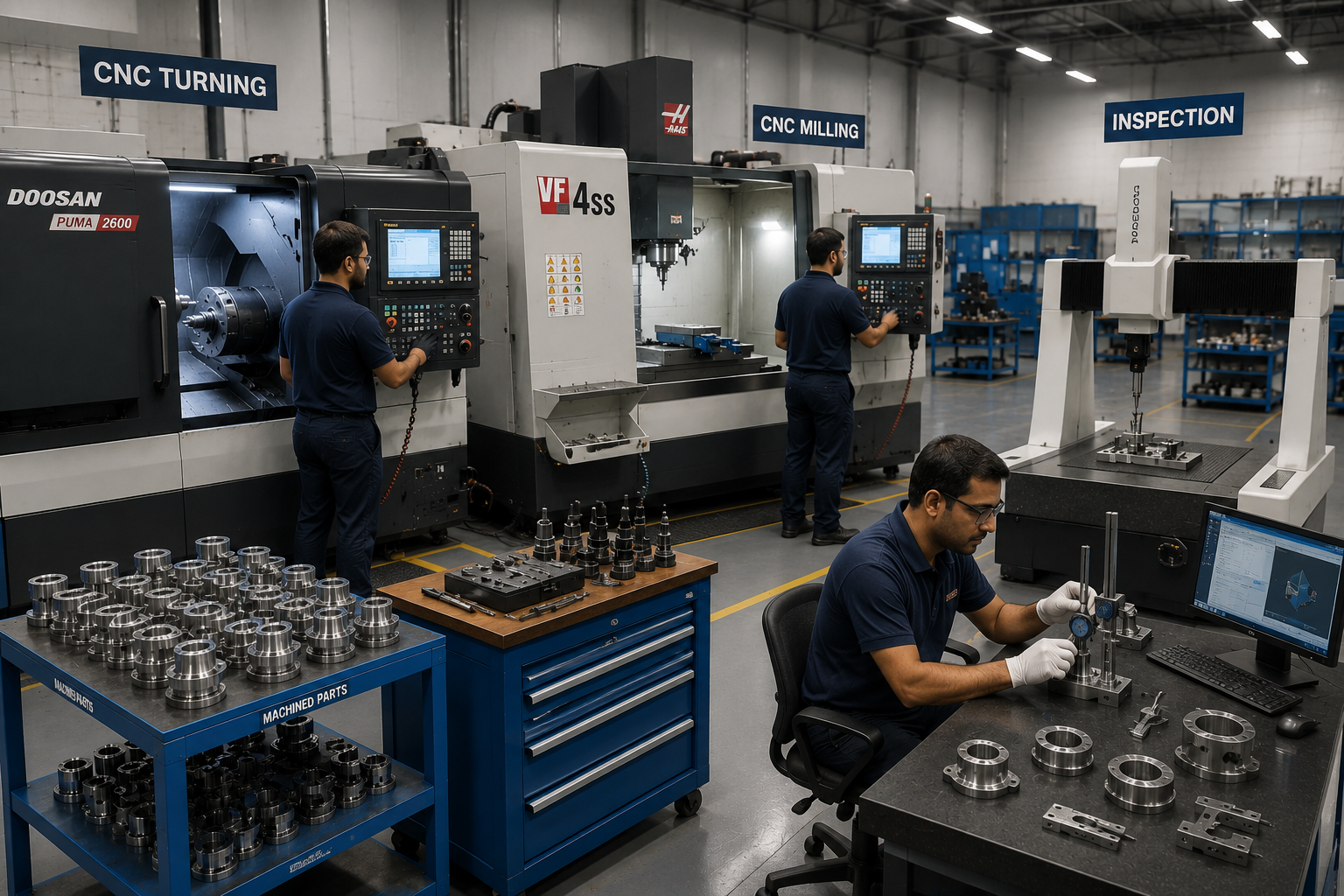
What Is CNC Turning?
CNC turning is a subtractive machining process in which a workpiece rotates around its spindle axis while a computer-controlled cutting tool removes material. It is particularly suited to cylindrical and rotationally symmetric components.
Rotational Geometry
CNC turning is well suited to shafts, pins, bushings, sleeves, spacers, rollers, fittings and other components primarily organized around a central axis.
Controlled Machining
CNC programs control tool movement, cutting operations and machining sequences to produce repeatable components from engineering drawings and CAD models.
Beyond Basic Turning
Suitable turning centers can also support operations such as drilling, tapping, grooving, threading and live-tool milling.
CNC Turning Services We Support
The appropriate machining route depends on component geometry, material, tolerances, quantity, tooling requirements and production objectives.
Precision CNC Turning
CNC turning for shafts, bushings, sleeves, rollers, pins, threaded components and custom-engineered rotational parts.
- Prototype to production
- Precision dimensional control
- Complex external profiles
- Internal and external features
Swiss-Type CNC Turning
Suitable for miniature and slender precision components where specialized workholding and machining strategies are required.
- Miniature components
- Long slender parts
- Precision concentric features
- Reduced machining vibration
Production CNC Turning
Repeat production for OEM and industrial requirements where process stability, dimensional consistency and production monitoring are important.
- Low-volume production
- Recurring production
- High-volume programs
- Bar-feed automation where appropriate
Turn-Mill Machining
Combines turning with selected milling, drilling and tapping operations when component geometry requires features away from the main rotational axis.
- Live tooling
- Cross-hole machining
- Reduced setups
- Off-axis features
Prototype CNC Turning
CNC turned prototypes for design validation, fit checks, functional testing and pre-production evaluation.
- One-off prototypes
- Engineering review
- DFM feedback
- Pre-production samples
India Manufacturing Support
Manufyn coordinates supplier identification, engineering communication, production monitoring, inspection, documentation and export logistics.
- Supplier selection
- Factory evaluation
- Quality coordination
- International logistics
CNC Turning Operations
Different turning operations are combined according to the geometry, dimensional requirements and machining sequence of the component.
Facing
Creates a flat reference surface perpendicular to the component axis.
OD Turning
Removes material from external cylindrical surfaces to achieve required diameters.
ID Turning & Boring
Machines internal diameters and bores to specified dimensions and finishes.
Threading
Produces internal or external threads according to the required thread standard.
Grooving
Creates controlled grooves, reliefs and other narrow recessed features.
Parting-Off
Separates the finished component from bar stock or prepares a component feature.
Drilling & Tapping
Creates holes and threaded holes where machine configuration permits.
Knurling & Chamfering
Produces functional or handling features according to the engineering requirement.
What Parts Can Be CNC Turned?
CNC turning is generally appropriate for components where the primary geometry is cylindrical or organized around a central axis.
Precision Shafts
Stepped shafts, drive shafts, rotor shafts and other rotational components requiring controlled diameter, concentricity or surface finish.
Bushings & Sleeves
Bearing bushes, spacer sleeves, wear bushes and custom sleeves in metals and suitable engineering plastics.
Pins & Fasteners
Dowel pins, guide pins, threaded pins and custom turned fastener components.
Valve Components
Valve stems, inserts, connectors and other precision-machined rotational parts.
Hydraulic Components
Fittings, adapters, couplings and other turned components used in hydraulic and fluid-handling applications.
Custom CNC Turned Parts
Components manufactured from customer drawings, CAD models and engineering specifications for OEM and industrial applications.
Materials for CNC Turned Components
Material selection should be based on mechanical properties, corrosion resistance, operating environment, machinability and application requirements.
Stainless Steel
SS303, SS304, SS316, SS310 and 17-4 PH.
Carbon & Alloy Steel
EN8, EN19, EN24, 4140 and 8620.
Aluminium
6061, 6082, 7075, 2024 and 2014.
Copper Alloys
Brass, bronze, phosphor bronze, copper and gun metal.
High-Performance Alloys
Titanium, Inconel, Monel, Hastelloy and duplex steel.
Engineering Plastics
PEEK, Nylon, Delrin, PTFE, Torlon and Ultem.
CNC Turning Capabilities & Technical Specifications
Manufyn’s manufacturing network includes CNC turning capabilities for components ranging from prototypes to high-volume production.
| Technical Parameter | Stated Capability |
|---|---|
| Maximum Turning Diameter | Up to 650 mm* |
| Maximum Turning Length | Up to 3000 mm* |
| Dimensional Tolerance | Up to ±0.005 mm* |
| Surface Finish | Ra 0.4 – 3.2 µm* |
| Thread Standards | Metric, BSP, BSPT, NPT, UNC, UNF, ACME |
| Production Volume | Prototype to high-volume production |
| CAD Formats | STEP, IGES, Parasolid, SolidWorks, DXF, PDF |
| Inspection Equipment | CMM, height gauge, micrometer, bore gauge, surface tester |
| Material Certification | MTC available on request |
*Actual achievable dimensions, tolerances and surface finish depend on component geometry, material grade, feature complexity, workholding and manufacturing process. Each drawing should be reviewed before confirming capability.
CNC Turning Machines & Technology
Machine selection should follow the component geometry and production requirement — not simply the machine specification.
2-Axis CNC Turning Centers
Suitable for shafts, sleeves, bushings, rollers, threaded components and general rotational parts.
Live-Tool CNC Machines
Combine turning with drilling, milling, tapping and other operations when suitable for the component.
Y-Axis Turning Centers
Useful for suitable complex components with off-axis features and reduced setup requirements.
Twin-Spindle Machines
Support front and back operations in suitable production applications, reducing handling between machining stages.
Swiss-Type CNC Machines
Designed for miniature and slender precision components where specialized workholding is beneficial.
Bar-Feed Automation
Supports repeat production by automatically feeding bar stock into suitable CNC turning systems.
CNC Turning vs CNC Milling
The right process depends primarily on the geometry and location of the component’s critical features.
CNC Turning
- Workpiece rotates around the spindle axis
- Best suited to cylindrical or rotational geometry
- Common for shafts, pins and bushings
- Strong for OD and ID features
- Suitable for grooves, shoulders and threads
CNC Milling
- Cutting tool rotates
- Well suited to prismatic geometry
- Useful for pockets, slots and profiles
- Multiple faces can be machined
- Suitable for many non-rotational geometries
CNC Turning DFM: What Engineers Should Consider
A manufacturable design can reduce unnecessary machining difficulty, additional setups, tooling requirements and avoidable cost.
Rotational Geometry
Evaluate critical features in relation to the component’s central axis and intended workholding method.
Length-to-Diameter Ratio
Long, slender components may require additional support or an appropriate machining strategy to control deflection and vibration.
Internal Bores
Small or deep bores should be evaluated for tool access, machining depth and achievable dimensional control.
Threads & Reliefs
Thread location, thread standard, relief grooves and tool access should be considered during design.
Surface Finish
Specify surface roughness according to functional requirements rather than applying unnecessarily tight finishes everywhere.
Tolerances & GD&T
Apply tight dimensional and geometric requirements where they are functionally necessary and clearly define critical datums.
From Prototype to Production CNC Turning
Manufacturing requirements can change as a product moves from development into recurring production. The sourcing approach should change with it.
Prototype
For design validation, fit checks, functional testing and engineering samples.
Low Volume
Suitable for initial launches, pilot programs and lower-demand components.
Recurring Production
Repeat manufacturing programs where supplier consistency and process control become increasingly important.
High Volume
Suitable components can use automation, bar feeding and optimized machining cycles for larger production requirements.
Quality Inspection for CNC Turned Components
Inspection requirements should be defined around the drawing, critical dimensions, GD&T, surface finish and customer documentation requirements.
Dimensional Inspection
- Micrometers
- Bore gauges
- Height gauges
- Dial indicators
- Digital measuring equipment
Advanced Measurement
- CMM inspection
- Profile projector
- Surface roughness testing
- Roundness testing
- Thread gauges
Quality Documentation
- First Article Inspection
- Dimensional inspection reports
- Material Test Certificates
- Heat-treatment reports
- PPAP documentation where required
Secondary Operations & Finishing
Where required, CNC turned components can be coordinated with additional machining, finishing and assembly operations.
Machining Operations
- CNC milling
- Drilling
- Tapping
- Grinding
- Wire EDM
- Thread rolling
- Knurling
Finishing & Processing
- Heat treatment
- Black oxide
- Zinc plating
- Nickel plating
- Chrome plating
- Anodizing
- Passivation
- Electropolishing
- Laser marking
What Should You Include in a CNC Turning RFQ?
The more complete the engineering information, the easier it is to evaluate manufacturability, select an appropriate supplier and prepare a meaningful quotation.
What Affects CNC Turning Cost?
CNC turning cost depends on the complete manufacturing route rather than machine time alone.
Why Work With Manufyn for CNC Turning?
CNC turning is only one part of the sourcing process. Manufyn provides engineering and procurement coordination around the manufacturing requirement.
Explore More CNC Manufacturing Resources
Go deeper into CNC design, tolerances, machining strategy, cost, GD&T and process selection through the Manufyn Resource Hub.
CNC Turning Design Guide
Practical design considerations for CNC turned components, including manufacturability and feature design.
Read Guide →CNC Machining Tolerances
Understand dimensional tolerances, precision requirements and the relationship between tolerance and manufacturing.
Read Guide →CNC Turning vs Milling
Compare the two machining processes and determine which manufacturing route is appropriate for your component.
Compare Processes →GD&T for CNC Machining
Learn how geometric dimensioning and tolerancing can define critical relationships between machined features.
Read Guide →CNC Machining Cost
Understand the major factors that influence CNC machining cost and manufacturing economics.
Read Guide →Explore All CNC Resources
Browse Manufyn’s wider library of CNC machining design, process, material and manufacturing resources.
Open Resource Hub →Explore Manufyn Case Studies & Manufacturing Insights
See how manufacturing, sourcing and engineering challenges are approached across real projects and technical content.
24-Hour CNC Turning Prototype Delivered to the USA
Explore a Manufyn CNC turning prototype project involving rapid manufacturing and international delivery.
Read Case Study →Manufacturing Projects & Supplier Solutions
Browse Manufyn’s manufacturing case studies covering CNC, sourcing, supplier management and production challenges.
Explore Case Studies →Rapid Prototyping Explained
Learn how rapid prototyping technologies can support product development and manufacturing validation.
Read Article →Design for Manufacturability
Practical DFM principles for engineers looking to improve manufacturability before production.
Read Article →Manufacturing Tolerances Explained
Understand tolerance types, standards and how precision requirements influence manufacturing.
Read Article →Explore Manufyn Blogs
Explore broader manufacturing, sourcing, engineering and procurement insights from Manufyn.
Explore Blogs →CNC Turning Services India FAQs
Answers to common engineering and procurement questions about CNC turned components and sourcing from India.
What is CNC turning?
What parts are suitable for CNC turning?
What operations can CNC turning perform?
What materials can be CNC turned?
What CNC turning tolerance can you achieve?
Can you manufacture CNC turning prototypes?
What is the difference between CNC turning and CNC milling?
When should I use turn-mill machining?
Can you manufacture parts from customer drawings?
What should I include in a CNC turning RFQ?
Can you provide FAI and PPAP documentation?
Can you export CNC turned components internationally?
Looking for CNC Turning Services in India?
Send your engineering drawing, CAD model and production requirement. Manufyn can review the requirement and coordinate the appropriate manufacturing partner in India.