Design for manufacturability (DFM) is the practice of designing a part so it’s as easy, reliable, and cheap to manufacture as possible — without compromising its function. It means applying the rules of the chosen process (uniform wall thickness for molding, adequate bend radii for sheet metal, accessible features for machining) while the design is still on the screen, when changes are free, rather than discovering the problems after tooling is cut or metal is scrapped.
DFM matters because the vast majority of a part’s manufacturing cost is locked in at the design stage, long before production begins. A feature that adds a slider to a mold, forces a second machining setup, or can’t be bent accurately costs the same to fix whether it’s caught in an hour of CAD work or after $15,000 of tooling — except one is free and the other isn’t. This guide explains DFM’s core principles, the process-specific rules for machining, sheet metal, and molding, when DFM should happen, and how much it actually saves.
The guidance here comes from a shop that reviews incoming drawings for manufacturability every day. Manufyn’s injection molding and wider manufacturing operations run from an ISO 9001 certified, strictly in-house facility in Pune, India — and every quote starts with a free DFM review, so this is written from the floor where design problems become production problems.
What Is Design for Manufacturability?
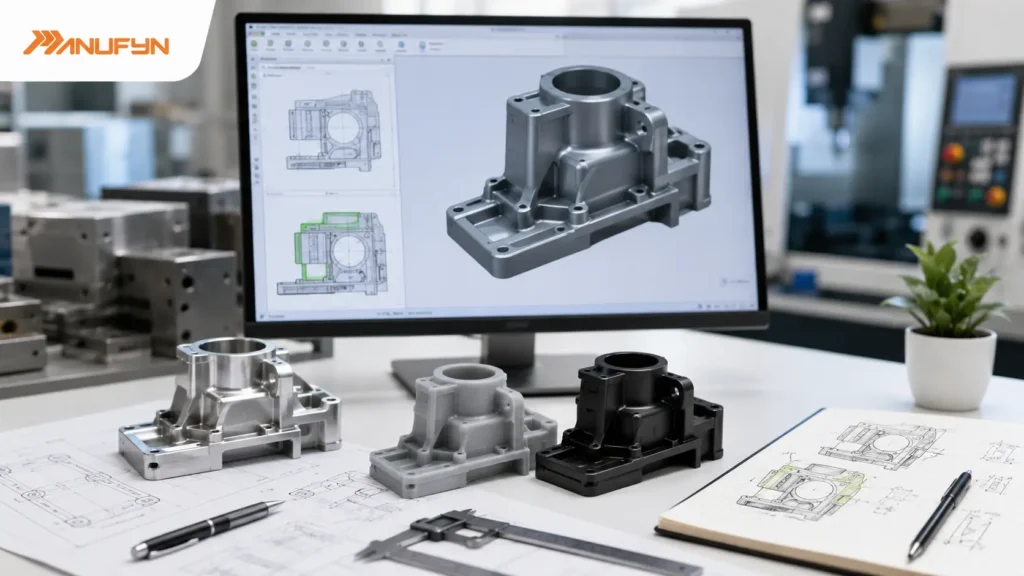
DFM is designing a part around how it will actually be made. It aligns the design with the realities of the chosen process so the part is cheaper, faster, and more reliable to produce.
Every manufacturing process has rules baked into its physics — a mold needs draft to release a part, a press brake needs a minimum flange to grip, a milling cutter needs room to reach a pocket floor. Design for manufacturability is the discipline of respecting those rules from the first sketch, so the part can be made without workarounds, extra operations, or scrap. It doesn’t mean compromising function; a good DFM decision keeps the part doing exactly what it needs to while removing the features that make it needlessly hard or expensive to produce. The best DFM is invisible in the finished part — it just quietly means the part cost less, arrived sooner, and came back right the first time. Its close relatives are DFA (design for assembly) and DFMA (the two combined), which extend the same thinking to how parts fit together.
The Core Principles of DFM
Across every process, DFM comes down to a handful of universal principles. Apply these and most process-specific problems never arise in the first place.
| Principle | What it means | Why it saves cost |
|---|---|---|
| Simplify geometry | Remove features the part doesn’t need | Fewer operations, less machine time |
| Reduce part count | Combine parts where possible | Less assembly, fewer tools, fewer suppliers |
| Standardise features | Use standard hole sizes, threads, materials | Standard tooling, no custom setups |
| Tolerance to function | Tighten only where it matters | Avoids slow machining and high scrap |
| Design for the process | Follow the chosen process’s rules | No workarounds, extra setups, or rework |
| Choose the right material | Match material to function and process | Avoids overspending or manufacturability issues |
DFM for CNC Machining
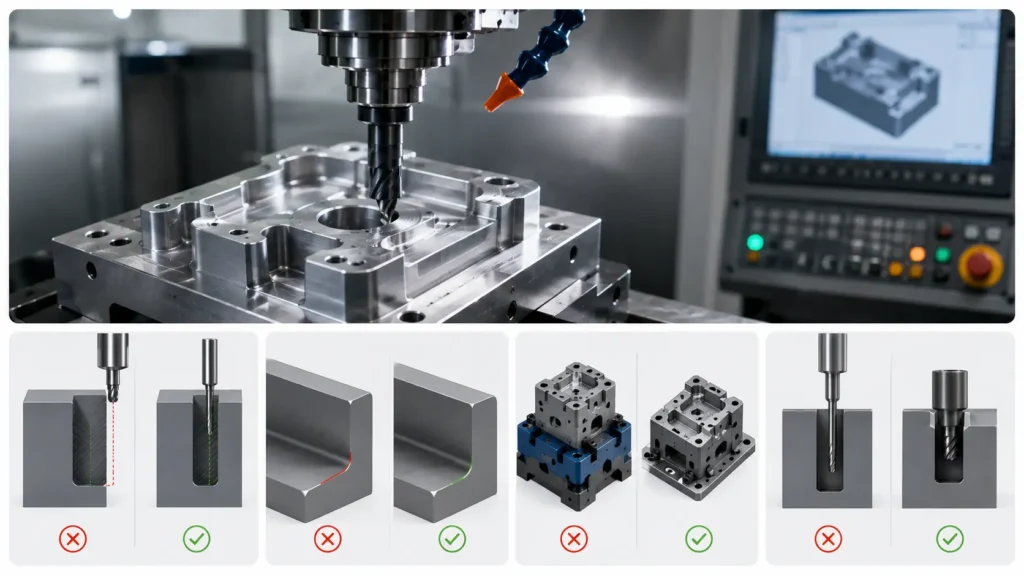
Machining DFM is mostly about tool access and setups. A feature a cutter can’t reach — or that needs a second setup — is where machining cost quietly climbs.
CNC machining removes material with a rotating tool, so its rules follow what the tool can physically reach and how many times the part must be re-fixtured. Deep, narrow pockets need long, thin tools that flex and cut slowly; sharp internal corners can’t be machined at all because a round cutter always leaves a radius; and every feature that requires flipping the part to a new setup adds cost and a small alignment error. Designing with generous internal radii, reachable features, and as few setups as possible keeps machining fast and accurate. The most common machining cost drivers, and the fixes, are covered in our CNC DFM checklist.
| Problem | DFM fix |
|---|---|
| Sharp internal corners | Add a radius at least 1/3 of pocket depth |
| Deep narrow pockets | Limit depth to ~4× tool diameter |
| Thin walls | Keep walls above ~0.8 mm metal, 1.5 mm plastic |
| Many setups | Group features on fewer faces |
DFM for Sheet Metal Fabrication
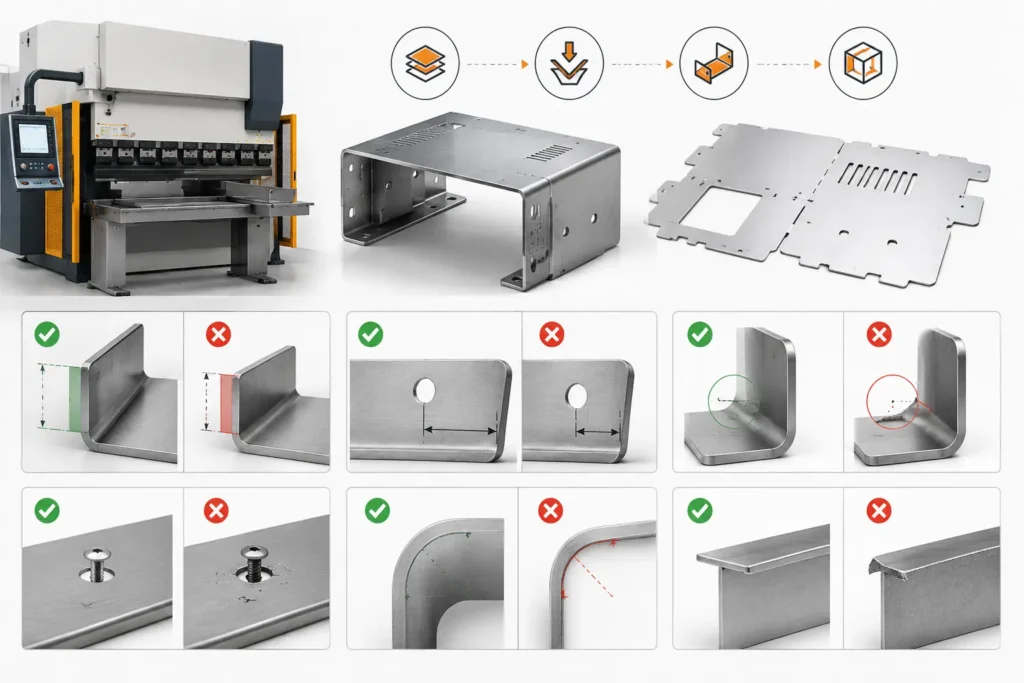
Sheet metal DFM centres on the bend. Most avoidable fabrication rework traces to features placed too close to a bend, or flanges too short to form.
Sheet metal starts as a flat blank that’s bent into shape, so its rules revolve around what bending does to the surrounding metal. A flange shorter than roughly four times material thickness can’t be gripped and formed accurately; a hole placed too close to a bend line distorts as the metal stretches; and hardware installed after coating cracks the finish. Keeping holes clear of bends, flanges long enough to form, and a consistent bend radius across the part is what separates a drawing that quotes cleanly from one that comes back with problems. The single biggest offender is bend geometry — covered in full in our bend radius guide.
| Problem | DFM fix |
|---|---|
| Flanges too short to bend | Keep flange length ≥ ~4× material thickness |
| Holes too close to a bend | Keep holes ≥ ~2× thickness from the bend line |
| Inconsistent bend radii | Use one bend radius across the whole part |
| Hardware after finishing | Install self-clinching hardware before coating |
Want your design checked for manufacturability before you commit? Send your drawing to Manufyn for a free DFM review — we flag cost and quality issues before quoting, and respond within 24 hours. ISO 9001, strictly in-house, no minimum order.
DFM for Injection Molding
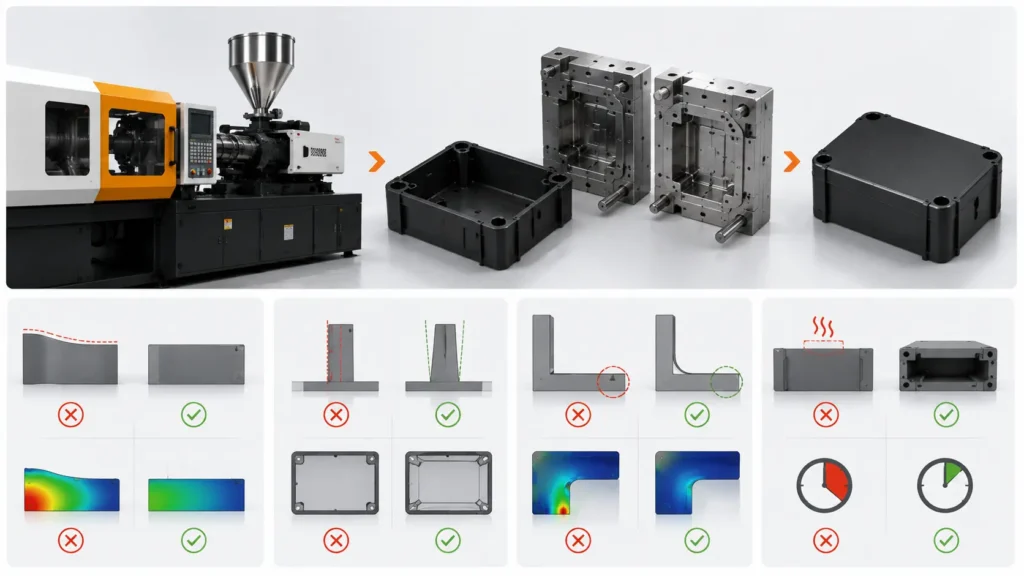
Molding DFM has the highest stakes — the rules are locked into expensive steel tooling, so a design error caught after the mold is cut is the costliest to fix.
Injection molding forces molten plastic into a mold and cools it, so its rules follow how plastic flows, cools, and releases. Uneven wall thickness cools at different rates, causing sink marks and warping; walls with no draft angle grip the mold and won’t eject cleanly; sharp corners concentrate stress and disrupt flow; and thick solid sections take far too long to cool. Because these rules are built into the mold itself, fixing them after tooling is cut can mean a full re-cut — which is why molding DFM has to happen before the tool is made, not after. Our injection molding cost breakdown shows how these design choices flow directly into tooling and per-part cost.
| Problem | DFM fix |
|---|---|
| Uneven wall thickness | Keep walls uniform (typically 1.5–3 mm) |
| No draft angle | Add at least 1–2° draft on vertical walls |
| Thick solid sections | Core out thick areas or add ribs instead |
| Sharp internal corners | Add fillets to ease flow and reduce stress |
When Should DFM Happen?
DFM is most valuable at the earliest possible stage, and its value drops sharply the later it happens — because the cost of changing a design rises at every step toward production.
| Stage | Cost to change the design | DFM value |
|---|---|---|
| Concept / early CAD | Near zero | Highest — change is free |
| Detailed design | Low | High — still just CAD edits |
| Pre-tooling / quoting | Moderate | Good — last free window |
| After tooling cut | High — re-cut or re-machine | Limited — damage mostly done |
| In production | Very high — scrap and delay | Lowest — worst case |
Buyer takeaway: the ideal DFM review happens before quoting, while the design is still on screen and every fix is free. A supplier that reviews your drawing for manufacturability before quoting — rather than after your PO — is catching problems in the one window where they cost nothing to fix.
How Much Does DFM Actually Save?
The savings from good DFM come from three places, and together they’re the difference between a part that quotes cleanly and one that bleeds cost:
- Avoided rework and scrap: catching an unmouldable feature or an over-tight tolerance before production eliminates scrapped parts and re-cut tooling entirely.
- Lower per-part cost: simpler geometry, fewer setups, and looser non-critical tolerances all reduce machine time and inspection on every part made.
- Faster time to market: problems caught in CAD don’t cause the weeks of delay that a re-cut tool or a failed first article would.
Buyer takeaway: because most of a part’s cost is committed at the design stage, DFM is the highest-leverage cost-saving step available — and when a supplier offers it free before quoting, there’s no reason not to use it.
How Manufyn Applies DFM on Every Quote
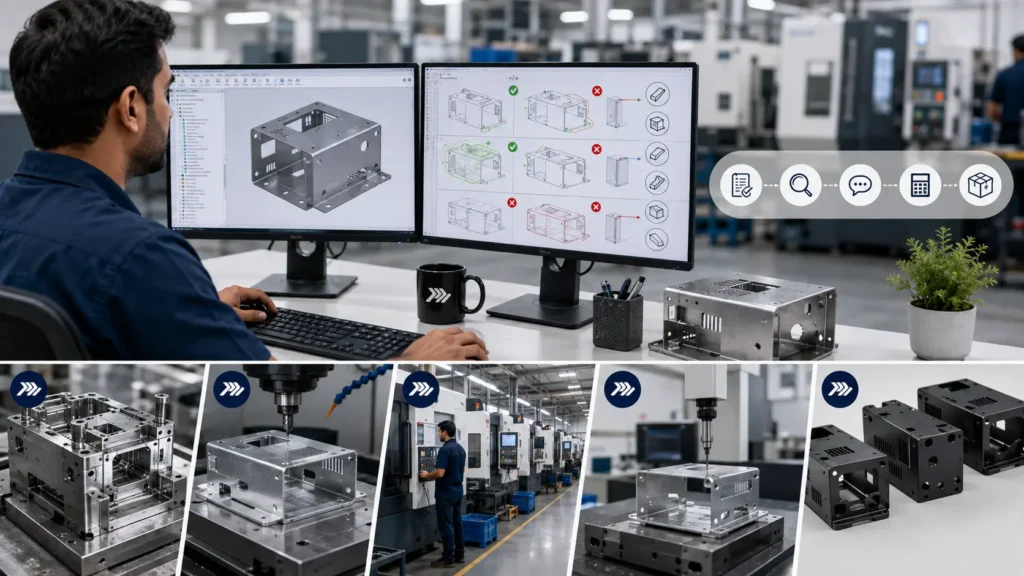
Manufyn is an ISO 9001 certified, strictly in-house manufacturer in Baner, Pune, India — not a broker. Every drawing gets a free DFM review before a quote goes out, from the engineers who will actually make the part.
Because design review, tooling, and production all sit under one roof, the DFM feedback comes from the people who run the machines — not a separate sales desk relaying it. When a feature will add a setup, an over-tight tolerance will inflate cost, or a wall won’t mould cleanly, it’s flagged while the fix is still free, and a part can move from a reviewed prototype into bridge tooling and production without a change of supplier or a re-review.
- Free DFM review on every drawing across every process, before quoting
- Feedback on geometry, tolerance, wall thickness, draft, and bend rules
- Material substitution guidance where it lowers cost without hurting function
- 80+ in-house processes, so DFM covers machining, molding, fabrication, and casting
- No minimum order and a firm quote within 24 hours
Read more about our approach on our Why Manufyn page.
Ready to catch design problems before they cost you? Send your drawing to Manufyn — free DFM review, issues flagged before quoting, no minimum order, and a firm quote in 24 hours.
FAQs
Design for manufacturability (DFM) is the practice of designing a part so it’s as easy, reliable, and cost-effective to manufacture as possible without compromising function. It means applying the rules of the chosen process — like uniform wall thickness for molding or adequate bend radii for sheet metal — while the design is still on screen, when changes cost nothing.
Because the majority of a part’s manufacturing cost is locked in at the design stage. A feature that adds a mold slider or forces a second machining setup costs the same to fix whether it’s caught in CAD or after tooling is cut — but one is free and the other isn’t. DFM catches these problems in the free window.
Simplify geometry, reduce part count, standardise features, tolerance only to function, design for the specific process being used, and choose the right material. Together these reduce operations, tooling, assembly, scrap, and inspection — cutting cost without compromising what the part does.
As early as possible — ideally at the concept and CAD stage, and at the latest before tooling is cut. The cost of changing a design rises sharply at every step toward production, so a DFM review before quoting, while the design is still just CAD edits, delivers by far the most value.
DFM (design for manufacturability) focuses on making each individual part easy and cheap to manufacture. DFA (design for assembly) focuses on making parts easy to assemble together. DFMA combines both. All three apply the same principle — designing for how the product will actually be made — at different stages.
It reduces cost three ways: avoiding rework and scrap by catching problems before production, lowering per-part cost through simpler geometry and fewer setups, and shortening time to market by preventing the delays a re-cut tool or failed first article would cause. Since most cost is set at design, DFM is the highest-leverage saving available.
Yes. Each process has its own rules: CNC focuses on tool access and minimising setups, sheet metal on bend geometry and hole placement, and injection molding on wall thickness, draft angles, and cooling. The universal principles are the same, but the specific rules follow the physics of each process.
Many in-house manufacturers, including Manufyn, provide a free DFM review with every quote, because catching problems early benefits both sides — the buyer avoids rework and the manufacturer avoids production issues. A supplier who reviews your drawing for manufacturability before quoting is removing risk, not adding cost.
Skipping DFM doesn’t remove design problems — it just moves their discovery to the most expensive possible moment: after tooling is cut, at first article inspection, or in production. That means scrapped parts, re-cut tooling, and delays, all of which cost far more than the design changes would have cost upfront.
Have a design you want reviewed for manufacturability? Send it to our engineers — we respond within 4 working hours.
Have a design ready to manufacture?
Get a free DFM review that flags cost and quality issues before you commit — plus a firm quote in 24 hours, no minimum order.
Talk to Manufyn