Manufyn machines and molds both nylon and Delrin in-house — compare with one quote
Nylon vs Delrin in one sentence: Delrin (POM acetal) is stiffer, holds dimensions almost perfectly because it absorbs virtually no moisture, and machines better than any other plastic — while nylon is tougher under shock loads, handles 20–50 °C more heat, and costs less. Choose Delrin for precision fits and wet or humid service; choose nylon for impact-loaded, hot, or cost-driven parts.
First, the naming: Delrin is a brand name (DuPont, now Celanese) for POM homopolymer — polyoxymethylene, also called acetal. “Delrin vs nylon” really means “acetal vs polyamide,” and this page uses the terms precisely because the homopolymer/copolymer distinction inside the POM family genuinely matters, as covered below.
These two materials fight over every gear, bushing, bearing, and sliding part in engineering. Manufyn machines and molds both in-house via CNC and plastic injection molding — this comparison is written from production experience, not datasheets alone. Free DFM review on every quote.
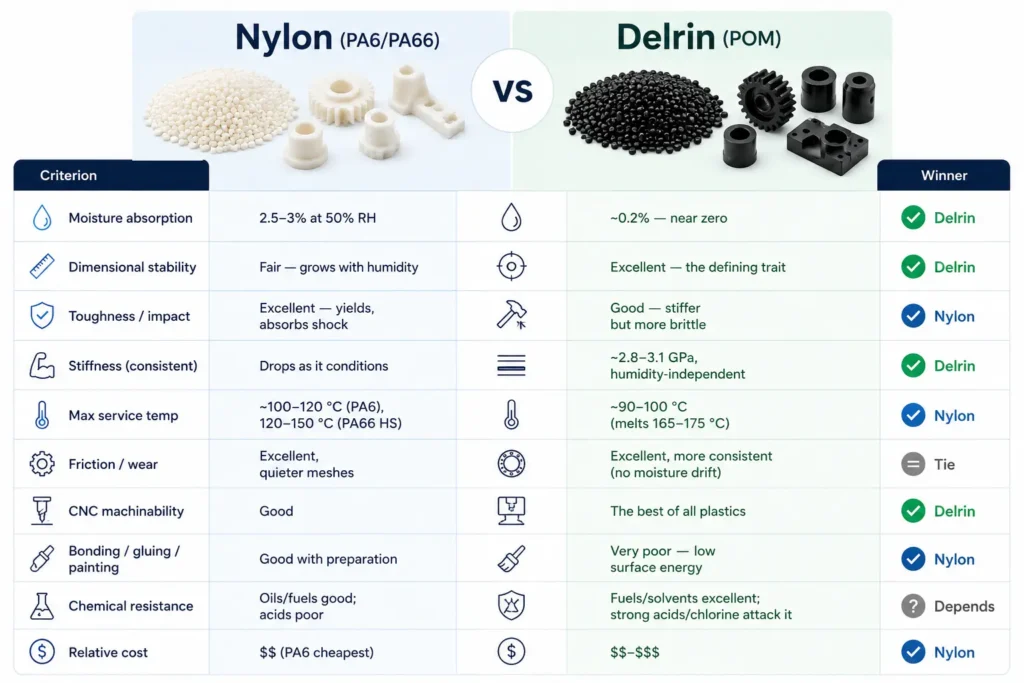
Nylon vs Delrin at a Glance
Ten criteria, one winner per row. Delrin wins on precision and processability, nylon wins on toughness, heat, and price — the rest of this page explains when each win matters for your part.
Nylon vs Delrin Comparison Table
| Criterion | Nylon (PA6/PA66) | Delrin (POM) | Winner |
|---|---|---|---|
| Moisture absorption | 2.5–3% at 50% RH | ~0.2% — near zero | Delrin |
| Dimensional stability | Fair — grows with humidity | Excellent — the defining trait | Delrin |
| Toughness / impact (conditioned) | Excellent — yields, absorbs shock | Good — stiffer but more brittle | Nylon |
| Stiffness (consistent) | Drops as it conditions | ~2.8–3.1 GPa, humidity-independent | Delrin |
| Max service temp | ~100–120 °C (PA6), 120–150 °C (PA66 HS) | ~90–100 °C (melts 165–175 °C) | Nylon |
| Friction / wear | Excellent, quieter meshes | Excellent, more consistent (no moisture drift) | Tie |
| CNC machinability | Good | The best of all plastics | Delrin |
| Bonding / gluing / painting | Good with preparation | Very poor — low surface energy | Nylon |
| Chemical resistance | Oils/fuels good; acids poor | Fuels/solvents excellent; strong acids/chlorine attack it | Depends |
What Is the Difference Between Nylon and Delrin?
Chemically they could hardly be more different. Nylon (polyamide — PA6 and PA66) is built on amide groups that hydrogen-bond between chains — the source of its toughness, and of its appetite for water. Delrin (POM) is built on a simple, dense –CH₂–O– backbone that packs into a highly crystalline structure with nothing for water to grab — the source of its stiffness, springiness, and near-perfect dimensional stability.
Inside the POM family, one distinction matters: homopolymer vs copolymer. Delrin is the homopolymer — slightly stronger and stiffer, but prone to centerline porosity in thick machined sections and less resistant to hot water. Copolymer POM (Celcon, Hostaform and generics) trades a few percent of stiffness for better hot-water and chemical resistance and porosity-free stock. Most “Delrin” parts quoted in the market are actually copolymer POM — Manufyn specifies which on every quote, because for food machinery and hot-water service the difference is real.
The Moisture Story — the Real Decider
Strip everything else away and most nylon-vs-Delrin decisions come down to water. Nylon equilibrates at 2.5–3% moisture in ordinary air, growing ~0.2–0.3% in dimension per 1% absorbed and softening as it conditions. Delrin absorbs ~0.2% — effectively nothing. The consequences:
- A 50 mm nylon bearing bore can move 0.1–0.3 mm between a dry workshop and a humid plant. The same bore in Delrin moves microns. If the drawing has tight fits and the environment has humidity swings, Delrin wins before any other property is discussed.
- Nylon’s published properties are a moving target (dry vs conditioned); Delrin’s datasheet is what you get, every day of the part’s life.
- In permanent water immersion, nylon swells and weakens while Delrin runs happily — why pump internals, valve components, and marine hardware default to acetal.
Is Delrin Stronger Than Nylon?
It depends what “stronger” means — and this is where most comparisons mislead. Delrin is stiffer: ~2.8–3.1 GPa modulus that never changes with humidity, with tensile strength around 65–75 MPa. Conditioned nylon is tougher: it yields and absorbs impact energy that can chip or crack acetal, and glass-filled PA66 (180–200 MPa) out-muscles any unfilled acetal for structural loads.
The honest split: for a part that must not deflect and must hold size — Delrin. For a part that gets shock-loaded, dropped, or over-torqued — nylon. For maximum structural strength — glass-filled nylon, which acetal compounds rarely match.
Which Handles Heat Better, Nylon or Delrin?
Nylon — and by a wider margin than most engineers expect. Delrin melts at just 165–175 °C with a practical continuous limit around 90–100 °C. PA6 serves to 100–120 °C, and heat-stabilized PA66 to 150 °C+ with a 260 °C melting point. Any wear part living near motors, engines, or steam belongs to the nylons; Delrin’s territory is room-temperature-to-warm precision.
Gears, Bushings, and Wear Parts: Which Should You Choose?
This is the application both materials were born for, and the split is clean:
- Delrin gears hold tooth profile and center distance precisely regardless of humidity — the choice for precision meshes, printer and instrument drives, timing mechanisms, and anything running against metal in wet or washdown environments.
- Nylon gears run quieter, absorb shock and misalignment that chips acetal teeth, and cost less — the choice for power transmission with impact loads, agricultural and outdoor drives, and large machined gears from cast PA6 stock.
- Bushings and sliding parts: both excel; Delrin’s spring-back makes superb snap-fit clips and leaf springs, while oil-filled and MoS2 nylons take the highest loads and speeds.
Pairing tip from the production floor: a nylon gear running against a Delrin gear wears better than either material running against itself — dissimilar polymer pairs shed heat and resist galling.
Gear, bushing, or wear part on your drawing board?
Send your CAD and duty conditions — Manufyn recommends nylon, Delrin, or the grade between, with pricing for both.
Machining: Why Delrin Is the Machinist’s Favourite Plastic
Ask any CNC programmer their favourite plastic and the answer is Delrin: it chips like brass, holds ±0.05 mm without drama, needs no special tooling, and leaves a glossy machined finish. Nylon machines well too, but its toughness makes it stringier, and its moisture movement means precision nylon parts should be machined from conditioned stock and inspected accordingly. Feeds, speeds, and workholding for both are in the CNC machining plastics guide, and the tolerance capability behind this is demonstrated in Manufyn’s micron-tolerance CNC machining with live tooling case study.
For molding, the roles reverse slightly: both mold well, but POM’s high shrinkage (1.8–2.2%) demands experienced tool sizing — see shrinkage rates — while nylon brings its drying and warp disciplines covered in the injection molding design guide. Prototypes in either material ship in 5–10 days via Manufyn’s rapid prototyping service.
When to Choose Nylon
- Shock-loaded gears, drives, and parts that get dropped, over-torqued, or abused
- Service above ~100 °C — under-hood, near motors, sterilization (PA66 territory)
- Structural parts in glass-filled grades — brackets, housings, metal replacement
- Parts that must be bonded, painted, or overmolded — acetal takes none of these well
- Cost-driven volume parts — PA6 is the cheapest of the engineering wear materials
When to Choose Delrin (POM)
- Precision fits, meshes, and mechanisms that must hold size in changing humidity
- Wet, washdown, or immersed service — pumps, valves, marine, food machinery (FDA copolymer grades)
- Fuel-system components — acetal’s fuel and solvent resistance is a long-standing industry standard
- Spring elements, snap-fit clips, and living mechanisms that exploit its stiffness and rebound
- Tight-tolerance CNC parts where machinability and stability decide the yield
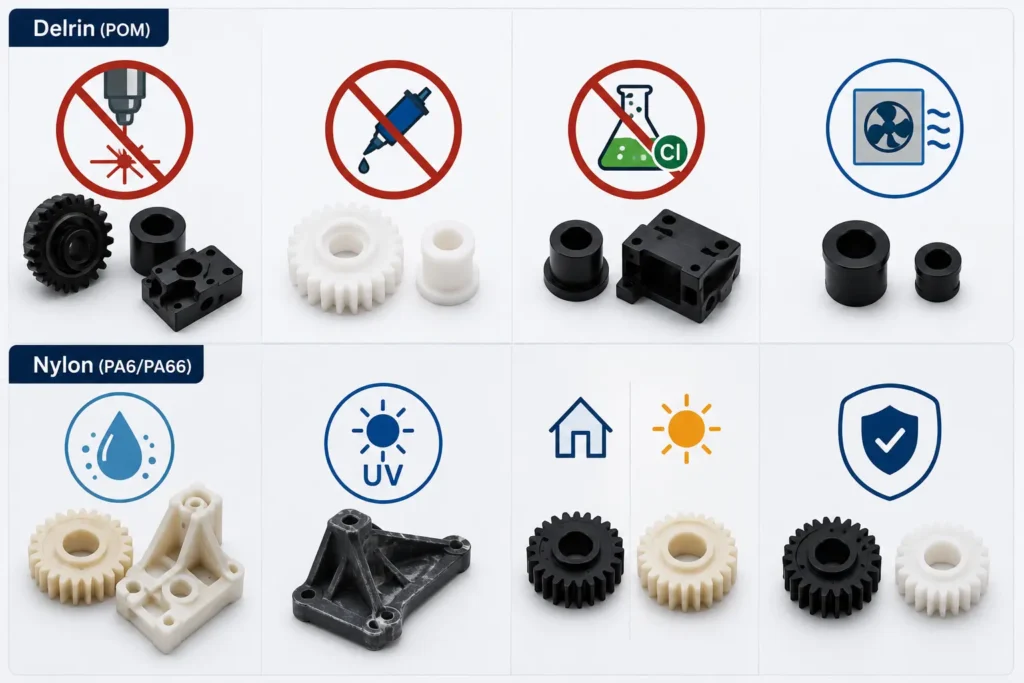
Safety Notes and Honest Limitations
Both materials carry limitations the datasheets whisper and a manufacturer must say plainly:
- Never laser-cut Delrin. POM decomposes into formaldehyde gas under laser heat — it is one of the few common plastics that must not go on a laser cutter. CNC routing and machining are the safe routes, and overheated molding or burning smells during processing demand ventilation. This is also why POM faces formaldehyde-emission scrutiny (EU REACH) in some automotive interior applications — a live trend pushing some interior parts toward nylon and other polymers.
- Delrin barely bonds. Its low surface energy defeats most adhesives and paints; design mechanical joints (snap-fits, fasteners, press-fits — its strengths) instead of glued ones.
- Delrin and strong acids/chlorine don’t mix — bleach-based washdown chemistry attacks homopolymer especially; specify copolymer POM for hot-water and aggressive cleaning environments.
- Nylon’s moisture movement and UV chalking remain its permanent trade-offs — covered fully in the PA6 guide and PA66 guide.
- Neither survives outdoors unstabilized — carbon-black grades for nylon, UV-stabilized grades for POM.
Cost closes the decision: PA6 is cheapest, POM and PA66 sit above it, and part-level pricing depends more on tooling, cycle, and machining time than resin — the logic is in our injection molding vs 3D printing cost guide and plastic injection parts guide. India sourcing through Manufyn typically lands 40–60% below US/UK/EU pricing in either material, across the industries we serve.
Get Nylon and Delrin Quoted Side by Side in 24 Hours
Still deciding? Send one drawing and Manufyn quotes both — machined or molded. We confirm:
Moisture & dimensional-stability requirements vs material
Shock load vs precision-mesh duty for gears and wear parts
Homopolymer vs copolymer POM for your environment
Machining vs molding route for your volume
40–60% cost savings vs US/UK/EU suppliers
Frequently asked questions
Is Delrin the same as nylon?
No — they are different polymer families often confused because both make white, slippery machine parts. Delrin is a brand of POM (acetal, polyoxymethylene); nylon is polyamide (PA6, PA66). Delrin is stiffer and dimensionally stable; nylon is tougher and more heat-capable.
Which is better for gears, nylon or Delrin?
Delrin for precision meshes that must hold tooth geometry in changing humidity or wet service; nylon for shock-loaded, quieter, or budget drives — and glass-filled nylon for the highest torque. A nylon gear running against a Delrin gear outlasts either material paired with itself.
Is Delrin stronger than nylon?
Delrin is stiffer (~2.8–3.1 GPa, humidity-independent); conditioned nylon is tougher and absorbs impacts that can chip acetal; glass-filled PA66 (180–200 MPa tensile) beats any unfilled acetal for structural strength. “Stronger” depends on whether your part fails by deflection, impact, or overload.
Does Delrin absorb water like nylon?
No — this is the core difference. POM absorbs about 0.2% moisture versus nylon’s 2.5–3% at ordinary humidity, so Delrin parts hold their molded or machined dimensions essentially forever while nylon parts grow and toughen as they condition.
Which handles heat better, Delrin or nylon?
Nylon, clearly. Delrin melts at 165–175 °C and serves continuously to about 90–100 °C; PA6 serves to 100–120 °C and heat-stabilized PA66 to 150 °C+ with a 260 °C melting point. Hot wear parts belong to the nylons.
Why can't Delrin be laser cut?
Laser heat decomposes POM into formaldehyde gas — hazardous to operators and equipment — so acetal must never go on a laser cutter. CNC machining and routing are the safe processes, and Delrin happens to be the best-machining plastic there is.
Can you glue or paint Delrin?
Barely — POM’s low surface energy defeats most adhesives and coatings without aggressive surface treatment. Design mechanical joints instead: snap-fits, press-fits, and fasteners, which exploit Delrin’s stiffness and spring-back. Nylon bonds and paints far better if joining is essential.
What is the difference between Delrin and generic POM (acetal)?
Delrin is Celanese’s brand of POM homopolymer — a few percent stronger and stiffer, but prone to centerline porosity in thick stock and weaker in hot water. Copolymer POM (Celcon, Hostaform, generics) resists hot water and chemicals better and machines porosity-free. Much of what is sold as “Delrin” is actually copolymer; Manufyn states which grade on every quote.
Is Delrin food safe?
FDA/EU-compliant POM grades are widely used in food machinery — conveyor components, filler nozzles, cutting guides — usually copolymer for hot-water and cleaning-chemical resistance. As with nylon, only certified grades qualify; state the requirement on your drawing.
Can Manufyn manufacture both nylon and Delrin parts?
Yes — Manufyn is an ISO 9001 certified in-house manufacturer machining and molding nylon (PA6, PA66, glass-filled) and POM (homopolymer and copolymer) in Pune, India, shipping to 30+ countries with no minimum order and quotes in 24 hours.