Manufyn molds and machines both ABS and PC in-house — compare with one quote
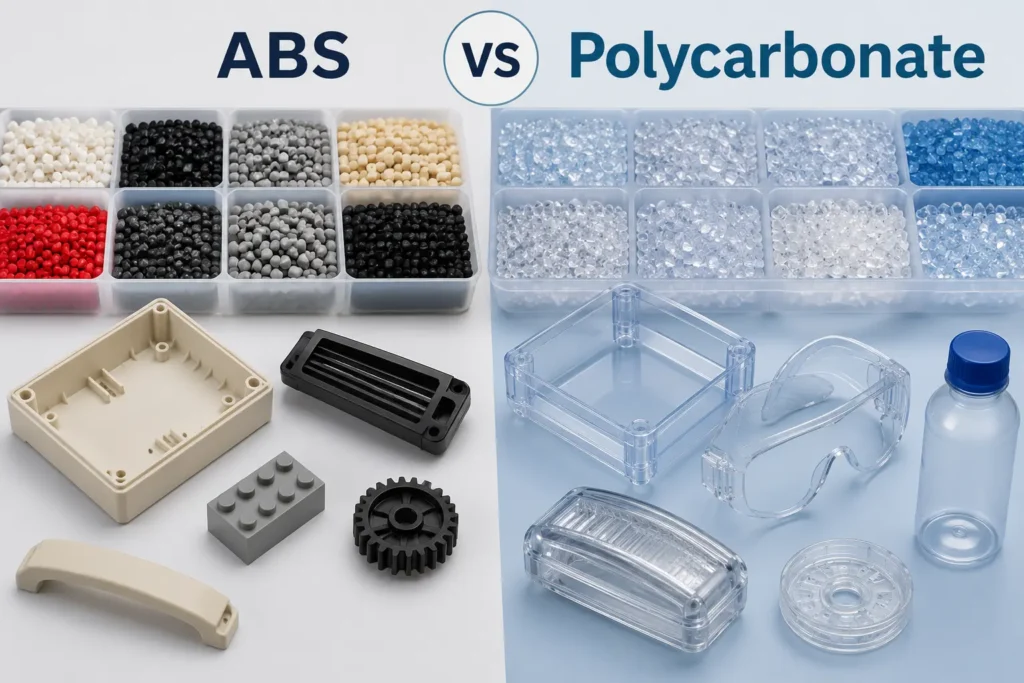
ABS vs polycarbonate in one sentence: polycarbonate is up to 4× more impact-resistant, survives 30 °C higher temperatures, and can be transparent — but costs about twice as much and is harder to process. Choose ABS for indoor housings and cost-driven parts; choose PC when impact, heat, or clarity is non-negotiable; choose a PC-ABS blend when you need most of PC’s toughness at closer to ABS’s price.
Both are amorphous engineering thermoplastics, both injection mold beautifully, and both appear in the same product categories — which is exactly why this is the most-asked material shortlist in plastics. Manufyn molds and machines both materials in-house via plastic injection molding, CNC, and 3D printing — this comparison is written from production experience, not datasheets alone. Free DFM review on every quote.
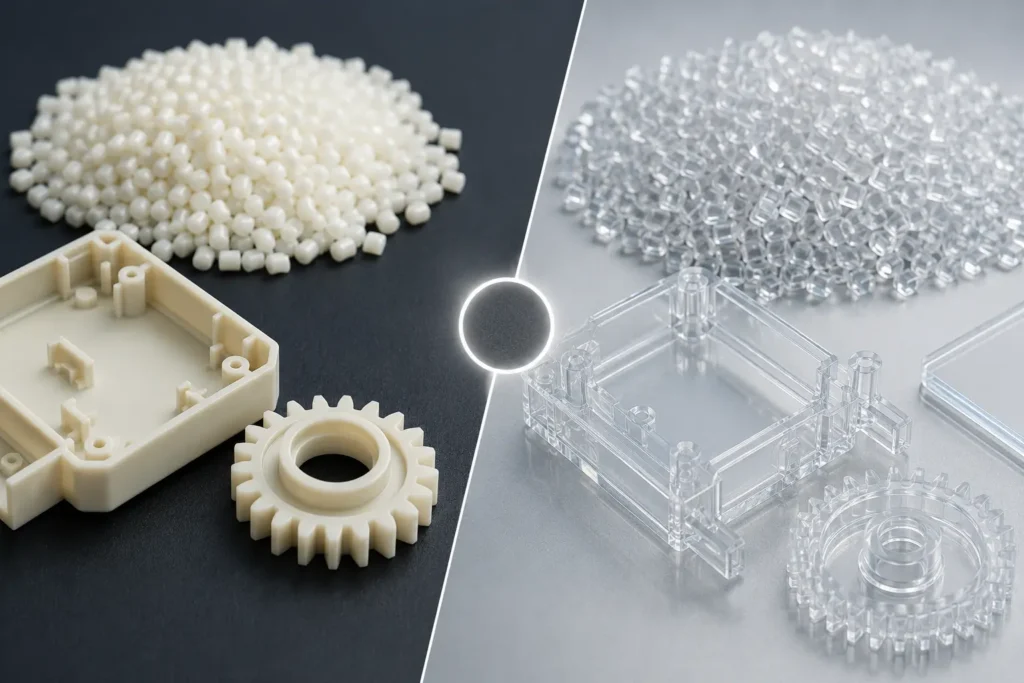
ABS vs PC at a Glance
Ten criteria, one winner per row. Score it and PC wins on performance, ABS wins on cost and processability — the rest of this page explains when each of those wins actually matters for your part.
ABS vs Polycarbonate Comparison Table
| Criterion | ABS | Polycarbonate (PC) | Winner |
|---|---|---|---|
| Impact strength (notched Izod) | 200–400 J/m | 600–850 J/m | PC |
| Max continuous service temp | ~85 °C | ~115–120 °C | PC |
| Transparency | Opaque | 88–90% light transmission | PC |
| Tensile strength | 40–50 MPa | 55–75 MPa | PC |
| Resin cost | $1.50–2.50/kg | $2.50–4.00/kg | ABS |
| Ease of molding | Very easy (200–250 °C) | Demanding (280–320 °C, strict drying) | ABS |
| Ease of 3D printing (FDM) | Moderate (heated bed) | Hard (enclosed high-temp printer) | ABS |
| Scratch resistance | Fair | Poor (needs hard coat) | ABS |
| Paint / plate / glue | Excellent (plating grade exists) | Good (watch stress cracking) | ABS |
| UV resistance (unstabilized) | Poor | Poor–fair (UV grades exist) | Tie |
What Is the Difference Between ABS and Polycarbonate?
The difference starts in the polymer chain. ABS is a terpolymer of three monomers — acrylonitrile for chemical resistance, butadiene rubber for impact, styrene for stiffness and gloss — blended in adjustable ratios (full breakdown in the ABS material guide).
Polycarbonate is a single polymer built from bisphenol-A units joined by carbonate linkages. Its bulky aromatic rings keep it amorphous and transparent; its flexible carbonate links absorb enormous impact energy (full breakdown in the polycarbonate material guide).
Practical consequence: ABS gets its toughness from dispersed rubber particles — effective, but temperature-limited, and the styrene matrix scatters light (opaque). PC gets its toughness from the backbone itself — so it stays tough at temperatures that soften ABS, and stays clear.
Is Polycarbonate Stronger Than ABS?
Yes — on every strength metric. Polycarbonate’s notched Izod impact of 600–850 J/m (per ASTM D256) is roughly 2–4× ABS’s 200–400 J/m depending on the grades compared, and its 55–75 MPa tensile strength beats ABS’s 40–50 MPa. A PC housing survives drops, impacts, and abuse that crack an identical ABS housing.
The engineering caveat: PC is notch-sensitive. A sharp internal corner or a deep scratch can cut its effective impact strength by an order of magnitude — a badly designed PC part can fail where a well-designed ABS part survives. That is a design problem, not a material ranking change: radius every internal corner at ≥ 0.5× wall thickness and PC keeps its full advantage.
Which Handles Heat Better, ABS or Polycarbonate?
Polycarbonate, decisively. PC’s glass transition temperature is ~147 °C against ABS’s ~105 °C, translating to continuous service limits of roughly 115–120 °C for PC versus 80–85 °C for ABS. In practice: parts near motors, lighting, under-hood zones, steam, or sterilization cycles need PC (or PC-ABS at minimum). Parts at room temperature or modest warmth are fully served by ABS.
Neither has a true melting point — both are amorphous, processed at 200–250 °C (ABS) and 280–320 °C (PC).
Which Costs More: ABS or Polycarbonate?
Polycarbonate — at every layer. PC resin runs about twice the price of ABS, its hotter, drying-critical processing adds 10–25%, and optical parts add tooling polish and hard-coating steps. A finished PC part typically lands 1.5–2.5× its ABS equivalent.
ABS vs PC Cost Breakdown
| Cost Layer | ABS | Polycarbonate | Notes |
|---|---|---|---|
| Resin (GP grade) | $1.50–2.50/kg | $2.50–4.00/kg | PC ≈ 2× ABS |
| Molding cycle | Faster, lower temps | Slower, hotter, strict pre-drying | PC adds 10–25% processing cost |
| Tooling | Standard | Higher-temp steel, better venting/polish for clear parts | PC tooling costs more for optical parts |
| Secondary operations | Rarely needed | Hard-coating for lenses/visors, annealing for machined parts | Add where specified |
From Manufyn’s Quote Log: Real Part Price Deltas
Datasheets tell you resin price; only a manufacturer can tell you part price. Three recent (anonymised) parts quoted in both materials at our Pune facility:
The decision rule: pay the PC premium only when a failure mode (impact, heat, clarity) demands it. Full part-cost logic is in the injection molding vs 3D printing cost guide and the plastic injection parts guide.
Want the delta for your exact part?
Manufyn quotes both materials side by side in 24 hours — India sourcing typically lands 40–60% below US/UK/EU pricing in either material.
Manufacturing: How ABS and PC Differ in Molding, Machining, and Printing
Injection Molding
ABS is one of the easiest materials to mold: forgiving window, 0.4–0.7% shrinkage, textures reproduce crisply. PC demands more — 280–320 °C melts, hot tools, and resin dried below 0.02% moisture or parts turn brittle; the reward is water-clear, dimensionally stable parts at 0.5–0.7% shrinkage. Process fundamentals in the injection molding design guide and wall thickness rules.
CNC Machining
Both machine cleanly with sharp tooling. The differences: PC can be polished back to optical clarity (ABS cannot), and PC needs annealing plus coolant-compatibility checks to avoid stress cracking. Feeds and speeds in the CNC machining plastics guide.
3D Printing (FDM)
ABS prints on any enclosed printer with a heated bed (230–250 °C) and vapor-smooths with acetone. PC needs a genuinely high-temperature machine (280–310 °C nozzle, heated chamber) — but printed PC survives load and heat tests that ABS prints fail. Technology selection in Manufyn’s 3D printing guides; prototypes in either material via the rapid prototyping service in 5–10 days.
When to Choose ABS
- Indoor enclosures, housings, covers with no heat or extreme-impact exposure
- Cost-driven consumer products and high-volume parts where 2× material price compounds
- Parts needing plating, painting, or gluing — ABS plating grade is the chrome-trim standard
- Easy prototyping — any FDM printer, quick mold trials, fast iteration
Reference project: precision injection molded building blocks held to toy-industry interlock tolerances in ABS.
When to Choose Polycarbonate
- Anything that must be transparent AND tough — lenses, guards, sight glasses, light guides
- Service above 85 °C: near motors, lighting, sterilization, under-hood
- Safety-critical impact: premium helmet shells, machine guards, protective covers
- Electrical enclosures needing UL94 V-0 with high heat margin
Reference project: a global medical startup’s injection molded assembly validated in record time — the certification-grade context where PC families dominate.
The Middle Path: PC-ABS Blends
When the shortlist genuinely deadlocks, the answer is often neither — it’s PC-ABS. Blending the two gives roughly 80% of PC’s impact strength and a heat ceiling of 110–125 °C, while keeping ABS-like molding ease and a price between the two. It is the default for laptop and phone housings, automotive interior structural trim, and power-tool bodies.
Unsure whether your part needs full PC or a PC-ABS blend?
Send the drawing — Manufyn’s engineers grade it against your impact, heat, and certification requirements free, and respond within 4 hours.
ABS vs Polycarbonate in Real Decisions: Luggage, Helmets, Enclosures, Automotive
Luggage
The most-searched version of this comparison. Polycarbonate shells flex and rebound from impacts that crack ABS shells, at 15–25% higher price — which is why premium luggage is PC and budget luggage is ABS. Marketing muddies this: many “polycarbonate” cases are actually ABS-PC blends or ABS with a PC film. The honest rule: for frequent flyers and checked bags, PC earns its premium; for occasional travel, quality ABS is fine.
Helmets
Both pass certification (DOT, ECE, ISI) — the standard, not the material, guarantees minimum safety. PC shells achieve the same impact rating thinner and lighter, and resist repeated minor impacts better; ABS keeps entry-level helmets affordable. Premium motorcycle and cycling helmets are predominantly PC or composite.
Electronics Enclosures
Indoor, room-temperature device housings: ABS, and it isn’t close on value. Add heat (adapters, chargers, battery packs), UL94 V-0 with margin, or a transparent window: PC or FR-PC. Laptop-class durability at consumer price: PC-ABS. See rapid prototyping for consumer electronics and IoT for enclosure development.
Automotive
The industry uses both by zone: ABS (often plated) for interior trim, wheel covers, and dashboards; PC for headlamp and tail-lamp lenses and light guides; PC-ABS for structural interior parts. More in automotive manufacturing and across the industries Manufyn serves.
Get Both Materials Quoted Side by Side in 24 Hours
Still deciding between ABS and polycarbonate? Send one drawing and Manufyn quotes both — with the PC-ABS option where it fits. We confirm:
Impact, heat & clarity requirements vs material
Grade & certification (UL94, plating, medical)
Corner radii & notch-sensitivity DFM
Side-by-side part pricing in both materials
40–60% cost savings vs US/UK/EU suppliers
Frequently asked questions
Which is better, ABS or polycarbonate?
Neither is universally better. Polycarbonate wins on impact strength, heat resistance (~115 °C vs ~85 °C), and transparency; ABS wins on cost (about half), molding and printing ease, and surface finishing. The better material is the one whose advantages match your part’s actual failure mode.
Is polycarbonate stronger than ABS?
Yes — PC’s notched Izod impact of 600–850 J/m is roughly 2–4× ABS’s 200–400 J/m depending on grade, and its tensile strength is higher too. The one caveat is notch sensitivity: sharp corners must be radiused or PC loses much of that advantage.
Is polycarbonate more expensive than ABS?
Yes. PC resin runs about twice the price of ABS ($2.50–4.00/kg vs $1.50–2.50/kg), and its hotter, drying-critical processing adds 10–25% more. A finished PC part typically lands 1.5–2.5× its ABS equivalent.
Which handles heat better, ABS or PC?
Polycarbonate, decisively. PC serves continuously at ~115–120 °C against ABS’s ~80–85 °C. Any part near motors, lighting, sterilization, or under-hood heat should be PC or at minimum PC-ABS.
ABS or polycarbonate luggage — which should I buy?
Polycarbonate for frequent travel and checked bags — it flexes and rebounds where ABS cracks. ABS for occasional travel on a budget. Note that many mid-price “polycarbonate” cases are actually ABS-PC blends; check the spec sheet, not the headline.
Are ABS or polycarbonate helmets safer?
Any certified helmet (DOT, ECE, ISI) meets the same minimum standard regardless of shell material. PC achieves the rating in a thinner, lighter shell and tolerates repeated minor impacts better, which is why premium helmets use it; certified ABS helmets remain safe and affordable.
What is PC-ABS and when should I use it?
PC-ABS is a blend of the two polymers — roughly 80% of PC’s toughness, a 110–125 °C heat ceiling, and near-ABS molding ease at an in-between price. Use it when full PC is overkill but ABS falls just short: laptop housings, automotive interior structure, power tools.
Which is easier to 3D print, ABS or polycarbonate?
ABS by a wide margin — it prints at 230–250 °C on common enclosed printers and vapor-smooths with acetone. PC needs a 280–310 °C nozzle and a heated chamber, but printed PC parts survive load and heat testing that ABS prints cannot.
Can ABS and polycarbonate be molded in the same tool?
Often yes for form-fit trials — their shrinkage ranges overlap (ABS 0.4–0.7%, PC 0.5–0.7%) — but dimensions, gate sizing, and cooling optimized for one are compromises for the other. For production-representative parts, tune the tool to the final material. Manufyn advises on this during DFM review.
Can Manufyn manufacture both ABS and polycarbonate parts?
Yes — Manufyn is an ISO 9001 certified in-house manufacturer molding, machining, and 3D printing both materials (plus PC-ABS blends) in Pune, India, shipping to 30+ countries with no minimum order and quotes in 24 hours.