Technical Brief: Eccentric Reducer Fabrication Without Dedicated Tooling
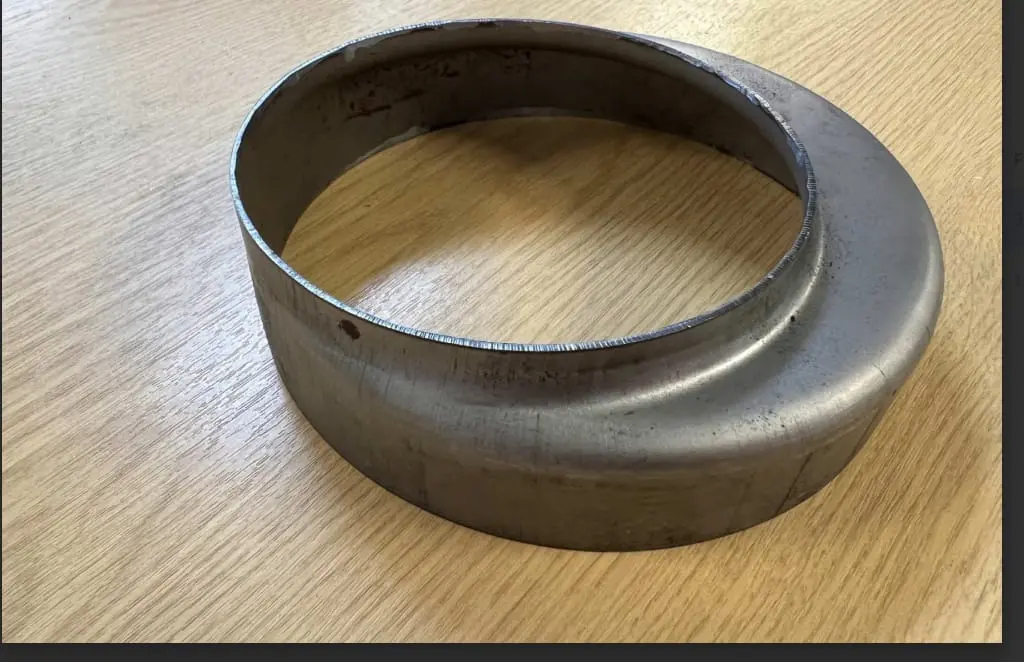
Manufyn delivered a geometrically precise eccentric reducer in DC01 steel within 48 hours — no dies, no press tooling, no compromise on tolerance.
Project Context
A piping systems integrator needed a custom transition component bridging 148 mm and 116 mm diameter pipes within a tight 40 mm height envelope. The design demanded a 16 mm eccentric offset with a strict Flat Side on Top configuration — essential for preventing air entrapment and cavitation in the downstream pump system. Standard off-the-shelf components couldn’t meet the geometry, and low production volume made dedicated tooling commercially unviable.
Engineering Challenges
The eccentric offset produces non-uniform wall angles across the transition body, making flat pattern development mathematically complex. Welding thin 2 mm DC01 steel introduced distortion risk that could compromise the critical flat top profile. Geometry verification was further complicated by reference centerlines that have no physical location on the part itself.
Process and Solution
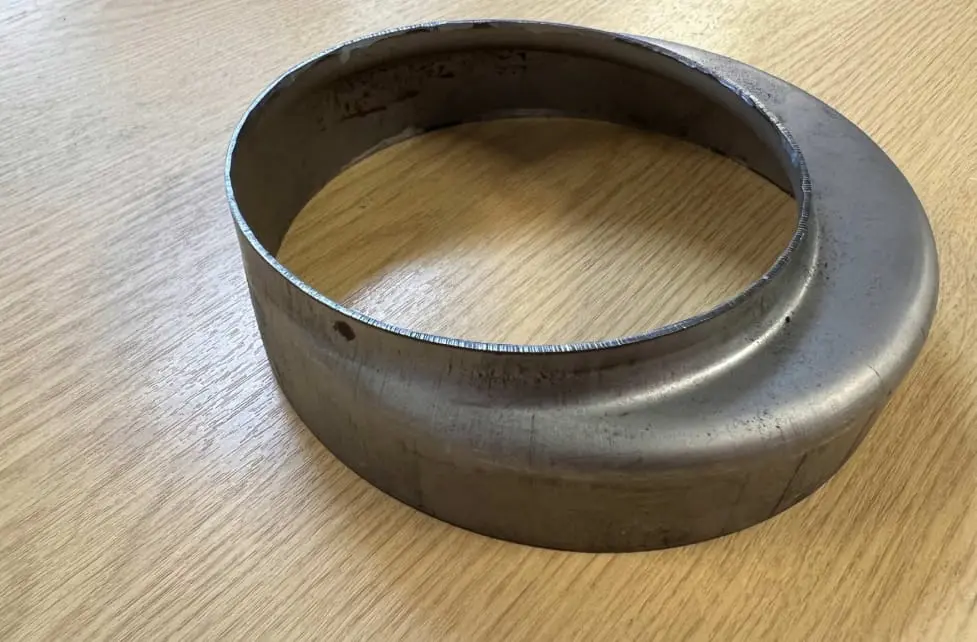
Manufyn applied a Segmented Fabrication Strategy, decomposing the complex 3D geometry into three precision 2D components. The 148 mm and 116 mm end rings were laser cut for clean, accurate edges. The transition body was developed from an unrolled flat pattern and formed on a CNC 3-roll bending machine. Pulse-TIG welding with rapid current cycling controlled heat input, minimizing thermal distortion and preserving eccentric alignment. A final 5-axis laser trimming pass machined both faces in a single 3D path, locking in the exact 40 mm height and full parallelism.
How Manufyn achieved high geometric precision for a complex piping transition using a die-less fabrication approach
Client Overview
This eccentric reducer fabrication project involved a specialized piping systems integrator requiring a custom transition component between two non-aligned pipes of 148 mm and 116 mm diameter, within a constrained 40 mm height envelope.
The design required a precise 16 mm eccentric offset to maintain a “Flat Side on Top” configuration, which is critical in piping systems to prevent air entrapment and cavitation that can damage pumps and reduce system efficiency.
Since standard components could not meet this geometry and dedicated tooling was not viable for low volumes, the client required a high-precision eccentric reducer fabrication solution in 2 mm DC01 steel.
Project Challenge
The main challenge in this eccentric reducer fabrication project was achieving precise offset geometry while maintaining strict dimensional accuracy without the use of press tooling.
Key challenges included:
- Maintaining eccentric centerline alignment, resulting in non-uniform wall angles
- Ensuring a perfectly flat top profile, critical for system performance
- Achieving accurate flat pattern development for the unrolled geometry
- Preventing distortion during welding of thin 2 mm steel components
- Verifying geometry where reference centers do not physically exist
Delivering accurate eccentric reducer fabrication without tooling required both mathematical precision and process control.
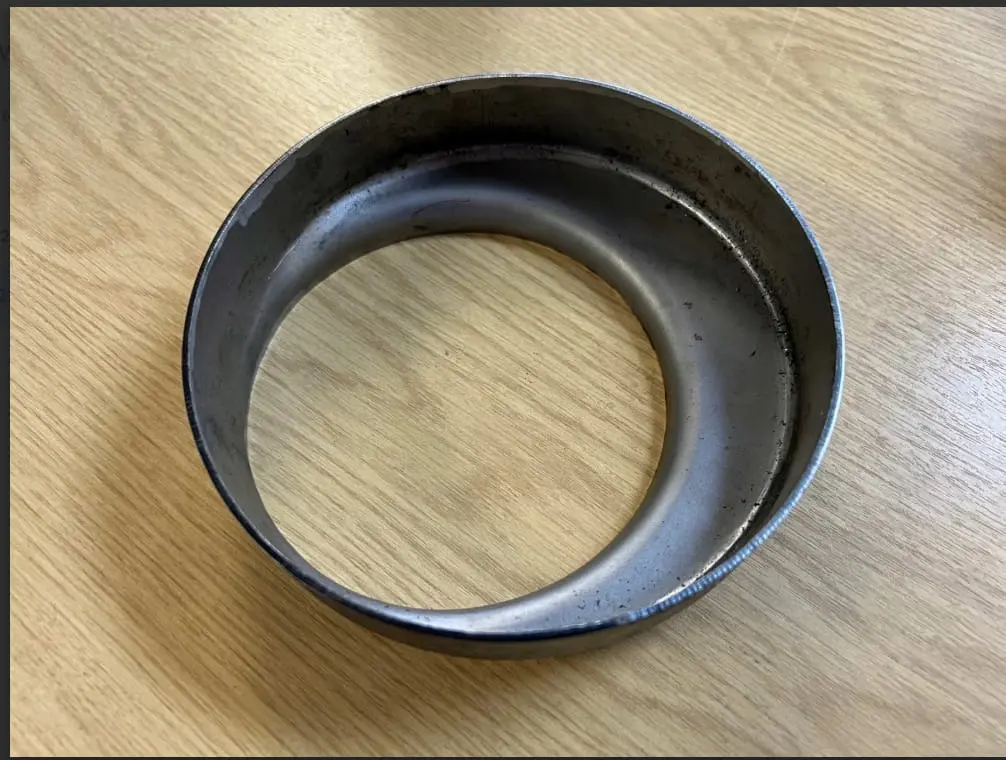
Engineering Approach for Eccentric Reducer Fabrication
Manufyn adopted a Segmented Machining and Welding Strategy to execute this eccentric reducer fabrication efficiently without relying on traditional tooling.
- The complex 3D geometry was broken into three precision-engineered 2D components
- This eliminated the need for expensive dies while maintaining tight dimensional control
- The approach achieved ≤0.5 mm tolerance across the entire geometry
- It significantly reduced cost and lead time
This method provided a flexible, scalable, and cost-effective eccentric reducer fabrication solution.
Manufacturing Process
Laser Cutting of Components
Two circular rings corresponding to 148 mm and 116 mm diameters were laser cut from DC01 steel to ensure precision and edge quality.
Rolling of the Eccentric Body
The central transition section was developed using an unrolled flat pattern and formed using a CNC 3-roll bending machine, ensuring controlled geometry.
Pulse-TIG Welding
To maintain dimensional integrity during eccentric reducer fabrication:
- Pulse-TIG welding was used to control heat input
- Rapid current pulses minimized thermal distortion
- Warping was prevented, preserving eccentric alignment
Post-Process 5-Axis Trimming
After welding:
- A 5-axis laser trimming process was performed
- Top and bottom faces were machined in a single 3D path
- Ensured exact 40 mm height and perfect parallelism
Results Achieved
The eccentric reducer fabrication approach delivered strong technical and commercial outcomes:
- Achieved ≤0.5 mm tolerance on eccentric geometry
- Maintained perfect Flat Side on Top configuration
- Eliminated need for expensive tooling
- Delivered parts within 48 hours
- Ensured seamless integration into the piping system
- Prevented air entrapment and improved system reliability
Value Delivered by Manufyn
- High-precision eccentric reducer fabrication without tooling
- Significant cost savings for low-volume custom components
- Rapid turnaround for time-sensitive industrial applications
- Strong control over geometry in complex eccentric designs
- End-to-end execution from design to final machining
Conclusion
This case study demonstrates that eccentric reducer fabrication can be executed with high precision even without dedicated tooling when supported by strong engineering and process innovation.
By combining segmented fabrication, precision welding, and 5-axis finishing, Manufyn delivered a mathematically accurate and high-performance component that met both functional and commercial requirements.
Need eccentric reducer fabrication or custom piping components with tight tolerances?
Share your drawings to explore cost-effective, tool-free fabrication solutions.
👉 Request Fabrication Feasibility Review