Technical Brief: Injection Mold Preventive Maintenance for Export Quality
Manufyn helped a global customer eliminate recurring surface defects in injection molded components destined for export. Instead of relying on reactive, post-defect correction, we implemented a structured Total Productive Maintenance (TPM) program covering daily, weekly, and monthly mold care, combined with standardized process control and strengthened quality inspection.
Key Technical Highlights:
-
Defect Prevention: Identified and eliminated surface blistering and raised bulges caused by poor mold venting, inadequate cleaning, and cooling channel contamination.
-
Root Cause Discipline: Used structured 5 Why Analysis, process audits, and mold condition assessment instead of treating the issue as an isolated molding defect.
-
Shipment Risk Reduction: Prevented customer line rejection, air freight replacement costs, and warranty claims by containing defective lots before export.
This strategy shifted mold care from reactive maintenance to source-level defect elimination, ensuring consistent export-ready quality.
Injection Mold Preventive Maintenance: TPM Case Study
Background
A global customer sourcing injection molded plastic components from India required consistent dimensional accuracy, excellent cosmetic finish, and zero-defect shipments for a circular engineering plastic ring used in an assembly where both appearance and dimensional stability were critical.
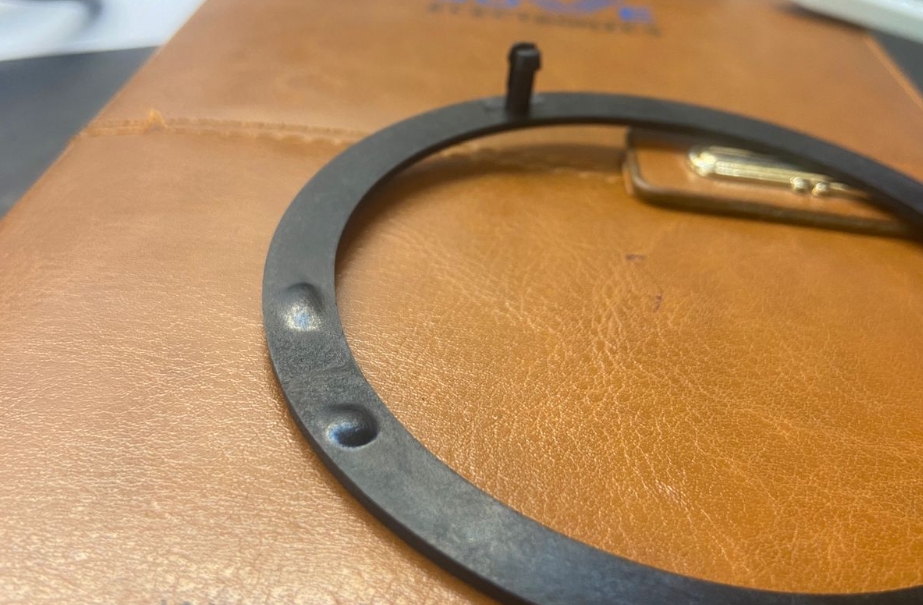
During Manufyn’s routine warehouse inspection prior to export, the Quality team identified an abnormal surface condition — localized raised bumps and surface blistering — on parts that had already passed the supplier’s in-process inspection. The defect was contained immediately, and no defective parts reached the customer.
At Manufyn, a comprehensive quality assurance and injection mold preventive maintenance system is designed to identify and eliminate root-cause mold issues before they surface as shipment-level defects, ensuring customers receive production-ready components and maintain uninterrupted manufacturing operations.
Defect Observed and Risk if Shipped
| Defect Observed | Risk if Shipped | Potential Cost Impact |
|---|---|---|
| Surface Blistering | Customer line rejection, assembly fitment issues | Sorting & containment costs across full lots |
| Raised Bulges on Molded Surface | Incoming inspection failures, production downtime | Costly air freight replacement shipments |
| Cosmetic Surface Defects | Export claim and warranty costs | Damage to supplier credibility |
| Non-Uniform Surface Finish | Increased Cost of Poor Quality (COPQ) | Assembly line stoppage under JIT production |
For customers following Lean Manufacturing and Just-in-Time (JIT) production, even a small percentage of defective parts can stop an entire assembly line.
Immediate Containment Actions
As part of Manufyn’s Quality Management System, the following actions were taken immediately upon detection:
- Complete lot segregation
- 100% visual inspection
- Defective parts quarantined
- Shipment placed on hold
- Supplier notified
- Cross-functional Root Cause Analysis initiated
Root Cause Investigation
Rather than treating the issue as an isolated molding defect, Manufyn conducted a structured Root Cause Analysis using 5 Why Analysis, process audit, mold condition assessment, injection molding parameter review, and a preventive maintenance audit. The investigation revealed that the issue was not caused by raw material alone — multiple process-related factors contributed to the defect.
| Root Cause | Finding |
|---|---|
| Poor Mold Venting | Gas trapped inside the mold cavity created localized pressure pockets, producing surface blisters. |
| Inadequate Mold Cleaning | Polymer deposits and residue partially blocked mold vents, restricting air evacuation. |
| Cooling Channel Contamination | Uneven mold temperature caused inconsistent cooling rates, leading to localized material expansion. |
| Ejector System Wear | Minor wear in the ejector system resulted in uneven pressure distribution inside the cavity. |
| Lack of Preventive Maintenance | Maintenance activities were reactive instead of preventive; no standard TPM checklist existed for periodic mold inspection. |
How Manufyn Implemented Injection Mold Preventive Maintenance
Instead of only correcting the defective batch, Manufyn introduced a structured Total Productive Maintenance (TPM) program for injection molds, designed to eliminate defects at the source.
Daily Activities
- Mold surface cleaning
- Vent cleaning
- Cooling channel inspection
- Water leakage check
- Ejector pin cleaning
- Lubrication of guide pillars and bushes
- Visual inspection for wear
Weekly Activities
- Mold cavity polishing
- Core inspection
- Alignment verification
- Parting line inspection
- Runner cleaning
- Hot runner inspection (where applicable)
Monthly Preventive Maintenance
- Complete mold dismantling
- Vent depth measurement
- Cooling efficiency verification
- Wear measurement
- Component replacement based on preventive schedule
- Fastener torque verification
- Maintenance history recording
Process Standardization
Alongside TPM, the molding process was standardized by controlling material drying conditions, barrel temperature, mold temperature, injection pressure, packing pressure, holding time, cooling time, and cycle time. Standard process sheets were introduced to prevent operator variation.
Quality Control Enhancements
- First Article Inspection (FAI)
- In-process quality checks
- Warehouse quality inspection
- Surface finish inspection against visual defect standards
- Sampling as per AQL
- Mold health checklist
- Traceability records
Results: Before vs After TPM Implementation
| Before TPM | After TPM |
|---|---|
| Reactive maintenance | Preventive maintenance |
| Surface blister defects | Defects eliminated |
| Inconsistent mold condition | Standardized mold condition |
| Emergency breakdowns | Planned maintenance |
| High inspection effort | Stable production process |
| Variable product quality | Consistent product quality |
| Customer risk | Reliable export shipments |
Customer Benefits
| Benefit Area | Result Delivered |
|---|---|
| Surface & dimensional quality | ✅ Improved surface finish and consistent dimensional accuracy |
| Process capability | ✅ Reduced molding defects, higher process capability |
| Tooling economics | ✅ Longer mold life, lower maintenance costs, reduced scrap generation |
| Production stability | ✅ Stable production, better delivery performance |
| Customer impact | ✅ Zero customer line stoppages, reliable export quality |
Conclusion
Injection molding defects such as surface blistering, gas trap marks, and inconsistent surface finish often originate from poor mold health rather than machine settings alone. Routine inspection alone cannot eliminate recurring defects — sustainable quality is achieved only through systematic mold maintenance, standardized processing, and preventive quality systems.
By implementing injection mold preventive maintenance through a structured TPM program, Manufyn transformed an isolated quality issue into a long-term process improvement, ensuring future production remained stable, defect-free, and export-ready.
At Manufyn, we believe quality is created during manufacturing — not just verified before shipment. Our team works closely with manufacturing partners to strengthen processes through Root Cause Analysis (RCA), Total Productive Maintenance (TPM), APQP and PPAP support, process audits, and continuous improvement initiatives, helping global customers receive defect-free injection molded components and build a resilient supply chain.
Want to eliminate recurring mold defects from your export shipments? Share your part drawings or quality requirements to get started.