Technical Brief: Heated Food Delivery Box — Concept to Market-Ready Product
Manufyn’s NPI team engineered a thermostat-controlled heated delivery box from a blank-slate concept, integrating thermal, electrical, and structural systems into a single production-ready product.
Project Context
A client with a clear product vision but no technical drawings, engineering specs, or manufacturing plan approached Manufyn to build an actively heated food delivery box for urban scooter-based delivery. The product needed to maintain safe food temperatures throughout transit while surviving vibration, weather exposure, and daily operational abuse.
Engineering Challenges
With no existing technical inputs, every system had to be architected from scratch. The core thermal problem required retaining high internal temperatures while keeping the exterior safe to touch — without active airflow. Integrating a heating coil, battery, and thermostat into a compact, vibration-exposed structure added electromechanical complexity. Ensuring uniform heat distribution and long-term electrical reliability under dynamic load conditions compounded the design challenge further.
Process and Solution
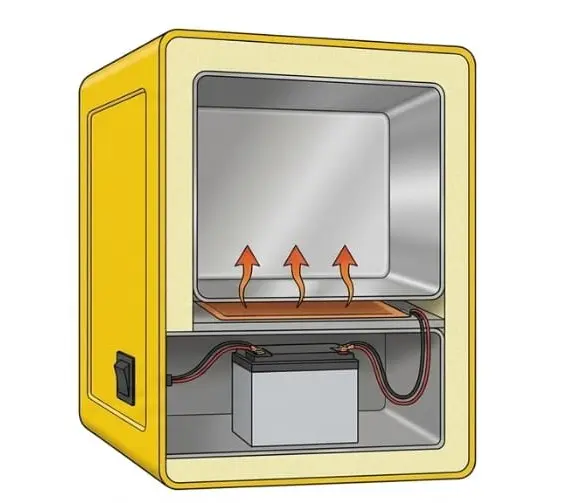
Manufyn developed a triple-layer thermal sandwich structure: an outer FRP shell for impact resistance, a rigid PIR foam core for insulation, and a food-grade 304 stainless steel inner chamber for heat retention and hygiene. The heating coil was base-mounted to harness natural convection — heat rises evenly from bottom to top, eliminating cold spots without fans. Battery and thermostat modules were mounted on vibration-resistant supports with high-fatigue fasteners and secured wiring to ensure electrical integrity over continuous real-world use. Each unit completed electrical safety checks, thermal performance validation, and weatherproofing testing before dispatch.
How Manufyn engineered a thermostat-controlled delivery box from concept to market-ready product
Client Overview
This heated food delivery box development project began with a client who had a strong product vision but no technical design, engineering drawings, or manufacturing plan. The goal was to create a delivery box capable of actively heating food during transport while being robust enough for real-world urban usage.
Manufyn’s NPI (New Product Introduction) team took full ownership of this heated food delivery box development, transforming a conceptual idea into a fully engineered, production-ready product.
Project Challenge
The core challenge in this heated food delivery box development project was engineering a system that could maintain high internal temperatures while ensuring safety, durability, and energy efficiency.
Key challenges included:
- Designing a multi-layer thermal insulation system to retain heat while keeping the exterior safe to touch
- Integrating a heating coil and battery system within a compact structure
- Ensuring uniform heat distribution without active airflow systems
- Designing for dynamic load conditions, including vibrations, shocks, and weather exposure
- Developing the entire product architecture from scratch without existing technical inputs
This required combining thermal engineering, electrical integration, and mechanical design into a single system.
Engineering Approach for Heated Food Delivery Box Development
Manufyn adopted a system integration approach to execute this heated food delivery box development, focusing on building a controlled thermal environment rather than just a physical container.
Hybrid Material Architecture
A triple-layer “thermal sandwich” structure was developed:
- Outer Layer: FRP (Fiber Reinforced Plastic) for strength and lightweight durability
- Core Layer: Rigid PIR foam for high thermal insulation
- Inner Layer: 304 Stainless Steel for food safety and heat retention
This architecture ensured optimal balance between thermal performance, structural rigidity, and usability.
Thermodynamic Layout
The heating coil was strategically positioned at the base of the stainless steel chamber to utilize natural convection:
- Heat rises evenly from bottom to top
- Eliminates cold spots
- Avoids need for fans or blowers
This improved energy efficiency and simplified system design.
Vibration-Resistant Engineering
Since the box is used on delivery scooters:
- Battery and thermostat modules were mounted using vibration-resistant supports
- High-fatigue fasteners and reinforced mounting points were used
- Electrical wiring was secured to prevent loosening over time
This ensured durability under real-world delivery conditions.
Development and Manufacturing Process
Concept to CAD Translation
The client’s idea was converted into a detailed 3D CAD model, including internal layout, insulation thickness, and battery placement.
Material Selection and Sourcing
A carefully selected material stack was used:
- High-gloss FRP for outer durability
- PIR foam for insulation
- Food-grade stainless steel for internal surfaces
Electromechanical Integration
The heating system was engineered with:
- Base-mounted heating coil
- Thermostat for temperature regulation
- Integrated wiring system for controlled operation
Fabrication and Assembly
The product was manufactured through:
- Bonding of triple-layer panels
- Precision wiring and electrical integration
- Structural assembly of all components
Quality Assurance and Testing
Each unit underwent:
- Electrical safety checks
- Thermal performance validation
- Structural integrity testing for vibration resistance
- Weatherproofing validation
Results Achieved
This heated food delivery box development project successfully delivered a market-ready solution:
- Fully functional, thermostat-controlled heated delivery box
- Efficient thermal insulation with cool external surface
- Uniform heat distribution across food storage chamber
- Durable design suitable for real-world delivery conditions
- Complete transformation from concept to production-ready product
Value Delivered by Manufyn
- End-to-end heated food delivery box development from concept to execution
- Integration of thermal, electrical, and structural engineering
- Rapid product development through NPI expertise
- Scalable design ready for commercial deployment
- Reduced development risk through structured engineering approach
Conclusion
This case study highlights Manufyn’s strength in heated food delivery box development, where multidisciplinary engineering is required to convert ideas into real-world products. By combining material science, thermodynamics, and electromechanical integration, Manufyn delivered a durable, efficient, and market-ready solution.
Building a new product or working on heated food delivery box development?
Share your concept to evaluate feasibility, prototyping, and manufacturing pathways.