Manufyn manufactures polycarbonate parts in-house — molding, machining & printing
Polycarbonate (PC) is a transparent, extremely impact-resistant engineering thermoplastic used for injection molding, CNC machining, 3D printing, and thermoforming. It is roughly 250 times more impact-resistant than glass while transmitting nearly 90% of light — which is why polycarbonate is the material of safety glazing, headlamp lenses, machine guards, and electronics housings that cannot be allowed to break.
This polycarbonate material guide covers everything an engineer or buyer needs before specifying PC:
- Exact properties — impact strength, optical clarity, temperature limits
- The seven grades available and when each is required
- Which manufacturing process suits which application
- How polycarbonate compares with acrylic, ABS, PETG, and nylon
- What polycarbonate parts actually cost — and how to reduce it
At Manufyn, we manufacture polycarbonate parts in-house — plastic injection molding, CNC machining, and 3D printing — with a free DFM review on every quote and dispatch to 30+ countries.
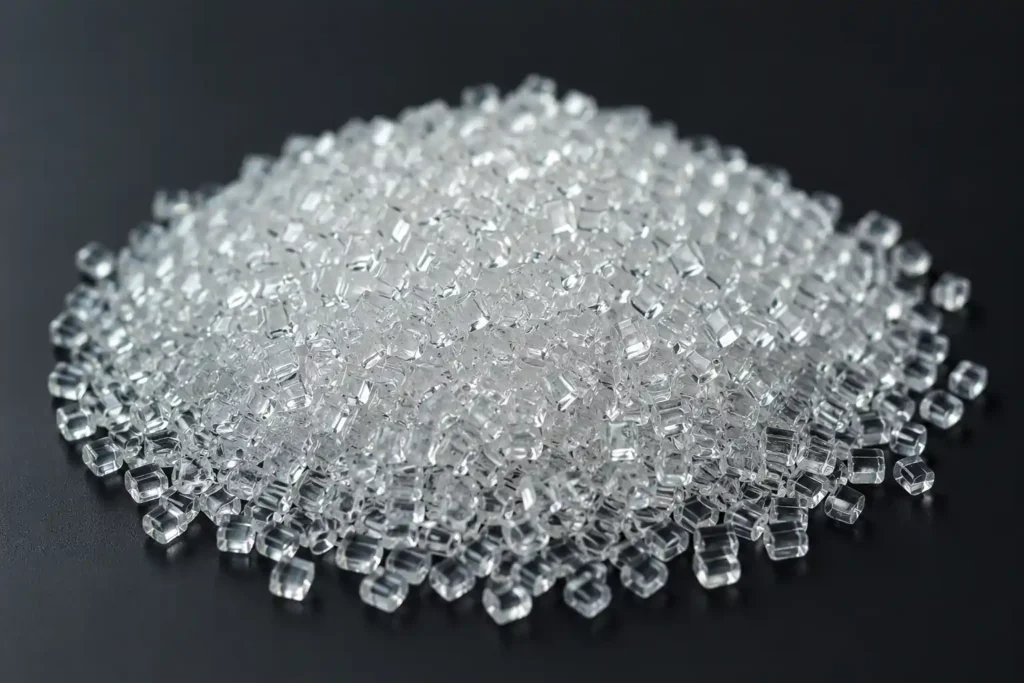
What Is Polycarbonate Made Of?
Polycarbonate is a polymer whose backbone is built from carbonate groups (–O–CO–O–) linked to bisphenol-A (BPA) units. That molecular structure explains everything about how PC behaves:
- The rigid bisphenol-A rings — give polycarbonate its high stiffness, heat resistance, and dimensional stability up to ~130 °C
- The flexible carbonate linkages — let the chains absorb enormous impact energy instead of fracturing; this is why PC is the standard for “unbreakable” applications
- The amorphous structure — no crystalline regions to scatter light, which is why polycarbonate is glass-clear straight out of the mold
One practical consequence engineers must know: polycarbonate is hygroscopic in the melt phase. Resin must be dried to below 0.02% moisture before molding, or the trapped water hydrolyses the carbonate bonds and produces brittle, splay-marked parts. This is a processing discipline issue — a reason to choose a manufacturer that controls drying in-house.
What Are the Properties of Polycarbonate?
Polycarbonate combines three properties that rarely coexist in one plastic: extreme impact resistance, optical transparency, and high heat tolerance. The table below gives typical values for general-purpose injection molding grade PC.
Polycarbonate Property Table
| Property | Typical Value | What It Means in Practice |
|---|---|---|
| Density | 1.20–1.22 g/cm³ | Less than half the weight of glass at equal thickness |
| Tensile strength | 55–75 MPa | Noticeably stronger than ABS (40–50 MPa) — suitable for load-bearing housings |
| Izod impact (notched) | 600–850 J/m | The headline property — 2–3× ABS, ~30× acrylic, ~250× glass |
| Light transmission | 88–90% | Glass-clear — usable for lenses, glazing, light guides |
| Glass transition temp (Tg) | ~147 °C | Far above ABS (~105 °C) — survives hot environments |
| Heat deflection temp (HDT) | ~130–140 °C | Continuous-use ceiling of roughly 115–120 °C |
| Processing (“melting”) temp | 280–320 °C | PC is amorphous — no sharp melting point; this high window demands proper equipment and dried resin |
| Mold shrinkage | 0.5–0.7% | Low and uniform — excellent for tight-tolerance molded parts |
| Water absorption (24 h) | 0.15–0.35% | Dimensionally stable in service (drying only matters before molding) |
| Flammability | UL94 V-2 (native), V-0 grades available | Better native flame behavior than ABS; FR grades pass strict tests |
Because polycarbonate is amorphous, it has no true melting point — engineers searching “polycarbonate melting point” are really asking for the 280–320 °C processing window above, and the ~147 °C glass transition temperature that defines its service limit. That 45 °C service advantage over ABS is the single most common reason parts get upgraded from ABS to PC.
Which Polycarbonate Grades Are Available?
Selecting the right polycarbonate grade matters more than selecting PC itself. The wrong grade fails certification (flame tests, biocompatibility, optical specs) even when the geometry is perfect.
Polycarbonate Grade Selection Guide
| Grade | Key Trait | Choose It For |
|---|---|---|
| General purpose (GP-PC) | Clear, tough, balanced flow | Covers, housings, guards, glazing — the default |
| Glass-filled (10–40% GF) | Stiffness up to 3×, lower creep | Structural brackets, pump housings, precision frames (opaque) |
| Flame retardant (FR-PC, UL94 V-0) | Passes vertical burn at thin walls | Electrical enclosures, EV battery components, chargers |
| Optical / lens grade | Highest clarity, controlled flow | LED optics, light guides, camera and headlamp lenses |
| Medical grade (ISO 10993 / USP Class VI) | Biocompatible, sterilisable | Device housings, IV connectors, diagnostic components |
| UV-stabilised / weatherable | Co-extruded UV cap or additive | Outdoor glazing, greenhouse panels, signage |
| PC-ABS blend | PC toughness + ABS processability at lower cost | Laptop housings, automotive interior structure |
Not sure which grade your drawing needs? Manufyn’s engineers confirm the grade against your certification requirements before quoting. See how we handled material and process selection for a global medical startup’s injection molded assembly in record time.
Unsure which polycarbonate grade your part needs?
Send your CAD — Manufyn confirms grade, flame rating, optical spec, and compliance before quoting.
How Is Polycarbonate Manufactured into Parts?
Polycarbonate performs across all four mainstream plastic manufacturing processes, but it is more demanding than ABS in every one of them — high melt temperatures, mandatory drying, and notch sensitivity all reward manufacturers with process discipline.
Polycarbonate Injection Molding — for Production Volumes
Injection molding is how most polycarbonate parts are made — from LED lenses weighing under a gram to full equipment enclosures. PC molds at 280–320 °C with mold temperatures of 80–120 °C, and its low 0.5–0.7% shrinkage holds tight tolerances shot after shot. Resin must be dried to below 0.02% moisture or parts come out brittle. Manufyn’s in-house plastic injection molding covers drying, tooling, molding, and finishing under one roof — see the injection molding design guide for process fundamentals.
CNC Machining Polycarbonate — for Precision One-Offs and Clear Prototypes
Polycarbonate machines beautifully — it cuts without chipping (unlike acrylic, which cracks), holds tolerances of ±0.05 mm, and can be polished back to optical clarity. CNC is the best route for clear functional prototypes, machine guards cut from sheet, and low-volume precision housings. Feeds, speeds, and workholding for PC are covered in the CNC machining plastics guide. For a precision example, see this medical device prototype produced on 5-axis machining.
Polycarbonate 3D Printing — for Tough Functional Prototypes
PC is one of the strongest FDM printing materials available — printed parts approach the toughness of molded ones, which makes it the choice for prototypes that will be load-tested, drilled, and abused. It demands a high-temperature printer (nozzle 290–310 °C, chamber heating) — a machine-capability question, not a design one. For technology selection, see Manufyn’s 3D printing guides. Manufyn’s rapid prototyping service delivers printed, machined, or molded polycarbonate prototypes in 5–10 days — quote in 24 hours, no minimum order.
Thermoforming Polycarbonate Sheet — for Large Transparent Panels
PC sheet thermoforms into deep, complex shapes without losing clarity — which is why machine guards, aircraft interior panels, skylights, and equipment canopies are so often polycarbonate. When a part is large, transparent, and needed in low-to-mid volumes, thermoforming beats injection molding on tooling cost by an order of magnitude.
Ready to prototype or produce in polycarbonate?
Printed, machined, or molded PC parts in 5–10 days. Quote in 24 hours. No minimum order.
Polycarbonate vs Acrylic, ABS, PETG, and Nylon — Which Should You Choose?
The most common shortlist decision is polycarbonate vs acrylic for transparent parts, and polycarbonate vs ABS for housings. The table settles both — plus the PETG and nylon questions that follow.
Polycarbonate Comparison Table
| Criterion | Polycarbonate | Acrylic (PMMA) | ABS | PETG | Nylon |
|---|---|---|---|---|---|
| Impact resistance | Excellent — near unbreakable | Poor — cracks and shatters | Very good | Good | Excellent |
| Optical clarity | 88–90%, glass-clear | 92% — the clearest plastic | Opaque | ~90%, clear | Opaque |
| Max service temp | ~115–120 °C | ~80 °C | ~85 °C | ~70 °C | ~100 °C+ |
| Scratch resistance | Poor — needs hard coating | Good | Fair | Fair | Good |
| UV / outdoor | Fair — UV grades required | Excellent — inherently UV stable | Poor (yellows) | Good | Fair |
| Choose it when… | Safety-critical, high heat, cannot break | Display clarity, outdoor signage | Indoor housings, cost-driven parts | Outdoor + food-adjacent parts | Wear parts, gears, hinges |
Rule of thumb: if the transparent part can hurt someone or shut down a line when it breaks — polycarbonate. If it just needs to look perfect and live outdoors — acrylic. If the housing never exceeds 80 °C and cost matters — ABS. If it slides, wears, or flexes millions of cycles — nylon.
For the full plastic-and-metal selection framework, see Manufyn’s prototyping material guide.
Design Guidelines for Polycarbonate Parts
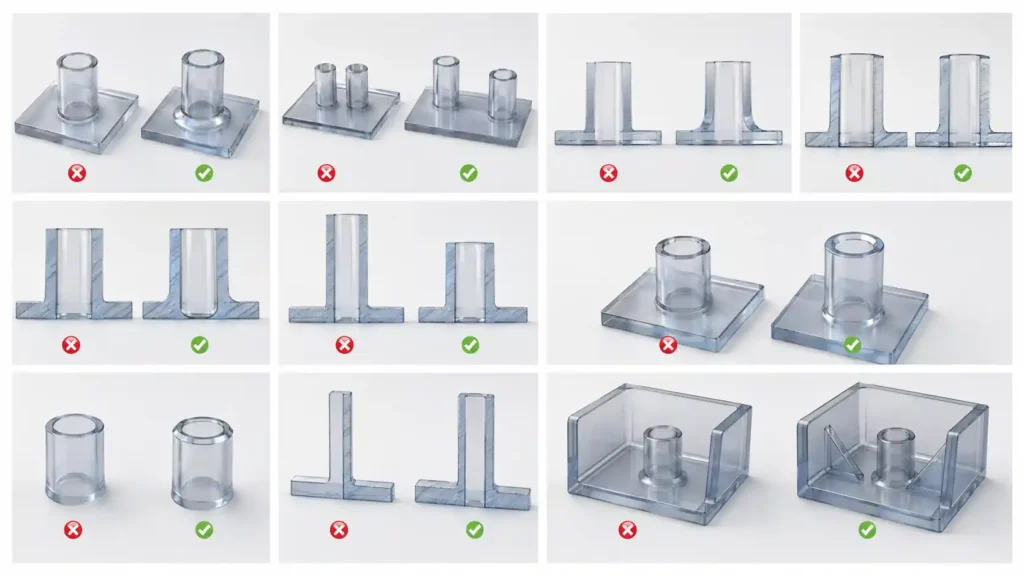
Polycarbonate is tough in service but unforgiving of design shortcuts — its one weakness is notch sensitivity, and every rule below exists to protect against it:
- Wall thickness 1.0–3.8 mm, kept uniform — PC’s higher melt viscosity resists thin-wall filling more than ABS; see the wall thickness design guide
- Radius every internal corner at ≥ 0.5× wall thickness — the most important PC rule. Sharp corners are notches, and notched polycarbonate loses most of its legendary impact strength
- Draft angle 1–2° per side (more on polished optical surfaces) so parts eject without drag marks — rules in the draft angles guide
- Design for 0.5–0.7% shrinkage — low and uniform, but it must be in the tool dimensions; see shrinkage rates
- Ribs at 50–60% of wall thickness with generous root radii — covered in ribs and bosses design
- Avoid molded-in stress near chemicals — PC stress-cracks when residual molding stress meets oils, greases, or cleaning agents; annealing or gate relocation solves it at the design stage, not after failure
Have a drawing ready?
Send it to Manufyn’s engineers for a free DFM review — we flag sharp corners, wall issues, and stress-crack risks before tooling is cut, and respond within 4 hours.
What Is Polycarbonate Used For? Applications by Industry
Wherever a part must be transparent, survive impact, or run hot, polycarbonate is usually the answer. Across the industries Manufyn serves, the most common PC applications are:
Polycarbonate Applications by Industry
| Industry | Typical Polycarbonate Parts |
|---|---|
| Automotive | Headlamp and fog lamp lenses, instrument cluster covers, panoramic glazing, EV charge-port covers |
| Electronics & electrical | LED optics and light guides, charger housings, DIN-rail enclosures, connector bodies (FR grades) |
| Medical | Device housings, IV and luer connectors, dialysis components, diagnostic cartridges (medical grades) |
| Industrial & machinery | Machine guards, safety windows, sight glasses, control panel covers |
| Construction | Skylights, greenhouse panels, multiwall roofing sheet, security glazing |
| Safety & defense | Face shields, riot shields, bullet-resistant laminates, helmet visors |
Manufyn examples: precision components for a critical medical device developed via 5-axis machining, and enclosure development for consumer electronics and IoT devices.
Is Polycarbonate Safe? (The Honest Limitations)
No material guide is complete without the drawbacks. Polycarbonate has four you must design around:
- It scratches easily. PC is soft-surfaced despite its toughness. Lenses, visors, and glazing need a hard coating (siloxane or UV-cured) — specify it on the drawing, because it adds cost and lead time.
- BPA and food contact. Polycarbonate is made from bisphenol-A. Cured PC is stable, but regulatory pressure has removed it from baby bottles and most food-contact roles. For food or drinking-water parts, use PETG or Tritan-type copolyesters instead — or specify a certified food-contact PC grade and confirm the target market’s regulations.
- Chemical and stress-cracking sensitivity. Ketones, aromatic solvents, strong alkalis, and even some greases attack PC — especially where molded-in stress exists. Chemical exposure must be declared at the quoting stage.
- UV yellowing without protection. Native PC yellows outdoors over years. Outdoor parts need UV-stabilised or co-extruded-cap grades — standard practice in glazing, but it must be specified.
On sustainability: polycarbonate is recyclable (resin code 7) and mechanically reprocessable as industrial regrind at controlled percentages. Chemical recycling of PC back to monomer is commercially emerging. It is not biodegradable.
How Much Does Polycarbonate Cost?
Polycarbonate resin trades at roughly USD 2.50–4.00 per kg for general-purpose grade — about 2× ABS. Optical, medical, and flame-retardant grades run higher still. And PC parts carry process premiums ABS parts don’t: mandatory resin drying, higher melt temperatures, hard-coating for optical surfaces. The full cost logic of molding vs printing is broken down in our guide to injection molding vs 3D printing cost.
This is exactly where sourcing from India changes the math: Manufyn’s in-house tooling and molding typically deliver 40–60% savings against US, UK, and EU suppliers at identical ISO 9001 quality — the economics are detailed in the plastic injection parts guide.
Get Your Polycarbonate Parts Quoted in 24 Hours
Manufyn is India’s ISO 9001 certified in-house manufacturer for polycarbonate parts. We confirm:
Grade & compliance (UL94, optical, medical)
Process fit — molding, machining, printing, thermoforming
Corner radii & stress-crack DFM
Hard-coating & UV protection needs
40–60% cost savings vs US/UK/EU suppliers
Frequently asked questions
What is polycarbonate in simple terms?
Polycarbonate (PC) is a transparent plastic that is extremely hard to break — roughly 250 times more impact-resistant than glass at half the weight. It is the material of headlamp lenses, machine guards, face shields, and electronics housings that must survive abuse.
What is the melting point of polycarbonate?
Polycarbonate has no sharp melting point because it is amorphous. It softens above its ~147 °C glass transition temperature and is processed (molded or printed) at 280–320 °C. Its practical continuous-use limit is about 115–120 °C.
What is the difference between polycarbonate and acrylic (plexiglass)?
Both are clear plastics, but they trade opposite strengths: polycarbonate is vastly more impact-resistant and heat-tolerant, while acrylic is slightly clearer, more scratch-resistant, more UV-stable, and cheaper. Choose polycarbonate when breakage is dangerous; choose acrylic for display clarity and outdoor signage.
Is polycarbonate safe? Does it contain BPA?
Polycarbonate is made from bisphenol-A, and cured PC is stable in normal use — it remains standard in medical devices and electronics. For food or drinking-water contact, however, most brands have moved to BPA-free alternatives like PETG or copolyesters; if PC must be used, specify a certified food-contact grade and confirm your market’s regulations.
Is polycarbonate bulletproof?
A single sheet of polycarbonate is not bulletproof, but laminated multi-layer polycarbonate is the basis of most bullet-resistant glazing (rated to UL 752 levels). Monolithic PC sheet from about 9–12 mm resists hammers, thrown objects, and forced entry — which is why it is used for riot shields and security glazing.
Does polycarbonate scratch easily?
Yes — scratch resistance is polycarbonate’s main optical weakness. Lenses, visors, and glazing are almost always hard-coated (siloxane or UV-cured coatings), which brings abrasion resistance close to glass. Specify the coating on the drawing; it adds cost and lead time.
Can polycarbonate be used outdoors?
Yes, but only UV-stabilised or co-extruded UV-capped grades. Unprotected polycarbonate yellows and loses impact strength after years of sun exposure. Outdoor glazing and greenhouse sheet are sold with a UV cap layer as standard — molded outdoor parts need a UV-stabilised resin grade.
Is polycarbonate stronger than ABS?
Yes on every structural measure: roughly 2–3× the impact strength, ~50% higher tensile strength, and a ~35 °C higher service temperature. ABS wins on cost, scratch behavior, and ease of processing — which is why PC-ABS blends exist to split the difference.
What tolerances can polycarbonate parts hold?
Injection molded polycarbonate typically holds ±0.05–0.1 mm on small features thanks to its low 0.5–0.7% shrinkage. CNC-machined PC holds ±0.05 mm or tighter and can be polished to optical clarity. FDM-printed PC is looser — typically ±0.2–0.5 mm — suitable for functional prototypes.
What is the minimum order for polycarbonate parts from Manufyn?
There is no minimum order. Manufyn quotes polycarbonate parts from a single machined or 3D-printed prototype up to million-piece injection molding runs, with a quote returned in 24 hours.