
4 Axis CNC Machining Services for Multi-Sided Precision Parts
Manufyn connects global engineering and procurement teams with qualified Indian manufacturers for custom 4-axis milled components — from prototypes and low-volume production to recurring manufacturing programs.
When 3-Axis Machining Is Not Enough
Some components have features distributed around multiple faces, angled surfaces, radial details or machining requirements that make repeated repositioning inefficient.
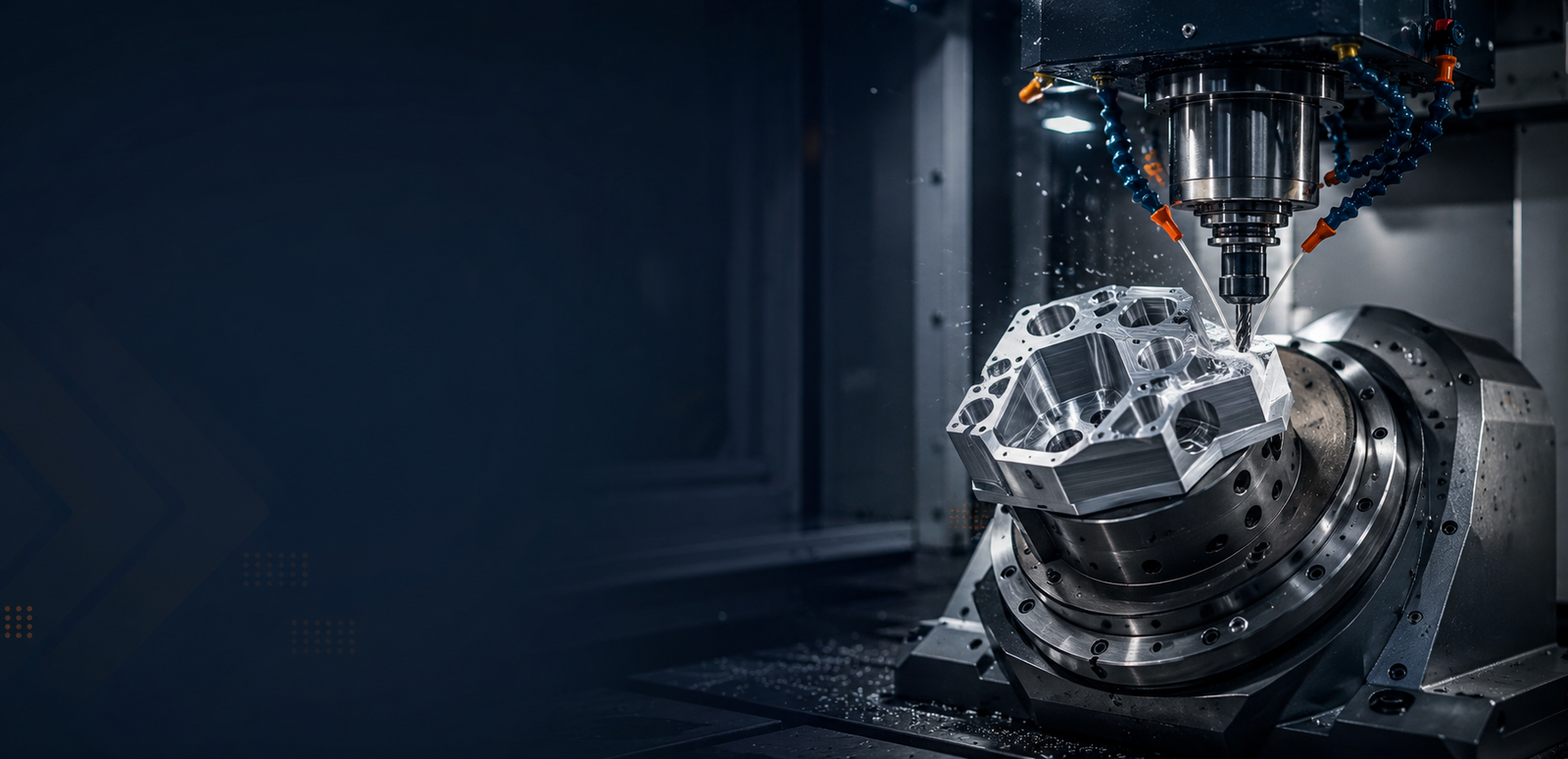
A fourth rotary axis gives the machining process additional access to the component. Instead of treating every face as a separate operation, the part can be rotated or indexed to expose additional machining surfaces.
The result can be fewer workholding changes, better positional consistency and a more efficient production route — particularly for multi-sided components.
What makes the fourth axis useful?
The fourth axis adds rotary movement to the conventional X, Y and Z linear axes. Depending on the machine and programming strategy, the rotary axis can be used for indexed machining or continuous rotary operations.
This makes the process especially useful when features need to be accessed around the circumference or across multiple faces of a component.
The right manufacturing route still depends on geometry, tolerance, material, quantity and required surface finish. For more complex simultaneous tool orientation, 5-axis machining may be the better solution.
4 Axis CNC Milling Capabilities
A practical machining route for components that require more access than conventional 3-axis milling but do not necessarily require full 5-axis movement.
Multi-Sided Machining
Machine features across multiple faces while reducing unnecessary workholding changes and manual repositioning.
Rotary Features
Suitable for components containing radial holes, slots, patterns and features distributed around a central axis.
Angled Features
Additional rotary positioning can provide improved access to angled surfaces and features that are difficult to reach from a fixed orientation.
Reduced Setups
Fewer setups can simplify the manufacturing process and reduce the opportunity for accumulated repositioning errors.
Prototype Production
Useful for engineering prototypes where several faces require machining without committing to more complex manufacturing equipment.
Repeat Production
Suitable for recurring production where a stable machining strategy can improve consistency across batches.
Why Choose a 4-Axis Process?
The objective is not simply to use more machine axes. It is to select the simplest process that delivers the required geometry, accuracy and production economics.
Fewer Workholding Changes
Rotary access can reduce the number of times a component has to be removed and repositioned.
Better Positional Consistency
Reducing manual repositioning can help maintain relationships between features on different faces.
Efficient Feature Access
Rotary positioning can make difficult-to-access features easier to reach with the cutting tool.
Potentially Lower Setup Cost
For the right component, fewer setups can reduce handling and setup time compared with repeated conventional machining operations.
3-Axis vs 4-Axis vs 5-Axis CNC Machining
Choosing the right machine starts with the geometry — not the number of axes.
| Capability | 3-Axis | 4-Axis | 5-Axis |
|---|---|---|---|
| Linear movement | X, Y, Z | X, Y, Z | X, Y, Z |
| Rotary movement | None | One rotary axis | Two rotary axes |
| Best suited for | Prismatic parts | Multi-sided parts | Complex 3D geometry |
| Typical advantage | Cost-effective | Better multi-face access | Maximum tool access |
| Setup reduction | Limited | Good for suitable parts | Excellent for complex geometry |
| Relative complexity | Low | Moderate | High |
For a deeper explanation of CNC process selection, see our CNC machining process guide and 5-axis CNC machining guide .
Applications for Multi-Sided CNC Components
4-axis machining can be valuable wherever a component combines multiple machined faces, rotary features or angled access requirements.
Robotics
Robot brackets, mounting components, actuator housings, structural parts and precision mechanical components.
Industrial Equipment
Machine components, fixtures, housings, brackets, manifolds and custom equipment parts.
Automotive
Prototype components, brackets, housings, fixtures and production engineering parts.
Aerospace & Defence
Complex structural and mechanical components where controlled machining access and dimensional accuracy matter.
Medical Devices
Precision components and functional prototypes requiring controlled machining and inspection.
Electronics
Enclosures, mounts, heat-management components, fixtures and mechanical interfaces.
Energy
Machined components for equipment, assemblies, fixtures and industrial applications.
Precision Engineering
Custom components requiring multiple machining orientations and controlled production processes.
Materials We Can Source for CNC Machining
Material selection should be based on strength, weight, corrosion resistance, temperature, wear, machinability and application requirements.
Explore our CNC machining for metals guide or view our aluminum CNC machining services , stainless steel CNC machining , brass CNC machining and copper CNC machining .
Engineering Review Before Production
A good machining process starts before the machine is switched on.
Drawing Review
We review dimensions, tolerances, datums, threads, surface requirements and critical features before quotation.
DFM Assessment
Geometry, tool access, workholding, feature depth and machining strategy are considered to identify avoidable manufacturing problems.
Process Selection
The component is evaluated against 3-axis, 4-axis, 5-axis, turning, mill-turn and secondary processes.
Quality Planning
Inspection requirements are considered alongside the manufacturing process rather than after machining is complete.
Read our Design for Manufacturability guide , high-precision CNC design rules , GD&T guide and hole & thread design guide .
From CAD File to Delivered Parts
Manufyn coordinates the manufacturing journey so global buyers have one point of contact from RFQ through delivery.
RFQ
CAD, drawings and quantity reviewed.
DFM
Manufacturing feasibility evaluated.
Supplier
Suitable manufacturing partner selected.
Machining
Parts produced to approved specifications.
Inspection
Critical requirements verified.
Delivery
Parts packed and shipped globally.
See the complete CNC machining workflow and learn about CNC toolpath optimization .
Quality Control for Production Parts
Precision machining is only valuable when the delivered component meets the engineering requirement.
Dimensional Verification
Critical dimensions and tolerances can be checked against approved drawings and inspection requirements.
Visual & Surface Inspection
Parts can be reviewed for machining marks, burrs, surface condition and workmanship.
First Article Inspection
For suitable projects, first article inspection can help validate the manufacturing process before production scaling.
Supplier Quality Oversight
Manufyn coordinates manufacturing partners, quality requirements and production communication for global buyers.
Learn more about First Article Inspection and ISO 9001 certified manufacturing in India .
Explore Related CNC Manufacturing Capabilities
Not sure which process fits your component? Start with the geometry and production requirement.
More Than a Machine Shop Connection
For overseas buyers, selecting a capable CNC manufacturer is only one part of the procurement challenge.
Manufyn can coordinate supplier selection, RFQ management, manufacturing follow-up, quality oversight and international procurement — helping engineering and purchasing teams source from India without having to manage every manufacturing activity themselves.
Built for Global Procurement Teams
Our manufacturing network supports prototype development, low-volume manufacturing and recurring production requirements.
For broader sourcing requirements, explore Sourcing from India , Procurement Support and our India Purchasing Office services.
4 Axis CNC Machining FAQs
What is 4 axis CNC machining?
4 axis CNC machining adds a rotary axis to the conventional X, Y and Z movements of a CNC machine. This allows a component to be rotated or indexed so additional surfaces and features can be machined with improved access.
What is the difference between 3-axis and 4-axis CNC machining?
A 3-axis machine primarily moves along X, Y and Z. A 4-axis machine adds rotary movement, making it particularly useful for multi-sided parts, radial features and components that would otherwise require additional workholding setups.
Is 4 axis CNC machining better than 5 axis?
Not necessarily. The best process depends on the component. 4-axis machining can be more economical when the geometry mainly requires rotary access, while 5-axis machining is useful when complex surfaces or multiple tool orientations require additional rotary movement.
What parts are suitable for 4 axis CNC machining?
Typical applications include multi-sided brackets, housings, fixtures, plates, radial components, industrial components, robotics parts and other engineered parts where several faces require machining.
Can Manufyn manufacture prototype and production parts?
Yes. Manufyn supports manufacturing requirements ranging from prototypes and low-volume production to recurring production programs, depending on the component and supplier capability.
What materials can be used?
Common options include aluminum, stainless steel, brass, copper, titanium, tool steels, Inconel and engineering plastics. The appropriate material depends on the component’s mechanical, thermal and environmental requirements.
How do I get a quote for a custom component?
Send your CAD file, drawing, material specification, quantity and delivery requirements through our contact page. The engineering and procurement requirements can then be reviewed before quotation.
Have a Multi-Sided Part to Manufacture?
Send your CAD model or drawing. We’ll review the geometry, material, quantity and manufacturing requirements and identify the appropriate machining route.
REQUEST A CNC QUOTE