Rapid Prototyping Case Study Brief
Manufyn helped a US brand launch a consumer device 60% faster by merging rapid prototyping with injection molding. To avoid the high risk and 10-week wait of traditional steel tooling, they used DFM reviews, 3D printing, and aluminum soft tooling. This allowed for quick design changes and functional testing in just 1-2 weeks. The project achieved 30% overall savings and an on-schedule market release. By validating designs before final production, the client moved from sketch to shelf with total confidence and zero errors.
Rapid Prototyping And Injection Molding: Accelerating Product Launch Timelines
How Manufyn helped a US brand cut development time by 60% and achieve a faster go-to-market
Who This Solution Is For
This rapid prototyping and injection molding workflow is ideal for:
- Product startups & scale-ups preparing for launch
- Brands moving from prototype → production in compressed timelines
- Projects needing multiple design revisions before finalization
- Teams avoiding early tooling risk on high-volume molds
Client Background
A US-based consumer product company was preparing to launch a new device that required a custom plastic enclosure. The team was under strict timelines, and any delay in validation or prototyping would directly affect the market release, retailer onboarding, and marketing commitments. They needed to confirm design fitment, surface finish, assembly tolerance, and manufacturing feasibility before entering full-scale injection molding.
In short, speed was not a preference — it was a deadline.
The Challenge
The client needed a development path that supported design exploration without jeopardizing the launch date. Without a flexible process like rapid prototyping and injection molding, the client risked entering tooling too early and losing time to redesign loops.
They faced three core problems:
- Multiple design changes expected due to functional & cosmetic needs
- Traditional steel tooling would take 8–10 weeks per iteration
- Early tooling investment was risky if revisions were still likely
In summary:
Find a faster, lower-risk route to injection molding without sacrificing part quality, engineering control, or manufacturability.
Manufyn’s Rapid Prototyping Strategy
Manufyn recommended a phased approach that merged rapid prototyping and injection molding to reduce risk and accelerate decision-making. Instead of locking into steel tooling too early, the process allowed controlled iteration and fast corrections before production.
Step 1 — Design for Manufacturing Review (DFM)
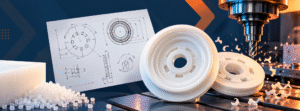
Our engineering team conducted a pre-tooling DFM review covering:
- Uniform wall thickness & draft analysis
- Flow behavior, gate locations & shrinkage planning
- Undercut feasibility & ejector direction
- Material recommendation & lifetime planning
Outcome: avoid rework, eliminate design flaws early, and protect tooling investment.
Step 2 — Rapid Prototyping (3D Printing + Soft Tooling)
Instead of committing to hardened steel tooling, Manufyn delivered:
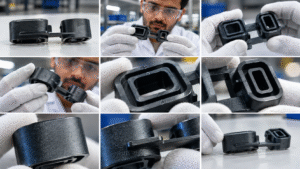
- High-accuracy 3D printed prototypes for form + fit checks
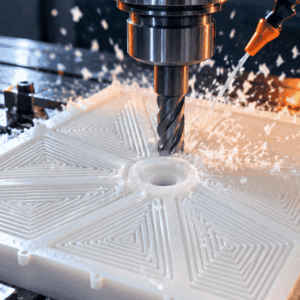
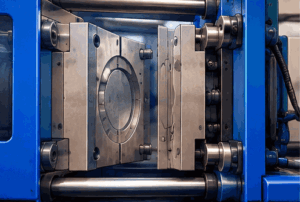
- Aluminum soft tooling for functional, injection-molded sample parts
This hybrid use of 3D printed samples + aluminum soft tooling created a bridge between early models and rapid prototyping and injection molding trials.
To understand how this reduced development risk, compare the traditional vs. soft tooling timelines below:
| Tooling Stage | Lead Time | Cost Impact |
|---|---|---|
| Traditional Steel Tool | 8–10 weeks | High (Risky at early stage) |
| Manufyn Soft Tooling | 1-2 weeks | Low (change-friendly) |
Logistics & Delivery
Samples were shipped via FedEx economy with 4-day doorstep delivery to the US, enabling fast iteration feedback loops.
Step 3 — Functional Testing & Iteration
Prototype parts were tested for:
- Assembly fit & snap alignment
- Mechanical durability
- Surface finish & cosmetic quality
- Field simulation + usage testing
Two design revisions were completed using updated soft tooling, requiring no major reinvestment or tool rebuild — a key advantage of this rapid prototyping and injection molding approach.
Step 4 — Transition to Production Injection Molding
With the design frozen, Manufyn proceeded to:
- Hardened steel production mould
- Optimized cavity layout & cycle times
- Production-grade QC workflow
Because the design had already been validated through rapid prototyping and injection molding, the transition to hardened steel tooling was risk-free.
Choosing the Right Tool Steel
| Material | Recommended Volume | Why Use It |
|---|---|---|
| C45 | Low volume / early stage | Cost-effective, perfect for launch |
| P20 | Medium volume | Balance of cost, strength & life |
| H13 | 1M+ parts / long-term production | High wear resistance for scale |
If a customer starts with C45 tooling and demand unexpectedly increases, Manufyn upgrades via vacuum hardening to extend tool life — no new tooling required.
Results Achieved
This confirms that integrating rapid prototyping and injection molding reduces risk, increases launch confidence, and compresses calendar timelines.
| Metric | Before | With Manufyn |
|---|---|---|
| Development Time | 8–10 weeks | 1-2 weeks (60% faster) |
| Tooling Investment Risk | High | Minimized |
| Design Iteration Flexibility | Low | High |
| Market Launch Readiness | Uncertain | On-schedule |
| Cost Efficiency | Standard | ~30% overall project savings |
Outcome: The client launched on time with zero last-minute design changes.
Why This Matters for Global Buyers
Rapid prototyping and injection molding allows companies to:
- Validate designs before spending on high-volume steel tooling and irreversible decisions
- Avoid expensive early-stage tool corrections that historically derail launch schedules
- Move confidently from sketch → prototype → production with documented technical learnings
- Protect launch timelines and brand reputation when speed-to-market is a competitive advantage
Global manufacturers are shifting to rapid prototyping and injection molding to avoid premature tooling investment and accelerate commercialization.
How Manufyn Adds Value
Manufyn acts as an extended engineering partner, offering:
- Rapid prototyping & soft tooling that allows safe design evolution before locking the mold
- Production-grade injection molding backed by quality control plans and documented checkpoints
- Tool steel guidance (C45, P20, H13) that balances cost, expected lifetime, and projected volume
- End-to-end sourcing, validation, and export management — eliminating multi-vendor friction
How to Start With Manufyn
| Step | You Provide | We Deliver |
|---|---|---|
| 1 | CAD / Drawing | NDA + DFM review |
| 2 | Requirements | Feasibility + cost options |
| 3 | Approval | Prototype / soft tooling |
| 4 | Finalization | Steel tooling + mass production |
Entry Options
Upload CAD for DFM feedback
Request prototype / soft tool pricing
Plan scale-up for launch volume
Conclusion
By combining rapid prototyping and injection molding, Manufyn reduced timeline pressure, protected tooling investment, and enabled a faster market launch. The phased development model provided clarity, confidence, and a commercially safe route to production.
Upload your CAD or drawing for a no-obligation feasibility check and DFM review.
Avoid early tooling risk. Validate before you invest. Scale when you’re confident.