Aerospace precision machining in India gives global aerospace companies access to tight-tolerance 5-axis machining of aluminium, titanium, and superalloy components at 30–50% below Western costs, from a base of quality-certified manufacturers with English-language engineering. The distinctions that matter most before you source: aerospace work demands full material traceability, first-article inspection to AS9102, and — for the certified supply chain — an AS9100 quality system and Nadcap accreditation for special processes, while export-controlled parts carry ITAR or dual-use obligations that stay with the design owner.
Aerospace is the least forgiving field to source badly, because a component failure is a safety and airworthiness event and the documentation trail is as scrutinised as the part. Sourcing aerospace machined components from India is entirely viable — the country has a growing aerospace manufacturing base and shops producing flight-relevant hardware — but only when you understand which certifications the work requires, which obligations stay with you, and how to vet a supplier against an aerospace standard rather than a general one. This guide covers why aerospace companies machine in India, the standards that matter, the materials and tolerances involved, and how to qualify a supplier.
It’s written from the manufacturer’s side. Manufyn’s CNC machining service produces aerospace-grade precision components from an ISO 9001 certified, strictly in-house facility in Pune — so this reflects what aerospace buyers actually ask us for. Note: this is general guidance, not regulatory, airworthiness, or export-control advice; confirm your specific obligations with the relevant authority or a qualified professional.
Why Global Aerospace Companies Machine in India
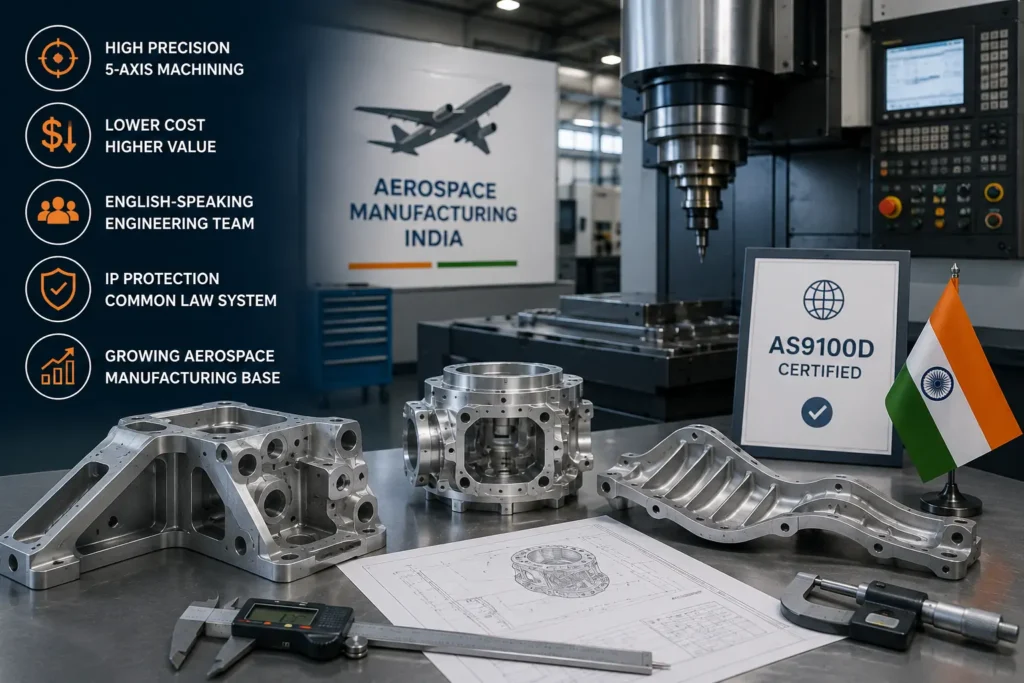
The draw is high-precision multi-axis machining at lower cost, English-language engineering, and a maturing aerospace base — for the low-to-mid volumes typical of aero programs.
Aerospace components are defined by tight tolerances, difficult materials, and complex geometry — brackets, housings, structural fittings, engine and nozzle components, and machined assemblies that demand 5-axis capability and rigorous process control. India offers that precision at labour and machine-hour rates a fraction of Western levels, which matters most on the low-to-mid production volumes and long program lifecycles typical of aerospace. Beyond cost, India brings an English-speaking engineering workforce that removes translation friction, a common-law environment generally viewed as lower-risk for intellectual property, and a rapidly maturing aerospace manufacturing ecosystem — the country has become a growing hub for aerostructure and component work supplying global primes and their tier suppliers. For aerospace companies sourcing non-flight tooling and ground equipment, prototype and development hardware, or qualified flight components through a properly certified supply chain, India is an increasingly serious option. Our guide to finding a reliable manufacturing partner in India covers how to identify one that documents to an aerospace standard.
The Standards That Matter in Aerospace Machining
Aerospace runs on a specific stack of certifications and requirements, and knowing what each governs is what lets a buyer specify correctly and qualify a supplier properly. The table summarises the ones that come up most.
| Standard / requirement | What it governs | Who holds responsibility |
|---|---|---|
| AS9100 | Aerospace quality management system | The manufacturer’s certified QMS |
| Nadcap | Accreditation for special processes (heat treat, NDT, finishing) | The manufacturer or its process suppliers |
| AS9102 | First article inspection (FAI) reporting | The manufacturer, per your requirement |
| Material traceability / DFARS | Full lot traceability and material sourcing rules | Manufacturer supplies; buyer specifies |
| ITAR / export control | Control of defence and dual-use technical data | The design owner / exporter |
| Prime-specific approvals | OEM-specific process and quality requirements | Manufacturer, per the prime’s spec |
The key principle: AS9100 is the aerospace quality system standard and the baseline for a certified aerospace supply chain, with Nadcap accreditation required where special processes like heat treatment, non-destructive testing, or chemical processing are involved. But airworthiness certification and export-control compliance are the design owner’s responsibility — the manufacturer machines to your specification and drawing, supplies first-article and traceability documentation, but does not certify airworthiness or assume your export-control obligations. Match the certification level to the part: non-flight tooling and development hardware have very different requirements from qualified flight components.
What Aerospace Precision Machining in India Covers
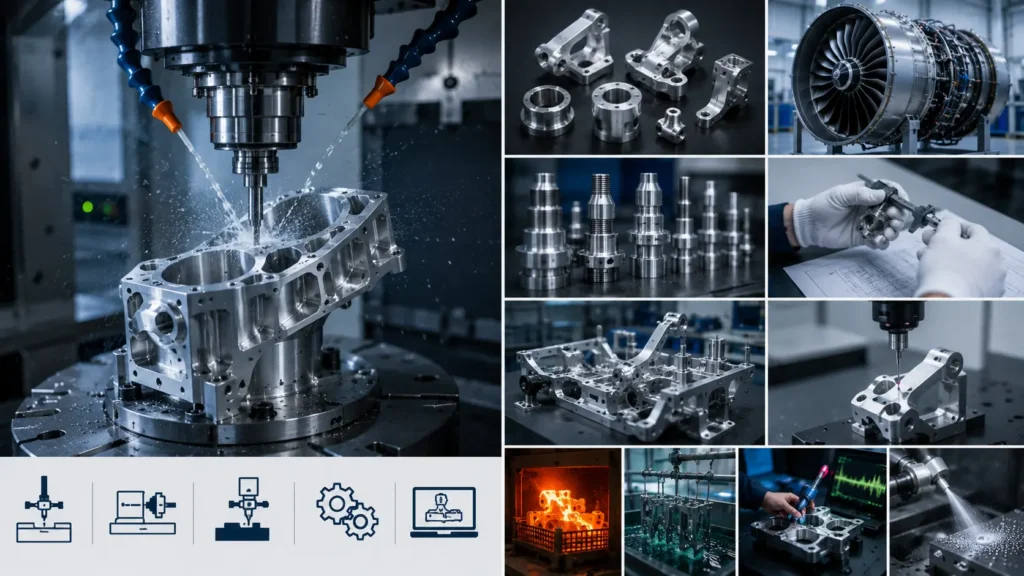
India’s strength is tight-tolerance multi-axis machining of aerospace alloys — from structural fittings to engine-adjacent components and machined assemblies.
| Capability | Typical aerospace applications |
|---|---|
| 5-axis CNC machining | Complex structural fittings, brackets, engine-adjacent components |
| CNC turning / mill-turn | Shafts, bushings, fittings, rotationally symmetric parts |
| Sliding-head machining | Small high-precision components in volume |
| Precision assembly | Machined sub-assemblies and fitted components |
| Prototype & development | Design validation and pre-production hardware |
The core capability is multi-axis CNC machining holding tight tolerances in difficult aerospace alloys, supported by precision inspection. Special processes an aerospace part often needs — heat treatment, anodising or chemical conversion coating, non-destructive testing, shot peening — are typically Nadcap-accredited operations; confirm which a supplier performs in-house versus through accredited process partners, and how that chain is documented and controlled.
Materials, Tolerances, and Traceability
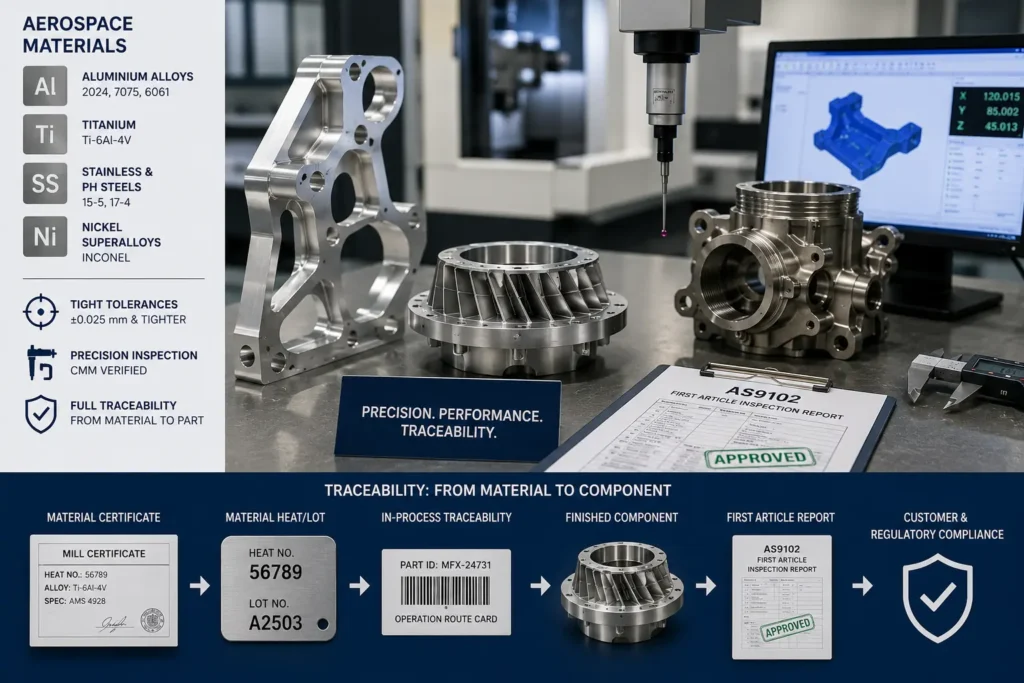
In aerospace, the part, its tolerance, and its paper trail are one deliverable. Traceability from finished component back to a certified material heat is non-negotiable.
Aerospace machining works predominantly in aluminium alloys (2024, 7075, 6061), titanium (Ti-6Al-4V), stainless and PH steels (15-5, 17-4), and nickel superalloys (Inconel) for high-temperature engine environments — materials chosen for strength-to-weight and temperature performance, and often difficult and slow to machine. Tolerances are demanding: precision CNC machining holds around ±0.025 mm and tighter on critical features, verified by CMM and documented. But in aerospace, the material and its traceability are inseparable — every component needs full traceability from the finished part back to a certified material heat and lot, supported by mill certificates and, where required, DFARS-compliant material sourcing. A first article inspection report to AS9102 documents that the first part meets every drawing characteristic. A supplier that can hold the tolerance but not fully trace the material or produce compliant first-article documentation is not aerospace-ready, regardless of machining skill. Our aerospace fabrication guide covers related requirements for fabricated aerospace hardware.
Need aerospace-grade precision components with full material traceability? Send Manufyn your drawing and material spec — we’ll confirm the documentation we can provide and quote within 24 hours. ISO 9001, strictly in-house, no minimum order.
How to Qualify an Aerospace Machining Supplier in India
Qualifying an aerospace supplier is stricter than general sourcing, because airworthiness and traceability carry consequences a commercial part never does. Work through these before committing:
- Quality system: confirm the standard — AS9100 for the certified aerospace supply chain, or ISO 9001 with aerospace-grade documentation for non-flight tooling, prototype, and development work — and verify the certificate with its issuing body.
- Material traceability: require full heat/lot traceability and mill certificates as standard, with DFARS-compliant sourcing where your program requires it.
- First article inspection: confirm the supplier can produce first-article documentation to AS9102, plus CMM dimensional reports.
- Special processes: where heat treat, NDT, or finishing is needed, confirm Nadcap accreditation — in-house or through accredited partners — and how the chain is controlled.
- In-house machining: verify the machining runs in-house, not through an unseen subcontractor network that breaks traceability and control.
- Export control: if your part or data is ITAR or dual-use controlled, confirm the compliant handling arrangement — this obligation stays with you as design owner.
- NDA before drawings: insist on a signed NDA before any design or technical data is shared.
Buyer takeaway: the manufacturer machines to your specification and supplies the traceability and first-article evidence your program requires. Airworthiness certification and export-control compliance stay with you as design owner. Keep that division clear in writing, and confirm your obligations with the relevant authority.
How Manufyn Supports Aerospace Companies
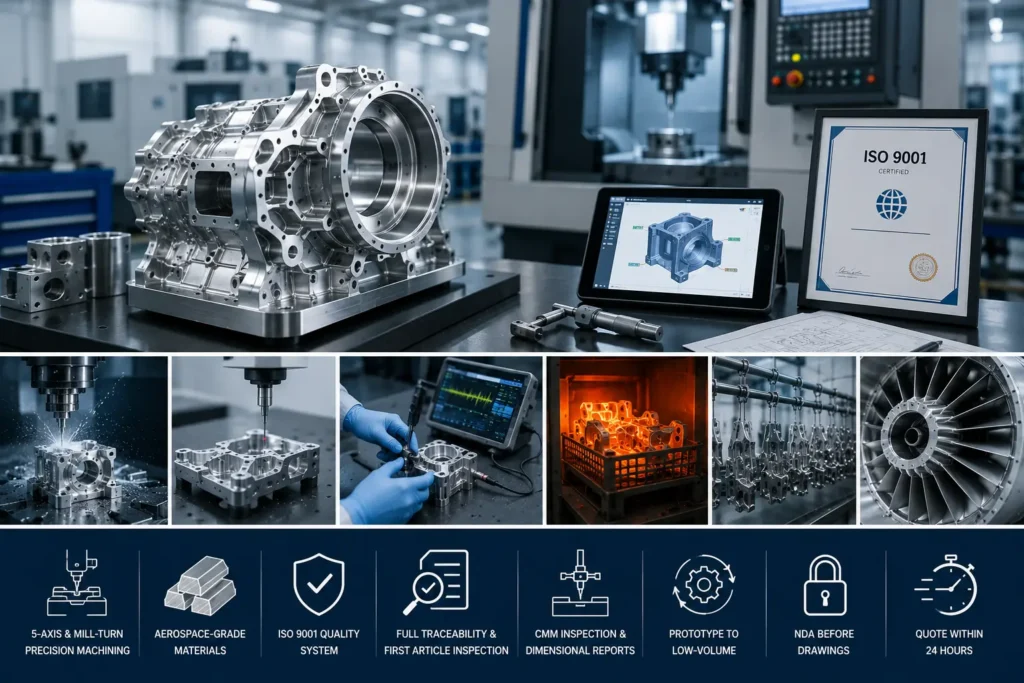
Manufyn is an ISO 9001 certified, strictly in-house manufacturer in Baner, Pune, producing aerospace-grade precision machined components with full material traceability — from prototype through low-volume production.
Manufyn machines aerospace-grade precision components — in aluminium, titanium, stainless, and superalloys — supported by an ISO 9001 quality system, full material and heat traceability, first article inspection, and CMM dimensional reporting. Because machining runs in-house across more than 80 processes, a component can move from a validated prototype into low-volume production without changing suppliers or breaking its documentation trail, and an NDA is signed before any drawing is opened. For programs that require an AS9100-certified quality system, Nadcap-accredited special processes, or handling under export control, we’ll confirm the scope honestly with you rather than overstate what we hold — an accurate capability assessment is worth more to an aerospace buyer than a claim that doesn’t survive an audit.
- 5-axis and mill-turn machining of aluminium, titanium, stainless, and superalloys to ±0.025 mm
- Full material and heat traceability, first article inspection, CMM reports
- Prototype-to-low-volume path in-house, NDA before drawings, quote in 24 hours
- Documented aerospace work — see our case study below
See real results: precision machining of an aerospace nozzle casing, a 7075-T6 aluminium precision spacer, and micron-tolerance CNC machining with live tooling. Read more on Why Manufyn.
Ready to discuss an aerospace machined component? Share your drawing with Manufyn — precision machining, full traceability, and an honest capability assessment, quoted within 24 hours.
FAQs
Yes. India has a growing aerospace manufacturing base and shops producing precision machined components for global aerospace companies and their tier suppliers. Sourcing is viable across non-flight tooling, development hardware, and — through a properly certified supply chain — qualified flight components, provided traceability and documentation meet your program’s requirements. This is general guidance, not airworthiness or export-control advice.
AS9100 is the aerospace-specific quality management system standard, built on ISO 9001 with additional aerospace requirements — the baseline for the certified aerospace supply chain and qualified flight hardware. For non-flight tooling, prototype, and development work, an ISO 9001 supplier with aerospace-grade documentation and traceability may be appropriate. Verify any certificate with its issuing body.
Nadcap is an industry-managed accreditation for aerospace special processes — heat treatment, non-destructive testing, chemical processing, coatings, and similar. It’s required when your part undergoes those processes in the certified aerospace chain. A machining supplier may hold it in-house or work through Nadcap-accredited process partners; confirm which, and how the chain is controlled and documented.
The design owner is responsible for airworthiness certification and export-control (ITAR or dual-use) compliance. The manufacturer machines to your specification and supplies traceability and first-article documentation, but does not certify airworthiness or assume your export-control obligations. If your part or technical data is controlled, confirm the compliant handling arrangement before sharing anything.
Commonly aluminium alloys (2024, 7075, 6061), titanium (Ti-6Al-4V), stainless and precipitation-hardening steels (15-5, 17-4), and nickel superalloys like Inconel for high-temperature engine environments. They’re selected for strength-to-weight and temperature performance, and are often difficult and slow to machine — which is part of what makes aerospace machining specialised.
Precision CNC machining typically holds around ±0.025 mm and tighter on critical features, verified by CMM and documented. Aerospace parts frequently combine tight dimensional tolerances with demanding geometric (GD&T) requirements, so both the machining capability and the inspection and documentation behind it matter equally.
It’s non-negotiable. Every component needs full traceability from the finished part back to a certified material heat and lot, supported by mill certificates and, where required, DFARS-compliant sourcing. A supplier that can machine the part to tolerance but not fully trace the material is not aerospace-ready — traceability is as much the deliverable as the part itself.
Confirm the quality system (AS9100, or ISO 9001 with aerospace-grade documentation for non-flight work) and verify it with the issuing body, require full heat/lot traceability and mill certificates, confirm AS9102 first-article capability and CMM reporting, check Nadcap accreditation for any special processes, verify in-house machining, and address export control where relevant. Get an NDA signed before sharing drawings or technical data.
Have an aerospace question about a specific part? Send it to our engineers — we respond within 4 working hours.
Sourcing aerospace precision machining from India?
Get precision machining, full material traceability, and an honest capability assessment — quoted in 24 hours, no minimum order.
Talk to Manufyn