
Automotive Exterior Prototypes
An engineering guide to prototyping vehicle exterior components, from early design validation to functional testing and production-intent parts.
Learn how material selection, manufacturing process, tolerances, surface finish, tooling and inspection influence automotive exterior prototype development.
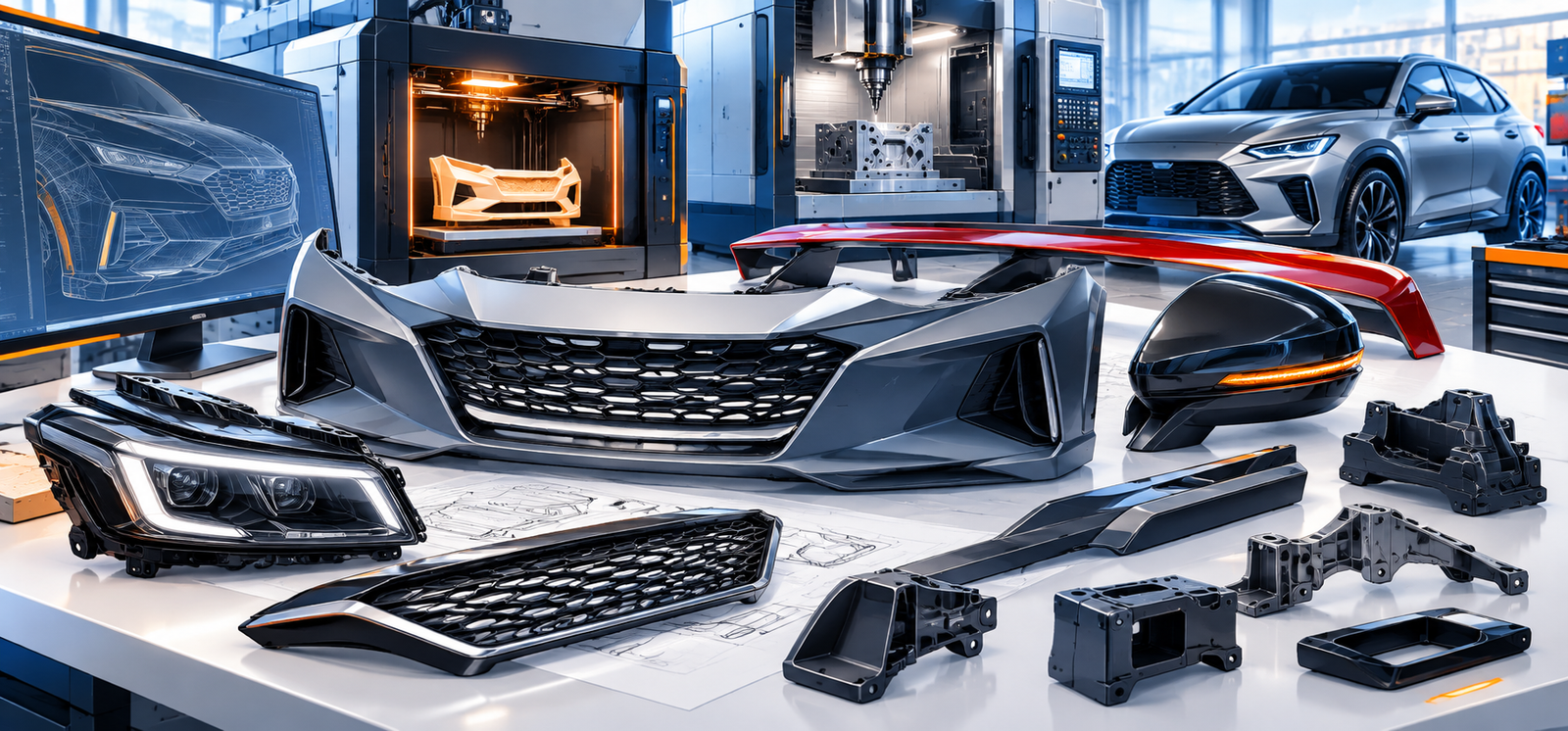
Automotive exterior prototypes are physical representations of vehicle exterior components used to evaluate design, dimensions, interfaces, appearance and manufacturability before production tooling or full-scale production begins.
The manufacturing process used for an exterior prototype depends on what the prototype needs to prove. A CNC machined aluminum component may be appropriate for dimensional and functional validation, while a 3D printed or vacuum cast component may be more suitable for evaluating form, fit and appearance.
This guide explains the engineering considerations behind automotive exterior prototype manufacturing, including process selection, materials, DFM, tolerances, surface finishing, inspection and the transition from prototype to production.
What Are Automotive Exterior Prototypes?
Automotive exterior prototypes are physical parts manufactured to evaluate components located on the outside of a vehicle. They can represent a complete component, a subassembly, or a specific interface between several components.
Depending on the development stage, an exterior prototype may be used to evaluate:
- Vehicle styling and visual appearance
- Dimensional accuracy and fit
- Panel and component interfaces
- Mounting locations
- Clearances and gaps
- Sensor and lighting integration
- Aerodynamic concepts
- Surface quality
- Assembly behavior
- Manufacturability
Automotive Exterior Parts That Can Be Prototyped
Exterior prototype requirements vary considerably between vehicle programs. Small brackets may require precision CNC machining, while larger cosmetic components may require additive manufacturing, casting, molding or fabrication.
| Exterior Component | Typical Prototype Processes | Primary Validation Objective |
|---|---|---|
| Grilles | 3D printing, CNC machining, molding | Form, fit and appearance |
| Mirror housings | CNC machining, 3D printing, vacuum casting | Fit, interfaces and appearance |
| Exterior trim | CNC machining, printing, casting | Styling and dimensional validation |
| Sensor housings | CNC machining, 3D printing, molding | Interface and sensor integration |
| Spoilers | 3D printing, machining, composite processes | Shape, fit and aerodynamic development |
| Exterior brackets | CNC machining, sheet metal fabrication | Functional and dimensional validation |
| Lighting housings | CNC machining, 3D printing, molding | Assembly and interface validation |
| Door handle components | CNC machining, printing, molding | Functional and ergonomic validation |
Manufacturing Processes for Automotive Exterior Prototypes
Process selection should consider geometry, quantity, material, tolerance, surface requirements, part size and the purpose of the prototype.
CNC Machining
CNC machining is useful for functional exterior components requiring controlled dimensions, machined interfaces and engineering materials such as aluminum and engineering plastics.
3D Printing
SLA, SLS, FDM, PolyJet and other additive processes can support early design iterations, complex geometry, fit checks and visual prototypes.
Vacuum Casting
Vacuum casting can be useful when multiple polyurethane parts are required with controlled cosmetic appearance and properties suitable for prototype evaluation.
Prototype Injection Molding
Prototype molding becomes useful when engineers need molded plastic parts, production-representative materials or a larger prototype quantity.
Rapid Tooling
Rapid tooling can bridge the gap between individual prototypes and low-volume production when molded parts are required in increasing quantities.
Sheet Metal Fabrication
Sheet metal processes are suitable for brackets, mounts, covers and other fabricated exterior components.
For broader process selection, see the rapid prototyping guide for automotive parts .
Materials for Automotive Exterior Prototypes
Material selection should be driven by the function of the prototype rather than simply choosing the lowest-cost material.
| Material Category | Typical Use | Important Considerations |
|---|---|---|
| ABS | Exterior trim and visual prototypes | Surface finish and dimensional stability |
| Polycarbonate | Functional plastic prototypes | Impact resistance and transparency where applicable |
| Nylon | Functional brackets and housings | Moisture absorption and dimensional behavior |
| Glass-filled Nylon | Stiff functional components | Fiber orientation and dimensional behavior |
| Aluminum | Brackets, housings and structural prototypes | Machinability, stiffness and weight |
| Stainless Steel | Corrosion-resistant functional components | Machining time and material cost |
Material-specific prototype guidance is also available in the Manufyn Nylon prototyping guide and Polycarbonate prototyping guide .
DFM Considerations for Automotive Exterior Prototypes
Design for Manufacturing should be reviewed before selecting the final prototype process. A CAD model can describe the intended geometry without necessarily representing the easiest or most stable manufacturing route.
Wall Thickness
Thin walls can create machining, printing, molding or dimensional stability challenges. Wall thickness should be evaluated relative to the material and manufacturing process.
Tool Access
CNC components require appropriate tool access. Deep cavities, narrow pockets and internal corners can increase machining time or require additional setups.
Part Orientation
Additive manufacturing requires careful orientation because orientation affects support structures, surface quality, build time and sometimes mechanical behavior.
Draft and Moldability
If a prototype is intended to represent an injection molded production component, draft, parting lines, undercuts and wall transitions should be considered before prototype tooling is designed.
Workholding
CNC prototypes require a practical workholding strategy. Complex exterior geometry may require multiple setups, soft jaws or dedicated fixtures.
For a deeper manufacturing perspective, see Design for Manufacturability: A Practical Guide .
Tolerances and Inspection
Not every feature on an automotive exterior prototype requires the same tolerance. Applying unnecessarily tight tolerances across an entire component can increase manufacturing complexity without improving the validation result.
Critical features should therefore be identified separately from general dimensions.
- Mounting holes
- Datum features
- Interface dimensions
- Fastener locations
- Panel gaps
- Assembly interfaces
- Critical surface locations
Inspection Methods
Depending on the part and requirement, inspection may include:
- Vernier and caliper inspection
- Micrometer inspection
- Height gauge measurement
- CMM inspection
- Visual inspection
- Surface inspection
- Material certification
- Inspection reports
- First article inspection
For a broader explanation of manufacturing tolerances, see Manufacturing Tolerances Explained .
Surface Finish for Exterior Prototype Parts
Exterior prototypes are often evaluated visually, making surface preparation an engineering consideration rather than simply a cosmetic afterthought.
Common Finishing Options
- Sanding
- Polishing
- Bead blasting
- Painting
- Powder coating
- Anodizing
- Plating
- Texturing
Bead blasting can provide a consistent matte appearance on suitable materials. See the bead blasting guide for more information.
For coated prototype components, see the powder coating prototypes guide .
What Affects Automotive Exterior Prototype Cost?
Prototype cost is determined by the complete manufacturing requirement rather than simply the physical size of the component.
| Factor | Effect on Prototype Cost |
|---|---|
| Material | Raw material price and availability influence total cost. |
| Geometry | Complex geometry can increase machining, tooling or finishing time. |
| Tolerances | Tighter tolerances can require additional operations and inspection. |
| Quantity | Setup costs can be distributed across multiple parts. |
| Surface finish | Cosmetic finishing adds secondary processing. |
| Tooling | Molded prototypes may require prototype or rapid tooling. |
| Inspection | CMM and specialized inspection can increase project cost. |
| Shipping | Part dimensions, packaging and destination affect logistics cost. |
Using Exterior Prototypes for Design Validation
A prototype becomes useful when it answers a specific engineering question.
| Validation Question | Useful Prototype Characteristics |
|---|---|
| Does the component fit? | Controlled interfaces and dimensional accuracy |
| Does the component look correct? | Representative geometry and surface finish |
| Can surrounding parts be assembled? | Accurate mounting features and interfaces |
| Does the mechanism operate? | Functional material and accurate moving interfaces |
| Can the design be manufactured? | Production-relevant geometry and DFM review |
Prototype fidelity should increase as the design moves toward production. Read the prototype fidelity guide for a deeper explanation.
From Automotive Prototype to Production
Prototype manufacturing is often one stage in a larger product development process.
Concept
Initial vehicle or component concept and requirements.
Prototype
Physical parts are manufactured for early validation.
Design Validation
Fit, form, function and interfaces are evaluated.
Functional Testing
Production-relevant performance requirements are tested.
Low Volume Production
Validated designs move toward controlled small-batch manufacturing.
Production
The final production process is established and qualified.
The transition from prototype to production is sometimes described as bridge manufacturing , particularly when production tooling or full production capacity is not yet available.
Related Automotive Prototyping Resources
Continue through the Manufyn Knowledge Hub for deeper information on prototype materials, processes, validation and production transition.
- Resource Hub Rapid Prototyping for Automotive Parts
- Resource Hub Vacuum Casting for Functional Prototypes
- Resource Hub Prototype Iteration & Design Validation
- Resource Hub Prototype Injection Molding Materials
- Resource Hub Prototype Wall Thickness
- Resource Hub Prototype Injection Molding Tolerances
- Resource Hub Bridge Manufacturing: From Prototype to Production
Relevant Manufyn Case Studies
Technical articles explain the manufacturing principles. Case studies show how those principles can be applied in real procurement and engineering projects.
Related Manufacturing Blogs
Automotive Exterior Prototype FAQs
What are automotive exterior prototypes used for?
Which processes are used for automotive exterior prototypes?
What materials are used for automotive exterior prototypes?
How are automotive prototype tolerances determined?
Can automotive exterior prototypes be surface finished?
Can prototype parts transition into low volume production?
What information is required for an automotive prototype RFQ?
What is the difference between CNC prototyping and 3D printing?
Need to Turn an Automotive Exterior Design Into a Physical Prototype?
If you have a CAD model or engineering drawing, Manufyn can review the manufacturing requirements and help identify an appropriate prototype process, material and inspection approach.
Discuss Your Prototype