
Rapid Prototyping for Automotive Parts
A practical guide to developing, manufacturing, inspecting and validating automotive prototype parts.
Learn how CNC machining, additive manufacturing, vacuum casting, prototype injection molding and rapid tooling are used during automotive product development.
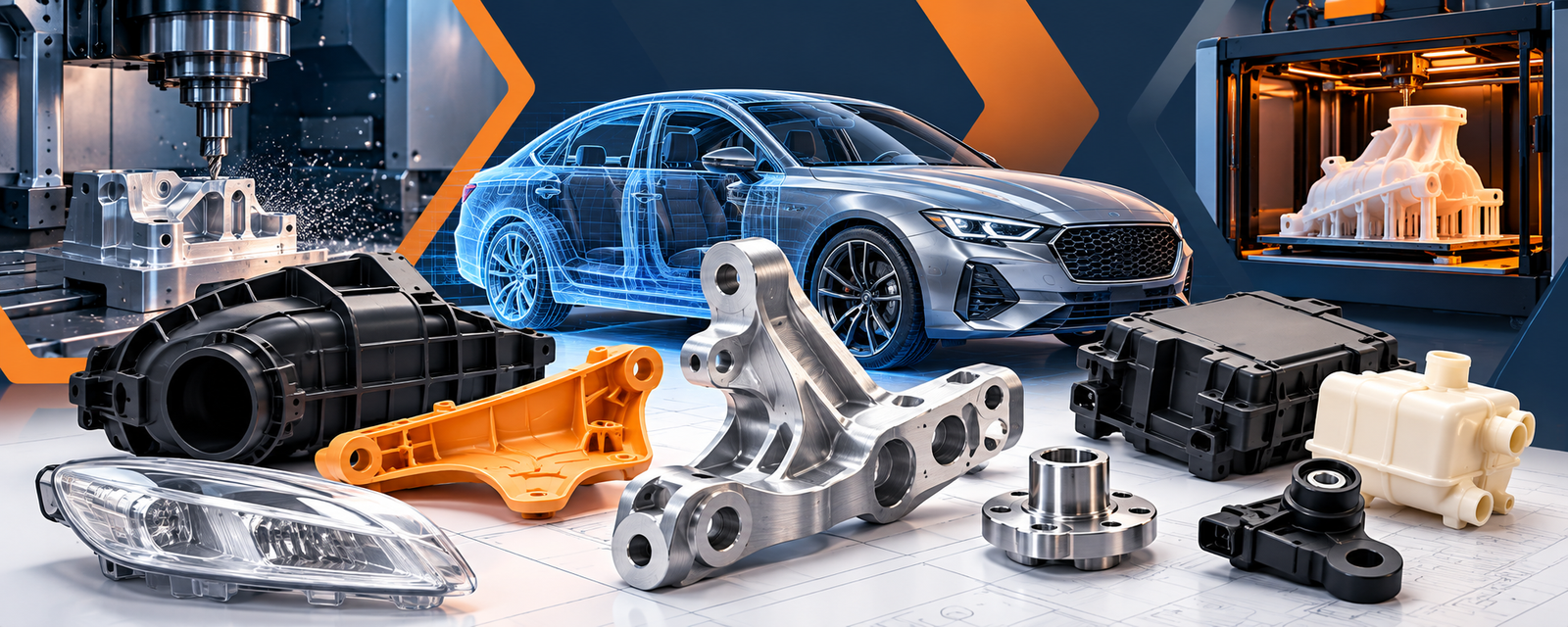
What Is Rapid Prototyping for Automotive Parts?
Rapid prototyping for automotive parts is the process of producing physical components before committing to full production tooling or high-volume manufacturing.
Automotive engineers use prototypes to evaluate dimensions, fit, form, assembly, function, material behavior and manufacturability during product development.
The manufacturing process selected for a prototype should depend on what the prototype needs to prove. A visual prototype may require a different process from a component intended for functional testing.
For this reason, automotive rapid prototyping is not simply about producing a part quickly. It is about selecting an appropriate manufacturing process, material and inspection method for each development stage.
- Automotive prototype manufacturing
- CNC automotive prototypes
- Plastic prototypes
- Metal prototypes
- Prototype injection molding
- Rapid tooling
- Prototype materials
- Tolerances and inspection
- Prototype cost factors
- Prototype to low volume production
Automotive Prototyping Knowledge
Explore the major technical areas involved in automotive prototype development, from process selection and materials to inspection and production transition.
Why Automotive Prototypes Matter
Automotive components frequently contain complex geometries, multiple interfaces and tightly controlled assembly requirements. Problems discovered after production tooling has been completed can require design changes, tooling modifications and additional validation.
Physical prototypes provide an opportunity to identify engineering issues earlier in the product development cycle.
- Check dimensional fit between components
- Verify mounting holes and interfaces
- Evaluate component clearance
- Check assembly sequence
- Validate connector and sensor locations
- Evaluate surface finish and appearance
- Test functional interfaces
- Evaluate manufacturability before production tooling
Choosing a Rapid Prototyping Process
There is no single manufacturing process that is suitable for every automotive prototype. Process selection depends on geometry, quantity, material, tolerance, surface finish, functional requirements and development stage.
| Requirement | Potential Process | Typical Purpose |
|---|---|---|
| Complex visual prototype | SLA / PolyJet / FDM | Form and appearance evaluation |
| Functional polymer prototype | SLS / CNC machining | Functional and assembly testing |
| Metal functional prototype | CNC machining | Engineering and functional validation |
| Small quantity molded parts | Prototype injection molding | Production-like plastic parts |
| Production-like polymer parts | Vacuum casting | Small batch functional or visual parts |
| Higher prototype quantity | Rapid tooling | Bridge between prototype and production |
Automotive Prototype Manufacturing Process
A structured prototype development process helps reduce unnecessary iterations and clarifications between engineering, procurement and manufacturing teams.
CAD and Drawing Review
Review the 3D CAD model, 2D drawing, material, tolerances, GD&T, surface finish and quantity before selecting the manufacturing process.
Design for Manufacturability
Evaluate features such as wall thickness, tool access, internal radii, undercuts, draft, workholding and machining accessibility.
Process Selection
Select CNC machining, additive manufacturing, vacuum casting, prototype injection molding, rapid tooling or another suitable process.
Prototype Manufacturing
Manufacture the prototype according to the agreed engineering requirements and process plan.
Inspection and Validation
Inspect critical dimensions and functional characteristics before the prototype is released for engineering validation.
Design Iteration
Use prototype findings to update the design, manufacturing approach or validation plan.
CNC Machining for Automotive Prototypes
CNC machining is useful when an automotive prototype needs engineering-grade material, accurate dimensions or functional mechanical features.
Depending on the geometry, automotive prototype components may be produced using 3-axis, 4-axis or 5-axis CNC machining, CNC turning, EDM, wire EDM, grinding and other secondary manufacturing operations.
CNC machining can be particularly useful for brackets, housings, mounts, fixtures, structural interfaces and precision mechanical components.
Learn more through the Manufyn Resource Hub and explore related CNC machining knowledge .
Plastic Prototypes for Automotive Parts
Polymer components represent a significant portion of automotive product development. The appropriate prototyping method depends on whether the objective is visual evaluation, assembly testing, functional validation or production simulation.
- SLA for detailed visual prototypes
- SLS for functional polymer prototypes
- FDM for rapid development models
- CNC machining for engineering plastics
- Vacuum casting for small batches
- Prototype injection molding for production-like parts
Material selection becomes increasingly important when a prototype will be exposed to mechanical load, temperature, chemicals or repeated assembly cycles.
Related technical reading: Nylon Prototyping and Polycarbonate for Prototyping .
Prototype Injection Molding for Automotive Parts
Prototype injection molding can be useful when engineers need molded plastic parts that more closely represent the intended production process.
It can provide useful information about filling, shrinkage, warpage, surface appearance, assembly fit and material behavior before committing to high-volume production tooling.
Materials Used for Automotive Prototypes
Prototype material selection should reflect the purpose of the prototype. A visual model and a functional validation component may require completely different materials.
- Aluminum 6061
- Aluminum 7075
- Stainless steel
- Mild steel
- Brass
- Copper
- ABS
- Polycarbonate
- Nylon
- Glass-filled Nylon
- PEEK
- Ultem
- TPU
- Other engineering polymers
The Manufyn Material Library can be used to explore material-specific manufacturing considerations.
Automotive Prototype Tolerances and Inspection
Not every dimension on an automotive prototype needs the same tolerance. Critical-to-function dimensions should be identified separately from non-functional features.
Achievable tolerance depends on the manufacturing process, material, part size, geometry, workholding, machining strategy and inspection method.
Depending on the project, inspection may include:
- Vernier and caliper inspection
- Micrometer inspection
- Height gauge measurement
- CMM inspection
- Dimensional inspection reports
- Material certificates
- First article inspection
Applications of Automotive Rapid Prototyping
Rapid prototyping can support multiple stages of automotive engineering and vehicle development.
- Interior component development
- Exterior component development
- Under-hood components
- Mounting brackets
- Sensor housings
- Electronic enclosures
- Battery-related components
- Cooling system components
- Motor-related components
- Assembly fixtures
- Fit and clearance validation
- Prototype vehicle builds
What Affects Automotive Prototype Cost?
Prototype cost is influenced by more than the quantity of parts. Manufacturing process, material, geometry, tolerances, finishing and inspection requirements can significantly change the economics of a prototype.
- Material type and availability
- Part geometry
- Manufacturing process
- Required tolerances
- Prototype quantity
- Surface finishing
- Tooling requirements
- Inspection requirements
- Packaging and logistics
A process that is economical for one prototype may not be economical when the quantity increases. This is why prototype process selection should consider the expected next stage of the project.
From Automotive Prototype to Low Volume Production
Automotive development typically moves through several manufacturing stages. The appropriate process can change as the engineering requirements and quantities increase.
| Development Stage | Potential Manufacturing Route | Primary Objective |
|---|---|---|
| Concept | 3D printing | Form and design iteration |
| Functional prototype | CNC / SLS / vacuum casting | Functional evaluation |
| Production-representative prototype | Prototype injection molding / rapid tooling | Process and product validation |
| Low volume | Production tooling / repeatable manufacturing | Initial production |
Continue Your Manufacturing Research
Resource Hub
Explore technical manufacturing guides and process-specific knowledge.
Related Technical Articles
Continue researching specific prototype processes and materials.
Manufyn Knowledge
Explore manufacturing projects, engineering insights and company experience.
Frequently Asked Questions
Need to Take an Automotive Prototype From CAD to Part?
Share the engineering requirements, CAD model or drawing and prototype quantity. Manufyn can help evaluate the appropriate manufacturing route and coordinate the next stage of development.
DISCUSS YOUR PROJECT EXPLORE PROTOTYPING