Buying sheet metal fabrication well comes down to four skills: sending a complete RFQ package so quotes come back accurate, specifying materials and tolerances the part actually needs, understanding what drives the price, and vetting the fabricator before the purchase order — not after the first bad delivery. Get those four right and sheet metal is one of the most predictable things you’ll ever buy. Get them wrong and every order becomes a negotiation about whose fault the rework is.
This guide exists because most fabrication problems are created before the metal is ever cut — in a drawing that leaves the fabricator guessing, a tolerance copied from an old part, or a supplier chosen on price alone. It walks the full buying journey in order: what to put in your RFQ, how to choose materials and tolerances, where the money in a quote actually goes, how batch size changes the price, and a seven-point checklist (plus a scorecard) for choosing the fabricator itself.
It’s written from the other side of the counter. Manufyn’s sheet metal fabrication service runs from an ISO 9001 certified, strictly in-house facility in Pune, India, quoting drawings from buyers in 30+ countries every week — so the advice below is what we wish every incoming RFQ already knew.
Step 1: Send a Complete RFQ Package
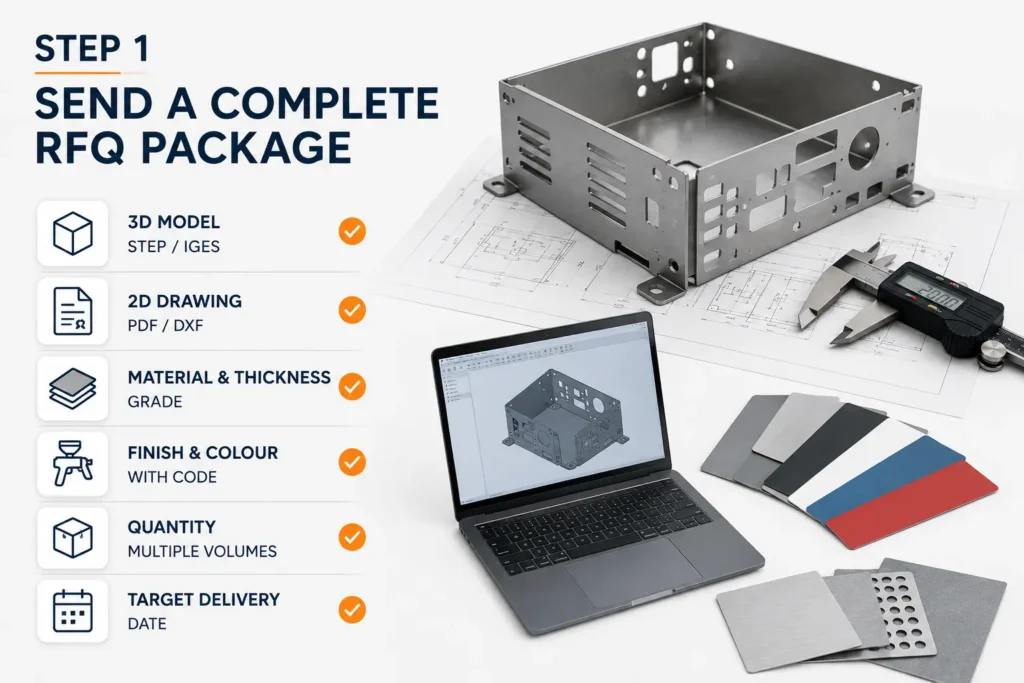
Every vague RFQ costs you twice — once in clarification emails, once in the risk margin a fabricator adds when guessing. A complete package gets you an accurate quote in one pass.
A fabricator can only quote what you send. Give them a 3D model with no material callout and they’ll either email you questions (delay) or assume something and pad the price to cover the risk (cost). The fix is a standard package: a STEP or IGES 3D model, a 2D drawing as PDF or DXF with critical dimensions and tolerances marked, and the handful of details that change the price most — material grade, thickness, finish with colour code, quantity at two or three volumes, and target delivery date. Two minutes assembling this saves days of back-and-forth and, more importantly, gets you quotes you can actually compare against each other, because every fabricator priced the same job.
| RFQ item | Why it matters |
|---|---|
| 3D model (STEP / IGES) | Drives programming and the flat pattern — the geometry source of truth |
| 2D drawing (PDF / DXF) | Carries tolerances, critical dimensions, and notes the model can’t |
| Material grade and thickness | The single biggest price and lead-time variable |
| Finish + colour code + masking | Powder coat adds 60–100 µm — mating surfaces must be planned |
| Quantity at 2–3 volumes | Reveals your real cost curve, not one point on it |
| Hardware spec (if any) | Self-clinching hardware must go in before finishing — sequence matters |
| Delivery date and destination | Sets air vs sea freight and whether expediting is needed |
If you’re unsure whether your drawing is fabrication-ready, our 7-step sheet metal fabrication process guide shows exactly what the fabricator does with each item — and why a DFM review before quoting catches the expensive mistakes while they’re still free.
Step 2: Choose the Right Material — Not the Familiar One
Material choice sets cost, weight, corrosion resistance, and which finishes are even possible — and the most common buyer error is defaulting to the grade used on the last project rather than the one this part needs. The short version of the decision:
| Material | Choose it when | Relative cost |
|---|---|---|
| Mild steel (CRCA) | Indoor parts that will be powder coated — the economical default | Lowest |
| Aluminium 5052 | Weight matters, good corrosion resistance, excellent bendability | Moderate |
| Stainless 304 | Corrosion resistance without coating — food, general outdoor | Higher |
| Stainless 316 | Marine, chemical, or chloride environments where 304 pits | Highest common |
| Galvanised steel | Pre-coated corrosion protection at low cost — ducting, enclosures | Low |
Two rules save most of the money here: specify the loosest grade the environment allows (316 where 304 would survive is pure overspend), and remember the finish and material are one decision — anodising only works on aluminium, passivation only on stainless. Our sheet metal materials guide goes grade by grade, with deeper pages on aluminium 5052 and stainless steel 304.
Step 3: Specify Tolerances Like Someone Who Pays the Invoice
Tolerance is the biggest cost lever you personally control, and over-tolerancing is the most common self-inflicted cost on incoming drawings. Every step tighter means slower cutting, more inspection, and higher scrap — multiplying cost on features that often never needed the precision. What’s realistic:
| Feature | Standard tolerance | Tight (achievable) |
|---|---|---|
| Laser-cut profile | ±0.1 mm | ±0.05 mm |
| Bend angle | ±0.5° | ±0.1° |
| Bend-to-edge dimension | ±0.25 mm | ±0.1 mm |
| Hole-to-hole (same face) | ±0.1 mm | ±0.05 mm |
Buyer takeaway: call out a general standard once — ISO 2768-m covers most engineering work — then tighten only the handful of features that mate, seal, or align. A drawing toleranced this way quotes lower and comes back right the first time. Full detail in our sheet metal fabrication tolerance guide.
Step 4: Understand What You’re Actually Paying For
A fabrication quote is built from five components, whether or not the fabricator shows them to you. Knowing them is what lets you negotiate the right line instead of just asking for a discount:
| Cost component | What drives it | How you reduce it |
|---|---|---|
| Material | Grade, thickness, sheet utilisation (15–35% is scrap) | Right-size the grade; nesting-friendly geometry |
| Cutting time | Perimeter length, hole count, thickness | Remove decorative cutouts and unneeded holes |
| Bending | Number of bends and setups per part | One consistent bend radius; fewer, simpler bends |
| Welding & hardware | Weld length, finish class, insert count | Tabs/slots for self-fixturing; weld only what’s structural |
| Finishing & inspection | Finish type, masking, documentation level | Specify the finish in the RFQ, not after production starts |
Batch size sits on top of all five: setup cost is fixed per run, so it’s spread across every part in the batch. Ten pieces carry the whole setup ten ways; five hundred carry it five hundred ways — which is why unit price falls steeply at first, then flattens. Our guides on fabrication price calculation and batch sizes, MOQ, cost and time work the numbers in full.
Want to see what your part actually costs? Send Manufyn your drawing and quantities — free DFM review, over-tight tolerances flagged, and a firm itemised quote within 24 hours. No minimum order.
Step 5: Vet the Fabricator — The 7-Point Checklist
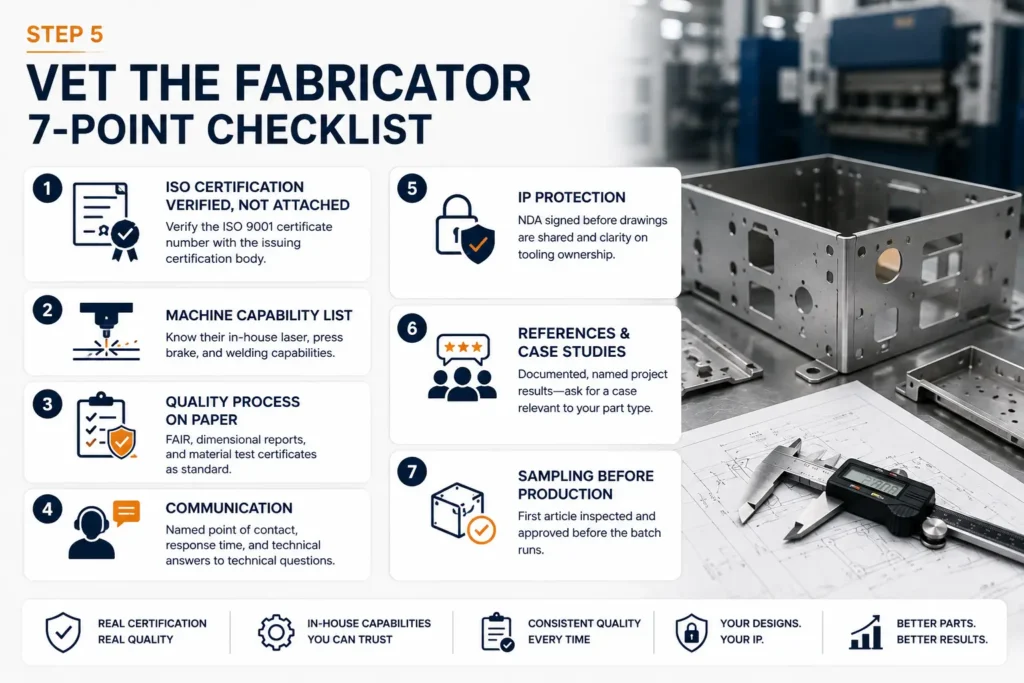
The cheapest quote from the wrong shop is the most expensive way to buy fabrication. Seven checks, mostly done from your desk, separate a real fabricator from a risk.
- ISO certification — verified, not attached. Ask for the ISO 9001 certificate number and confirm it with the issuing certification body directly. A PDF on an email proves nothing; a certificate the issuer confirms proves a real, audited quality system.
- Machine capability list. Ask what they run in-house: laser wattage and bed size, press-brake tonnage and length, welding processes. A shop that answers specifically owns its machines; vague answers usually mean subcontracting you’ll never see.
- Quality process on paper. FAIR on first articles, dimensional reports on batches, material test certificates for traceability — offered as standard, not produced only when chased.
- Communication. A named engineer or account manager, a stated response time, and technical answers to technical questions. If the sales inbox can’t tell you a minimum flange length, the shop floor is a long way from your order.
- IP protection. NDA signed before drawings are shared, and clarity on tooling ownership. An in-house fabricator keeps your files in one building; a broker’s network propagates them.
- References and case studies. Documented, named project results — not logos on a homepage. Ask for a case relevant to your part type.
- Sampling before production. A first article you inspect and approve before the batch runs. A fabricator who resists sampling is asking you to absorb their process risk.
Score each item 0–2 (0 = fails, 1 = partial, 2 = verified) and total it: 12–14 is a supplier you can commit to, 9–11 needs the gaps closed first, below 9 is a pass regardless of price. Our full guide on finding a fabrication supplier company expands each check.
Red Flags That End the Conversation
- A price dramatically below every other quote with no engineering explanation for how
- Reluctance to share a factory address or allow a live video facility tour
- No willingness to sign an NDA before drawings change hands
- Vague or shifting answers about which processes are subcontracted
- 100% advance payment as the only option, with no inspection milestone
Buyer takeaway: every flag on this list costs minutes to check before a purchase order and weeks to discover after one.
How Manufyn Measures Against This Checklist
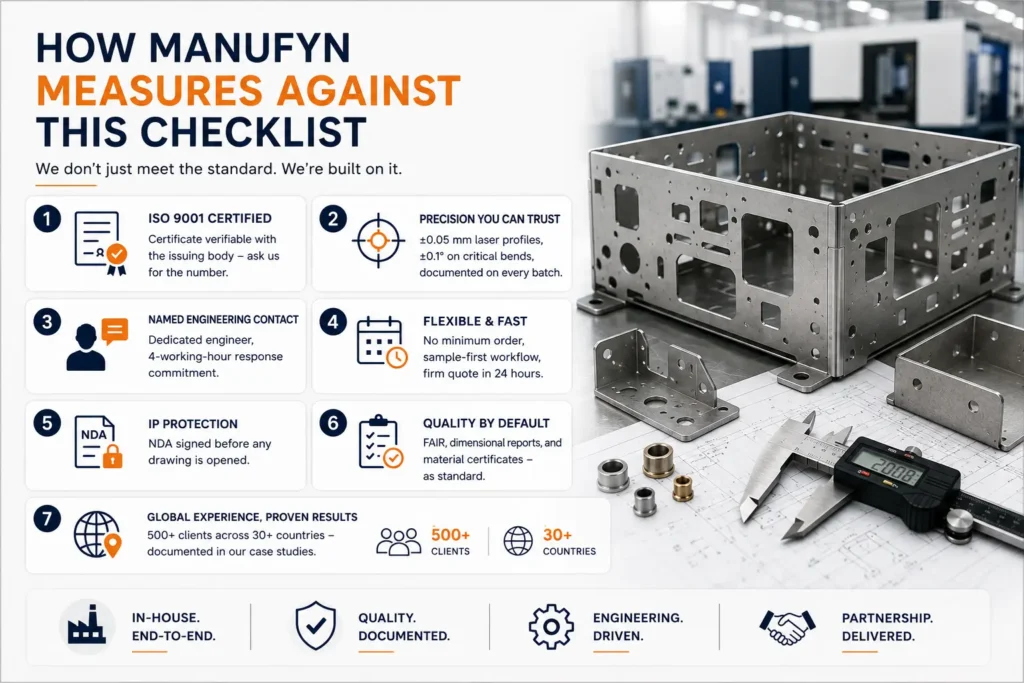
The checklist above wasn’t written around Manufyn — but we expect to be scored against it, and we pass every line. That’s the standard worth holding any fabricator to.
Manufyn is an ISO 9001 certified, strictly in-house sheet metal fabricator in Baner, Pune, India — not a broker or marketplace. Fiber laser cutting, CNC press-brake bending, welding, hardware insertion, and finishing all run in one facility, so the machine list is ours, the quality records are ours, and the engineer who reviews your drawing is the one whose floor makes the part. Every quote starts with a free DFM review, first articles ship for approval before batches run, and FAIR, dimensional reports, and material certificates arrive as standard — with an NDA signed before any drawing is opened.
- ISO 9001 certificate verifiable with the issuing body — ask us for the number
- ±0.05 mm laser profiles, ±0.1° on critical bends, documented on every batch
- Named engineering contact, 4-working-hour response commitment
- No minimum order, sample-first workflow, firm quote in 24 hours
- 500+ clients across 30+ countries — documented in our case studies
Read more about how we work on Why Manufyn.
Ready to run your first order the right way? Send your RFQ package to Manufyn — complete DFM feedback, a sample before production, and every document this guide told you to demand.
FAQs
A complete RFQ includes a STEP or IGES 3D model, a 2D drawing (PDF or DXF) with tolerances marked, material grade and thickness, finish with colour code and any masking, quantity at two or three volumes, hardware specification, and the delivery date and destination. This lets fabricators quote accurately in one pass and makes competing quotes directly comparable.
Match the material to the environment and finish: mild steel with powder coat for economical indoor parts, aluminium 5052 where weight and bendability matter, stainless 304 for uncoated corrosion resistance, stainless 316 for marine or chemical exposure, and galvanised steel for low-cost pre-coated protection. Specify the loosest grade the environment allows — upgrading beyond need is pure overspend.
Laser cutting typically holds ±0.1 mm standard and ±0.05 mm tight; bends hold ±0.5° standard and ±0.1° on critical callouts; bend-to-edge dimensions run ±0.25 mm standard. Call out ISO 2768-m as the general standard and tighten only mating, sealing, or aligning features — over-tolerancing is the most common avoidable cost on incoming drawings.
Five components: material (grade, thickness, and the 15–35% of sheet lost to nesting scrap), cutting time (perimeter and hole count), bending (number of bends and setups), welding and hardware (weld length and insert count), and finishing plus inspection. Batch size sits on top — setup cost is fixed per run, so unit price falls steeply as quantity rises, then flattens.
Confirm the ISO 9001 certificate number with the issuing body directly, ask for a specific in-house machine list, require documented quality (FAIR, dimensional reports, material certificates) as standard, get an NDA signed before sharing drawings, check named references, and run a sample before production. A genuine in-house fabricator passes all of these readily.
No. A price dramatically below every other quote with no engineering explanation is a red flag, not a bargain — it usually means a different material grade, skipped inspection, or hidden subcontracting. Compare quotes only after confirming they price the same specification, and weigh the supplier’s verification score alongside the number.
A first article inspection report documents that the first produced part meets every dimension on your drawing, measured and recorded. It converts “the parts are fine” from a claim into evidence, catches process errors before a full batch runs, and — with material certificates — gives you traceability from finished part back to raw sheet.
Many fabricators impose minimums to cover setup cost, but not all. Manufyn quotes from one piece with no minimum order — though unit price at very low quantities carries the full setup cost, so requesting price breaks at two or three volumes shows you where your real cost curve sits.
Prototypes and first articles typically ship in 5–10 working days from drawing approval; production batches depend on volume and finishing. Powder coating, anodising, and welded assemblies add time. From India, air freight adds 3–7 days to most global destinations and sea freight 2–5 weeks, so match the freight mode to the urgency.
Have a question this guide didn’t answer? Send your drawing to our engineers — we respond within 4 working hours.
Buying sheet metal fabrication for your next project?
Get a free DFM review, a sample-first workflow, and a firm itemised quote in 24 hours — no minimum order.
Talk to Manufyn