Rapid prototyping in design thinking is the fourth stage of the design thinking process — following Empathise, Define, and Ideate — in which designers and product developers build quick, low-cost physical or digital models of their leading ideas to test assumptions, gather feedback, and iterate before committing resources to development or production.
Prototyping in design thinking is intentionally rough, fast, and disposable: the goal is learning, not perfection. Manufyn’s physical rapid prototyping service supports the design thinking prototyping process at the critical transition from low-fidelity paper models and digital wireframes to physical functional prototypes that can be held, tested, and evaluated with end users.
When your design thinking prototype moves from paper to physical, Manufyn delivers CNC, 3D printing, and sheet metal rapid prototypes in days. Free DFM review. 24-hour quote.
The Five Stages of Design Thinking and Where Prototyping Fits
Design thinking is a human-centred problem-solving framework developed and popularised by IDEO, the Stanford d.school, and the Hasso Plattner Institute. It organises product development and innovation work into five stages that are intended to be cycled through iteratively rather than completed sequentially:
- Empathise: deep qualitative research into users’ needs, behaviours, and contexts. Interviews, observation, journey mapping.
- Define: synthesis of empathy research into a clear problem statement the Point of View (POV) statement that frames the design challenge.
- Ideate: generative brainstorming of solutions to the defined problem. Quantity of ideas over quality at this stage — no evaluation.
- Prototype: rapid prototyping in design thinking — build quick physical or digital representations of the most promising ideas to make them tangible for testing. This is the stage this guide addresses.
- Test: present prototypes to real users and observe reactions. Collect qualitative data on what works, what confuses, what delights. Feed findings back into any earlier stage.
Rapid prototyping in design thinking is not a linear progression from low-fidelity to high-fidelity. Design teams cycle back through Prototype and Test multiple times — each cycle producing a higher-fidelity prototype that addresses the failures of the previous iteration. The rapid prototyping design process is intentionally non-linear.
What Prototyping in Design Thinking Is — And What It Is Not
Prototyping in design thinking is often misunderstood as being equivalent to prototype manufacturing. It is not. In the design thinking context, a prototype can be a paper sketch, a cardboard model, a role-played service scenario, a Wizard-of-Oz simulation, a clickable Figma wireframe, or a physical 3D-printed part — depending on what assumption needs to be tested and what fidelity is required to test it credibly.
The cardinal principle of design thinking prototyping is that the fidelity of the prototype should match the question being tested — nothing more. Testing whether a medical device feels comfortable in a surgeon’s hand requires a physical model of the correct dimensions and weight. Testing whether users understand a software menu structure requires a clickable wireframe, not working code. Building a fully functional prototype to test a basic interaction concept wastes resources and slows the rapid prototyping design process.
When the design thinking prototyping process reaches the stage where a physical prototype must replicate the functional properties of the production part — material, tolerance, assembly — Manufyn’s manufacturing rapid prototyping service takes over. The connection between design thinking prototyping and manufacturing rapid prototyping is explored further in the complete guide to what rapid prototyping is and the types of rapid prototyping guide.
Fidelity Levels in Rapid Prototyping in Design Thinking
The prototype design thinking literature distinguishes three fidelity levels that correspond to different stages in the design thinking iterative cycle:
Low-Fidelity Prototypes — Fast and Disposable
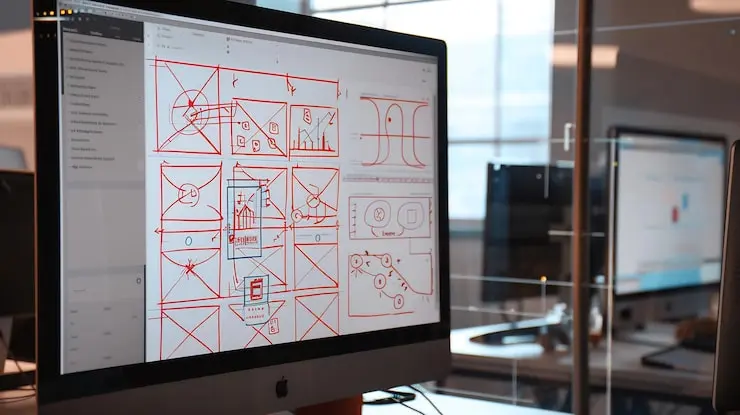
Low-fidelity prototypes in the rapid prototyping design process are intentionally rough representations that can be built in minutes or hours. Examples: paper sketches of UI screens pinned to a wall; cardboard models of physical product form factors; storyboard sequences of a service interaction; role-played scenarios of a user journey. The purpose is to externalise thinking and test basic concept viability before investing in higher fidelity.
Low-fidelity prototyping in design thinking is most effective in the early Prototype stage, immediately after the Ideate stage, when multiple concepts are being evaluated in parallel and the team needs to quickly eliminate the weakest ideas before investing in higher-fidelity versions of the most promising ones.
Mid-Fidelity Prototypes — Interactive and Testable
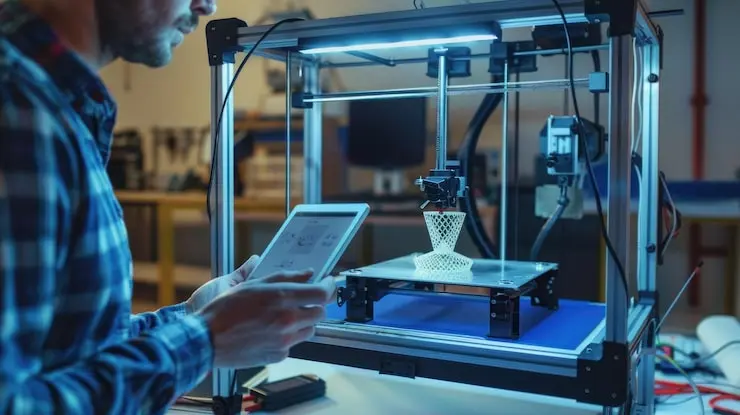
Mid-fidelity prototypes support interactive testing with real users. For digital products: clickable wireframes in Figma or InVision that support navigation flows and key interactions without visual design polish. For physical products: 3D-printed concept models in FDM plastic that replicate form and some function — suitable for grip evaluation, size comparison, and spatial layout testing — but not for functional mechanical testing or material evaluation.
The 3D-printed models used for mid-fidelity prototyping in design thinking are typically FDM or SLA parts — see Manufyn’s 3D printing rapid prototyping guide for how FDM and SLA differ in accuracy and surface finish. At this stage of the rapid prototyping design process, SLA is preferred for consumer products where surface quality affects user perception during testing.
High-Fidelity Prototypes — Production-Equivalent
High-fidelity prototypes in the design thinking prototyping process closely replicate the properties and appearance of the final product. For physical products, high-fidelity prototype design thinking prototypes are typically produced using the same manufacturing technologies as the production part: CNC machined metal components, sheet metal fabricated enclosures, or vacuum cast plastic housings. These prototypes are used for final user testing, regulatory submissions, investor presentations, and retail buyer evaluations.
The distinction between design thinking prototyping (the process) and manufacturing rapid prototyping (the technology) is most apparent at high fidelity: the design thinking team defines what the prototype must demonstrate; Manufyn’s engineers determine how to manufacture it to that specification using CNC, 3D printing, sheet metal, or casting. For technology selection guidance, see the types of rapid prototyping guide.
When design thinking prototyping reaches high-fidelity, Manufyn produces manufacturing-grade physical rapid prototypes — CNC, 3D printing, sheet metal — from your design files. Quote in 24 hours.
Testing in Design Thinking — How Prototyping Informs Iteration
Prototyping in design thinking only generates value when the Test stage produces actionable learning. The most common testing methods used with rapid prototyping in design thinking are:
- Usability testing: 5–8 users complete defined tasks with the prototype while the team observes. The rapid prototyping design process captures what confuses users, what they ignore, and what they do intuitively correctly — revealing design assumptions that were wrong.
- Think-aloud protocol: users narrate their thought process while interacting with the prototype design thinking model. Surfaces mental models and expectations that diverge from the design intent.
- Wizard-of-Oz testing: a human operator simulates system responses behind the scenes while the user interacts with a prototype that appears to be functional. Validates concepts before any functional development — the most extreme form of rapid prototyping in design thinking.
- A/B prototype testing: two different prototype design thinking versions of a feature are tested with different user groups. Provides comparative data on which design concept performs better on defined metrics.
- Bodystorming: prototyping in design thinking for physical products and spaces — team members physically act out using a product or navigating a space using rough physical models. Surfaces embodied and contextual requirements invisible to non-physical prototyping methods.
Rapid Prototyping in Design Thinking for Physical Product Development
The design thinking prototyping process was originally developed primarily for service and software design. Its application to physical product development has expanded dramatically with the availability of affordable manufacturing rapid prototyping. The rapid prototyping design process for physical products typically follows this sequence:
- Paper and cardboard models: basic form and size validation. Can be done in hours in the product development studio.
- FDM 3D-printed concept models: accurate form-factor testing, ergonomics evaluation, spatial layout in context. See FDM in the 3D printing guide.
- SLA or SLS functional models: higher surface quality for user perception testing; SLS nylon for functional feature testing (snap-fits, living hinges). See the types guide.
- CNC or sheet metal high-fidelity prototypes: production-equivalent material and tolerance for final user testing, regulatory submission, and investor presentation. This is where design thinking prototyping hands off to manufacturing rapid prototyping.
For consumer electronics products specifically, the design thinking prototyping sequence often uses PolyJet multi-material prototypes at Stage 3 to simulate the tactile properties of overmoulded elastomeric surfaces before committing to the SLA master for vacuum casting at Stage 4. See consumer electronics rapid prototyping. For medical device product development, the design thinking prototyping process must align with FDA and ISO 13485 design controls — see medical device rapid prototyping.
Design Thinking Prototyping in Practice — Industries and Applications
Consumer Electronics and IoT
Consumer electronics companies use rapid prototyping in design thinking intensively. A typical smart home device development cycle involves 4–6 prototype iterations: paper mockups of the physical form; FDM models for size and placement testing; SLA models for button and interaction surface evaluation; vacuum cast production-equivalent housings for retail buyer presentations. For manufacturing support at the later stages, see consumer electronics rapid prototyping.
Medical Device Development
Medical device design teams use prototype design thinking methods within the constraints of ISO 13485 design controls. The rapid prototyping design process for medical devices includes clinical observation (Empathise), clinical requirement specification (Define), HMI concept generation (Ideate), physical ergonomic model production (Prototype), and human factors evaluation with clinical end users (Test). The high-fidelity stage requires manufacturing rapid prototyping in production-equivalent materials — see medical device rapid prototyping.
Automotive Interior Design
Automotive OEMs use design thinking prototyping extensively for interior human-machine interface (HMI) design, dashboard layout, seat ergonomics, and infotainment interface design. The rapid prototyping design process produces clay models, CNC-milled interior panel sections, and 3D-printed HMI prototypes for driver evaluation in simulator environments. For automotive manufacturing rapid prototyping, see automotive rapid prototyping.
Industrial Equipment and B2B Products
Industrial equipment manufacturers increasingly apply design thinking prototyping methods to products that were historically designed without formal user research — machinery control panels, maintenance interfaces, safety system indicators. The prototyping in design thinking approach reveals that industrial equipment operators have strong contextual needs (glove-compatible interfaces, high-visibility indicators, single-hand operation) that purely engineering-driven design frequently misses.
The Transition from Design Thinking Prototyping to Manufacturing Rapid Prototyping
The handoff from the design thinking prototyping process to manufacturing rapid prototyping typically occurs when the design team has validated the concept through low- and mid-fidelity testing and needs a production-representative physical prototype for final user validation, regulatory submission, or pre-production approval. At this transition, the design team’s concept model becomes a manufacturing drawing, and Manufyn’s engineering team produces the rapid prototype using CNC machining, 3D printing, sheet metal fabrication, or casting as appropriate to the application.
The complete rapid prototyping process — from drawing submission through DFM review, fabrication, inspection, and delivery — is described in Manufyn’s rapid prototyping process guide. For material selection at the production-representative prototype stage, see the rapid prototyping materials guide. For cost planning at this stage, see the rapid prototyping cost guide.
When your design thinking prototype moves from concept to physical reality, Manufyn produces production-representative rapid prototypes — CNC, 3D printing, sheet metal. Global delivery. Quote in 24 hours.
Frequently Asked Questions — Rapid Prototyping in Design Thinking
Rapid prototyping in design thinking is the fourth stage of the design thinking process, in which quick physical or digital models are built to test assumptions, gather user feedback, and iterate the design. The prototype design thinking models range from paper sketches to functional physical prototypes depending on the fidelity required for the test being conducted.
The fidelity of prototyping in design thinking should match the question being tested nothing more. Testing basic concept viability: low-fidelity paper or cardboard. Testing interaction flows: mid-fidelity clickable wireframe or 3D-printed concept model. Testing production readiness: high-fidelity manufacturing prototype. Over-building a prototype relative to the question wastes time and money.
Design thinking prototyping is a methodology — a structured process of building and testing models to generate learning. Manufacturing rapid prototyping is a technology — the fast physical fabrication of parts using CNC, 3D printing, sheet metal, or casting. They are complementary: design thinking defines what to build and why; manufacturing rapid prototyping defines how to build it.
Low-fidelity: paper, cardboard, sticky notes, sketching. Mid-fidelity digital: Figma, InVision, Axure. Mid-fidelity physical: FDM 3D printing, foam models. High-fidelity physical: SLA, SLS, CNC machining, vacuum casting (via Manufyn or equivalent manufacturer).
Design thinking prototyping is intentionally non-linear — there is no specified number of iterations. The process continues until the prototype reveals no new significant user insights, which typically occurs after 3–7 iterations depending on product complexity and user testing efficiency. The rapid prototyping design process should be stopped when the cost of additional iteration exceeds the expected learning value.
Yes. While design thinking prototyping originated in consumer and service design, its principles apply equally to industrial equipment, B2B software, and technical infrastructure. Industrial product design teams that apply prototyping in design thinking methods consistently find operator needs that purely engineering-driven design misses — particularly around control interface design, maintenance access, and safety signal visibility.
Design thinking prototyping requires physical manufacturing — via Manufyn’s rapid prototyping service or equivalent — at the stage where a physical representation of the product is needed for user testing that cardboard, foam, or 3D-printed concept models cannot credibly support. This typically occurs in the second or third prototype iteration for physical products, when the form factor and interaction model are validated and material, weight, and surface finish need to be representative.
Prototyping in design thinking tests an idea or assumption — it may be discarded or significantly changed. An MVP (Minimum Viable Product) is a shippable product with the minimum features needed to attract early customers. The design thinking prototyping process typically precedes and informs the MVP: multiple prototype iterations validate what the MVP should include before it is built.