Rapid prototype casting is the production of near-production-equivalent prototype parts using casting and moulding technologies vacuum casting (urethane casting), rapid injection moulding, and investment casting without the cost or lead time of production hard tooling. It bridges the gap between one-off CNC or 3D-printed prototypes and full production tooling commitment, enabling engineers to test production-equivalent material properties, cosmetic finish quality, and assembly compatibility at quantities of 1–5,000 pieces before a single production mould is cut.
Manufyn’s rapid prototype casting service at its in-house facility in Pune, India provides all three casting and moulding methods with a 24-hour quote, free DFM review, and DDP delivery globally.
Rapid prototype casting and moulding from Manufyn — vacuum casting, injection moulding, and investment casting. All in-house. ISO 9001 certified. Quote in 24 hours.
Why Casting and Moulding Fills a Critical Gap in the Rapid Prototyping Toolkit
The rapid prototyping toolkit has two primary limitations that casting and moulding resolves. First, 3D-printed prototypes — covered in Manufyn’s 3D printing rapid prototyping guide produce parts in photopolymer resins, sintered nylon, or metal powder that do not fully replicate the mechanical properties, chemical resistance, or appearance of injection-moulded thermoplastics.
Second, CNC machined prototypes covered in the CNC rapid prototyping guide are expensive per piece for quantities above 5–10 units and cannot replicate the surface finish quality of injection-moulded parts.
Rapid prototype casting addresses both limitations: vacuum casting produces parts with production-equivalent urethane resin properties and injection-moulded cosmetic quality at 1–50 pieces; rapid injection moulding produces 50–5,000 parts in actual thermoplastic production materials.
The strategic role of rapid prototype casting is in the phase between design validation (typically done with 3D printing or CNC prototypes) and tooling commitment. Before spending USD 15,000–150,000 on a production injection mould, manufacturers use rapid prototype casting to validate the design in production-equivalent material, confirm cosmetic finish quality, test assembly compatibility, and in many cases present samples to customers or regulatory bodies. The rapid prototype casting service effectively de-risks the tooling investment.
Method 1: Vacuum Casting (Urethane Casting) Production-Equivalent Plastic Without Tooling
Vacuum casting, also called urethane casting or silicone casting, is the most widely used form of rapid prototype casting for plastic parts at quantities of 1–50 pieces. The process uses a silicone mould produced from a master SLA prototype to cast polyurethane resin parts under vacuum, eliminating air bubbles and producing dense, accurate parts.
The process sequence for vacuum casting rapid prototyping at Manufyn is:
- Produce SLA master pattern to the finished part dimensions;
- Cast silicone around the master to produce the two-part mould;
- Demould the silicone;
- Cast polyurethane resin under vacuum into the silicone mould;
- Cure and demould the cast part;
- Post-process (paint, texture, assembly hardware).
The silicone mould is reusable for approximately 20–25 cast parts before dimensional wear requires a new mould.
Vacuum Casting Rapid Prototyping Technical Specifications
- Tolerance: ±0.3–0.5mm closely matches injection moulding equivalents for most assembly applications
- Surface finish: production-equivalent the silicone mould captures every surface detail of the SLA master, including texture (leather-grain, pebble, fine matte achievable), parting lines, and gate witness marks
- Part size range: typically up to 500×500×400mm in a single shot; larger parts can be produced in sections and bonded
- Materials: polyurethane resins formulated to simulate ABS, ABS+PC blends, PP, HDPE, rubber/TPE (Shore A 20–90), transparent PC-like resin, glass-filled PA-like resin, flame-retardant ABS-like resin
- Colour: any colour can be achieved by pigmenting the resin before casting no painting required for most colour requirements
- Lead time: 10–14 working days for the first set of cast parts (master + mould + first shots). Subsequent shots from the same mould: 3–5 working days
- Batch size: 1–25 parts per mould before the mould requires replacement; typically 20–25 shots per mould
- Cost: mould production cost is amortised across the batch at 10+ pieces, rapid prototype casting by vacuum casting is often cheaper per unit than CNC machining
Method 2: Rapid Prototype Molding Injection Moulding with Soft Tooling
Rapid prototype molding uses aluminium (soft) injection mould tooling to produce 50–5,000 injection-moulded plastic parts in production-grade thermoplastics without the cost or lead time of production steel tooling. The tooling is machined from aerospace-grade aluminium alloy rather than P20 or H13 tool steel, cutting tooling cost by 60–80% and tooling lead time from 8–16 weeks to 2–4 weeks.
Rapid prototyping injection moulding is the most commercially significant form of rapid prototype casting for medium-volume pre-production runs. It produces parts with properties, surface finish, weld line positions, gate marks, and dimensional characteristics identical to production injection-moulded parts. For consumer product launches, medical device pre-production builds, and automotive Tier-1 pre-PPAP builds, rapid prototyping injection moulding from aluminium tooling is the standard approach.
Rapid Prototyping Injection Moulding Technical Specifications
- Tolerance: ±0.1–0.2mm — matches production injection moulding for most features. Warpage and sink marks depend on wall thickness uniformity and cooling channel design.
- Surface finish: A-grade cosmetic (SPI A1, A2, A3), texture (MT series textures available on aluminium tooling), and standard as-moulded. Surface finish specification is applied to the aluminium tool cavity by EDM or hand polishing.
- Production materials: ABS, ABS+PC, PP (homo and copo), PE (HDPE, LDPE), PA6, PA66, PC, POM (Delrin), PETG, TPE, TPU, glass-filled variants of most resins, flame-retardant grades
- Tooling lead time: 2–4 weeks from DFM approval to first shots — versus 8–16 weeks for production steel tooling
- Tooling cost: USD 2,000–15,000 for aluminium tooling versus USD 15,000–150,000 for production steel tooling
- Part cost at 100 pieces: typically USD 8–45 per piece depending on part size and material
- Batch size range: 50–5,000 parts per aluminium tool before tooling wear requires review
Rapid prototype casting and moulding — vacuum casting, rapid injection moulding, and investment casting all in-house at Manufyn. Free DFM review. Quote in 24 hours.
Method 3: Investment Casting for Rapid Prototyping Complex Metal Parts
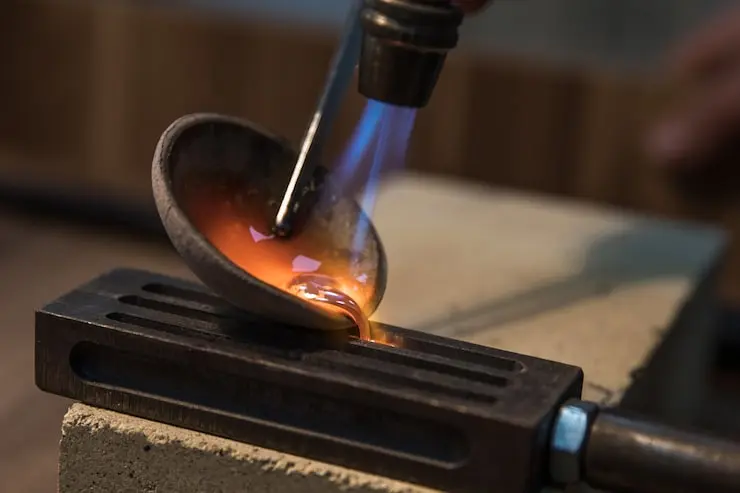
Investment casting for rapid prototyping uses SLA printed patterns typically in castable wax-like resin as a substitute for traditional wax injection-moulded patterns in the lost-wax casting process. The SLA pattern is invested in ceramic shell, the resin is burned out, and molten metal is cast into the ceramic cavity. The result is a complex metal casting that would require expensive production pattern tooling if produced conventionally.
Rapid prototype casting by investment casting is used for: precision metal parts with complex geometry unsuitable for CNC machining (thin walls, undercuts, curved channels); jewelry prototypes and luxury goods components where the SLA castable resin pattern produces fine detail in precious metal; industrial components in stainless steel, carbon steel, aluminium, and copper alloys where batch sizes of 1–50 pieces make hard tooling uneconomical.
Investment Casting for Rapid Prototyping Technical Specifications
- Pattern materials: castable SLA resin (most common), PolyJet wax-like material, FDM burnout filament all burn out cleanly at ceramic firing temperatures
- Casting materials: carbon steel, stainless steel 304/316/17-4PH, aluminium A356, copper alloys, bronze, brass, cobalt-chrome for dental and medical applications
- Tolerance: ±0.3–0.5mm on investment cast dimensions tighter than sand casting, requires post-machining for critical features
- Surface finish: Ra 3–6µm as-cast smoother than sand casting; post-machining achieves Ra 0.8µm or better on critical surfaces
- Part size range: small to medium (5g to 20kg typical range for rapid prototype casting by investment casting)
- Lead time: 14–21 working days for first castings including pattern production
Choosing Between Vacuum Casting, Injection Moulding, and Investment Casting
| Factor | Vacuum Casting | Rapid Injection Moulding |
|---|---|---|
| Material | Polyurethane resins (simulate thermoplastics) | Actual production thermoplastics |
| Quantity range | 1–50 pieces per mould | 50–5,000 pieces |
| Tooling cost | No tooling — SLA master + silicone mould | USD 2,000–15,000 aluminium tool |
| Lead time first shot | 10–14 working days | 14–28 working days |
| Tolerance | ±0.3–0.5mm | ±0.1–0.2mm |
| Surface finish | Production-equivalent cosmetic | Production injection moulded |
| Best for | Pre-launch samples, regulatory submissions | Pre-production, PPAP, customer approval |
Rapid Prototype Casting Service Materials Available at Manufyn
Vacuum Casting Resins
| Resin Type | Properties | Application |
|---|---|---|
| ABS-like PU | Rigid, impact-resistant, paintable, opaque | Consumer electronics housings, industrial enclosures |
| ABS+PC-like PU | Higher heat resistance (120°C), tougher | Automotive interior parts, power tool housings |
| PP-like PU | Flexible, chemical-resistant, living hinge capable | Packaging, caps, flexible connectors |
| Rubber/TPE PU | Shore A 20–90, flexible, elastic | Seals, grips, vibration dampers, wearable parts |
| Transparent PC-like PU | Clear, tinted colours possible | Light guides, lenses, display covers |
| Flame-retardant PU | UL 94 V-0 rated | Electrical enclosures, consumer electronics |
| Glass-filled PU | Higher stiffness, reduced shrinkage | Structural parts, dimensional stability critical |
Rapid Injection Moulding Materials
- ABS: standard grade and flame-retardant grade most common for consumer electronics and industrial housings
- ABS+PC blend: improved heat resistance and impact strength automotive interiors, power tools
- PP: excellent chemical resistance and fatigue life living hinges, food-grade containers, medical device housings
- PA6 and PA66: high strength, good thermal resistance automotive under-bonnet, industrial structural
- PC: clear, high impact resistance optical parts, protective guards, display covers
- POM (Delrin): low friction, dimensionally stable gears, bushings, sliding mechanisms
- TPE and TPU: flexible production overmoulding grips, seals, soft-touch surfaces
- Glass-filled variants of all resins above: higher stiffness, reduced warpage, improved dimensional stability
Industry Applications of Rapid Prototype Casting at Manufyn
Automotive Pre-Production and PPAP
Automotive OEMs and Tier-1 suppliers use rapid prototype casting extensively for PPAP (Production Part Approval Process) submissions and pre-production quality evaluations. Vacuum casting rapid prototyping provides customer presentation samples and colour approval sets before tooling is cut. Rapid prototyping injection moulding from aluminium tooling provides PPAP-level dimensional and material samples. See Manufyn’s automotive rapid prototyping guide for the full automotive application context.
Consumer Electronics Hardware Sign-Off
Consumer electronics companies use vacuum casting rapid prototyping for final cosmetic sign-off — typically 5–20 pre-production samples in production-equivalent cosmetic quality presented to design, marketing, and customer teams before the production mould is cut. The cost of 10–20 vacuum cast samples is typically USD 800–3,000, compared to USD 30,000–80,000 for a production mould that would need to be modified if the cosmetic design changes. See consumer electronics rapid prototyping for the full application context.
Medical Device Pre-Production Builds
Medical device companies use rapid prototyping injection moulding for pre-production builds of 50–500 pieces used in clinical trials, usability studies, and regulatory submissions. Parts must be produced in the production material (not a simulated resin) to be valid for these submissions. Rapid prototyping injection moulding from aluminium tooling satisfies this requirement at 60–80% lower tooling cost and 50% shorter lead time than production steel tooling. See medical device rapid prototyping for FDA and ISO 13485 documentation requirements.
Jewelry and Investment Casting Patterns
Jewelry designers and luxury goods manufacturers use SLA castable resin patterns for investment casting of rings, pendants, brooches, watch components, cufflinks, and trophy elements in gold, silver, bronze, and brass. The SLA rapid prototype casting pattern is produced in 24–48 hours from the CAD model and can be burned out in a standard jewelry kiln without residue. See Manufyn’s jewelry and luxury goods rapid prototyping guide for detailed guidance on the SLA-to-investment-casting workflow.
Rapid Prototype Casting Service Cost Overview
For full cost benchmarks across all casting methods with sample part calculations and India vs USA/UK comparisons see Manufyn’s rapid prototyping cost guide. Indicative costs:
- Vacuum casting rapid prototyping: SLA master USD 80–300 + silicone mould USD 200–600 + USD 20–80 per cast part. At 20 pieces, total cost typically USD 700–2,500 40–60% lower than US domestic equivalents.
- Rapid prototyping injection moulding: aluminium tool USD 2,000–15,000 + USD 5–40 per moulded part at 100 pieces. Tooling cost 60–80% lower than production steel tooling.
- Investment casting rapid prototype: SLA pattern USD 80–250 + casting and ceramic shell USD 150–500 per piece for small components in standard alloys. 40–55% lower than US domestic foundry quotes.
Rapid prototype casting from Manufyn India vacuum casting, injection moulding, and investment casting. All in-house. ISO 9001. Ships globally. Quote in 24 hours.
Frequently Asked Questions Rapid Prototype Casting
Rapid prototype casting is producing physical prototype parts using casting or moulding technologies — vacuum casting, rapid injection moulding, or investment casting — without production hard tooling. It produces parts closer in material properties and cosmetic finish to production parts than 3D printing, at lower per-unit cost than CNC machining for quantities above 5–10 pieces.
A silicone vacuum casting mould typically produces 20–25 shots before dimensional wear requires a replacement mould. For batches larger than 25 pieces, a new silicone mould is cast from the same SLA master the master is reusable. For batches above 50 pieces, rapid prototype molding from aluminium injection tooling becomes more cost-effective.
The injection moulding process is identical the difference is tooling material. Rapid prototype molding uses aluminium tooling (2,000–5,000 shots before wear) instead of hardened steel tooling (500,000+ shots). The parts produced are in the same production-grade thermoplastics with the same surface finish quality. The distinction matters for PPAP: aluminium-tooled parts are accepted for most PPAP submissions as they are produced by the same process and material as production.
Vacuum cast polyurethane resin parts are generally not accepted for regulatory submissions requiring production material equivalence (FDA 510(k), CE marking, ISO 13485 design verification). Rapid prototyping injection moulding in the actual production thermoplastic material is required for those submissions. For medical device applications, see Manufyn’s rapid prototyping for medical devices guide.
Carbon steel (various grades), stainless steel 304, 316, and 17-4PH, aluminium A356, copper alloys, brass, bronze, cobalt-chrome CoCrMo for dental and orthopaedic applications. Precious metals (gold, silver, platinum) for jewelry investment casting are also available discuss at the quoting stage.
SLA produces individual parts directly from the digital file. Vacuum casting rapid prototyping uses an SLA master to create a silicone mould, then casts multiple parts from that mould in polyurethane resin. Vacuum cast parts closely replicate the properties of injection-moulded thermoplastics; SLA resin parts do not. For 2–4 pieces, SLA is typically faster and cheaper. For 5–50 pieces, vacuum casting rapid prototyping is typically cheaper per unit and produces higher-quality parts. See Manufyn’s 3D printing rapid prototyping guide for the full comparison.
Vacuum casting: 10–14 days fabrication + 5–6 days air freight = 16–20 days total. Rapid prototype molding: 14–28 days tooling and moulding + 5–6 days air freight = 20–34 days total. Investment casting: 14–21 days + 5–6 days air freight = 20–27 days total. Express options available contact Manufyn to confirm.
Yes. Manufyn manages the complete rapid prototype casting workflow in-house: SLA master production, silicone mould creation, urethane casting, post-processing, and finishing. All steps are performed at Manufyn’s Pune facility under the same ISO 9001 quality system, with a single project manager and single delivery date.