CNC rapid prototyping is the production of engineering prototypes by removing material from a solid billet using multi-axis CNC milling and turning without tooling, directly from a CAD file, in 3–7 working days. It is the method of choice when material properties, dimensional accuracy, or surface finish requirements cannot be met by 3D printing. Manufyn’s CNC rapid prototyping delivers machined prototypes in aluminium, stainless steel, titanium, and engineering plastics shipped globally from Pune, India, with a 24-hour quote.
Need tight-tolerance CNC prototypes in aluminium, stainless steel, or titanium? Manufyn quotes in 24 hours. Free DFM review. Ships globally.
What is CNC Rapid Prototyping?
CNC rapid prototyping uses computer-controlled milling machines and lathes to remove material from a solid block or bar stock, producing the prototype directly from the digital CAD model. Unlike 3D printing, which adds material layer by layer (see the 3D printing rapid prototyping guide for a full comparison), CNC machining starts from a solid piece of metal or plastic and removes everything that is not the part.
The ‘rapid’ in CNC rapid prototyping refers to the absence of production tooling. Modern CAM software automatically generates toolpaths from the 3D model, compressing setup time to hours. The rapid prototyping process guide describes how CNC fits into the eight-step workflow from CAD submission to delivery.
CNC Rapid Prototyping vs 3D Printing When Each Wins
The choice between CNC and 3D printing is covered broadly in the types of rapid prototyping guide. The table below provides a direct comparison for the most common decision points:
| Factor | CNC Rapid Prototyping | 3D Printing |
|---|---|---|
| Tolerance | ±0.05mm standard | ±0.1–0.5mm depending on technology |
| Material | Production-grade metals and plastics | Limited to printable materials |
| Surface finish | Ra 0.8µm achievable as-machined | Layer lines unless post-processed |
| Strength | Isotropic — same as solid material | Anisotropic — weaker in Z-axis |
| Complex internal geometry | Limited by tool access | Excellent — especially SLS/DMLS |
| Lead time (1 piece) | 3–7 working days | 1–5 working days |
| Best for | Functional, tight-tolerance, end-use material | Concept models, complex geometry, fast iteration |
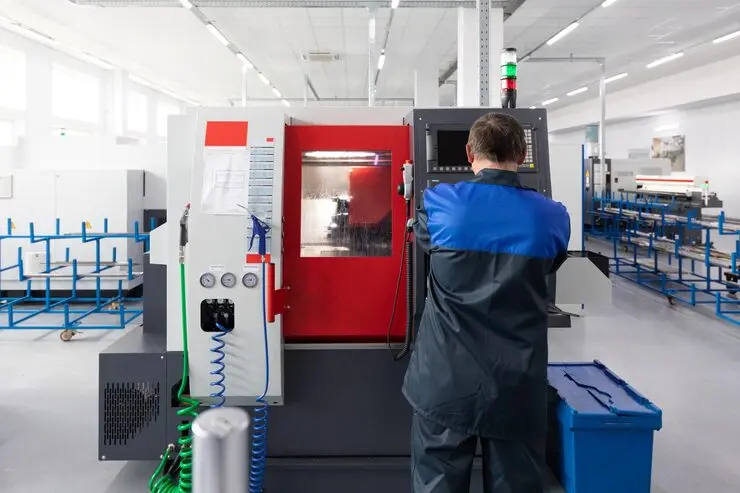
When CNC Rapid Prototyping is the Right Choice
1. End-Use Material Properties Are Required
When a prototype will be used in thermal testing, vibration analysis, pressure testing, or structural load testing, CNC machining from the actual production material is the only reliable method. A CNC aluminium prototype will behave identically to an aluminium production part under load. An SLA resin prototype will not. For material selection guidance, see the rapid prototyping materials guide.
2. Tolerances Tighter Than ±0.2mm Are Required
The best 3D printing technologies achieve ±0.1–0.2mm. CNC machining achieves ±0.05mm as standard, and ±0.02mm or tighter on grinding operations. For mating parts, bearing housings, hydraulic fittings, or any feature where fit and clearance are critical, CNC is the only reliable option at prototype quantities.
3. Surface Finish Requirements Cannot Be Met by 3D Printing
As-printed 3D printing surfaces have Ra values of 1.6–12µm depending on technology. CNC achieves Ra 0.8µm as standard, Ra 0.4µm with fine finishing, and Ra 0.1µm or better after grinding or polishing. For sealing surfaces, optical surfaces, or any surface where roughness directly affects function, CNC is required.
4. The Production Part Will Be CNC Machined
If production will use CNC for precision components in aerospace, medical devices, hydraulics, or industrial equipment prototype in CNC. Prototyping in 3D printing and then switching to CNC for production introduces material behaviour differences that affect functional test outcomes. See how this principle applies inaerospace rapid prototyping and medical device rapid prototyping.
5. Regulatory or Certification Submissions
FDA 510(k), CE marking, AS9100 first articles, and PPAP documentation require samples that closely represent production intent in material and dimensions. CNC from certified material with full traceability is the standard. Seemedical device rapid prototyping and aerospace rapid prototyping for sector-specific documentation requirements.
CNC rapid prototyping from Manufyn aluminium, stainless steel, titanium, PEEK. ±0.05mm tolerance. ISO 9001. Ships to USA, UK, UAE, Australia. Quote in 24 hours.
Materials for CNC Rapid Prototyping at Manufyn
For a full materials selection guide covering both 3D printing and CNC materials, see Manufyn’s rapid prototyping materials guide. Manufyn stocks and machines the following at its Pune facility:
| Material | Grade / Spec | Common Applications |
|---|---|---|
| Aluminium | 6061-T6, 7075-T6, 5052 | Aerospace, automotive, electronics enclosures |
| Stainless Steel | 304, 316L, 17-4PH, 303 | Medical, food-grade, marine, structural |
| Mild Steel | S235, S355, 4140 alloy | Industrial, structural, HVAC |
| Titanium | Grade 5 (Ti6Al4V) | Aerospace, medical implants, performance parts |
| Brass | CZ121, CZ132 | Electrical, plumbing, decorative |
| Copper | C101, C110 | Electrical, thermal management |
| PEEK | Medical / Aerospace grade | High-temp, chemical-resistant, biocompatible |
| Delrin (POM) | Acetal | Gears, bushings, sliding mechanisms |
Tolerances Achievable with CNC Rapid Prototyping
| Tolerance Class | Typical Range | When Required |
|---|---|---|
| ISO 2768-m (Medium) | ±0.1–0.3mm linear | General engineering prototypes |
| ISO 2768-f (Fine) | ±0.05–0.1mm linear | Precision engineering, mating parts |
| Tight / GD&T | ±0.01–0.05mm | Aerospace, medical, hydraulics |
| Grinding | ±0.005–0.01mm | Bearing seats, sealing surfaces |
CNC Rapid Prototyping Lead Times
| Part Complexity | Standard Lead Time | Express Lead Time |
|---|---|---|
| Simple (2–3 setups) | 3–4 working days | 1–2 working days |
| Medium (4–6 setups) | 5–7 working days | 3–4 working days |
| Complex (5-axis, tight tolerance) | 7–10 working days | 5–7 working days |
| Multi-component assembly | 8–12 working days | 6–8 working days |
CNC pricing at Manufyn is 40–65% lower than equivalent US and UK domestic quotes. For cost comparisons and sample calculations, see the rapid prototyping cost guide. For country-specific cost comparisons, see theUSA guide,UK guide, or Germany guide.
CNC for Industry Specific Applications
- Medical devices — stainless steel 316L, titanium Grade 5, PEEK surgical instruments and device housings with full material traceability
- Aerospace — aluminium 7075, titanium Ti6Al4V, Inconel with AS9100 documentation and FAIR
- Automotive — powertrain components, brake parts, EV motor mounts in aluminium and steel
- Defence — precision housings and enclosures for non-ITAR commercial defence applications
- Consumer electronics — aluminium heat sinks, precision mounts, antenna housings
From CNC Prototype to Production
CNC rapid prototypes at Manufyn are produced using the same machines, materials, tolerances, and quality processes as Manufyn’s production CNC parts so the transition from prototype to production involves no supplier change and no re-qualification. For parts that transition to injection moulding or investment casting for production, see the casting and moulding guide. For sheet metal production parts that were first prototyped in CNC, see the sheet metal rapid prototyping guide and Manufyn’s full sheet metal service at manufyn.com/commodities/sheet-metal/fabrication/.
CNC rapid prototyping from Manufyn India ±0.05mm tolerance, ISO 9001, full FAIR documentation. Ships to USA, UK, UAE, Australia, Canada, Germany, Singapore, Malaysia. Quote in 24 hours.
Frequently Asked Questions CNC Rapid Prototyping
Express: 1–2 working days for simple parts (single-setup aluminium brackets). Medium-complexity parts: 3–4 working days express. Contact Manufyn to confirm express availability before submitting.
STEP files are preferred they carry exact CAD geometry without tessellation errors. IGES files are also accepted. Always include a PDF 2D drawing with tolerance callouts, surface finish symbols, and material specification.
Yes. Manufyn regularly machines titanium Grade 5 (Ti6Al4V) for aerospace and medical device prototypes, and Inconel 625/718 for high-temperature applications. Mill certificates and material traceability provided as standard.
Yes. CMM inspection produces a full dimensional report with measured values against drawing tolerances. Recommended for aerospace, medical, and regulatory submission orders.
3-axis mills in X, Y, Z suitable for prismatic parts. 5-axis adds two rotational axes, enabling complex aerospace and medical components with compound curves, undercuts, and features on multiple angled faces. Manufyn operates both.
For simple-to-medium geometry in aluminium or stainless at 1–5 pieces, CNC is often cheaper than DMLS because metal powder and print time are expensive. DMLS becomes cost-competitive for very complex geometry. See the rapid prototyping cost guide for sample cost comparisons.
Anodising (Type II and III hard anodise) for aluminium, passivation and electropolishing for stainless steel, powder coating, bead blasting, painting, and hardware installation. Specify in your quote request.
Aerospace and defence (brackets, housings, fixtures), medical devices (surgical instruments, implant prototypes), automotive (powertrain, brake, EV components), industrial equipment (valve bodies, pump components), and consumer electronics (heat sinks, precision mounts).