Rapid prototyping electronics is the production of physical prototype parts for consumer electronics and IoT device development product enclosures, PCB mounting systems, antenna housings, button and interface mechanisms, heat sink structures, and multi-material overmoulded housings using 3D printing, CNC machining, sheet metal fabrication, and vacuum casting.
IoT rapid prototyping and consumer electronics prototyping share a common commercial driver: speed to market. The window between product concept and market launch has compressed from years to months in consumer hardware; each prototype iteration that takes two weeks instead of six weeks adds a compounding development advantage that translates to earlier revenue and better competitive positioning.
Manufyn’s rapid prototyping electronics service delivers from Pune, India to Silicon Valley, Austin, Singapore, Penang, Shenzhen-adjacent Hong Kong, and all major electronics manufacturing hubs globally — with 24-hour quotes, free DFM review, and door-to-door air freight in 2–7 days.
Consumer electronics prototyping from Manufyn India SLA cosmetic models, CNC aluminium heat sinks, sheet metal enclosures, vacuum casting production samples. Ships globally in 3–7 days. 24-hour quote.
The Consumer Electronics and IoT Product Development Cycle
Consumer electronics prototyping at the product development level follows a consistent four-stage cycle that maps directly to the rapid prototyping technologies available at Manufyn:
- Stage 1 — Concept validation (FDM and SLA): Form factor, button placement, port positions, and screen size are validated with FDM or SLA concept models. At this stage, rapid prototyping for electronics is about geometry and visual impression, not materials or function. Cost: USD 15–80 per piece. Lead time: 1–3 days.
- Stage 2 — Engineering validation (CNC and SLS): The design intent is validated in production-equivalent materials CNC aluminium heat sinks are thermally tested; SLS nylon internal structural brackets are mechanically tested; SLA or PolyJet interface and button mechanisms are evaluated for actuation force and travel. IoT rapid prototyping at this stage focuses on functional validation.
- Stage 3 — Industrial design sign-off (Vacuum casting): 10–25 production-equivalent samples are produced via vacuum casting in ABS-like or PC-like polyurethane resin for industrial design, colour, and surface texture sign-off. Consumer electronics prototyping at this stage requires production-equivalent cosmetic quality that 3D printing cannot achieve.
- Stage 4 — Pre-production and certification samples (Rapid injection moulding): PPAP/samples for regulatory submission (FCC, CE, RoHS, UL), retail buyer presentations, and investor demonstrations use rapid injection-moulded parts in the actual production thermoplastic. This is the final rapid prototyping electronics stage before production tooling commitment.
Rapid Prototyping Electronics Technology Applications
Product Enclosure Rapid Prototyping
Consumer electronics enclosure rapid prototyping covers the full range of housing materials and technologies: SLA for cosmetic review at stage 2; vacuum cast ABS-like or PC-like polyurethane for stage 3 cosmetic sign-off; CNC aluminium for premium metal-body device prototypes (smartphones, laptops, smart home hubs); and CNC polycarbonate or PEEK for transparent or high-temperature enclosure prototypes. Sheet metal mild steel and aluminium enclosures are used for industrial IoT rapid prototyping where the production device will be a sheet metal IP-rated cabinet.
Heat Sink and Thermal Management Prototypes
Thermal management is a critical engineering challenge in consumer electronics prototyping — particularly for high-power IoT edge computing devices, EV charging stations, LED lighting systems, and motor controllers. CNC aluminium 6061 and 6063 heat sink prototypes with fin geometries, mounting boss patterns, and surface finish (bead blasted for high emissivity) are core rapid prototyping for electronics deliverables at Manufyn. For complex geometry conformal heat sinks with internal microchannels, DMLS AlSi10Mg is used.
PCB Mounting and Electronic Assembly Fixtures
IoT rapid prototyping for PCB mounting systems standoff arrays, PCB guide rails, connector alignment fixtures, and cable management uses CNC machined aluminium or SLS nylon. Standoffs and mounting points are particularly critical for EMI shielding compliance: the distance between the PCB ground plane and the metal enclosure must be within the specified tolerance for effective shielding. Manufyn’s consumer electronics prototyping for PCB mounting uses CNC machining at ±0.1mm to achieve the required standoff height consistency.
Multi-Material PolyJet Prototypes for Overmoulded Devices
Consumer electronics products with TPE (thermoplastic elastomer) overmoulded surfaces grip zones, button pads, sealed connectors, and gasket interfaces are prototyped using PolyJet multi-material 3D printing. PolyJet simulates the rigid-flexible overmoulded interface in a single print, enabling accurate evaluation of button actuation force, grip texture, and seal compression before production tooling is cut. For PolyJet technical specifications, see the 3D printing rapid prototyping guide.
Antenna Housing and RF-Transparent Prototypes
IoT rapid prototyping for antenna housings and RF-transparent enclosure sections requires materials with specified dielectric properties critical for 5G, WiFi 6E, LoRa, and Zigbee antenna performance. Manufyn’s consumer electronics prototyping for antenna housings uses SLA engineering resin (low dielectric constant, low loss tangent for RF-transparent prototypes), CNC polycarbonate (similar dielectric to production polycarbonate mouldings), and vacuum cast PC-like polyurethane for multi-material assemblies.
IoT rapid prototyping and consumer electronics prototyping from Manufyn India SLA, PolyJet, CNC aluminium, vacuum casting, sheet metal. Ships to San Jose, Singapore, Penang in 3–6 days. Quote in 24 hours.
AS9100 Documentation for Aerospace Rapid Prototyping at Manufyn
Manufyn’s aerospace rapid prototyping documentation package includes:
- FAIR to SAE AS9102 standard: balloon-annotated drawing, full dimensional measurement record (all characteristics, not sampled), pass/fail status against drawing tolerance, instrument calibration references
- AMS or ASTM material certificate: EN 10204 3.1 mill certificate specifying material chemistry, mechanical properties, heat/lot number, and certifying laboratory compatible with AS9100 material traceability requirements
- Conformance statement: written statement confirming that the prototype was produced to the submitted drawing revision and specification, signed by Manufyn’s quality manager
- Process control records: machining programme reference, setup sheet, tool list, and inspection checkpoint records available on request for AS9100 audit readiness
- NDA and IP protection: bilateral NDA before drawing review critical for aerospace designs containing controlled technology
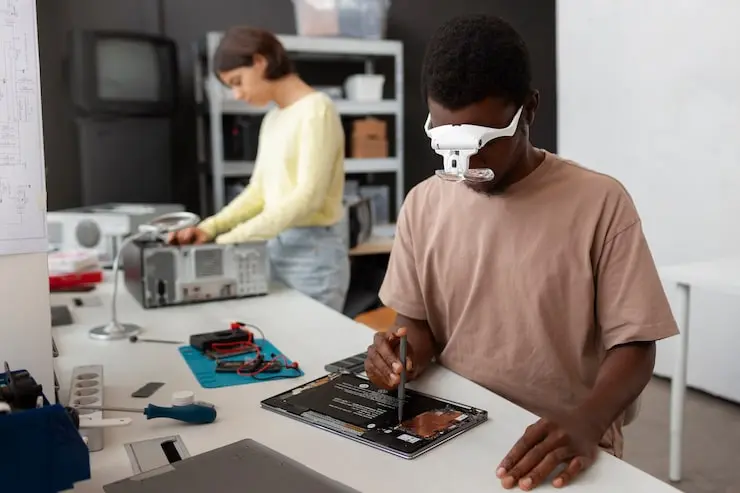
Speed-to-Market How Manufyn’s Electronics Prototype Service Accelerates Development
The competitive advantage of consumer electronics prototyping from India is primarily speed-to-market, not just cost. The ability to run concurrent prototype iterations one technology for cosmetic review while a parallel order runs functional validation is enabled by the 40–60% cost saving from India: the same budget funds two simultaneous prototype orders rather than one sequential order. This compression of the development calendar is the primary commercial value for rapid prototyping electronics hardware teams.
Typical development calendar comparison for a consumer IoT device smart home hub from concept to pre-production:
- US domestic consumer electronics prototyping: 6 prototype iterations over 18–22 weeks, total prototype spend USD 18,000–28,000
- Manufyn India consumer electronics prototyping: 8–10 prototype iterations over 14–18 weeks (more iterations possible due to lower per-iteration cost), total prototype spend USD 8,000–14,000
- Net saving: 40–55% cost reduction and 4–6 week faster time to pre-production

Industry Geography Consumer Electronics Rapid Prototyping Markets
Manufyn’s consumer electronics prototyping service is used in all major global electronics hardware development markets: USA (San Jose, Austin, Seattle, New York) | Singapore (Changi, One-North, JTC LaunchPad) | Malaysia (Penang electronics cluster) | UK (Cambridge, London hardware ecosystem) | Germany (Berlin hardware startups, Stuttgart automation).
Aerospace rapid prototyping from Manufyn India AMS material certs, AS9102 FAIR, CNC titanium and aluminium 7075, DMLS. 40–60% cost saving. Ships globally. Quote in 24 hours.
Frequently Asked Questions Rapid Prototyping Electronics
FDM, SLA, SLS, MJF, PolyJet, DMLS all 3D printing technologies; CNC machining in aluminium, stainless, and engineering plastics; sheet metal fabrication (aluminium and mild steel IP-rated enclosures); and vacuum casting for production-equivalent cosmetic samples. All technologies in-house at Manufyn’s Pune facility.
SLA cosmetic models to San Jose: 2 days print + 5 days air = 7 days total. CNC aluminium heat sink: 3 days machine + 5 days = 8 days. Vacuum cast 10-piece batch: 12 days + 5 days = 17 days. Express options: SLA to San Jose in 4–5 days total (24 hours print + 3 days express air).
Yes. Manufyn’s PolyJet rapid prototyping for consumer electronics and IoT produces rigid-flexible multi-material parts simulating production overmoulded assemblies buttons, grips, gaskets, and sealed interfaces all in a single print. Ra 1.2µm as-printed surface finish.
Yes. Sheet metal enclosure rapid prototyping at Manufyn includes gasket groove machining, gasket material sourcing, and hardware installation for IP65/IP67 sealing validation samples. The physical prototype is used to confirm gasket compression and sealing before production tooling is committed. See sheet metal rapid prototyping for full sheet metal IP-rated enclosure capability.
Yes. CNC aluminium enclosures with bead-blasted or conductive-anodised surfaces for EMI shielding, copper-plated surfaces for RF shielding, and CNC stainless shielding can liners are all available. Specify EMI shielding requirements in the quote request for Manufyn’s engineers to confirm the appropriate process.
Yes and this is one of the most common consumer electronics prototyping applications at Manufyn. Pre-launch demonstration samples for CES, MWC, or retail buyer presentations require vacuum cast production-equivalent cosmetic samples in launch colour and surface texture. A 20-piece vacuum cast batch from Manufyn typically takes 12–14 working days + 5 days air to USA = 17–19 days total. For express requirements, CES preparation should start at least 3 weeks before the event.
At 40–55% lower cost per iteration from Manufyn, a USD 20,000 total prototype budget funds 8–10 iterations from Manufyn versus 5–6 iterations from US domestic suppliers. The additional iterations translate directly to a more refined design at production commit fewer expensive last-minute design changes after tooling is cut.
Yes. Manufyn signs a bilateral NDA before reviewing any design files. Consumer electronics designs enclosure geometries, PCB layout references, industrial design language, and product positioning data shared in the course of prototyping are held in strict confidence. Manufyn does not share, reference, or disclose designs to any third party.