
No Drawing.
No Supplier.
Just One Worn-Out Part.
How a physical motorcycle engine component became the starting point for a new manufacturing solution.
A sample-based reverse engineering and manufacturing case study involving dimensional study, component reconstruction, supplier development, prototyping and production planning.
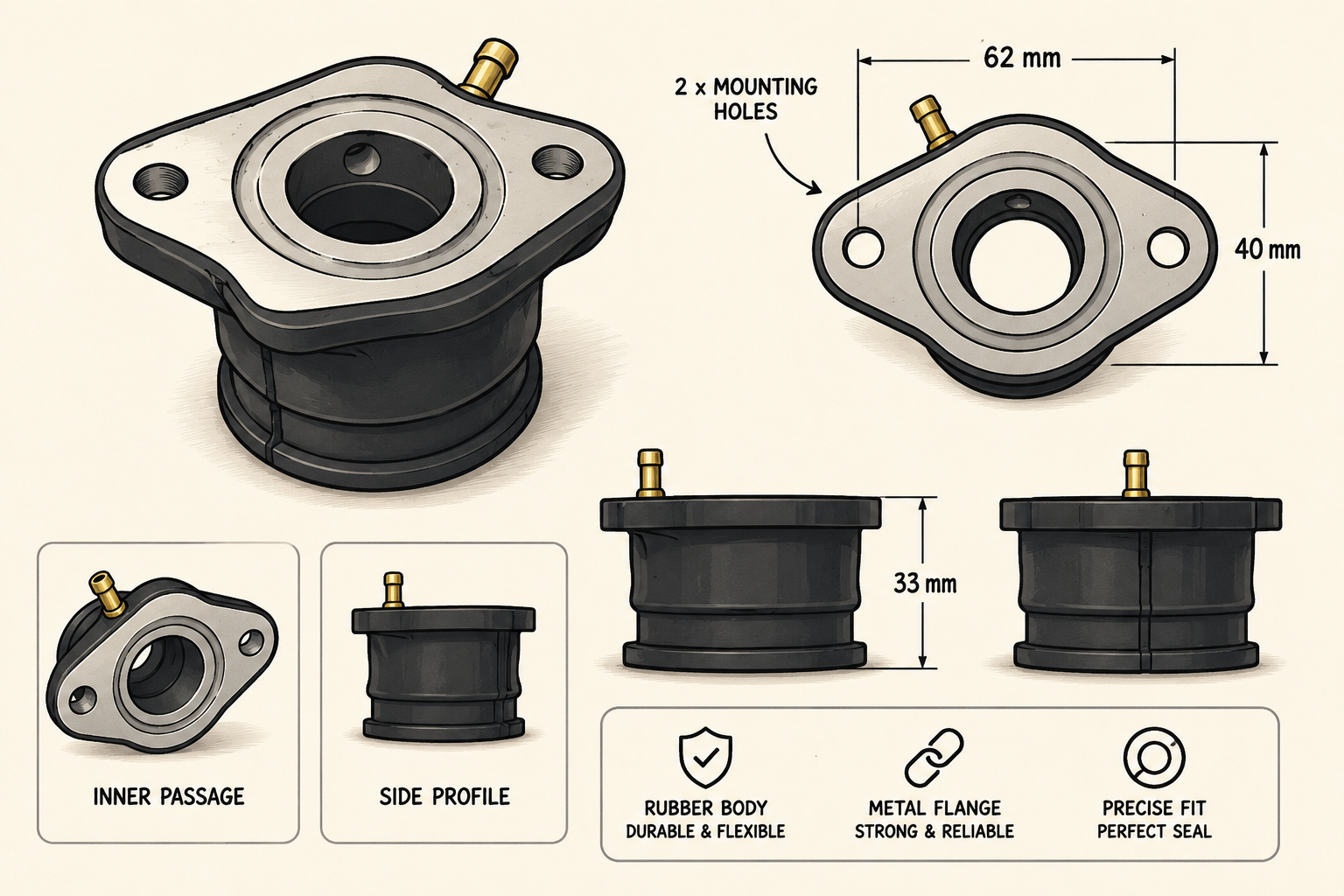
A small motorcycle engine component arrived as a physical sample. It had a metal mounting flange, a rubber body and an internal passage. There was nothing particularly complicated about its appearance.
The problem was that the usual information required for manufacturing was not readily available in the form of a complete engineering drawing and an established production source.
The customer needed more than a visually similar replacement. The reproduced component had to work with the existing assembly, maintain the important interfaces and be manufacturable consistently.
That changed the nature of the project.
It wasn’t simply
“Who can make this part?”
It was
“How do we turn this sample into a repeatable manufacturing solution?”
A physical sample had to become engineering information.
Reverse engineering starts with understanding what the component actually needs to do—not simply copying its external appearance.
- Overall component dimensions
- Mounting flange geometry
- Mounting-hole positions
- Internal bore and passage geometry
- Rubber body profile
- Metal-to-rubber interface
- Auxiliary port / connection geometry
- Critical sealing and mating surfaces
Why a visual copy was not enough
Components used in an engine assembly can have several interfaces that determine whether a replacement actually works.
A part may look almost identical while having a different bore, mounting position, sealing surface or interface geometry.
The objective therefore became to understand the component as an engineered product before asking a manufacturer to reproduce it.
From physical sample to manufacturable component
The project followed a structured reverse engineering workflow, designed to reduce ambiguity before production.
Understand the Sample
The physical component was examined to identify its geometry, interfaces, construction and visible wear characteristics.
Capture Critical Dimensions
Key dimensions and interfaces were identified so the sample could be translated into useful manufacturing information.
Rebuild the Geometry
The component geometry was broken down into its individual manufacturing and functional elements.
Identify Manufacturing Capability
Supplier capabilities were evaluated against the component’s material, process, dimensional and assembly requirements.
Produce a Prototype
A prototype provides an opportunity to evaluate fit, form, interfaces and manufacturing feasibility before scaling.
Prepare for Repeatability
The final objective is not one successful part, but a repeatable manufacturing route suitable for future production.
Simple on the outside.
Multiple engineering requirements underneath.
The sample was approached as a combination of functional interfaces rather than a single undifferentiated component.
The right supplier mattered as much as the right design.
A component combining metal and elastomer requirements cannot always be treated like a conventional off-the-shelf part.
The manufacturing route therefore had to account for the individual component features, production process, dimensional requirements, assembly and repeatability.
Why supplier selection was critical
The lowest quotation does not necessarily represent the best manufacturing solution.
For reverse-engineered components, supplier selection should consider engineering interpretation, process capability, inspection discipline, prototype flexibility and production consistency.
Learn about supplier selection →Before production, the component has to make sense.
Sample-based manufacturing requires attention to the characteristics that influence fit, function and repeatability.
Dimensional Inspection
Critical dimensions, hole locations and interfaces can be checked against the defined component requirements.
Fit & Interface
Mating and mounting features should be evaluated to ensure compatibility with the intended assembly.
Material Consideration
Material selection needs to reflect the operating environment and functional requirements of the component.
Production Repeatability
The manufacturing process should be capable of producing consistent parts beyond the initial prototype.
From an undocumented physical sample
to a manufacturing pathway.
What began as a worn physical component became an engineering and sourcing exercise: understand the sample, define the critical requirements, identify capable manufacturing partners, prototype the component and establish a path toward repeatable production.
That is the real value of reverse engineering—not simply recreating the appearance of an old part, but converting an existing physical reference into something that can be manufactured again.
It can be sitting on a workbench as a worn-out component that has already survived years of real-world use.
This is particularly relevant when dealing with obsolete parts, legacy equipment, aftermarket components, replacement parts, undocumented assemblies and products where the original supplier is no longer accessible.
A physical sample can become the starting point for reverse engineering, prototyping, supplier development and eventual production sourcing.
For global companies sourcing from India, this can also create an opportunity to combine engineering support with qualified manufacturing suppliers and quality oversight.
Reverse Engineering Motorcycle Components from Physical Samples
Reverse engineering can provide a practical route for reproducing motorcycle components when original drawings, suppliers or manufacturing documentation are unavailable. A physical sample can be studied, measured and converted into useful engineering information for prototype manufacturing and production sourcing.
When is motorcycle component reverse engineering useful?
Sample-based reverse engineering can be useful for obsolete motorcycle parts, replacement components, legacy assemblies, aftermarket products, low-volume components and parts where the original manufacturer or supplier is difficult to access.
What does the reverse engineering process involve?
Depending on the component, the process may include physical inspection, dimensional measurement, geometry reconstruction, material assessment, manufacturing process selection, prototype development, quality inspection and supplier qualification.
Why combine reverse engineering with manufacturing sourcing?
Engineering information alone does not guarantee a successful production part. The manufacturer must also have the appropriate process capability, equipment, inspection systems and production discipline. Combining reverse engineering with supplier development can create a more complete path from physical sample to repeatable production.
Manufyn supports global companies looking for manufacturing and procurement solutions in India, connecting engineering requirements with qualified suppliers, prototyping, production and quality oversight.
Have an old part, sample or undocumented component?
Send Manufyn the component, drawing, photographs or available specifications. We can help evaluate the engineering and manufacturing path for sourcing from India.