Surface finishing is any process applied to a metal part after fabrication to improve its corrosion resistance, appearance, hardness, or wear life. The main options for metal parts are powder coating, anodizing, electroplating, passivation, painting, and mechanical finishes like brushing and bead blasting. Each suits different materials and purposes — anodizing is for aluminium, passivation is for stainless steel, and powder coating works across most metals — so the right finish depends on your part’s material, environment, and function.
Choosing the wrong finish, or leaving it as an afterthought, is a common and avoidable mistake. A finish applied to the wrong material won’t adhere or protect; one specified without accounting for its thickness can turn a precise fit into an interference fit; and a finish requested after production has started costs more than one planned into the design. This guide compares every major surface finishing option by purpose, material compatibility, cost, and dimensional impact, so you can specify the right one from the start.
The comparisons here reflect what Manufyn applies to finished parts daily. Manufyn’s sheet metal fabrication service runs finishing in-house from an ISO 9001 certified facility in Pune, India — so this is written from the shop that actually coats and plates the parts.
Why Surface Finishing Matters
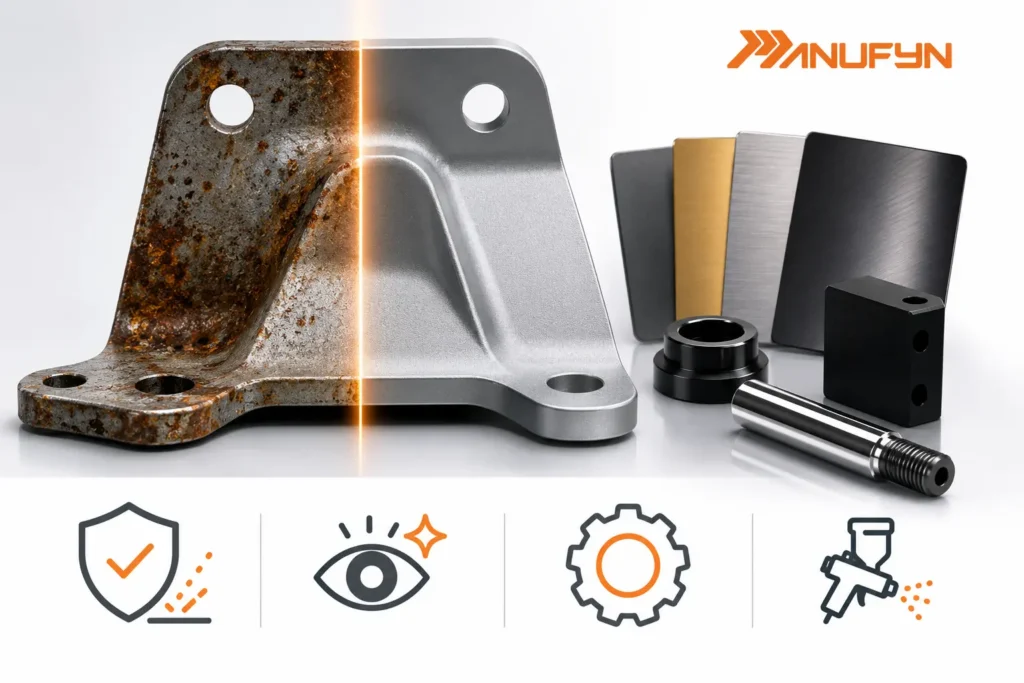
A finish decides how long a part survives and how it looks doing it. It’s the difference between a bracket that rusts in a season and one that lasts a decade.
Bare metal is rarely the finished product. Left uncoated, most steels corrode, aluminium oxidises, and machined surfaces show tool marks — so a surface finish is applied to protect the part, improve its appearance, or add a specific property like hardness or electrical conductivity. Finishing serves four broad purposes: corrosion protection (the most common reason), cosmetic appearance, functional performance (wear resistance, conductivity, or friction control), and preparation for a subsequent coating. The right finish is chosen by weighing the part’s operating environment against its material and its cosmetic requirements — a hidden internal bracket needs different treatment from a visible outdoor enclosure. One consequence buyers often overlook is dimensional: every finish adds or removes a small amount of material, which matters on mating surfaces and tight tolerances.
Surface Finishing Options Compared
Here’s how the main finishing options compare on what they do, which materials they suit, and their relative cost — the core reference for choosing a finish.
| Finish | Main purpose | Best materials | Relative cost |
|---|---|---|---|
| Powder coating | Durable colour + corrosion protection | Steel, aluminium, most metals | Low–moderate |
| Anodizing | Hardness + corrosion resistance | Aluminium only | Moderate |
| Electroplating (zinc, nickel, chrome) | Corrosion + wear + appearance | Steel and other metals | Moderate |
| Passivation | Restore corrosion resistance | Stainless steel | Low |
| Painting (wet paint) | Colour + basic protection | Most metals | Low |
| Powder + zinc (duplex) | Maximum corrosion protection | Steel in harsh environments | High |
| Brushing / bead blasting | Cosmetic surface texture | Stainless, aluminium | Low |
The Main Finishes Explained
Powder Coating
Powder coating applies a dry powder electrostatically, then cures it in an oven into a tough, uniform layer. It’s the most popular finish for fabricated metal parts because it’s durable, available in almost any colour and texture, and provides strong corrosion protection at low-to-moderate cost. It typically adds 60–100 µm of thickness — enough to affect a tight fit — so mating surfaces should be masked or the tolerance adjusted.
Anodizing
Anodizing is an electrochemical process exclusive to aluminium that grows a hard, corrosion-resistant oxide layer from the metal itself, rather than coating over it. Because the layer is integral to the part, it won’t chip or peel like paint. It can be dyed in colours and comes in types (Type II for general use, Type III / hard anodize for wear resistance). It’s the standard finish for machined aluminium parts.
Electroplating
Electroplating deposits a thin metal layer — zinc, nickel, or chrome — onto a part using an electric current. Zinc plating is a cost-effective corrosion barrier for steel; nickel adds wear resistance and a bright finish; chrome adds hardness and a decorative shine. Plating is thin, so it has minimal dimensional impact, making it suitable for precision parts.
Passivation
Passivation is a chemical treatment for stainless steel that removes free iron from the surface and restores the protective chromium-oxide layer that fabrication can compromise. It adds no measurable thickness and no colour — it simply returns the stainless to its full corrosion resistance, which is why it’s standard for medical, food, and marine stainless parts.
Not sure which finish your part needs? Send your drawing and its operating environment to Manufyn — we’ll recommend the right finish and return a firm quote within 24 hours. ISO 9001, strictly in-house, no minimum order.
How to Choose the Right Finish
The right finish follows directly from your part’s material, environment, and function:
- Aluminium needing hardness or a premium look → anodizing
- Steel needing colour and durable protection → powder coating
- Stainless steel after fabrication → passivation
- Precision steel parts needing thin corrosion protection → zinc or nickel plating
- Steel in harsh or outdoor environments → duplex (zinc + powder coat)
- Cosmetic-only requirement → brushing or bead blasting
Buyer takeaway: match the finish to the material first (anodizing only works on aluminium, passivation only on stainless), then to the environment. Always state the finish, its colour code, and target thickness in the RFQ — and mask mating surfaces where thickness affects fit. Material selection is covered in our sheet metal materials guide, with detail on grades like aluminium 5052 and stainless steel 304.
How Finishing Affects Part Dimensions
A finish is never truly “zero thickness,” and ignoring this is a common cause of parts that no longer fit. Here’s the dimensional impact of each:
| Finish | Typical thickness added | Fit impact |
|---|---|---|
| Powder coating | 60–100 µm | Significant — mask mating surfaces |
| Anodizing (Type II) | ~5–25 µm (grows into the part) | Small but real on tight fits |
| Electroplating | ~5–25 µm | Minimal — suits precision parts |
| Passivation | Negligible | None |
| Wet paint | 25–75 µm | Moderate on tight fits |
Buyer takeaway: powder coating adds the most thickness and is the finish most likely to turn a designed slide fit into an interference fit. If a coated surface has to mate with something, either mask it or open the tolerance to account for the coating.
How Manufyn Finishes Metal Parts
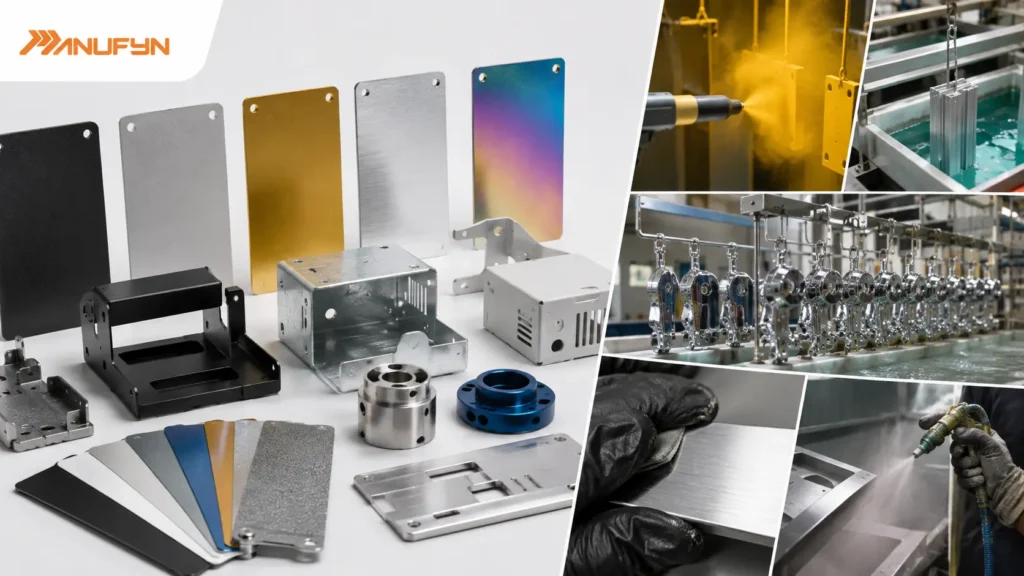
Manufyn is an ISO 9001 certified, strictly in-house manufacturer in Baner, Pune, India — not a broker. Finishing runs alongside cutting, bending, and welding, so a part is fabricated and finished under one roof.
Because fabrication and finishing sit in the same facility, the finish is planned into the part from the DFM stage — mating surfaces are flagged for masking, the finish is matched to the material, and thickness is accounted for on tight tolerances before the part is made. That avoids the common problem of a part that fits perfectly bare but binds once coated. Powder coating, anodizing, plating, passivation, and cosmetic finishes are all specified against your RFQ with colour code and target thickness recorded.
- Powder coating, anodizing, plating, passivation, and mechanical finishes
- Finish matched to material and environment during free DFM review
- Mating surfaces masked and coating thickness accounted for on tight fits
- No minimum order and a firm quote within 24 hours
Read more about our approach on our Why Manufyn page.
Ready to fabricate and finish your part in one place? Send your drawing to Manufyn — finish matched to your material, thickness accounted for, no minimum order, and a firm quote in 24 hours.
FAQs
The main options are powder coating (durable colour and corrosion protection), anodizing (hardness and corrosion resistance for aluminium), electroplating (zinc, nickel, or chrome for corrosion, wear, and appearance), passivation (restoring stainless steel’s corrosion resistance), wet painting, and mechanical finishes like brushing and bead blasting for cosmetic texture.
Powder coating applies a cured polymer layer over the metal and works on most materials in almost any colour, adding 60–100 µm of thickness. Anodizing is an electrochemical process exclusive to aluminium that grows a hard oxide layer integral to the part — it won’t chip or peel and adds far less thickness, but it only works on aluminium.
It depends on the material and environment. For steel in harsh conditions, a duplex system (zinc plating plus powder coat) offers maximum protection. Powder coating alone is strong for general use, anodizing protects aluminium, passivation restores stainless steel, and zinc plating is a cost-effective barrier for steel in milder environments.
Yes. Powder coating adds the most — 60–100 µm — enough to turn a designed slide fit into an interference fit. Anodizing and plating add roughly 5–25 µm, and passivation adds essentially none. Always account for finish thickness on mating surfaces, either by masking them or opening the tolerance to compensate.
No. Anodizing is an electrochemical process that works only on aluminium (and a few other metals like titanium), because it grows an oxide layer from the metal itself. Steel is instead protected by powder coating, plating, or duplex systems. Matching the finish to the material is the first rule of choosing a finish.
Passivation is a chemical treatment for stainless steel that removes free iron from the surface and restores the protective chromium-oxide layer that fabrication can compromise. It’s needed whenever stainless steel has been machined, welded, or handled in ways that reduce its corrosion resistance — standard for medical, food, and marine parts.
State the finish type, the colour code where relevant (for example, a RAL number for powder coat), the target thickness, and any surfaces to be masked. Specifying these in the original RFQ lets the manufacturer plan for the finish — a finish requested after production has started costs more and can force rework.
Passivation, wet paint, and mechanical finishes like brushing tend to be lowest cost, and powder coating is low-to-moderate. Anodizing and electroplating are moderate, and duplex systems are the most expensive because they combine two processes. The cheapest suitable finish depends on the material and the level of protection the part actually needs.
Have a part that needs finishing? Send your drawing to our engineers — we respond within 4 working hours.
Need metal parts fabricated and finished?
Get the right finish matched to your material, thickness accounted for on fits, and a firm quote in 24 hours — no minimum order.
Talk to Manufyn