
Mass Production Advantages
and Disadvantages
Mass production enables manufacturers to produce thousands or even millions of identical parts with consistent quality and lower unit costs. But is it the right choice for every product? Learn the benefits, limitations, ideal applications, and how Manufyn helps global companies successfully transition from prototype development to full-scale production in India.
Scale Manufacturing with Confidence
From production tooling and injection molding to CNC machining, die casting, sheet metal fabrication and global procurement, Manufyn helps businesses manufacture at scale while maintaining quality, competitive pricing, and reliable delivery.
What is Mass Production?
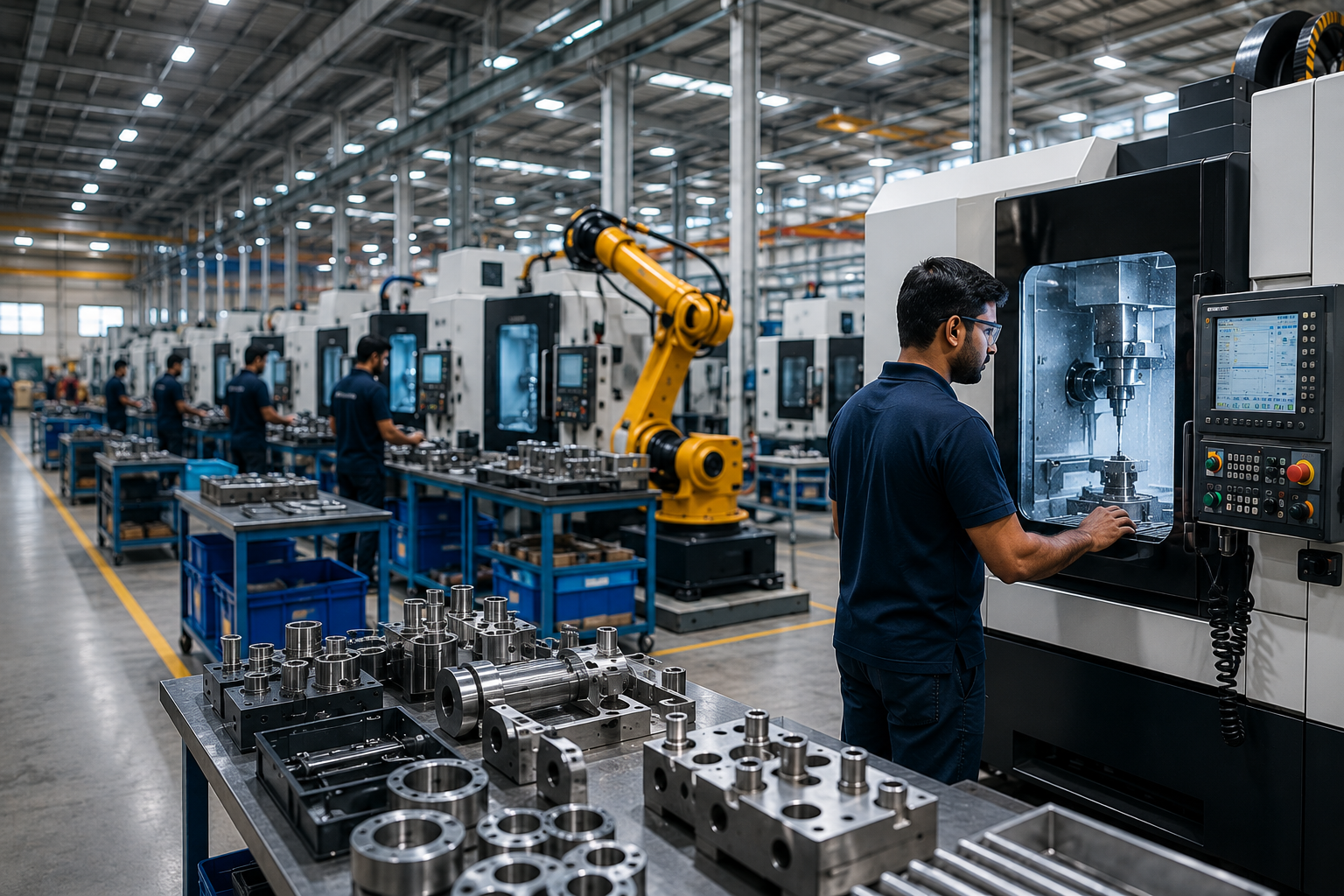
Mass production is a manufacturing method used to produce large quantities of identical products using standardized processes, dedicated tooling, automation, and efficient production lines. It allows manufacturers to achieve lower production costs, consistent quality, and faster delivery while meeting increasing market demand.
Businesses generally transition to mass production after successful prototyping, design validation, and production tooling development. Whether manufacturing plastic components through Injection Molding, precision parts using CNC Machining, or metal components through die casting and sheet metal fabrication, mass production enables companies to scale efficiently without compromising quality.
Lower Unit Cost
Large production volumes spread tooling and setup costs across thousands of components, significantly reducing the cost per part.
Consistent Quality
Automated manufacturing processes ensure every component meets the same dimensional and quality standards.
Higher Production Capacity
Modern manufacturing equipment can produce thousands of parts daily while maintaining repeatability and efficiency.
Global Supply Support
Mass production helps companies maintain stable inventories and fulfil worldwide customer demand with predictable lead times.
Why Companies Scale to Mass Production
- Growing customer demand
- Reduced manufacturing costs
- Improved production efficiency
- Higher quality consistency
- Better delivery performance
- Improved profitability
- Supports international expansion
- Reliable long-term supply chain
Advantages of Mass Production
Mass production has transformed modern manufacturing by enabling companies to produce large quantities of identical products with exceptional efficiency. Whether manufacturing automotive components, industrial equipment, plastic parts, or consumer products, businesses benefit from lower costs, consistent quality, and shorter production cycles. The following advantages explain why many global companies choose large-scale manufacturing once product demand has been validated.
Lower Manufacturing Cost
One of the biggest advantages of mass production is the significant reduction in cost per component. Tooling, machine setup, engineering, and production overheads are distributed across thousands of parts, making large-scale manufacturing far more economical than low-volume production.
Consistent Product Quality
Dedicated production tooling, automated machinery, and standardized quality control processes ensure every manufactured component meets the same specifications. This consistency improves customer satisfaction while reducing defects and warranty claims.
Higher Production Speed
Automated manufacturing systems allow factories to produce thousands of identical parts every day. This enables businesses to respond quickly to increasing customer demand and reduce production lead times.
Scalable Manufacturing
Once production tooling is established, manufacturers can easily increase output without redesigning the manufacturing process. This flexibility supports business growth while maintaining operational efficiency.
Supports Global Supply Chains
Mass production enables companies to supply distributors, OEMs, and international customers with consistent inventory levels, making it easier to expand into new markets while ensuring reliable product availability.
Better Return on Tooling Investment
Although production tooling requires an initial investment, manufacturing high volumes spreads the tooling cost across many parts. Over time, this delivers a substantially lower overall manufacturing cost and a stronger return on investment.
Mass Production Works Best When…
Mass production delivers the greatest value when product designs are stable, customer demand is predictable, and production volumes justify dedicated tooling. Businesses often transition from Prototype Tooling to Production Tooling before scaling manufacturing through Injection Molding, CNC Machining, die casting, sheet metal fabrication, or automated assembly lines.
At Manufyn, we help global companies successfully scale manufacturing in India by selecting the right production process, qualifying reliable suppliers, managing quality, and ensuring on-time global delivery.
Disadvantages of Mass Production
While mass production offers significant economic benefits, it is not the ideal manufacturing solution for every product. Businesses should carefully evaluate production volumes, tooling investment, product lifecycle, and market demand before committing to high-volume manufacturing. Understanding these limitations helps manufacturers make informed decisions and minimize production risks.
High Initial Tooling Investment
Production molds, dies, fixtures, and automation equipment require a considerable upfront investment. For products with uncertain demand or low production volumes, recovering these costs may take longer than expected.
Limited Design Flexibility
Once production tooling has been manufactured, design modifications become expensive and time-consuming. Every engineering change may require tooling repairs, modifications, or complete replacement.
Inventory Management Challenges
Producing large quantities without accurate demand forecasting can result in excess inventory, higher storage costs, and increased working capital requirements.
Longer Development Phase
Before production begins, manufacturers must complete product validation, prototype development, tooling design, process optimization, and quality approvals, extending the overall project timeline.
Demand Fluctuation Risk
Unexpected changes in customer demand can leave businesses with unused inventory, idle production capacity, or tooling that is no longer economically viable.
Quality Issues Can Scale Quickly
If process validation is incomplete or production parameters are not properly controlled, even a minor defect can affect thousands of components before it is detected.
How Manufyn Helps Reduce These Risks
Successful mass production starts long before manufacturing begins. At Manufyn, we help customers validate designs through Prototype Tooling, optimize manufacturability using our Prototype Material Selection Guide, and transition smoothly into Production Tooling once the product is ready for large-scale manufacturing.
Our engineering team works closely with certified manufacturing partners for Injection Molding, CNC Machining, die casting, sheet metal fabrication, precision machining, and assembly. Combined with supplier qualification, quality inspections, and project management, this approach minimizes manufacturing risks while ensuring consistent quality and reliable global delivery.
Mass Production vs Low Volume Manufacturing
Choosing the right manufacturing strategy depends on production quantity, budget, product maturity, and market demand. While low-volume manufacturing is ideal for prototypes, testing, and custom products, mass production becomes the preferred solution once demand is established and production efficiency becomes the priority.
| Comparison | Mass Production | Low Volume Manufacturing |
|---|---|---|
| Production Quantity | Thousands to millions of parts | 10 to a few thousand parts |
| Unit Cost | Very low | Higher due to setup costs |
| Tooling Investment | High initial investment | Minimal or no dedicated tooling |
| Lead Time | Longer setup, faster production | Quick setup, lower production speed |
| Design Flexibility | Limited after tooling approval | Excellent for design revisions |
| Quality Consistency | Excellent repeatability | Depends on production process |
| Ideal Applications | Consumer products, automotive, electronics, industrial equipment | Prototype validation, pilot production, product testing |
| Best Manufacturing Processes | Injection molding, die casting, automated machining, stamping | 3D printing, CNC machining, prototype tooling, vacuum casting |
When Low Volume Manufacturing Makes Sense
Low-volume manufacturing is the right choice when products are still under development, customer requirements are evolving, or production quantities remain uncertain. It allows manufacturers to validate designs before investing in dedicated Prototype Tooling and large-scale manufacturing.
When Mass Production is the Better Choice
Once product demand becomes consistent, businesses benefit from transitioning to Production Tooling and automated manufacturing processes. This reduces production costs, improves quality consistency, and enables global supply through processes such as Injection Molding, CNC Machining, die casting, and precision manufacturing.
Industries That Benefit Most from Mass Production
Mass production is widely used across industries that require high-quality components in large quantities while maintaining competitive costs and reliable delivery schedules. By combining automated manufacturing, production tooling, and robust quality control, businesses can efficiently meet global demand without compromising consistency.
Automotive Industry
Automotive manufacturers rely on mass production for precision-machined components, plastic injection molded parts, sheet metal assemblies, forgings, and die-cast components. High production volumes ensure cost efficiency while maintaining strict quality standards.
Industrial Automation & Robotics
Robotics manufacturers require repeatable production of structural components, machined housings, gears, brackets, and engineering plastics. Mass production enables consistent performance across every assembled machine.
Electronics & Electrical Equipment
Consumer electronics, electrical enclosures, connectors, and precision plastic components are commonly produced using high-volume manufacturing processes to satisfy rapidly growing market demand.
Medical Devices
Medical manufacturers use mass production to manufacture disposable products, diagnostic equipment components, precision plastic parts, and medical-grade assemblies while maintaining strict quality and traceability requirements.
Industrial Equipment
Heavy machinery manufacturers benefit from large-scale production of fabricated parts, machined components, castings, and engineered assemblies that support reliable industrial operations worldwide.
Consumer Products
Household appliances, packaging products, furniture components, sporting goods, and consumer accessories all benefit from lower production costs and improved manufacturing efficiency through mass production.
How Manufyn Supports Large Scale Manufacturing
Manufyn partners with qualified Indian manufacturers to help global OEMs and industrial companies scale production efficiently. From prototype development to production tooling, we manage the complete manufacturing journey with supplier qualification, engineering support, project management, quality inspections, and international logistics.
Our expertise spans Injection Molding, CNC Machining, castings, forgings, sheet metal fabrication, precision engineering plastics, rubber components, and complete procurement solutions, enabling customers to build resilient global supply chains while reducing manufacturing costs.
Best Manufacturing Processes for Mass Production
Selecting the right manufacturing process is essential for achieving cost efficiency, product quality, and production scalability. The ideal process depends on material selection, product geometry, annual production volume, tolerance requirements, and overall project budget. Below are some of the most widely used manufacturing technologies for high-volume production.
Injection Molding
Injection molding is one of the most economical manufacturing processes for producing plastic components in large quantities. Once production tooling is developed, identical parts can be manufactured with excellent dimensional consistency, low cycle times, and minimal material waste.
CNC Machining
CNC machining is ideal for precision metal and engineering plastic components that require tight tolerances and superior surface finishes. Modern multi-axis machining centres enable repeatable production with exceptional accuracy.
Die Casting
Die casting is commonly used for manufacturing aluminium and zinc components in large production volumes. It provides excellent dimensional accuracy, complex geometries, and smooth surface finishes while maintaining low unit costs.
Sheet Metal Fabrication
Laser cutting, bending, stamping, punching, and welding allow manufacturers to efficiently produce sheet metal components for industries such as automotive, electronics, industrial equipment, and construction.
Forging & Casting
Forged and cast components offer exceptional mechanical strength for demanding industrial applications. These manufacturing methods are widely used in heavy engineering, mining equipment, agriculture, and automotive sectors.
Assembly & Value Added Manufacturing
Many OEMs combine component manufacturing with assembly, testing, packaging, labeling, and quality inspections to reduce logistics complexity and streamline their global supply chain.
How to Select the Right Manufacturing Process
There is no single manufacturing process that suits every product. Companies should evaluate annual production quantity, material properties, functional requirements, dimensional tolerances, tooling investment, and long-term production costs before selecting a manufacturing method.
Manufyn works with global OEMs to identify the most suitable manufacturing process, develop production tooling, qualify reliable suppliers, manage quality inspections, and coordinate end-to-end procurement from India. This engineering-first approach helps businesses reduce manufacturing costs while improving quality, scalability, and delivery performance.
When Should You Shift to Mass Production?
Moving from prototype manufacturing to mass production is an important business decision. Transitioning too early can increase inventory costs and financial risk, while waiting too long may limit your ability to meet customer demand. A structured approach helps ensure a smooth and cost-effective scale-up.
Prototype Validation
Confirm that the product design performs as expected through functional testing and customer evaluation before investing in production tooling.
Market Demand
Validate customer demand through pilot production, repeat orders, or long-term supply agreements before increasing manufacturing capacity.
Production Tooling
Invest in durable production tooling that supports high-volume manufacturing while maintaining dimensional accuracy and repeatability.
Scale Production
Begin full-scale manufacturing with validated suppliers, robust quality control, and efficient production planning to ensure consistent delivery.
Is Your Product Ready for Mass Production?
At Manufyn, we help customers transition confidently from Prototype Tooling to Production Tooling. Our engineering team supports material selection, supplier development, manufacturing process optimization, quality inspections, and production planning to ensure a successful product launch.
Whether your product requires Injection Molding, CNC Machining, die casting, sheet metal fabrication, or complete contract manufacturing, we help you build a reliable and scalable manufacturing supply chain in India.
Talk to Our Manufacturing ExpertsWhy Manufacture in India?
India has become one of the world’s fastest-growing manufacturing destinations for OEMs, startups, and industrial companies seeking reliable, high-quality, and cost-effective production. Supported by a skilled engineering workforce, advanced manufacturing infrastructure, and a mature supplier ecosystem, India enables businesses to scale production while maintaining global quality standards.
Competitive Manufacturing Costs
India offers excellent value through efficient manufacturing processes, optimized production costs, and access to experienced suppliers, helping companies improve profitability without sacrificing quality.
Skilled Engineering Talent
Thousands of experienced engineers, machinists, toolmakers, and quality professionals support industries including automotive, aerospace, industrial automation, medical devices, and electronics.
Advanced Manufacturing Capabilities
Indian manufacturers support injection molding, CNC machining, die casting, forgings, precision sheet metal fabrication, rubber molding, assemblies, and complete contract manufacturing.
Strong Export Ecosystem
Manufacturers across India regularly export to North America, Europe, the Middle East, and Asia, following internationally accepted quality systems and documentation requirements.
Integrated Supply Chain
A well-developed supplier network enables sourcing of raw materials, tooling, machining, finishing, assembly, inspection, and logistics from a single manufacturing ecosystem.
Ideal for Scaling Production
Whether manufacturing a few thousand parts or several million units annually, India’s manufacturing infrastructure supports sustainable long-term production growth.
Partner with Manufyn for Manufacturing in India
Manufyn helps international buyers simplify manufacturing in India by providing a single point of contact throughout the entire project lifecycle. We assist with supplier identification, factory audits, engineering support, prototype development, production tooling, quality inspections, project management, procurement, and international logistics.
Whether you require Injection Molding, CNC Machining, castings, forgings, sheet metal fabrication, or complete manufacturing services, our team ensures reliable production, transparent communication, and on-time delivery.
Start Your Manufacturing ProjectWhy Choose Manufyn for Mass Production Projects?
Scaling from prototype to mass production requires more than finding a manufacturer. It demands engineering expertise, qualified suppliers, strong project management, consistent quality control, and transparent communication. Manufyn acts as your manufacturing partner in India, helping you reduce risks while ensuring your products are delivered on time and to specification.
Qualified Manufacturing Network
Access a carefully evaluated network of Indian manufacturers specializing in injection molding, CNC machining, die casting, sheet metal fabrication, forgings, rubber molding, assemblies, and precision engineering components.
Engineering Driven Approach
Our team supports design reviews, material selection, manufacturability improvements, production tooling, and supplier coordination to ensure smooth production from the first batch to full-scale manufacturing.
Quality Assurance
Supplier qualification, production inspections, dimensional verification, PPAP support, and final quality checks help ensure every shipment meets your technical and commercial requirements.
End-to-End Project Management
We coordinate supplier communication, manufacturing progress, production planning, packaging, documentation, and export logistics, allowing you to focus on growing your business.
Global Customer Support
Whether you are located in North America, Europe, the Middle East, or Asia, our team provides responsive communication and complete visibility throughout your manufacturing project.
Scalable Manufacturing Solutions
From prototype quantities to millions of production parts annually, we help businesses scale efficiently while maintaining quality, competitive pricing, and reliable delivery schedules.
Ready to Scale Your Manufacturing?
Whether you’re planning your first production run or looking to optimise an existing supply chain, Manufyn can help you select the right manufacturing process, develop production tooling, qualify reliable suppliers, and manage complete manufacturing from India. Our engineering-led approach ensures quality, cost efficiency, and dependable global delivery.
Mass Production FAQs
Below are answers to some of the most common questions businesses ask before transitioning from prototype manufacturing to large-scale production.
What is mass production?
What are the main advantages of mass production?
What are the disadvantages of mass production?
When should a company move from prototype to mass production?
Which manufacturing processes are best for mass production?
Why do global companies manufacture in India?
How does Manufyn support mass production projects?
Let’s Build Your Next Manufacturing Project
Whether you’re developing a new product or preparing for full-scale production, Manufyn can help you identify the right manufacturing process, qualify reliable suppliers, develop production tooling, and manage complete manufacturing in India. Contact our engineering team to discuss your project requirements.
Contact Manufyn Today