
Rapid Prototyping for Aerospace
From CAD validation to production-ready aerospace prototypes
Understand how aerospace prototypes are designed, manufactured, inspected and transitioned toward production using CNC machining, additive manufacturing and other precision manufacturing processes.

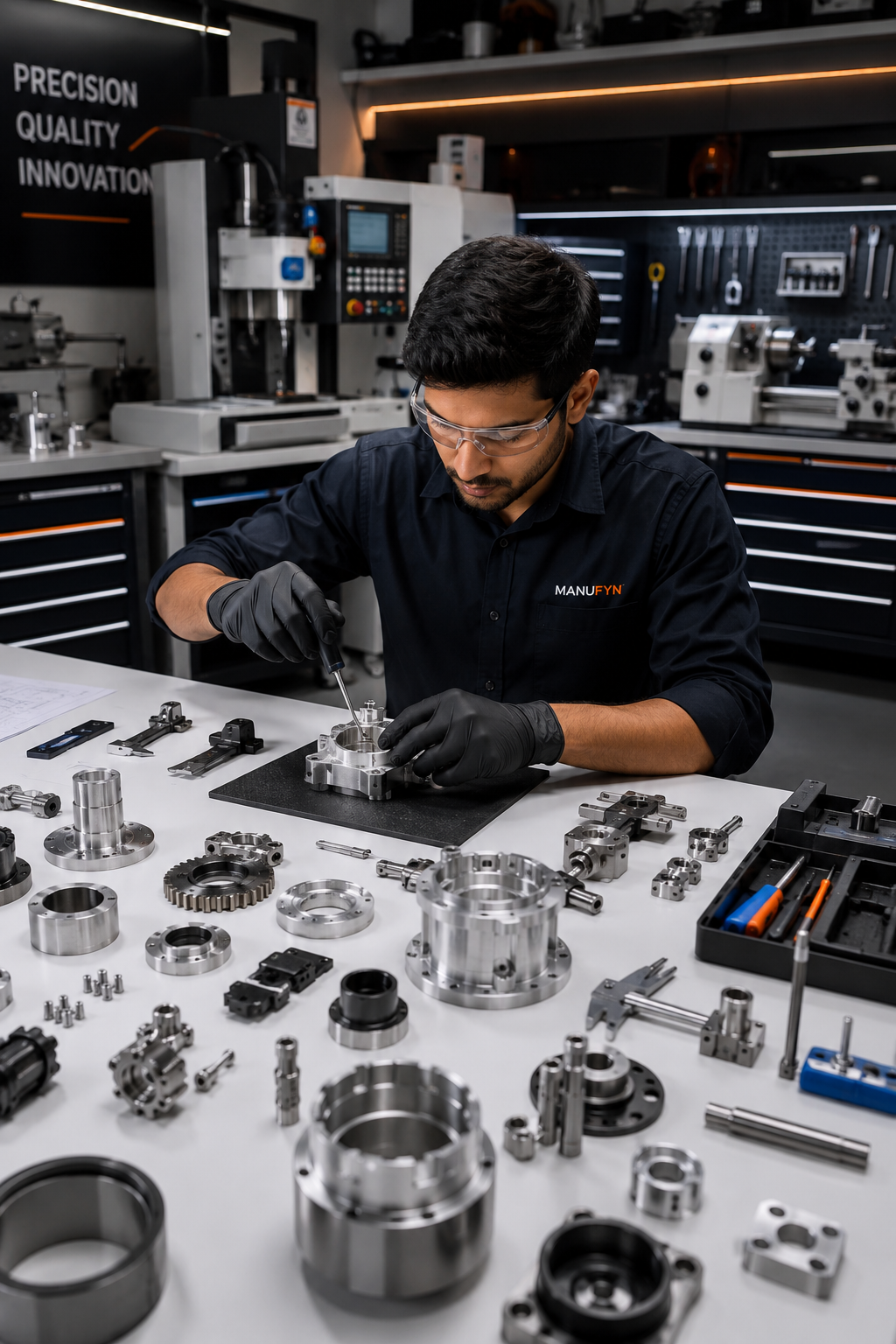
What Is Aerospace Rapid Prototyping?
Aerospace rapid prototyping is the development of physical components or assemblies before production release, tooling investment or larger manufacturing commitments.
The objective is not simply to make a part quickly. A useful aerospace prototype should answer a specific engineering or manufacturing question.
Depending on the application, prototypes may be produced using CNC machining, polymer additive manufacturing, metal additive manufacturing, sheet metal fabrication or other suitable manufacturing processes.
The appropriate process depends on the prototype objective, geometry, material, tolerance, quantity, testing requirements and eventual production route.
For a broader introduction, see Manufyn’s Rapid Prototyping Engineering & Manufacturing Guide .
Why Aerospace Prototyping Matters
Aerospace development programmes can involve expensive tooling, specialized materials, supplier qualification, inspection, testing and production commitments. Discovering a design or manufacturing problem late in the development cycle can therefore create additional engineering and procurement work.
Physical prototypes move some of that learning earlier in the development process.
A prototype can be used to validate form, fit, function, interfaces, manufacturability and selected material or process assumptions before a larger production decision is made.
| Development Question | What the Prototype Can Help Validate |
|---|---|
| Does the geometry work? | Form, envelope and physical geometry |
| Does it fit? | Interfaces, clearances, mounting points and assembly |
| Does it function? | Mechanical operation and selected functional requirements |
| Can it be manufactured? | DFM, tooling access, workholding and process limitations |
| Can it be inspected? | Critical dimensions, datums and inspection accessibility |
| Can it move toward production? | Manufacturing route, supplier capability and process considerations |
Common Aerospace Prototyping Challenges
The difficult part is often not manufacturing the prototype. It is choosing and controlling the complete development route.
Choosing the Wrong Technology
3D printing may be appropriate for geometry or packaging validation, while CNC machining may be more appropriate when the prototype needs production-relevant material and machined interfaces.
Designing Without DFM Feedback
A prototype manufactured directly from an impractical design does not remove the underlying manufacturing problem. DFM should happen before manufacturing.
Over-Specified Tolerances
Tight tolerances can increase machining and inspection complexity. Critical tolerances should be connected to function and assembly requirements.
Weak Material Control
Material requirements, certificates and traceability expectations should be established during procurement when they are relevant to the project.
Prototype and Production Suppliers Are Disconnected
A prototype made successfully by one supplier may require a completely different manufacturing route for production. Production intent should be considered early.
Inspection Comes Too Late
Inspection requirements should be considered before manufacturing so that critical characteristics, datums and measurement methods are understood.
Aerospace Rapid Prototyping Process
A controlled prototype programme connects engineering requirements with manufacturing execution and validation.
Engineering Review Before Manufacturing
The prototype requirement should be understood before the manufacturing process is selected.
- 3D CAD model review
- 2D drawing review
- GD&T interpretation
- Critical dimension identification
- Material requirement review
- Surface finish requirements
- Assembly and interface requirements
- Prototype validation objective
Manufyn’s Design for Manufacturability guide provides a broader framework for evaluating manufacturability before production.
Process Selection, Manufacturing & Inspection
The manufacturing route should reflect what the prototype needs to demonstrate.
- 3-axis CNC machining
- 4-axis CNC machining
- 5-axis CNC machining
- CNC turning
- Polymer additive manufacturing
- Metal additive manufacturing
- Sheet metal fabrication
- Secondary finishing and inspection
For complex multi-sided aerospace components, 5-axis CNC machining can be evaluated where the geometry and manufacturing requirements justify it.
Which Manufacturing Process Should Be Used?
There is no universal aerospace prototyping process. The correct choice depends on what needs to be validated.
| Prototype Requirement | Potential Process | Key Consideration |
|---|---|---|
| Visual / form validation | Polymer additive manufacturing | Speed, geometry and appearance |
| Complex polymer geometry | SLS / MJF / other additive processes | Geometry and functional requirements |
| Precision metal prototype | CNC machining | Material, tolerance and surface finish |
| Complex multi-face component | 4-axis / 5-axis CNC | Tool access and setup strategy |
| Cylindrical component | CNC turning | Diameter, concentricity and features |
| Complex metal geometry | Metal additive manufacturing | Geometry, material and post-processing |
| Sheet-metal development | Laser cutting + bending | Material, bend geometry and assembly |
Material Selection for Aerospace Prototypes
Prototype material selection should reflect the reason the component is being built.
A material selected only for visual similarity may be suitable for form validation but inappropriate for functional testing. Conversely, using an expensive production-grade material for every early concept iteration may not be necessary.
Depending on the application and manufacturing process, aerospace prototype requirements may involve aluminium alloys, titanium alloys, stainless steels, engineering plastics or other application-specific materials.
For example, Manufyn’s Titanium CNC Machining Guide and Grade 5 Titanium CNC Machining Guide provide deeper technical information for titanium machining.
Material certificates, heat numbers and lot traceability should be specified during procurement when they are required by the engineering or quality requirements.
Inspection Should Be Designed Into the Prototype
Inspection is not simply the final step after machining. It should support the engineering objective of the prototype.
- Critical dimension inspection
- GD&T verification
- Datum verification
- Thread verification
- Surface finish verification
- CMM measurement where appropriate
- Material documentation
- First Article Inspection where required
Explore CMM Inspection Services and First Article Inspection Services for more information.
From Aerospace Prototype to Production
A prototype should ideally generate useful manufacturing knowledge for the next stage of development.
The transition may involve design changes, process changes, supplier qualification, tooling, inspection planning, production fixtures, material procurement and capacity planning.
This is why prototype manufacturing and production planning should not always be treated as completely separate activities.
Manufyn’s CNC Prototype to Production Engineering Guide explores this transition in greater detail.
| Stage | Primary Objective | Typical Questions |
|---|---|---|
| Concept | Understand the design | Does the geometry communicate the intended concept? |
| Prototype | Validate the design | Does the part fit, function and make sense to manufacture? |
| Engineering Validation | Generate evidence | Do dimensions, materials and functional requirements meet expectations? |
| Pilot / Bridge Production | Validate repeatability | Can the manufacturing process consistently produce the component? |
| Production | Manufacture consistently | Can cost, capacity, quality and delivery requirements be maintained? |
What Should Engineers and Buyers Evaluate?
Common Aerospace Prototyping Mistakes
Choosing the process before defining the objective
Start with what must be validated. Process selection should follow the engineering requirement.
Using generic material for a functional prototype
If material behaviour is part of the validation, representative material and process conditions matter.
Applying unnecessarily tight tolerances
Tight tolerances can increase machining and inspection effort. Link tolerance requirements to function.
Ignoring production manufacturability
A prototype can demonstrate that a design works while still revealing that the intended production route is commercially or technically difficult.
Choosing suppliers only by prototype price
Technical capability, inspection, material control, communication and production capability should also be evaluated.
Continue Learning: Aerospace Prototyping & Manufacturing
Use these technical resources to investigate individual manufacturing decisions in more depth.
CNC Machining Tolerances
Practical guidance on precision, accuracy and tolerancing.
Explore Resource →Titanium CNC Machining
Technical considerations for machining titanium components.
Explore Resource →Manufacturing Knowledge for Engineering & Procurement Teams
Aerospace prototyping decisions often overlap with broader manufacturing topics such as DFM, tolerancing, supplier qualification, procurement and production planning.
See Manufacturing Execution in Practice
Explore documented Manufyn projects covering rapid prototyping, supplier qualification and manufacturing execution.
CNC Turning Prototype
A documented prototype manufacturing project involving CNC turning and international delivery.
Read Case Study →Product Development to Mass Production
A case study covering the transition from a problem statement through rapid prototyping toward production.
Read Case Study →Supplier Audit in India
A documented example of supplier evaluation and manufacturing partner selection.
Read Case Study →Where Prototyping Meets Procurement
Aerospace prototyping can involve more than manufacturing a component. The buyer may also need to identify capable suppliers, compare quotations, review manufacturing assumptions, control quality requirements and coordinate delivery.
This is where engineering and procurement need to work together.
- Supplier capability evaluation
- Technical RFQ review
- Manufacturing process comparison
- Commercial comparison
- Material procurement
- Quality coordination
- Inspection coordination
- International delivery support
Learn more about Manufyn’s India Purchasing Office and Procurement Support for Global Manufacturing Companies .
Aerospace Rapid Prototyping FAQ
What is aerospace rapid prototyping?
Aerospace rapid prototyping is the development of physical aerospace components or assemblies for design validation, fit checks, functional evaluation, manufacturability review or engineering development before production.
What technologies are used for aerospace rapid prototyping?
Depending on the requirement, technologies can include CNC machining, polymer additive manufacturing, metal additive manufacturing, sheet metal fabrication and other suitable manufacturing processes.
Is CNC machining suitable for aerospace prototypes?
CNC machining can be suitable when the prototype requires production-relevant metals or engineering plastics, controlled dimensions, machined surfaces, threads, precision holes or functional mechanical interfaces.
Is 3D printing suitable for aerospace prototypes?
It can be suitable for concept models, geometry validation, selected functional prototypes, fixtures and complex geometries. The material and additive process should be evaluated against the intended validation objective.
What materials can be used for aerospace prototypes?
Depending on the application and manufacturing process, prototype components may use aluminium alloys, titanium alloys, stainless steels, engineering plastics and other application-specific materials.
Can aerospace prototypes be inspected?
Yes. Inspection can include dimensional measurement, critical-feature verification, GD&T verification, surface finish checks, material documentation and First Article Inspection where required.
Can Manufyn support material traceability?
Where required by the project, material documentation and heat or lot traceability can be incorporated into the procurement and manufacturing workflow.
Can Manufyn support prototype-to-production transition?
Yes. Prototype manufacturing can be considered alongside the eventual production route, including manufacturing, procurement, supplier coordination and production planning.
How should I prepare an aerospace prototype RFQ?
Provide the available CAD model, engineering drawing, material requirement, quantity, critical tolerances, inspection requirements and target delivery date. These inputs allow the manufacturing route and supplier requirements to be evaluated.
Does Manufyn support manufacturing from India?
Manufyn supports international manufacturing requirements from India, including engineering coordination, supplier evaluation, procurement, manufacturing and quality coordination.
Start With the Engineering Requirement, Not Just the Part
Share your CAD model, drawing or prototype requirement. Manufyn can help evaluate the manufacturing route, supplier requirements and next steps toward production.
Discuss Your Prototype