Validate grain alignment with load paths before tooling.
Grain flow is one of the primary reasons forged components outperform cast or machined parts in demanding applications. During forging, metal is plastically deformed under high pressure, causing its internal grain structure to realign and follow the shape of the part. This controlled grain orientation significantly improves strength, fatigue resistance, impact toughness, and structural reliability.
Unlike casting—where metal solidifies with randomly oriented grains—forging reshapes existing metal and creates continuous grain flow that follows the geometry of the component. When properly designed, forging grain flow enhances load-bearing capability and reduces the likelihood of crack initiation and propagation.
This guide explains what forging grain flow is, why it matters, how it differs from cast or machined components, and how to optimize grain orientation during design and DFM review.
What is Grain Flow in Forging?
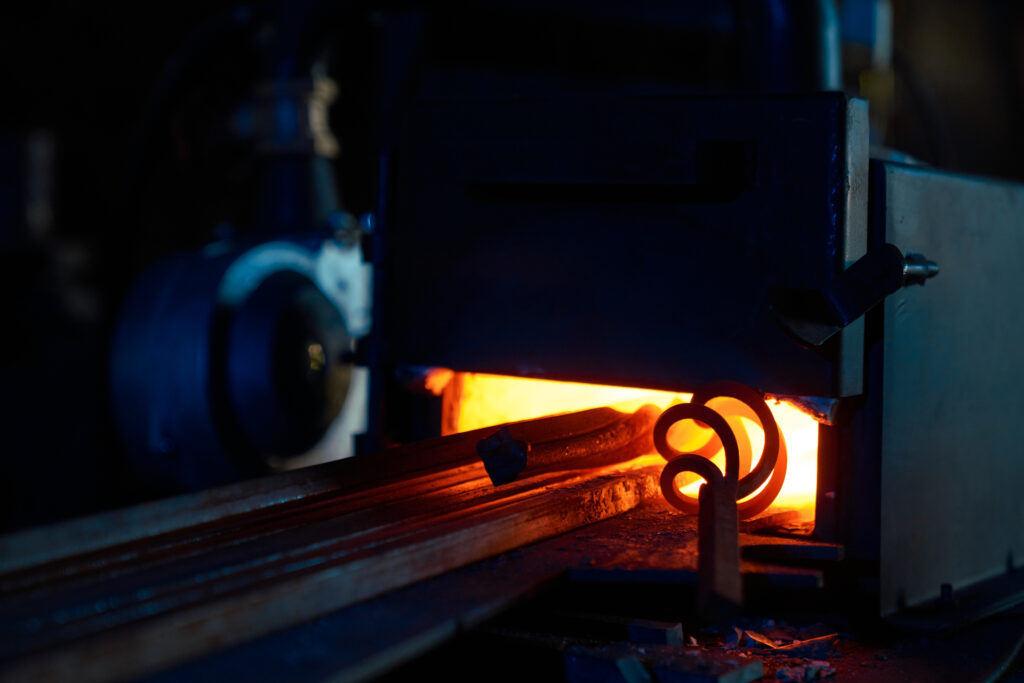
Grain flow in forging refers to the directional alignment of metal grains that occurs when a metal billet is plastically deformed under compressive force. As the metal is pressed or hammered into shape, its internal microstructure elongates and aligns in the direction of material movement.
This alignment creates a continuous internal structure that strengthens the component along specific load paths.
How Metal Grains Align During Forging
When metal is forged:
- The billet is heated to a plastic state (in hot forging)
- Compressive forces reshape the material into the die cavity
- Internal grains elongate and align along the deformation path
- The resulting grain structure follows the contour of the forged geometry
Instead of cutting across the grain (as in machining), forging preserves and redirects grain continuity. This is why forged crankshafts, connecting rods, gears, and aerospace components exhibit superior mechanical properties compared to similar parts made by casting or machining from bar stock.
Forging vs Casting vs Machining – Grain Structure Differences
The difference in grain structure explains performance differences:
- Forged components: Continuous, aligned grain flow following part geometry
- Cast components: Random grain orientation formed during solidification
- Machined-from-bar components: Straight grain from rolled stock, often cut across load paths
Forging creates a structure that resists fatigue and crack growth because the grain flow acts like internal reinforcement along stress directions.
Get expert review of grain alignment and load-path optimization before tooling. Evaluate Grain Flow for Your Forged Part
Why Grain Flow Matters in Forged Components
The primary advantage of forging over casting or machining is not just density or surface finish—it is controlled grain flow. When grain orientation follows the geometry and load path of a component, the result is significantly improved mechanical performance.
Grain flow influences how a part behaves under static load, cyclic fatigue, impact, and stress concentration. Properly aligned grain structure acts as internal reinforcement, increasing reliability in high-performance applications.
Improved Mechanical Strength
Forged components exhibit higher strength because:
- Grain flow aligns with load direction
- Internal voids are reduced through compressive deformation
- Material continuity is preserved instead of cut
When grain orientation follows the direction of applied stress, the part resists deformation more effectively compared to cast or machined alternatives.
Enhanced Fatigue Resistance
Fatigue failure often initiates at microstructural discontinuities. Forging improves fatigue life because:
- Continuous grain flow reduces stress concentration sites
- Compressive forces eliminate internal porosity
- Grain boundaries follow part contours rather than cutting across them
This makes forged parts ideal for cyclic loading applications such as crankshafts, connecting rods, gears, and suspension components.
Better Impact Resistance
Forged parts absorb energy more effectively due to:
- Dense microstructure
- Aligned grain structure
- Reduced internal defects
In impact-prone applications, grain flow helps prevent sudden brittle fracture.
Reduced Crack Propagation
In cast or machined parts, cracks can propagate easily across grain boundaries. In forged parts:
- Grain flow redirects crack paths
- Crack growth slows when aligned against grain direction
- Structural integrity improves under extreme stress
This is particularly important in aerospace, automotive, oil & gas, and heavy machinery components, where failure is not an option.
Types of Grain Flow in Forging
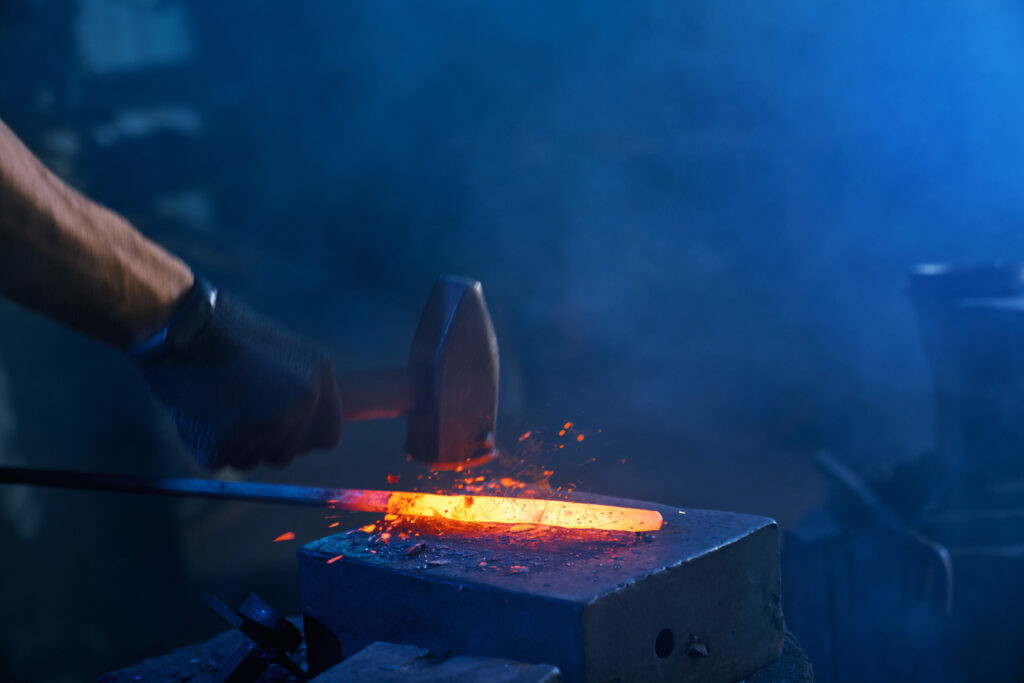
Grain flow patterns in forged components depend on part geometry, die design, and deformation path. Understanding different grain flow types helps engineers evaluate whether a forging design supports optimal mechanical performance.
Directional Grain Flow
Directional grain flow occurs when grains align primarily in one dominant direction due to unidirectional deformation.
Typical characteristics:
- Strong alignment along the main forging direction
- Increased strength along that axis
- Suitable for shafts and elongated components
While beneficial in linear parts, directional grain flow may not follow complex geometries effectively.
Radial Grain Flow
Radial grain flow develops when material flows outward from a central point.
Typical characteristics:
- Common in round forgings such as discs or flanges
- Grain lines radiate outward
- Strength distribution is more uniform circumferentially
This type of grain flow improves performance in components subjected to rotational or radial loading.
Conformal Grain Flow (Following Part Geometry)
Conformal grain flow is the most desirable pattern in many forged components. Here, the grain structure follows the contour of the final part geometry.
Typical characteristics:
- Grain lines wrap around contours and load paths
- Improved fatigue resistance
- Enhanced crack resistance
This is commonly seen in forged connecting rods, crankshafts, and structural brackets where grain orientation follows stress flow.
Interrupted or Improper Grain Flow
Improper grain flow occurs when:
- Die design does not guide material properly
- Sharp transitions disrupt grain continuity
- Excessive machining removes beneficial grain alignment
Consequences include:
- Cross-grain weakness
- Reduced fatigue life
- Increased risk of crack initiation
Poor grain flow often results from inadequate DFM review during forging design.
Ensure grain flow aligns with load paths and maximize mechanical performance. Get Forging DFM Review for Grain Optimization
Grain Flow vs Machined & Cast Components
The structural difference between forged, cast, and machined parts lies primarily in grain orientation and internal continuity. The table below highlights the performance implications of each manufacturing method.
Grain Structure Comparison
| Feature | Forged Component | Cast Component | Machined from Bar Stock |
|---|---|---|---|
| Grain Orientation | Aligned, continuous, follows geometry | Random, formed during solidification | Straight, original rolled grain often cut across |
| Mechanical Strength | High | Moderate | Moderate |
| Fatigue Resistance | Excellent | Lower than forged | Lower if load cuts across grain |
| Internal Defects | Minimal (compressed structure) | Possible porosity/shrinkage | Minimal but cut grain continuity |
| Best Use Case | High-stress, load-bearing parts | Complex shapes with lower stress | Precision parts, low-to-medium stress |
Forging creates a continuous internal structure that enhances mechanical reliability. Machining from bar stock preserves straight grain, but often cuts across load paths, reducing fatigue performance. Casting produces random grain structure and may introduce internal defects.
Design Guidelines to Optimize Grain Flow
Grain flow does not automatically align perfectly with load paths—it must be intentionally guided through forging design and die development. Engineers who understand how material moves inside the die can design components that preserve and enhance grain continuity in high-stress regions.
The goal is simple:
Align grain flow with primary load directions and avoid interrupting continuity in critical areas.
Align Grain Flow with Load Direction
The most important rule in forging grain flow design is:
Grain orientation should follow the direction of maximum applied stress.
Design best practices:
- Identify primary load paths early in design
- Position high-stress regions where grain flow will naturally align
- Avoid cutting across grain in critical sections
For example:
- In a connecting rod, grain flow should follow the rod’s curvature
- In a shaft, grain should run along the longitudinal axis
Proper alignment dramatically improves fatigue resistance and crack resistance.
Avoid Sharp Transitions & Sudden Geometry Changes
Abrupt geometry changes can:
- Disrupt grain continuity
- Create localized distortion
- Introduce cross-grain weaknesses
Design best practices:
- Add generous radii at transitions
- Blend sections smoothly
- Avoid sharp internal corners in forged regions
Smooth geometry supports uninterrupted grain flow through the component.
Optimize Die Design for Grain Continuity
Die design strongly influences how material flows.
Best practices:
- Ensure material flows progressively into cavities
- Avoid forcing material into tight pockets late in the stroke
- Design preforms that guide grain toward final geometry
Poor die sequencing can create distorted or misaligned grain patterns.
Minimize Machining on High-Stress Areas
Excessive machining can remove beneficial grain alignment.
Design best practices:
- Preserve forged surfaces in critical load regions
- Add machining allowance only where functionally required
- Avoid removing material across aligned grain flow
Maintaining forged surface integrity retains the performance advantage created during forging.
Get expert guidance to align grain flow with stress direction and improve structural performance. Optimize Forging Design for Load Paths
Common Grain Flow Problems & How to Avoid Them
Even when forging is selected correctly, improper design or die strategy can compromise grain alignment. These issues often remain invisible until fatigue failure or mechanical testing reveals weaknesses.
Understanding common grain flow problems helps prevent structural underperformance.
Cross-Grain Weakness
Cross-grain weakness occurs when:
- The primary load direction cuts across the grain structure
- Machining removes aligned grain in critical areas
- The forging design does not follow stress flow
This reduces fatigue life and increases crack initiation risk.
Prevention:
- Align geometry with expected load direction
- Avoid machining across high-stress regions
- Validate load paths during DFM review
Grain Flow Breakage at Sharp Corners
Sharp transitions can interrupt grain continuity, causing:
- Localized stress concentration
- Reduced fatigue resistance
- Microstructural distortion
Prevention:
- Add generous radii
- Blend transitions gradually
- Redesign geometry to promote smooth material flow
Grain Distortion Due to Poor Die Design
Improper die sequencing can:
- Force material unnaturally into cavities
- Create inconsistent grain orientation
- Produce internal structural discontinuities
Prevention:
- Design progressive deformation stages
- Optimize preform geometry
- Simulate material flow when geometry is complex
Excessive Machining Removing Beneficial Grain Flow
Heavy machining may:
- Remove forged skin with aligned grain
- Cut through load-bearing grain paths
- Reduce fatigue performance
Prevention:
- Preserve forged surfaces in high-stress areas
- Limit machining to functional interfaces
- Plan machining allowances strategically
Inspection & Validation of Grain Flow
Grain flow should not be assumed—it must be validated, especially in safety-critical applications. Inspection ensures that forging design and die development produced the intended grain alignment.
Macro-Etch Testing
Macro-etch testing involves cutting and chemically etching a forged sample to reveal visible grain flow patterns.
Used to:
- Confirm grain follows geometry
- Detect flow interruptions
- Evaluate die effectiveness
This is one of the most common validation methods in forging quality control.
Microstructure Analysis
Microscopic examination helps assess:
- Grain size and orientation
- Heat treatment effectiveness
- Metallurgical integrity
Microstructure analysis ensures grain refinement and alignment meet performance requirements.
Mechanical Testing Correlation
Grain flow validation is often correlated with:
- Tensile testing
- Impact testing
- Fatigue testing
Properly aligned grain flow typically translates into measurable performance improvements.
When Grain Flow Validation Is Critical
Grain flow validation is especially important for:
- Aerospace components
- Automotive drivetrain parts
- Oil & gas load-bearing components
- Heavy machinery structural elements
In these applications, grain alignment directly impacts safety, reliability, and lifespan.
Confirm grain alignment and mechanical performance before scaling production. Validate Forging Grain Flow Before Production
Design for Manufacturability (DFM) Checklist – Grain Flow Optimization
Before releasing a forging design for tooling, a focused DFM review ensures that grain flow aligns with structural requirements. This checklist helps engineering teams confirm that load paths, geometry, and die strategy support optimal grain orientation.
Grain Flow DFM Checklist (Pre-Tooling Review)
| Checklist Item | What to Validate | Status (Yes / Needs Review) |
|---|---|---|
| Load Path Identification | Are primary and secondary load directions clearly defined? | ☐ |
| Grain Alignment | Does grain flow align with major stress directions? | ☐ |
| Geometry Transitions | Are radii and blends sufficient to maintain continuity? | ☐ |
| Die Design Review | Does die sequence guide progressive material flow? | ☐ |
| Preform Optimization | Is preform geometry designed to support final grain orientation? | ☐ |
| Machining Strategy | Are high-stress forged surfaces preserved where possible? | ☐ |
| Stress Concentration Areas | Are sharp corners and abrupt section changes minimized? | ☐ |
| Material Selection | Is selected alloy suitable for forging and grain refinement? | ☐ |
| Inspection Plan | Is macro-etch or structural validation planned? | ☐ |
| Application Criticality | Is validation level aligned with safety requirements? | ☐ |
Using this checklist helps:
- Improve fatigue performance
- Reduce crack initiation risk
- Avoid cross-grain structural weaknesses
- Prevent costly redesign after tooling
CAD & Data Requirements for Grain Flow Review
Accurate evaluation of forging grain flow requires more than just part geometry. To optimize grain alignment and mechanical performance, forging engineers need complete information about load conditions, material selection, and application criticality. Without this context, grain flow optimization becomes guesswork rather than engineering.
Providing the right data upfront ensures grain structure is intentionally aligned with performance requirements.
CAD Inputs Required
For grain flow analysis, manufacturers typically require:
- Clean 3D CAD files (STEP/IGES)
- Clear identification of critical load-bearing regions
- Indication of parting line preference (if available)
- Machining allowance areas clearly defined
Accurate CAD geometry allows engineers to predict material flow paths and grain alignment zones during forging.
Load Case & Application Information
Grain flow optimization depends heavily on how the part will be used.
Provide:
- Primary load direction(s)
- Type of loading (tensile, compressive, torsional, cyclic)
- Safety factor requirements
- Application environment (impact, fatigue, temperature exposure)
Aligning grain orientation with real-world load paths maximizes structural performance.
Material & Production Inputs
Grain flow behavior varies with:
- Alloy composition
- Forging temperature range
- Production volume
- Heat treatment requirements
Material selection influences grain refinement and mechanical performance. Production scale influences die design and process stability.
Design Stage vs Production Stage Inputs
Grain flow review evolves across project stages:
- Concept stage: Validate grain alignment feasibility
- Pre-tooling stage: Optimize die design and preform geometry
- Production stage: Validate grain orientation via inspection
Providing stage-appropriate data prevents late-stage structural redesign.
Manufacturing Readiness: Optimize Grain Flow Before Tooling
Grain flow advantages are only realized when properly aligned with stress paths and preserved through manufacturing. Once tooling is built, correcting grain misalignment becomes costly and time-consuming.
Manufyn supports engineering teams with:
- Forging feasibility review
- Grain flow alignment analysis
- Die and preform optimization guidance
- Mechanical performance validation support
- Scalable forging production from prototype to mass manufacturing
Proper grain flow design improves fatigue life, impact resistance, and structural reliability — especially in high-load applications.
Forging Grain Flow Feasibility Review. Validate grain alignment with load paths before tooling.
FAQs – Forging Grain Flow
What is grain flow in forging?
Grain flow in forging refers to the directional alignment of metal grains that occurs when a billet is plastically deformed under compressive force. The grains elongate and follow the geometry of the forged part, improving strength and fatigue resistance.
Why is grain flow important in forged components?
Grain flow improves mechanical strength, fatigue life, and impact resistance because the internal grain structure aligns with load paths. This reduces crack initiation and slows crack propagation under cyclic stress.
How does forging grain flow differ from casting grain structure?
Forged components have continuous, aligned grain flow that follows part geometry. Cast components solidify with random grain orientation, which provides lower fatigue resistance and may contain internal defects like porosity.
How can grain flow be aligned with load direction?
Grain flow can be optimized by designing geometry that supports material movement along primary stress directions, using proper die sequencing, and minimizing abrupt geometry transitions.
How is forging grain flow tested or inspected?
Grain flow is commonly validated using macro-etch testing, microstructure analysis, and mechanical testing. Macro-etching reveals visible grain patterns to confirm alignment with design intent.
When is grain flow validation critical?
Grain flow validation is critical for high-load or safety-sensitive applications such as aerospace components, automotive drivetrain parts, oil & gas equipment, and heavy machinery structural components.