
Active vs Passive Components: Engineering, Manufacturing & Procurement Guide
Active and passive components perform fundamentally different electrical functions, but both are critical to reliable PCB design, assembly and electronic product manufacturing. Understanding the difference also matters when managing BOMs, component substitutions, quality control and procurement risk.
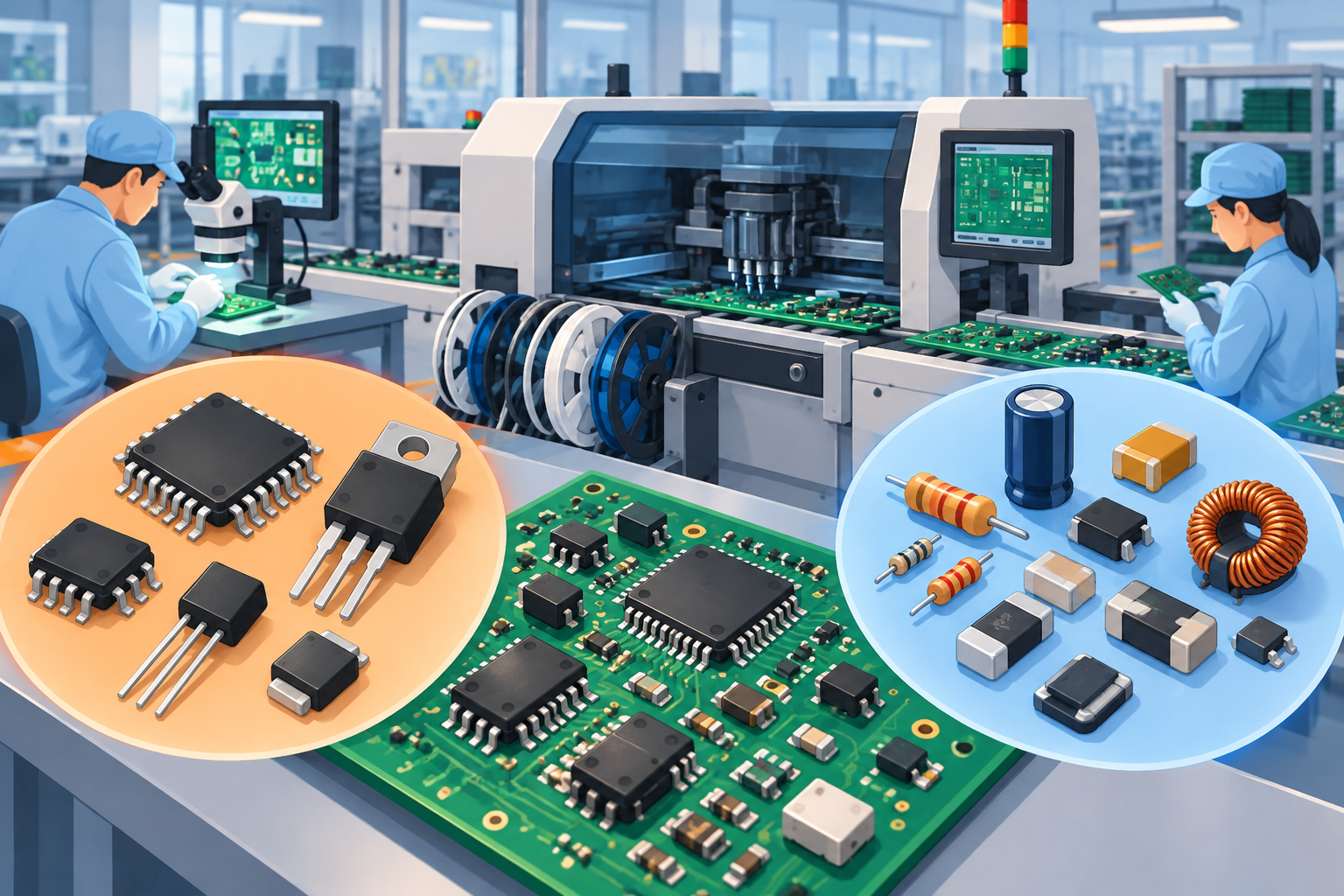
Why Active vs Passive Components Matter
Every electronic product contains a combination of components that control, process, store, transfer or condition electrical energy and signals. Two fundamental categories are active components and passive components.
Passive components such as resistors, capacitors and inductors influence voltage, current, timing, filtering and energy storage without providing power gain. Active components such as transistors, integrated circuits, operational amplifiers and many semiconductor devices can control current or voltage and may provide switching, amplification, regulation or signal-processing functions.
The distinction is important well beyond circuit theory. During electronics manufacturing, component type affects package selection, PCB footprint, placement, soldering, inspection, testing, sourcing, lifecycle management and BOM risk.
What Are Active Components?
Active components are electronic devices that can control electrical current or voltage and, depending on the device and circuit configuration, provide switching, amplification, regulation, oscillation or signal processing. Semiconductor devices are the dominant class of active components in modern electronic products.
Transistors
BJTs, MOSFETs and other transistor families are used for switching, amplification, current control and power conversion.
Integrated Circuits
ICs integrate semiconductor functions into a single package. Examples include microcontrollers, processors, memory devices, analog ICs and power-management ICs.
Diodes
Diodes provide controlled current conduction and are widely used for rectification, protection, switching, clamping and signal processing.
LEDs
Light-emitting diodes convert electrical energy into light and are used for indicators, displays, illumination and optical functions.
Voltage Regulators
Linear regulators and switching regulator ICs maintain or control supply voltage within a defined operating range.
Power Semiconductors
MOSFETs, IGBTs and related semiconductor devices are used in motor drives, power supplies, inverters and energy-conversion applications.
What Are Passive Components?
Passive components do not normally provide power gain. Instead, they resist, store, release, filter or transfer electrical energy and signals. The three fundamental passive component families are resistors, capacitors and inductors.
Resistors
Resistors oppose electrical current and are used for current limiting, voltage division, biasing, sensing and termination.
Capacitors
Capacitors store electrical energy in an electric field and are used for decoupling, filtering, timing, coupling and energy storage.
Inductors
Inductors store energy in a magnetic field and are commonly used in filtering, impedance matching and power-conversion circuits.
Transformers
Transformers transfer electrical energy between windings through magnetic coupling and can provide voltage transformation and electrical isolation.
Thermistors
Thermistors are temperature-dependent resistive components used for temperature sensing, compensation and current limiting.
Potentiometers
Potentiometers provide adjustable resistance and are used for user controls, calibration and analogue adjustment.
Active vs Passive Components: Key Differences
| Parameter | Active Components | Passive Components |
|---|---|---|
| Primary function | Control, switch, amplify, regulate or process electrical signals and power. | Resist, store, release, filter or transfer electrical energy and signals. |
| Examples | Transistors, ICs, diodes, LEDs, MOSFETs, regulators. | Resistors, capacitors, inductors, transformers, thermistors. |
| Power gain | Some active circuits can provide power or signal gain. | Do not provide power gain. |
| Typical role | Processing, switching, amplification, control and power conversion. | Biasing, filtering, timing, energy storage, current limiting and signal conditioning. |
| Manufacturing sensitivity | Often highly sensitive to package, semiconductor specification, ESD and handling requirements. | Often sensitive to tolerance, dielectric, temperature coefficient, voltage/current rating and mechanical construction. |
| Procurement risk | Counterfeits, lifecycle changes, allocation, firmware compatibility and semiconductor availability can be significant concerns. | Specification drift, quality variation, dielectric substitution, tolerance and availability can create risk. |
How Active and Passive Components Work Together
Electronic circuits rarely use active and passive components independently. Their functions are normally complementary.
Power Entry
Passive components can provide filtering, protection and impedance control at a power input.
Regulation
Active semiconductor devices regulate or convert the incoming electrical power.
Signal Processing
ICs and transistors perform computation, switching or amplification while passive networks establish biasing and filtering.
Output
Passive filtering and impedance matching can condition the final signal or power delivered to the load.
How These Components Enter PCB Manufacturing
Active and passive components are normally supplied to the PCB assembly operation in package formats compatible with the selected assembly technology. The majority of modern electronic products use a combination of surface-mount technology and, where required, through-hole components.
BOM Preparation
Part numbers, manufacturers, approved alternatives, quantities and lifecycle information are established.
Incoming Inspection
Components are checked against purchasing and quality requirements before release to production.
SMT Placement
SMD components are placed using automated pick-and-place equipment.
Reflow
Solder paste is heated through a controlled thermal profile to form solder joints.
THT Assembly
Through-hole components are inserted where required for mechanical or electrical reasons.
Inspection
SPI, AOI, visual inspection and other inspection methods verify assembly quality.
Electrical Testing
ICT, flying probe or functional testing can verify electrical performance depending on product requirements.
Final Release
Test records, traceability information and quality documentation are reviewed before shipment.
Manufyn’s electronic assembly capability includes SMT, through-hole and mixed-technology assembly, along with inspection and testing coordination. Explore Electronic Assembly .
Design Considerations for Active and Passive Components
Active Components
- Verify electrical ratings and operating conditions.
- Check package dimensions and PCB land pattern.
- Consider thermal dissipation and junction temperature.
- Define ESD handling requirements.
- Evaluate semiconductor lifecycle status.
- Check firmware or software compatibility for programmable devices.
- Review manufacturer-specific electrical characteristics.
- Consider approved alternate devices before production.
Passive Components
- Specify resistance, capacitance or inductance accurately.
- Define tolerance requirements.
- Check voltage, current and power ratings.
- Consider temperature coefficient.
- For capacitors, specify dielectric and voltage rating.
- Consider DC bias effects where applicable.
- Check physical size and PCB footprint.
- Evaluate long-term availability for production.
Manufacturing Considerations
Design for Manufacturability and Design for Assembly should be considered before releasing the PCB design to production. Component selection can influence placement density, solderability, inspection access, thermal performance and production yield.
Component Availability
Avoid selecting parts solely because they are available for prototype quantities. Production availability and lifecycle status should also be evaluated.
Package Selection
Package size affects placement capability, soldering, inspection, repairability and PCB density.
Thermal Design
Power semiconductors and regulators may require thermal vias, copper areas, heatsinks or controlled airflow.
Testability
Test points, programming interfaces and access to critical electrical nodes should be considered before PCB release.
Assembly Compatibility
Component package and orientation should suit the selected SMT, THT, reflow, wave or selective soldering process.
Alternate Components
Pre-qualified alternatives can reduce production disruption when a preferred component becomes unavailable.
Procurement Considerations for Electronic Components
Component procurement is not simply a matter of finding the lowest unit price. Buyers need to balance technical compliance, availability, lifecycle, supplier authorization, quality, logistics and total landed cost.
| Procurement Factor | What the Buyer Should Check |
|---|---|
| BOM | Manufacturer part number, approved manufacturer, revision, quantity and specification. |
| MOQ | Supplier minimum order quantity versus actual production requirement. |
| Lead Time | Stock position, factory lead time, distributor availability and logistics time. |
| Lifecycle | Active, NRND, obsolete or end-of-life status. |
| Alternates | Form-fit-function compatibility and customer approval requirements. |
| Traceability | Lot information, date codes, certificates and supplier documentation. |
| Authenticity | Authorized distribution channels and controls against counterfeit or suspect components. |
| Logistics | Packaging, moisture sensitivity, ESD protection, transportation conditions and import requirements. |
| Cost | Unit price, tooling where applicable, MOQ impact, freight, duties, inspection and inventory carrying cost. |
Electronics Manufacturing Supplier Qualification Checklist
Technical Capability
- SMT line capability
- Component package range
- Fine-pitch and high-density assembly capability
- Through-hole capability where required
- Reflow profile control
- AOI and inspection capability
- Electrical testing capability
- Programming capability where required
Quality System
- Documented quality system
- Incoming inspection procedure
- Process controls
- Non-conformance management
- Corrective and preventive action
- Traceability
- Calibration system
- Change control
Supply Chain
- Approved component distributors
- Component sourcing controls
- Counterfeit prevention
- Long-lead component management
- BOM substitution process
- Inventory controls
- Supplier continuity planning
Commercial Capability
- MOQ flexibility
- Prototype support
- Low-volume production
- Scalable production capacity
- Quotation transparency
- Lead-time commitments
- Export documentation capability
Inspection and Testing of Electronic Assemblies
The appropriate inspection method depends on the component type, package, PCB design, product risk and testing objective. No single inspection technique detects every failure mode.
Incoming Inspection
Verifies component identity, quantity, packaging condition, documentation and selected characteristics before production.
SPI
Solder Paste Inspection checks deposited paste volume, area, alignment and other process characteristics before component placement and reflow.
AOI
Automated Optical Inspection identifies many placement, polarity, solder and component presence defects.
X-Ray Inspection
X-ray inspection is useful for hidden solder joints such as BGAs and for selected internal defects that optical inspection cannot directly observe.
ICT / Flying Probe
These methods can test electrical characteristics and connectivity depending on product architecture and test coverage.
Functional Testing
Confirms that the completed assembly performs its intended electrical or system function.
Common Problems and Failure Modes
| Problem | Possible Cause | Detection Method | Corrective Action |
|---|---|---|---|
| Wrong component installed | BOM error, feeder setup error or component mix-up. | AOI, component verification, electrical test. | Improve material identification, feeder controls and first-off verification. |
| Incorrect component value | Wrong reel, substitution error or procurement mistake. | Incoming inspection, automated component verification, electrical testing. | Strengthen BOM controls and approved-part management. |
| Insufficient solder joint | Incorrect paste volume, pad design, profile or component placement. | SPI, AOI, visual inspection, X-ray where applicable. | Adjust stencil, paste process, placement or reflow profile. |
| Component tombstoning | Uneven thermal or solder forces on small passive components. | AOI and visual inspection. | Review pad geometry, paste deposition and thermal profile. |
| Polarity error | Incorrect placement orientation or ambiguous PCB markings. | AOI, visual inspection and functional test. | Improve PCB markings, feeder setup and placement verification. |
| Counterfeit component | Uncontrolled supply channel or inadequate component authentication. | Documentation review, visual inspection, electrical testing and component authentication where necessary. | Use approved supply channels and strengthen traceability. |
| Premature component failure | Electrical overstress, thermal stress, poor component selection or manufacturing defect. | Functional testing, environmental testing and failure analysis. | Review design margins, component specification and process controls. |
What Drives Electronic Component Manufacturing Cost?
Component Cost
Component selection, manufacturer, package, technology and purchasing volume directly influence BOM cost.
PCB Complexity
Layer count, board size, material, controlled impedance, surface finish and fabrication requirements affect total cost.
Assembly Complexity
Placement count, fine-pitch devices, THT components and mixed technology can increase assembly cost.
Testing
ICT fixtures, flying probe programming, functional test systems and inspection requirements can significantly affect NRE and recurring cost.
Production Volume
Prototype and low-volume orders generally carry higher unit costs because setup, engineering and procurement effort is distributed over fewer units.
Supply Chain
Freight, inventory, MOQ, long lead times, shortages and expedited procurement can materially change landed cost.
Prototype vs Low Volume vs Mass Production
| Factor | Prototype | Low Volume | Mass Production |
|---|---|---|---|
| Component purchasing | Small quantities may be purchased through distributors. | Planned purchasing and inventory management become more important. | Long-term supply agreements and volume purchasing may become relevant. |
| Alternates | Often evaluated during development. | Preferred alternates should be validated. | Formal change control is generally required. |
| Testing | Manual and engineering testing may dominate. | Automated testing becomes increasingly useful. | Dedicated production test systems are often justified. |
| Quality control | Engineering inspection and functional validation. | Process controls and repeatability become critical. | Statistical process control, traceability and formal quality systems become increasingly important. |
| Cost priority | Engineering speed and learning. | Balance cost, flexibility and repeatability. | Optimize total landed cost, yield and supply continuity. |
Procuring Electronics Manufacturing from India
International buyers evaluating electronics manufacturing in India should assess both the manufacturing capability and the supplier-management system behind it. The right supplier depends on the product’s technical complexity, volume, testing requirements, component supply chain and export destination.
Supplier Selection
- Review PCB assembly equipment and process capability.
- Check relevant quality certifications.
- Review production capacity and current utilization.
- Audit component procurement controls.
- Evaluate inspection and testing equipment.
- Review traceability systems.
Documentation
- Approved BOM
- Gerber and drill files
- Assembly drawings
- Component specifications
- Inspection requirements
- Test procedures
- Packaging requirements
- Change-control requirements
Export Readiness
- Commercial invoice
- Packing list
- Shipping documentation
- Country-specific import requirements
- Packaging and ESD protection
- Customer-specific labelling requirements
Supplier Development
- Initial factory audit
- Process capability review
- First article inspection
- Pilot production monitoring
- Corrective action follow-up
- Production performance monitoring
Practical Buyer Checklist
- □ Release the latest controlled BOM revision.
- □ Identify manufacturer part numbers and approved manufacturers.
- □ Define acceptable alternate-component rules.
- □ State annual or project production volume.
- □ Define prototype, pilot and production requirements.
- □ Specify inspection and testing requirements.
- □ Define component traceability requirements.
- □ Confirm packaging and ESD requirements.
- □ Request lead time and MOQ with the quotation.
- □ Confirm supplier quality certifications.
- □ Establish change-control expectations.
- □ Define delivery terms and destination requirements.
Active vs Passive Components FAQ
What is the main difference between active and passive components?
Active components can control electrical current or voltage and may provide switching, amplification, regulation or signal processing. Passive components primarily resist, store, release or transfer electrical energy and do not provide power gain.
Are resistors active or passive components?
Resistors are passive components. They dissipate electrical energy and are commonly used for current limiting, voltage division, biasing and signal conditioning.
Are capacitors active or passive components?
Capacitors are passive components. They store electrical energy in an electric field and are commonly used for filtering, decoupling, coupling and timing.
Is a diode an active component?
Diodes are commonly classified as active semiconductor devices in engineering component taxonomies because their operation depends on semiconductor junction behavior and they control current direction. Classification conventions can vary by context, so the device’s electrical function is more useful than the label alone.
Why do active components create higher procurement risk?
Semiconductor devices can introduce lifecycle, allocation, counterfeit, package, firmware compatibility and manufacturer substitution risks. Critical ICs may also have long lead times or require customer approval before substitution.
Can an electronic component be replaced with an equivalent part?
Only after engineering validation. The replacement should be checked for electrical specifications, package, footprint, thermal characteristics, operating conditions, reliability, regulatory requirements and supply-chain implications.
What should a buyer include in an electronics BOM?
A production-ready BOM should identify the component reference, manufacturer, manufacturer part number, description, quantity, approved alternatives where applicable, revision and relevant procurement or lifecycle information.
How are components inspected before PCB assembly?
Incoming inspection can include part-number verification, quantity checks, packaging checks, date-code or lot verification, documentation review and selected component or authenticity checks based on product risk.
What inspection is used after SMT assembly?
Common methods include solder paste inspection, automated optical inspection, visual inspection, X-ray for selected hidden joints, ICT or flying probe testing, and functional testing.
How should electronics suppliers in India be qualified?
Buyers should evaluate technical capability, PCB assembly processes, quality systems, component procurement controls, inspection and testing capability, traceability, capacity, documentation, change control and export readiness.
Related Manufyn Resources
Electronic Assembly
Understand PCB assembly, component placement, inspection, testing and electronics manufacturing workflows.
Surface Mount Technology
Learn how SMD components are placed and soldered during automated PCB assembly.
PCB Assembly & Final Enclosure Manufacturing
Explore the transition from assembled PCB to integrated, tested electronic product.
Rapid Prototyping Knowledge Hub
Explore prototype manufacturing approaches used during electronics and product development.
CNC Machining for Rapid Prototyping
Useful when electronic products also require machined housings, brackets, fixtures and mechanical interfaces.
Electronics Manufacturing Knowledge Hub
Continue exploring electronics design, PCB manufacturing, components, assembly, testing, quality and procurement topics.
How Manufyn Can Support Electronics Procurement from India
Manufyn India Private Limited supports international companies evaluating electronics manufacturing and procurement opportunities in India. The role can extend beyond identifying a supplier to coordinating the commercial, technical and quality activities required to establish a reliable supply chain.
Supplier Identification
Identify manufacturing suppliers according to product, process, volume and quality requirements.
Supplier Qualification
Coordinate technical reviews, documentation checks, supplier audits and capability assessments.
RFQ Management
Coordinate BOM-based RFQs, quotation collection, clarification and commercial comparison.
Quality Coordination
Coordinate inspections, quality documentation, non-conformance follow-up and supplier corrective actions.
Production Follow-Up
Support communication between the customer, manufacturing supplier and internal project stakeholders.
Logistics Coordination
Coordinate packaging, dispatch, shipping documentation and delivery activities for international procurement.
Manufyn’s electronics manufacturing activities include PCB assembly, SMT, through-hole assembly and integration with mechanical manufacturing where required. The objective is to coordinate the manufacturing supply chain around the customer’s engineering and procurement requirements. Explore Electronics Manufacturing .
Evaluating Electronics Manufacturing or Procurement from India?
Share your BOM, PCB data, drawings, production volumes and quality requirements. Manufyn can help evaluate suitable Indian suppliers, coordinate RFQs and support the technical and quality qualification process.
Discuss Your Electronics Requirement