Batch production makes products in defined groups — a set quantity of one item, then a changeover to the next — while mass production makes a single product continuously in very high volume on a dedicated line. Batch production trades some per-unit cost for flexibility; mass production trades flexibility for the lowest possible cost per unit. The right choice depends almost entirely on how much you make, how often the design changes, and how many different products share the same equipment.
Getting this decision wrong is expensive in both directions. Run a stable, high-volume product in batches and you pay for setup and changeovers you didn’t need. Commit to a dedicated mass-production line for a product whose demand or design isn’t settled, and you’re locked into tooling and capacity you can’t easily change. This guide compares both models on volume, cost, flexibility, equipment, and quality control, adds continuous production as a third reference point, and gives a clear framework for which model fits your product today.
The figures and trade-offs below reflect what Manufyn’s engineering team weighs when scoping a production run for buyers moving from prototype into volume. Manufyn’s manufacturing services run batch and higher-volume production from a single ISO 9001 certified, strictly in-house facility in Pune, India — so the guidance here is from the production floor, not a scheduling-software vendor’s blog.
What Is Batch Production?
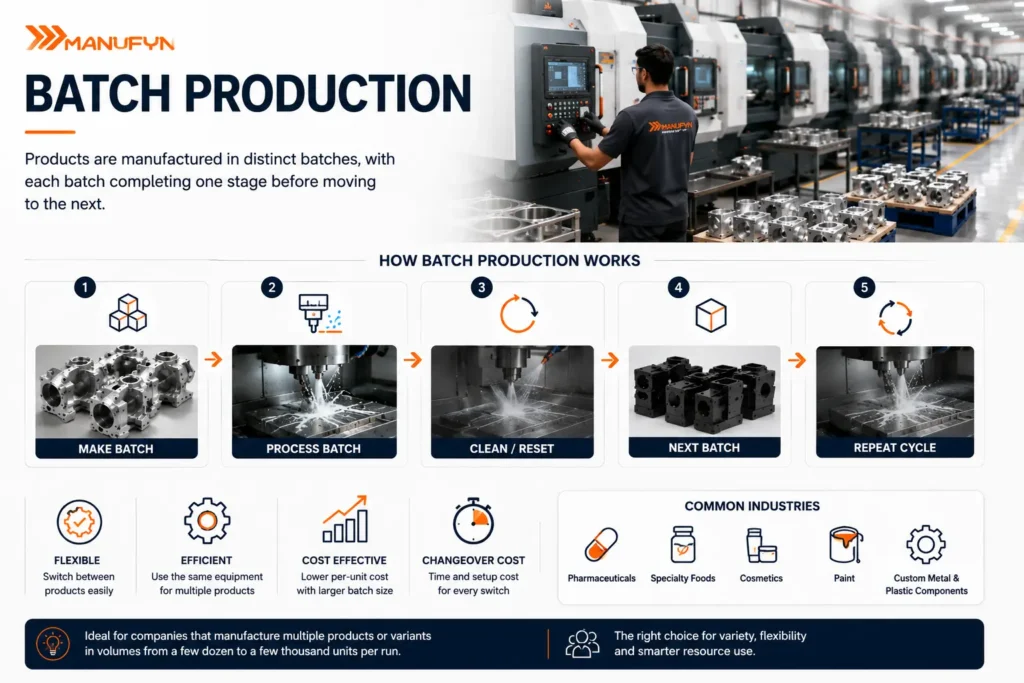
Batch production makes products in distinct groups, or batches, with each batch finishing one stage before the whole group moves to the next — then the equipment resets for a different product on the same line. It suits volumes from a few dozen to a few thousand units per run, where dedicated tooling isn’t yet justified but one-off production would be inefficient. It’s the model behind most pharmaceuticals, specialty foods, cosmetics, paint, and custom-engineered metal and plastic parts.
Where Batch Production Fits Best
Batch production earns its place when product variety is high, demand per product is moderate, or a design is still evolving between runs. It lets a manufacturer serve many customers from one set of equipment and adjust each batch — a different material, a revised dimension, a new finish — without scrapping a dedicated line. Our guide to batch production covers the method in depth, and our guide on when to use small-batch production handles the low end of the range.
What Is Mass Production?
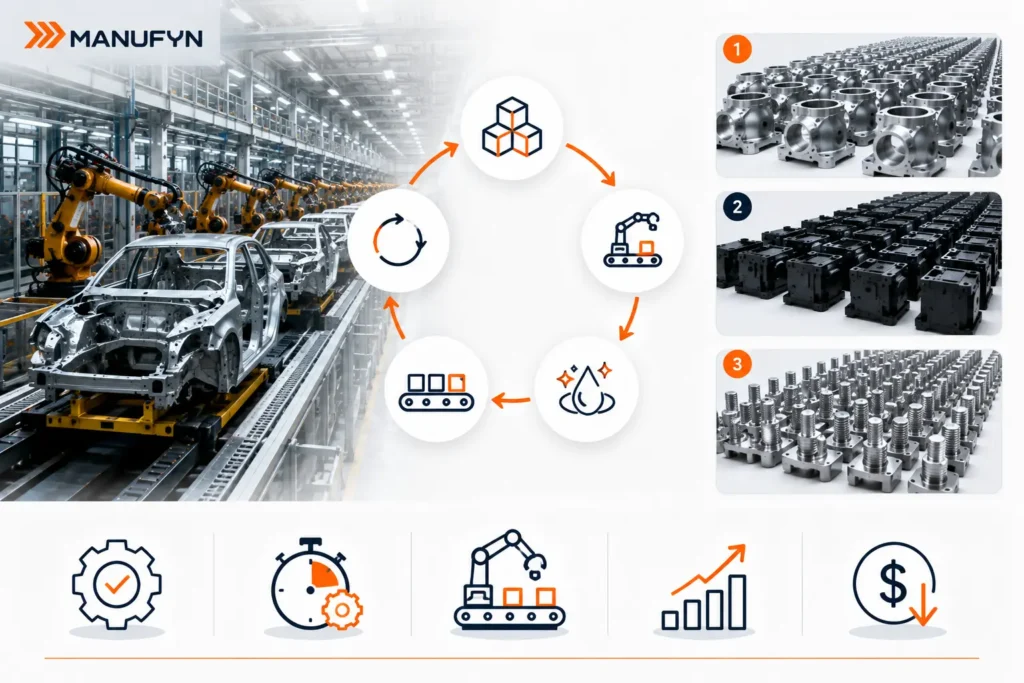
Mass production makes a single standardized product continuously in very high volume — often tens of thousands to millions of units — on a dedicated line where every station is optimized for one repeated task. Spreading fixed costs like tooling and line setup across that enormous output drives the cost per unit to its lowest possible level, but a dedicated line is expensive to build and slow to change, so it only pays off when demand is high, stable, and proven. It’s the model behind automobiles, consumer electronics, fasteners, and bottled beverages — and where injection molding, stamping, and die casting reach their cheapest per-part cost.
Where Mass Production Fits Best
Mass production is the right model once a product’s design is locked, demand is proven and sustained, and cost per unit is the deciding commercial factor. Committing to it before those three conditions are met is the most common and most expensive mistake in the batch-versus-mass decision. Our guide to mass production covers the method, its processes, and real examples in full.
Batch Production vs Mass Production: The Full Comparison
| Factor | Batch Production | Mass Production |
|---|---|---|
| Typical volume | Dozens to a few thousand per run | Tens of thousands to millions |
| Cost per unit | Moderate — setup spread over one batch | Lowest — fixed cost spread over huge volume |
| Setup / changeover cost | Frequent — between every batch | Rare — one setup, long run |
| Product flexibility | High — switch products between batches | Low — line dedicated to one product |
| Equipment | General-purpose, shared across products | Dedicated, specialized, often automated |
| Upfront investment | Lower — no dedicated line | High — dedicated line and tooling |
| Design change cost | Low — adjust the next batch | High — reconfigure or retool the line |
| Lead time to first output | Shorter — no dedicated line to build | Longer — line and tooling setup first |
| Quality control style | Per-batch inspection and traceability | In-line, continuous statistical control |
| Best for | Variety, moderate volume, evolving designs | One proven product, high stable demand |
Buyer takeaway: batch production optimizes for flexibility and low upfront cost; mass production optimizes for the lowest cost per unit at scale. Every row above is really a restatement of that one trade-off.
How Cost Per Unit Decides Between Batch and Mass Production
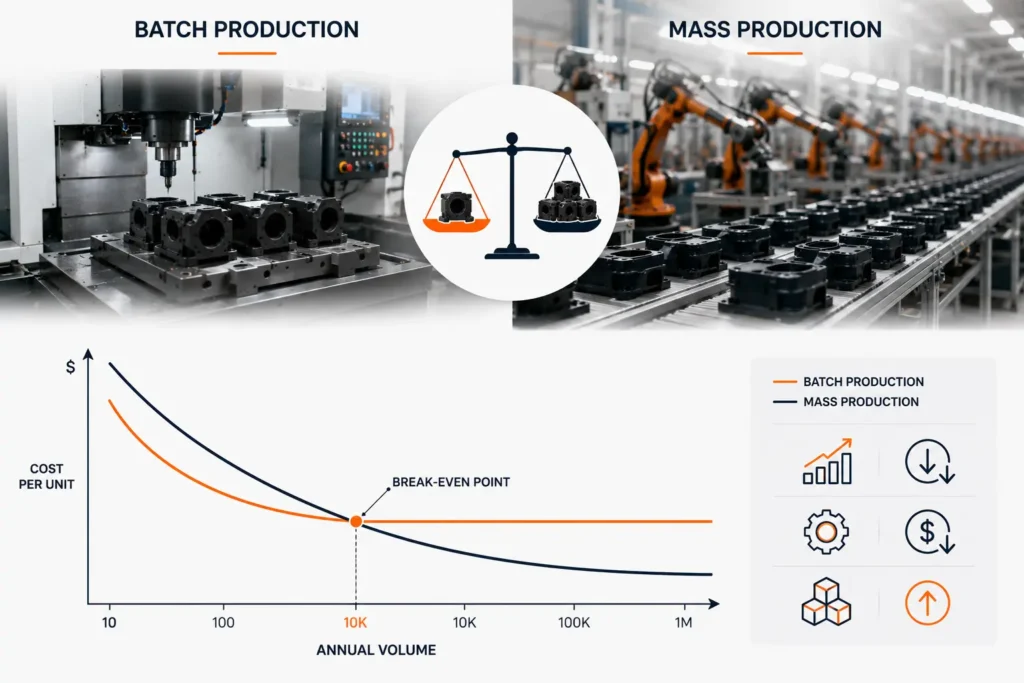
The decision almost always comes down to one question: at your real annual volume, does a dedicated mass-production line save more per unit than it costs to build and maintain? Below a certain volume, batch production wins because you never pay for a dedicated line; above it, mass production’s per-unit savings overtake that fixed cost and keep widening. The table below shows the pattern for a representative plastic component — the exact crossover shifts with tooling cost and complexity, but the shape of the curve holds for nearly every product.
| Annual volume | Batch production (cost/unit) | Mass production (cost/unit) | Cheaper model |
|---|---|---|---|
| 500 units | $4.50 | $38.00 | Batch |
| 5,000 units | $4.10 | $4.60 | Batch (near crossover) |
| 25,000 units | $3.95 | $1.60 | Mass |
| 100,000 units | $3.90 | $0.85 | Mass |
Treat these as illustrative planning figures, not a quote — but the message is consistent: somewhere between a few thousand and a few tens of thousands of units per year, most products cross from batch being cheaper to mass being cheaper. Our injection molding cost breakdown works this same math through the tooling side in detail.
Not sure whether your volume justifies a dedicated production line yet? Share your part and annual quantity with Manufyn — we’ll model batch versus mass cost per unit against your real numbers, not a generic curve.
Where Does Continuous Production Fit In?
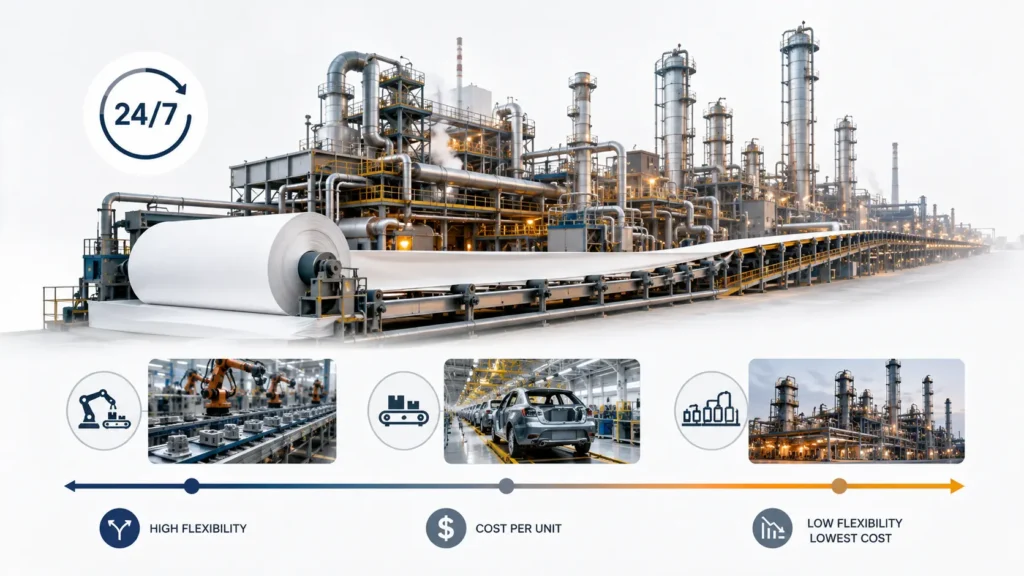
Continuous production is a distinct third model, often confused with mass production. Where mass production makes discrete units on a line that can be stopped and restarted, continuous production runs 24/7 without interruption to produce flowing outputs like oil, chemicals, steel, paper, and cement — achieving the lowest cost per unit and the least flexibility of any model. For engineering buyers sourcing discrete parts like brackets, enclosures, and machined components it rarely applies directly, but it clarifies why mass production sits in the middle of the flexibility-versus-cost spectrum rather than at the extreme.
Our guide to the continuous production process covers this model and where it applies in full detail.
Which Production Model Should You Choose?
The decision comes down to four questions. Answer them honestly and the right model is usually obvious.
Choose Batch Production When:
- Your annual volume is in the dozens-to-low-thousands range per product
- You make several products or variants on shared equipment
- Your design is still evolving, or demand isn’t yet proven
- You need per-batch traceability (common in pharma, food, medical)
- You want to avoid tying up capital in a dedicated line
Choose Mass Production When:
- Your annual volume runs into the tens of thousands or higher
- The product design is frozen and unlikely to change
- Demand is proven, stable, and sustained over years
- Cost per unit is the deciding commercial factor
- You can amortize dedicated tooling and line setup over the run
Buyer takeaway: most products start in batch production and graduate to mass production only once design and demand are both locked. Committing to a mass-production line before that point is the costliest error in this decision — and the hardest to reverse.
Common Mistakes in the Batch vs Mass Production Decision
- Committing to a dedicated mass-production line before demand is proven — locking in capacity that may never be used
- Freezing a design too early for mass production, then paying to retool when a change becomes necessary
- Staying in batch production well past the volume where a dedicated line would already be cheaper per unit
- Comparing per-unit quotes without factoring in the dedicated line’s fixed cost on the mass-production side
- Ignoring changeover cost in batch production when running many small, frequent batches
Buyer takeaway: the two most expensive mistakes point in opposite directions — going to mass production too early, and staying in batch production too late. Both are avoided by modeling cost per unit against realistic annual volume before committing.
How Manufyn Supports Batch and Volume Production
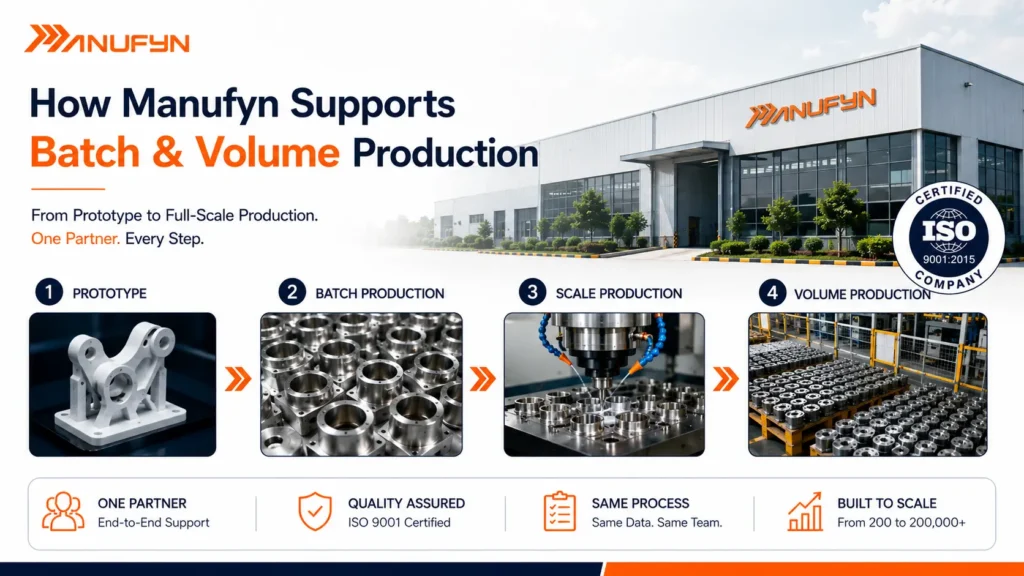
Manufyn is an ISO 9001 certified, strictly in-house on-demand manufacturer in Baner, Pune, India — not a broker or trading company. Because prototyping, batch production, and higher-volume manufacturing all run from the same facility, a part can move from validated prototype to batch run to full production without changing suppliers or re-sending drawings under a new NDA. The same engineering team that ran your first batch of 200 scales you to 200,000, using the same process data and quality records throughout.
- No minimum order quantity — from a single trial batch to full production volumes
- Free DFM review before every run, flagging cost and quality issues before tooling
- Per-batch inspection, FAIR, and material certificates as standard
- A clear path from batch to dedicated tooling as your volume grows
- Serving 500+ clients across 30+ countries, including the US, UK, Australia, UAE, Canada, Germany, Singapore, and Malaysia
See our full process range on our commodities directory, documented results in our case studies, or read more about our approach on Why Manufyn.
Ready to run a batch, scale to production, or figure out which you need? Share your drawing and volume plan with Manufyn — quoted in 24 hours, with no minimum order and a free DFM review.
FAQs
Batch production makes products in defined groups on shared, general-purpose equipment, switching between products between batches. Mass production makes a single standardized product continuously in very high volume on a dedicated line. Batch production offers flexibility at moderate cost per unit; mass production offers the lowest cost per unit but very little flexibility.
It varies with tooling cost and part complexity, but for most discrete products the crossover falls somewhere between a few thousand and a few tens of thousands of units per year. Below that, batch production is usually cheaper overall because there’s no dedicated line to pay for; above it, mass production’s per-unit savings overtake the fixed line cost.
At low to moderate volumes, yes — batch production avoids the large fixed cost of a dedicated production line, so total cost is lower. At high, stable volumes, mass production becomes cheaper per unit because that fixed cost is spread across a much larger output.
Pharmaceuticals, specialty and baked foods, cosmetics, paint, craft beverages, and most custom-engineered metal and plastic components are made in batches. Any situation where a manufacturer produces a set quantity of one item, then changes over to another on the same equipment, is batch production.
Automobiles, consumer electronics, fasteners and hardware, bottled beverages, and standardized plastic and metal parts made in the millions are classic mass production. The common thread is a frozen design, proven high demand, and a dedicated line optimized for one product.
Yes, and most successful products do. A product typically starts in batch production while its design and demand are validated, then graduates to mass production once both are locked and annual volume justifies a dedicated line. Working with a manufacturer that handles both models makes this transition far smoother.
Batch production makes groups of products with changeovers between them. Mass production makes one standardized product continuously in high volume on a dedicated line. Continuous production runs 24/7 without stopping to produce flowing or non-discrete outputs like oil, chemicals, or steel. They sit on a spectrum from most flexible (batch) to least flexible but lowest cost (continuous).
Neither is inherently better — they use different approaches. Batch production relies on per-batch inspection and traceability, which suits regulated industries needing lot-level records. Mass production uses in-line statistical process control across a continuous run, which suits catching drift in a high-volume standardized output. The right choice depends on your traceability and volume requirements.
At high volumes, yes — batch production carries repeated setup and changeover costs and can’t spread fixed costs across as large an output, so its per-unit cost plateaus higher than mass production’s. At low volumes, batch production is cheaper overall because it avoids the dedicated line investment mass production requires.
Answer four questions: What’s your realistic annual volume? Is your design frozen? Is demand proven and stable? Is cost per unit the deciding factor? High volume with a frozen design, proven demand, and cost-driven decisions points to mass production; everything else points to batch. Modeling cost per unit against your real volume before committing is the safest way to decide.
Have a specific part and volume in mind? Send your drawing to our engineers — we respond within 4 working hours.
Moving from prototype into volume production?
Get a batch-versus-mass cost model and a clear scale-up roadmap before you commit to tooling.
Talk to Manufyn