
CNC Milling of a Complex PP Homopolymer Medical Device Component
A technically demanding polypropylene component with intricate radial channels, repeated profiles, thin features and detailed geometry required a controlled CNC milling strategy rather than conventional aggressive machining.
When CNC Machining Plastic Requires More Than a CNC Machine
A Germany based medical device manufacturer approached Manufyn with a requirement for five complex PP Homopolymer components manufactured directly from an engineering drawing.
The component featured an approximately 272 mm × 272 mm overall envelope, multiple radial and concentric channel patterns, repeated recessed profiles, small radii, thin sections and detailed central geometry.
Although polypropylene is generally easier to machine than metals such as stainless steel, machining a large and geometrically complex thermoplastic introduces a different engineering problem.
The low stiffness of PP, thermal sensitivity, workpiece deflection and potential for burrs or material smearing meant that the machining strategy had to be developed specifically around the behaviour of the material.
The result was 5 CNC milled parts delivered within 7 days, providing the customer with a rapid route for its medical device development requirement.
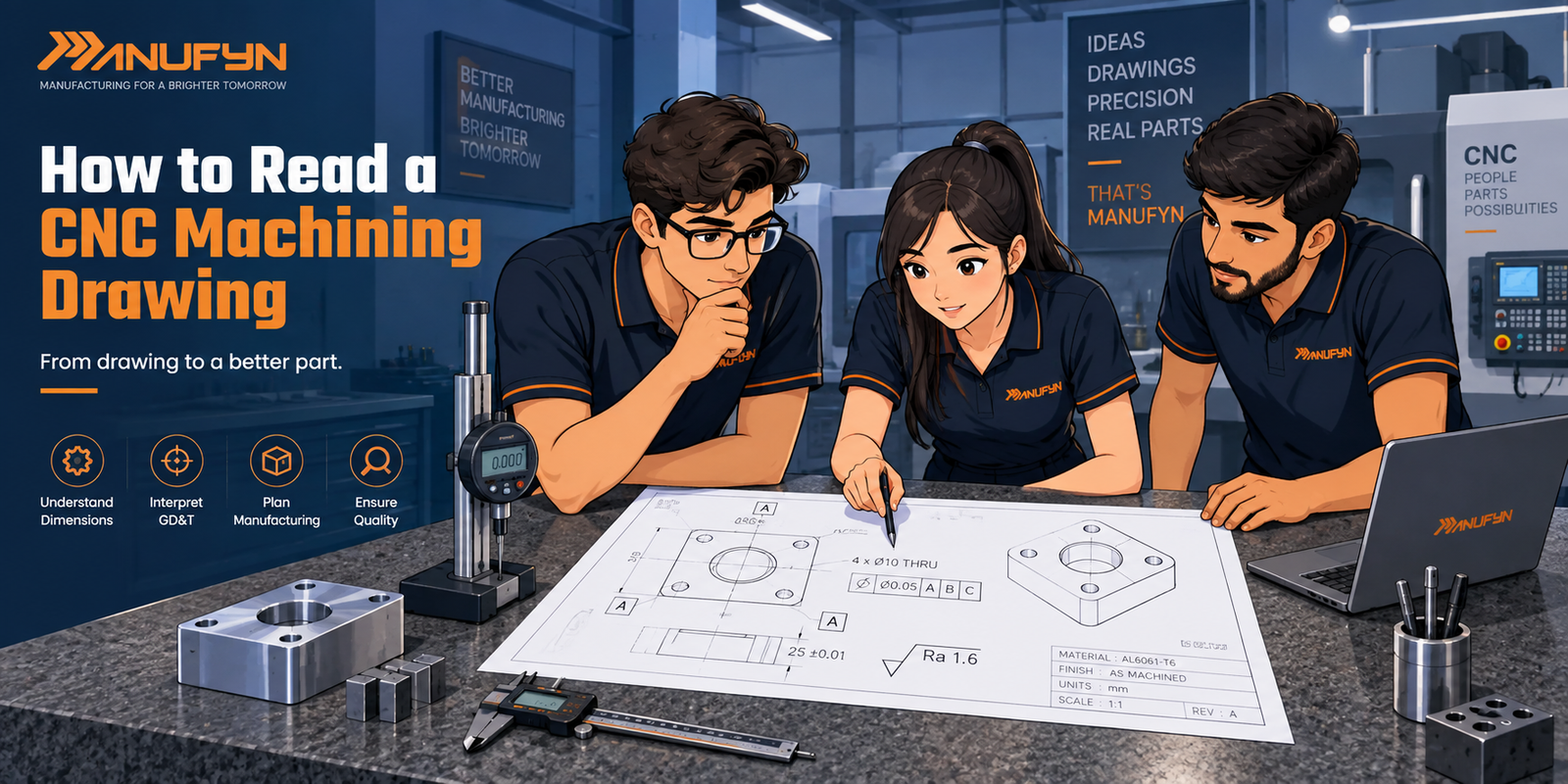
Engineering Drawing Interpretation Was the First Manufacturing Step
The drawing contained considerably more information than a conventional flat profile.
Manufacturing required interpretation of the main view together with Section A-A, Section D-D and Details B through H.
These views defined local geometry that could not be reliably understood from the primary view alone. The machining plan therefore considered the complete drawing package before CNC programming.
This included understanding the relationship between the central circular region, radial channel patterns, recessed profiles, small radii and thin material sections.
For international manufacturing projects, drawing interpretation is particularly important because a manufacturing supplier must translate the customer’s engineering intent into a practical machining sequence without introducing unnecessary assumptions.
HOW TO READ A CNC DRAWINGThe Technical Challenges Behind CNC Machining PP Homopolymer
The difficulty of this project was not simply the size of the component. It was the interaction between material behaviour, geometry and machining strategy.
Low Material Stiffness
PP Homopolymer is significantly less rigid than aluminium or steel. Cutting forces can therefore cause local movement or deflection of the workpiece. This becomes more important when a large component contains thin webs and closely spaced machined channels.
Heat Management During Plastic Machining
Thermoplastics require careful control of cutting conditions. Excessive heat can soften the material and cause smearing, poor surface definition or dimensional instability. Chip evacuation and controlled tool engagement therefore become important process considerations.
Dense Repeated Channel Geometry
The component contains multiple concentric, radial and repeated channel profiles. The machining strategy had to progressively develop these features while maintaining consistent cutting conditions and avoiding excessive tool loading.
Workholding and Distortion Control
Clamping a large plastic component introduces a trade-off. Insufficient support can allow movement during machining, while excessive clamping force can deform the material. Workholding therefore needed to provide stable support without unnecessarily stressing the PP component.
Burr and Edge Control
Plastic machining can create raised edges, strings or burrs when the material deforms rather than cleanly shears. Tool condition, cutting direction and finishing passes therefore play an important role in achieving clean functional channel edges.
In-Process CNC Milling
The in-process machining stage demonstrates why this component required a controlled CNC strategy. Multiple channel profiles were progressively machined across the large thermoplastic workpiece.
The machining process had to balance cutting force, heat generation, chip evacuation and dimensional stability throughout the operation.
Rather than treating PP like a soft metal, the process was approached around the specific behaviour of thermoplastic material.
This becomes especially important when machining components with thin webs, closely spaced channels and repeated profiles because local heat or deflection can influence the final geometry.
CNC SPEEDS & FEEDS GUIDECNC Milling Process Strategy
The manufacturing sequence was structured to progressively establish the geometry while controlling cutting forces and material behaviour.
What Controlled Plastic CNC Machining Looks Like in Practice
Tool Engagement
Controlled engagement helps reduce unnecessary cutting force and heat during thermoplastic machining.
Chip Evacuation
Effective chip evacuation helps reduce chip recutting and unnecessary heat accumulation.
Workpiece Stability
Support and clamping must control movement without introducing unnecessary distortion into the plastic.
Progressive Machining
Roughing, semi-finishing and finishing operations provide better control over complex plastic geometry.
Edge Control
Appropriate finishing strategy helps maintain clean edges around narrow channels and repeated profiles.
Inspection Planning
Critical dimensions and functional geometry need to be considered during manufacturing, not only after machining is complete.
Project Outcome
Manufyn successfully coordinated the CNC milling of five complex PP Homopolymer components for the Germany based medical device manufacturer.
The requirement was completed within the customer’s compressed 7 day timeline, providing a practical low-volume manufacturing route without the need to develop injection molding tooling for only five components.
Why CNC Machining Was Practical for This Low-Volume Requirement
When the requirement is only a few components, the economics and lead time of injection molding tooling can make CNC machining an attractive alternative for prototype, validation and low-volume requirements.
Explore More CNC Machining, Medical Device & Manufacturing Resources
Continue exploring Manufyn’s engineering resources, manufacturing case studies and procurement guides.
CNC Machining Resources
3 Axis CNC Machining 5 Axis CNC Machining GD&T for CNC Machining CNC Speeds and Feeds How to Read a CNC Drawing CNC Production Machining in IndiaPlastic Manufacturing
PP Injection Molding Medical Device Prototype Materials Medical Device Prototyping Medical Prototype Validation Injection Molding ServicesRFQ & Procurement
RFQ Process for Manufacturing Manufacturing RFQ Template Vendor Evaluation Manufacturing Purchasing Checklist Manufacturing from IndiaMedical Manufacturing
Medical Device Prototyping Medical Prototype Materials Medical Prototype Validation Surgical Device PrototypingHave a Complex Plastic CNC Machining Requirement?
Send Manufyn your engineering drawing, 3D CAD model or RFQ. Our team can review the material, geometry, quantity and delivery requirement and identify a suitable manufacturing route in India.
- CNC milled plastic components
- PP, Nylon, PEEK, POM and engineering plastics
- Medical device prototypes
- Low-volume CNC machining
- Complex machined geometries
- Prototype and production requirements
Start Your RFQ
Share your drawing, CAD model, quantity and required delivery date with our team.
GET A FREE QUOTEEMAIL YOUR RFQ
Or call +91 84840 32262
Frequently Asked Questions
Can PP Homopolymer be CNC machined?
Is CNC machining suitable for low-volume plastic parts?
Can Manufyn CNC machine medical device components?
What information is required for a CNC machining RFQ?
Can Manufyn manufacture CNC machined plastic prototypes from India for European companies?
When should I choose CNC machining instead of injection molding?
Your Drawing. Our Manufacturing Network.
If you have a complex CNC machining requirement in plastic, metal or engineering materials, send the drawing to Manufyn. We will evaluate the requirement and help identify the appropriate manufacturing route.