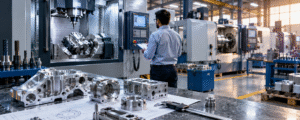
The main types of injection molding are conventional (single-shot) molding, overmolding, insert molding, multi-shot molding, gas-assisted molding, thin-wall molding, and liquid silicone rubber (LSR) molding. They all share the same core principle — molten material forced into a mold cavity under pressure — but differ in how many materials are used, what’s placed in the mold beforehand, and how the cavity is filled. Choosing the right one comes down to your part’s material combination, geometry, and function.
“Types of injection molding” can mean three different things — the molding processes themselves, the machines that run them (hydraulic, electric, hybrid), or the plastic resins used. This guide focuses on the processes, because that’s the decision that actually shapes your part, and briefly covers the other two so you have the full picture. For each process type you’ll get what it is, what it’s best suited to, and where it fits on cost.
The guidance here comes from a shop that runs these processes daily. Manufyn’s injection molding service operates from an ISO 9001 certified, strictly in-house facility in Pune, India — so this is written from the molding floor, not a rewritten definition list.
Liquid Silicone Rubber (LSR) Molding
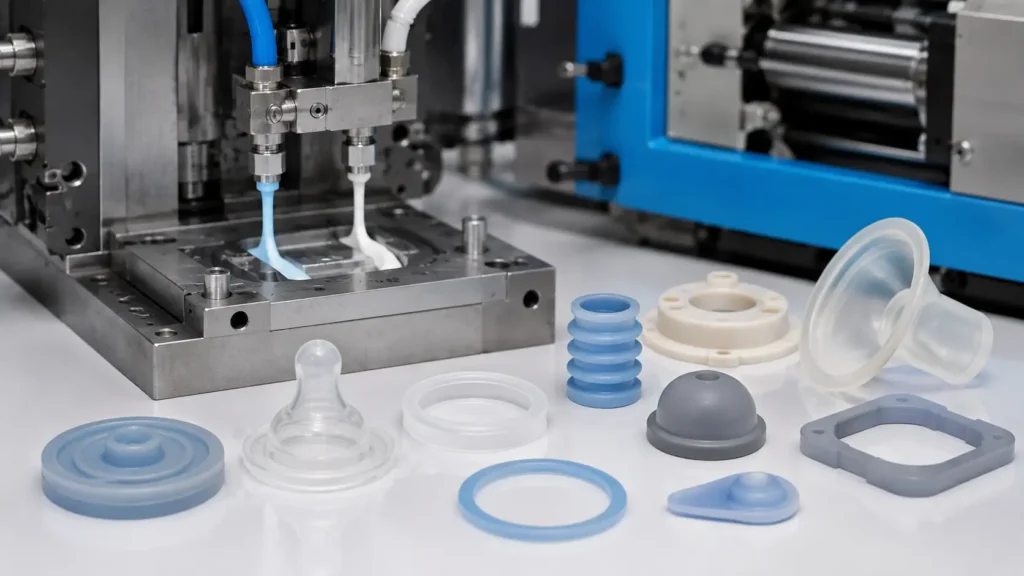
LSR molding uses a two-part liquid silicone that’s mixed, injected, and heat-cured in the mold — producing flexible, heat-resistant, biocompatible parts.
LSR molding stands apart from the thermoplastic processes above because silicone cures rather than cools. Two liquid components are metered, mixed, and injected into a heated mold, where they cross-link and cure into a flexible, durable rubber part. LSR is prized for properties thermoplastics can’t match: it stays flexible across extreme temperatures, resists chemicals and UV, and many grades are biocompatible — which makes it the standard for medical devices, seals, gaskets, baby products, and wearable components. The process needs specialised metering and mold-heating equipment, but for parts that must be soft, sealed, and stable across a wide temperature range, it’s often the only real option. It’s frequently combined with insert or overmolding to bond silicone to a rigid substrate.
The Main Types of Injection Molding at a Glance
Here’s the full set of process types in one view, with what each is used for — the detail follows below.
| Type | What it is | Best for |
|---|---|---|
| Conventional (single-shot) | One material shot into one cavity | The majority of standard plastic parts |
| Overmolding | A second material molded over a first | Soft-touch grips, seals, multi-material parts |
| Insert molding | Plastic molded around a pre-placed insert | Threaded metal inserts, embedded components |
| Multi-shot (2K) | Two or more materials in one cycle | Multi-colour or multi-material high volume |
| Gas-assisted | Gas creates hollow sections in the part | Thick, hollow, or large structural parts |
| Thin-wall | Very thin walls at high speed and pressure | Packaging, thin electronics housings |
| Liquid silicone rubber (LSR) | Two-part liquid silicone, heat-cured | Medical, seals, flexible heat-resistant parts |
Conventional (Single-Shot) Injection Molding
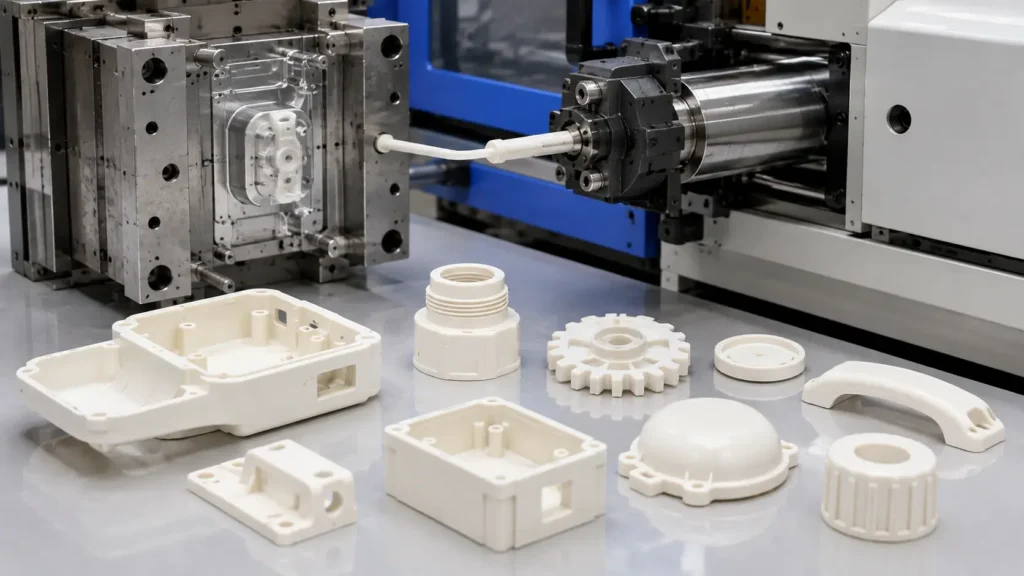
Conventional molding shoots a single material into a single cavity — the standard process behind the vast majority of plastic parts you handle every day.
This is the baseline everything else builds on. Plastic pellets are melted, injected into a closed mold under high pressure, cooled, and ejected as a finished part. It covers most enclosures, housings, brackets, caps, and consumer components — anything that’s a single material in a single colour. Because it’s the simplest variant, it’s also the cheapest per part and the fastest to tool, which is why it’s the default unless a part specifically needs a second material, an embedded insert, or a hollow section. The design rules that govern it — uniform wall thickness, draft angles, and gate placement — apply to every other type on this list too, which is why our injection molding design guide starts there.
Overmolding
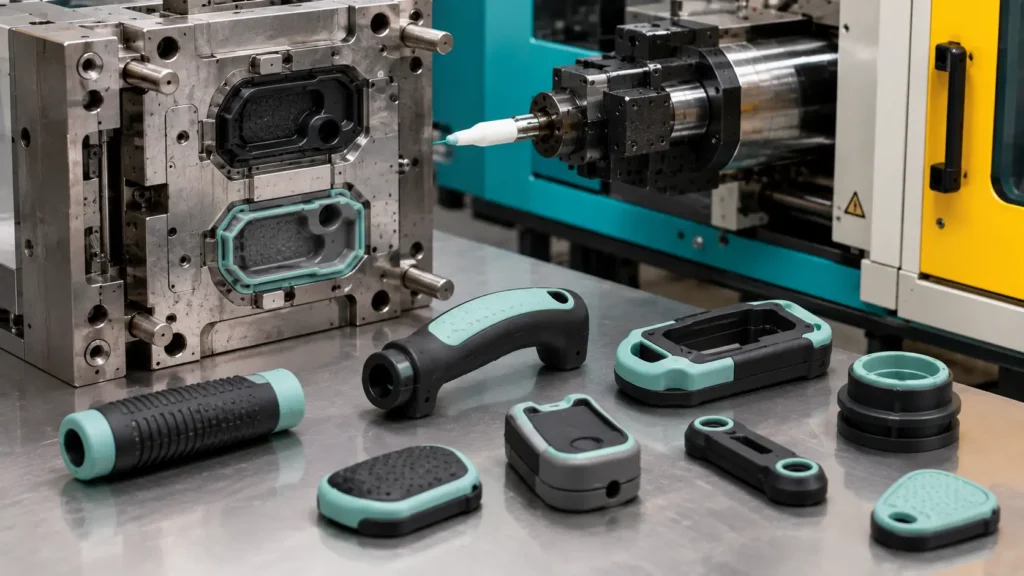
Overmolding molds a second material over a first — most often a soft rubber-like layer over a rigid plastic base — in two stages.
Overmolding is how a rigid tool gets a soft-touch grip, how a hard housing gets an integrated seal, and how a single part combines two very different material properties without glue or assembly. A rigid substrate is molded first, then a second material — commonly a thermoplastic elastomer (TPE) or TPU — is molded directly over it, bonding chemically or mechanically. The result is one part that behaves like two: hard where it needs structure, soft where it needs grip, cushioning, or a seal. It costs more than conventional molding because it needs two shots and careful material-compatibility selection, but it eliminates a separate assembly step and produces a more durable bond than adhesives. Our dedicated overmolding page covers the process and material pairings in detail.
Insert Molding
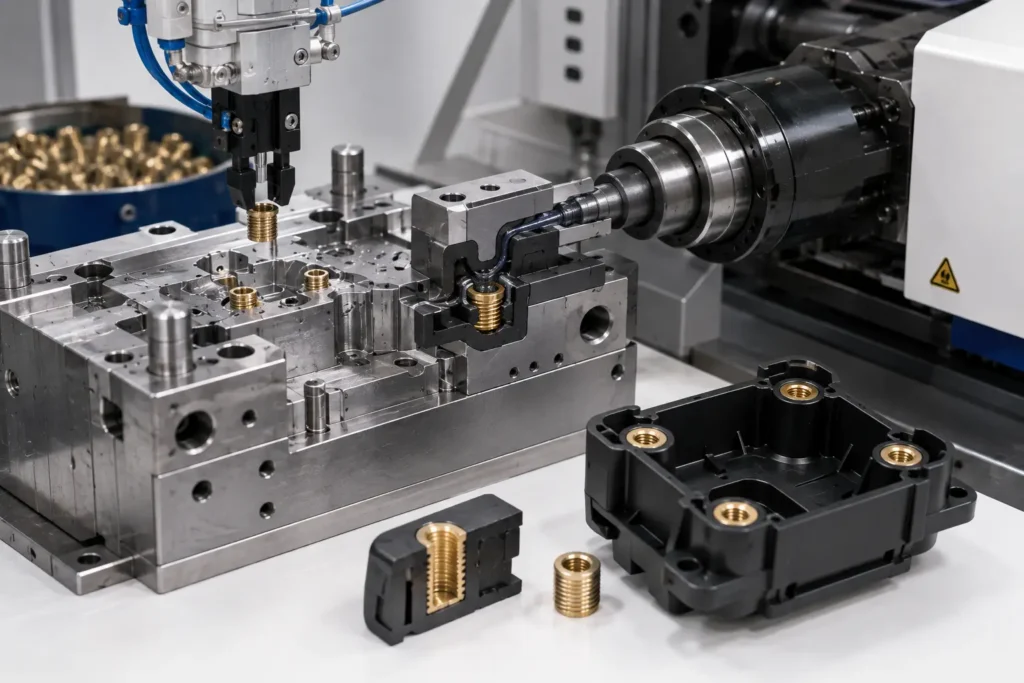
Insert molding places a pre-made component — usually a metal insert — into the mold, then molds plastic around it to lock it permanently in place.
Insert molding is the answer whenever a plastic part needs the strength or function of metal at a specific point — most commonly a threaded brass insert that gives a plastic housing a durable, reusable screw thread. The insert is loaded into the cavity before injection, and the molten plastic flows around it, encapsulating it as the part forms. This produces a stronger, more reliable bond than pressing or gluing an insert in afterward, and it’s widely used for threaded bosses, electrical contacts, terminals, and embedded fasteners. It’s often confused with overmolding — the distinction is simple: overmolding molds a material over another molded material, while insert molding molds plastic around a separate, pre-made (usually non-plastic) component.
Not sure which molding type your part needs? Send your drawing to Manufyn — we’ll recommend the right process and return a firm quote within 24 hours. ISO 9001, strictly in-house, no minimum order.
Multi-Shot (2K) Molding
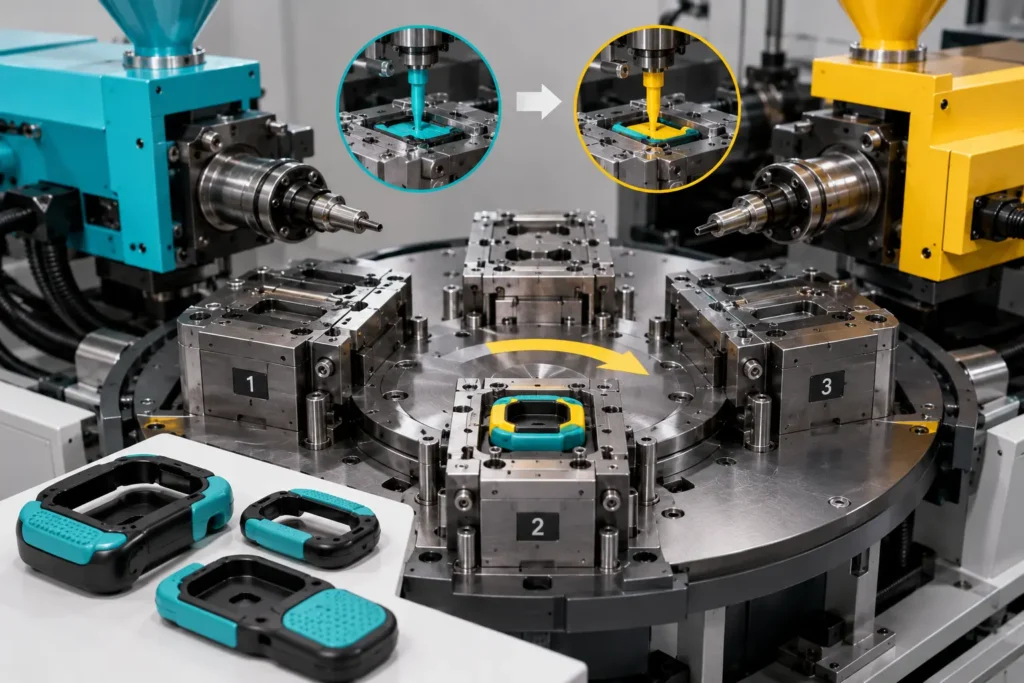
Multi-shot molding injects two or more materials or colours in a single machine cycle, using a rotating or multi-barrel mold.
Multi-shot molding — often called 2K (two-component) molding — achieves what overmolding does, but in one automated cycle rather than two separate operations. A specialised machine with two injection units and a rotating or indexing mold shoots the first material, rotates the part, then shoots the second directly onto it. It’s used for multi-colour parts, integrated hard-soft components, and high-volume products where the per-cycle efficiency justifies the higher tooling and machine cost. The trade-off is upfront: multi-shot tooling and machinery are significantly more expensive than single-shot, so it only makes sense at volumes high enough to spread that cost. Below those volumes, two-stage overmolding usually wins on total cost.
Gas-Assisted Injection Molding
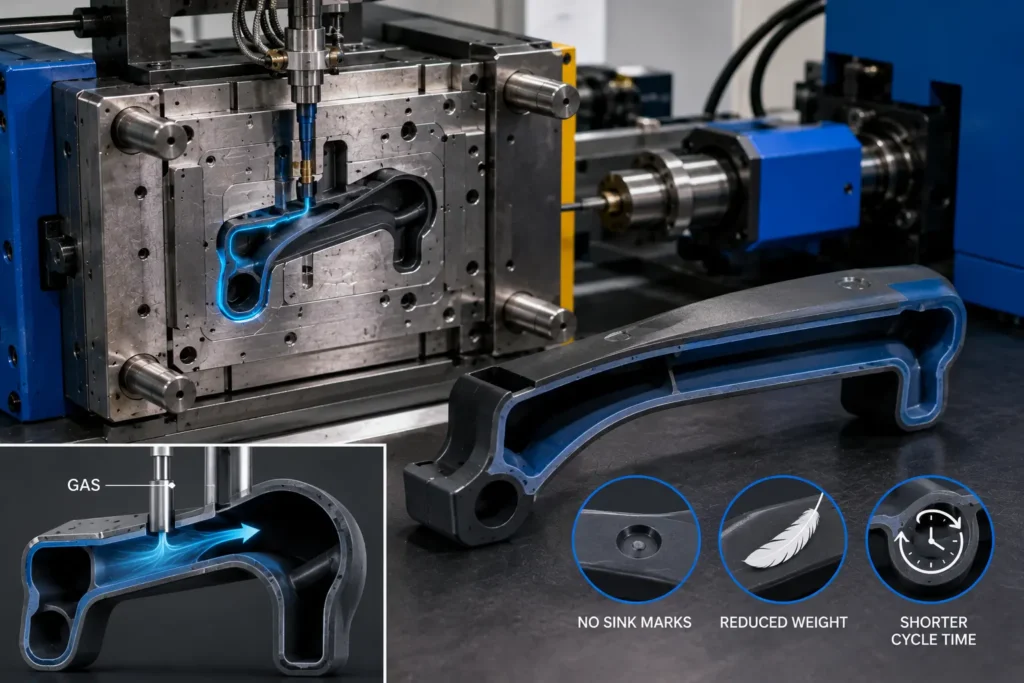
Gas-assisted molding injects pressurised gas into the molten plastic, creating hollow channels through thick sections of the part.
Gas-assisted molding solves a specific problem: thick plastic sections cool unevenly, causing sink marks, warping, and long cycle times. By injecting nitrogen gas into the melt during molding, the process hollows out thick areas from the inside, pushing plastic against the cavity walls while leaving a hollow core. The result is a part with the stiffness of a thick section but far less material, no sink marks, reduced weight, and shorter cooling time. It’s common in large structural parts, handles, TV and appliance housings, and automotive trim — anywhere a part needs rigidity without the mass and cooling penalty of solid thick walls. The trade-off is added process complexity and tighter control requirements.
Thin-Wall Injection Molding
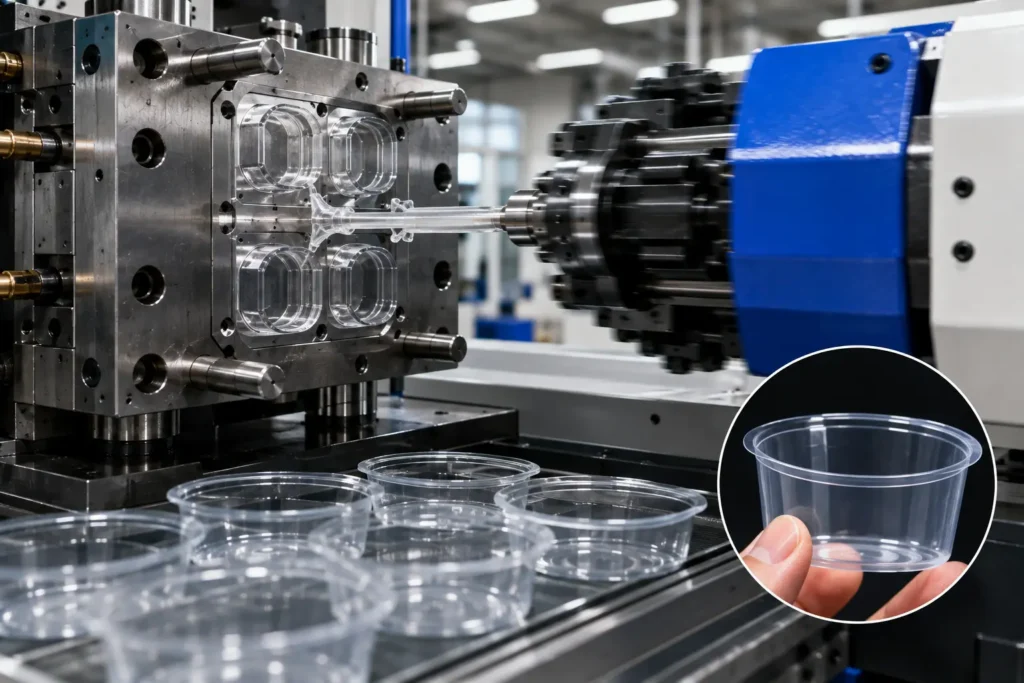
Thin-wall molding produces parts with very thin walls — often under 1 mm — using high injection speed and pressure to fill before the plastic sets.
Thin-wall molding is less a different process than conventional molding pushed to its limits. As walls get thinner, plastic cools and solidifies faster, so the cavity must be filled extremely quickly and at very high pressure before the flow front freezes off. It demands high-tonnage machines, fast-flowing resins, and carefully engineered gating, but it delivers lighter parts, less material per part, and faster cycles — which is why it dominates high-volume packaging (cups, lids, containers) and slim electronics housings where every gram and every second of cycle time multiplies across millions of units. The engineering challenge is real: too thin, and the mold won’t fill; the balance between wall thickness, flow, and pressure is where thin-wall expertise lives.
Types of Injection Molding Machines and Materials
Two secondary meanings of “types of injection molding” are worth clarifying so the picture is complete. First, the machines: injection molding presses come in hydraulic (high clamping force, lower cost), electric (precise, energy-efficient, clean), and hybrid (a balance of both) types — the machine affects precision, energy use, and cost, but not the fundamental process. Second, the materials: the resin is chosen separately from the process, spanning commodity plastics like PP, ABS, and PE, engineering resins like PC, nylon, and POM, and elastomers like TPE and silicone. The process type and the resin are independent decisions — you can run most resins through most process types.
The full range of related processes, including transfer, blow, compression, and rotational molding, sits on our rubber and plastics commodity page.
How to Choose the Right Type of Injection Molding
The right process follows directly from what your part needs to do:
- One material, one colour, standard part → conventional single-shot molding
- A soft grip, seal, or second material on a rigid base → overmolding (or multi-shot at high volume)
- A metal thread, contact, or component embedded in plastic → insert molding
- Thick sections that would sink or warp if solid → gas-assisted molding
- Very thin, lightweight, high-volume parts → thin-wall molding
- Flexible, heat-resistant, or medical-grade parts → LSR molding
Buyer takeaway: the process type drives tooling complexity, and tooling is usually the biggest single cost on a molding quote — so choosing the simplest process that meets your part’s function is the most direct way to control cost. Our injection molding cost breakdown shows exactly how tooling and process choice flow into the per-part price.
How Manufyn Supports Injection Molding
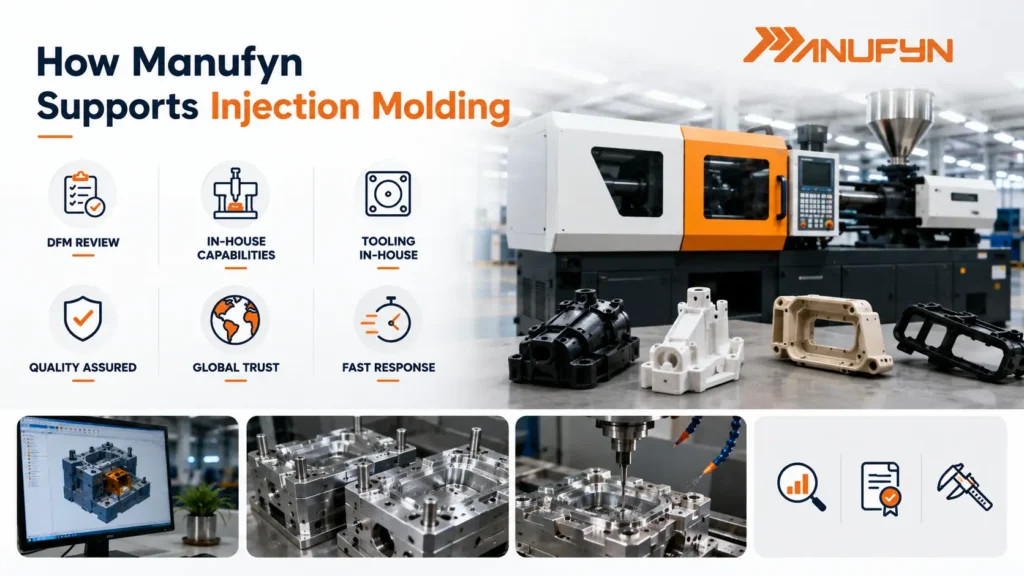
Manufyn is an ISO 9001 certified, strictly in-house on-demand manufacturer based in Baner, Pune, India — not a broker or trading company. Injection molding runs alongside 80+ other processes under one roof, so tooling, molding, and any secondary machining or assembly stay with one accountable team.
Every molding project starts with a free DFM review that flags wall-thickness, draft, and gating issues before the tool is cut — the stage where most molding cost is won or lost. Because production is in-house, the design feedback comes from the people who will actually run the mold, and a part can move from a machined or 3D-printed prototype straight into bridge tooling and production without changing suppliers.
- Conventional, insert, and overmolding capabilities in-house
- Free DFM review on every quote before tooling is cut
- Aluminium bridge tooling and hardened production molds in the same tool room
- FAIR, material certificates, and dimensional reports as standard
- Serving 500+ clients across 30+ countries, quoted within 24 hours
See documented results in our case studies, or read more about our approach on Why Manufyn.
Ready to mold your part? Send your drawing to Manufyn — free DFM review, the right process matched to your part, no minimum order, and a firm quote in 24 hours.
FAQs
The main process types are conventional (single-shot) molding, overmolding, insert molding, multi-shot (2K) molding, gas-assisted molding, thin-wall molding, and liquid silicone rubber (LSR) molding. They share the same core principle — material forced into a cavity under pressure — but differ in how many materials are used and what’s placed in the mold beforehand.
Overmolding molds a second material over a first molded material — typically a soft grip over a rigid plastic base. Insert molding molds plastic around a separate, pre-made component that’s usually not plastic, most often a metal insert like a threaded brass boss. In short: overmolding bonds material to material; insert molding bonds plastic around an inserted component.
Conventional single-shot injection molding is by far the most common — one material injected into one cavity. It’s the cheapest per part and fastest to tool, which is why it’s the default for the majority of standard plastic parts unless the part specifically needs a second material, an embedded insert, or a hollow section.
Multi-shot (2K) molding injects two or more materials or colours in a single machine cycle using a specialised machine and a rotating or indexing mold. It achieves what overmolding does but in one automated cycle, making it efficient at high volume — though its tooling and machine costs are significantly higher, so it only pays off at large volumes.
Gas-assisted molding injects nitrogen into the molten plastic to hollow out thick sections from the inside. It’s used for large structural parts, handles, appliance housings, and automotive trim — anywhere a part needs rigidity without the sink marks, warping, weight, and long cooling times that solid thick walls would cause.
Liquid silicone rubber (LSR) molding mixes and injects a two-part liquid silicone into a heated mold, where it cures into a flexible rubber part. LSR stays flexible across extreme temperatures, resists chemicals and UV, and many grades are biocompatible — making it standard for medical devices, seals, gaskets, and baby products.
Yes, significantly. The process type drives tooling complexity, and tooling is usually the biggest single cost on a molding quote. Conventional single-shot molding is cheapest; multi-shot, gas-assisted, and LSR require more complex tooling and specialised machines, raising cost. Choosing the simplest process that meets your part’s function is the most direct way to control cost.
No — they’re different. Types of injection molding refer to the processes (conventional, overmolding, insert, and so on). Types of machines refer to the presses that run them: hydraulic, electric, and hybrid. The machine affects precision, energy use, and cost, but not the fundamental molding process, which is chosen separately based on the part.
Have a specific part in mind? Send your drawing to our engineers — we respond within 4 working hours.
Have a plastic part to mold?
Get the right process matched to your part, a free DFM review, and a firm quote in 24 hours — no minimum order.
Talk to Manufyn