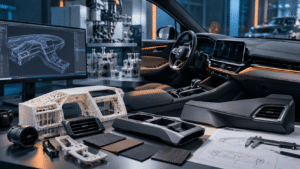
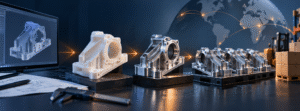
On-demand manufacturing is a production model where parts are made to order — machined, molded, cast, or fabricated only when a customer places a purchase order — instead of being built to a forecast and held in inventory. It covers CNC machining, sheet metal fabrication, injection molding, casting, forging, and rapid prototyping, all quoted and produced against a specific drawing and quantity.
The model exists because holding inventory against a forecast is expensive and risky when demand, designs, or specifications are still moving — which describes most engineering and product development work at some point in its life. On-demand manufacturing removes the inventory bet: you order the quantity you need, when you need it, from a supplier equipped to run that quantity economically whether it’s one prototype or fifty thousand production units.
This guide covers what on-demand manufacturing actually includes, how the process works from RFQ to delivery, how it compares to traditional contract manufacturing and mass production, and how to evaluate a supplier before committing your first purchase order. Manufyn’s on-demand manufacturing services span more than 80 processes from a single ISO 9001 certified, strictly in-house facility in Pune, India — the model this guide describes is the one we operate.
What Is On-Demand Manufacturing?
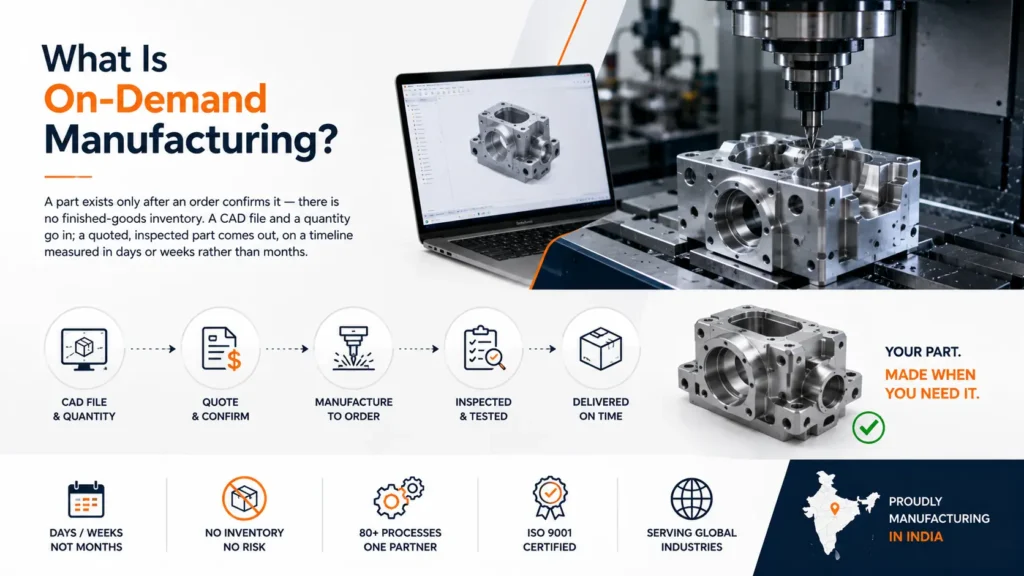
On-demand manufacturing means a part exists only after an order confirms it — there is no finished-goods inventory sitting in a warehouse waiting for a buyer. A CAD file and a quantity go in; a quoted, inspected part comes out, on a timeline measured in days or weeks rather than the months a build-to-forecast supply chain often requires.
On-Demand vs Made-to-Stock: The Core Difference
Made-to-stock manufacturing produces a forecasted volume in advance and sells from inventory — efficient when demand is predictable and designs are frozen. On-demand manufacturing produces against a confirmed order — better when demand is uncertain, designs are still evolving, or holding inventory ties up capital you’d rather deploy elsewhere. Most companies use both models at different points in a product’s life: on-demand while validating a design and demand, made-to-stock once both are proven.
How Does On-Demand Manufacturing Work?
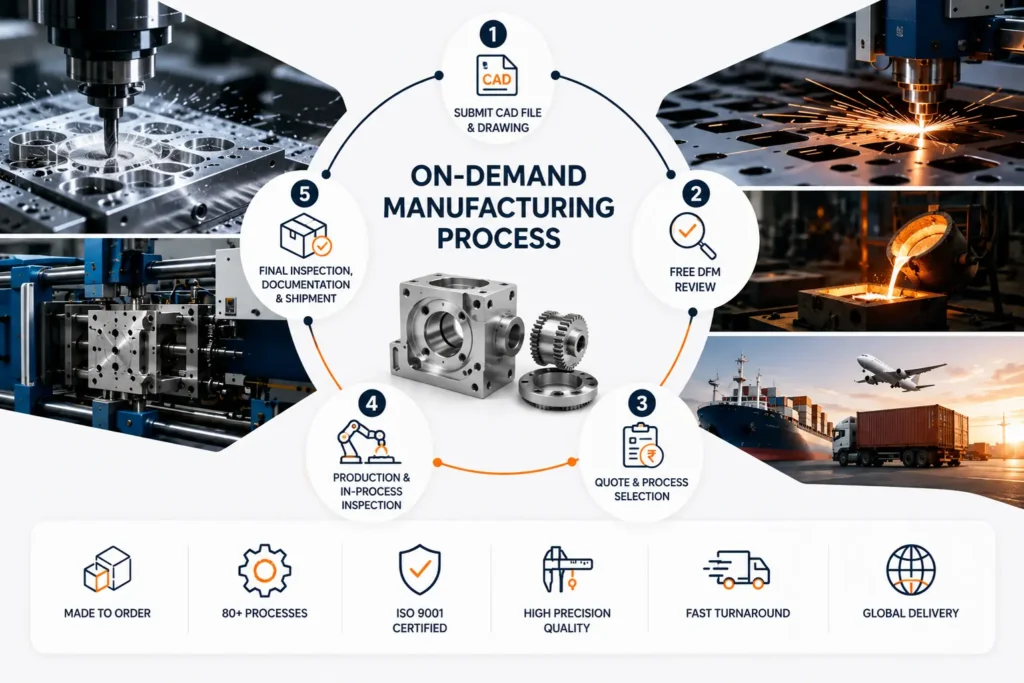
The on-demand manufacturing process follows the same five stages regardless of which technology ultimately makes the part.
- Submit your CAD file (STEP or IGES) and a 2D drawing (DXF or PDF) with material, tolerance, and finish specified.
- A free DFM (design for manufacturability) review flags features that would add cost or fail in the chosen process.
- Quote and process selection — CNC, sheet metal, injection molding, casting, or another process, matched to your quantity and timeline.
- Production, with in-process inspection at defined stages.
- Final inspection, documentation (FAIR, material certificates), and shipment.
What Processes Are Included in On-Demand Manufacturing?
| Process | Typical MOQ | Typical lead time | Best for |
|---|---|---|---|
| CNC machining | 1 piece | 3–10 days | Metal and plastic prototypes, low-to-mid volume production |
| Sheet metal fabrication | 1 piece | 5–10 days | Enclosures, brackets, panels, ductwork |
| Injection molding | 500–1,000+ (tooled) | 4–12 weeks (first run) | High-volume plastic parts |
| Casting (die / investment / sand) | 25–500+ | 3–8 weeks | Complex metal geometries, thin walls |
| Forging | 100–1,000+ | 4–10 weeks | High-strength, load-bearing metal parts |
| Rapid prototyping (3D printing, vacuum casting) | 1 piece | 1–10 days | Design validation, low volume |
| Electronic assembly (PCBA) | 1–10 pieces | 5–15 days | Wired assemblies, electronics enclosures |
| Aluminium extrusion | 100 kg+ | 3–6 weeks | Structural profiles, heat sinks, frames |
Explore each process in detail: CNC machining, sheet metal fabrication, injection molding, casting, forging, electronic assembly, and aluminium extrusion.
On-Demand Manufacturing vs Traditional Contract Manufacturing vs Mass Production
| Factor | On-Demand Manufacturing | Traditional Contract Manufacturing | Mass Production |
|---|---|---|---|
| Minimum order quantity | 1 piece | Often 500–5,000+ | 10,000+ |
| Contract commitment | Per order, no long-term contract | Often 6–24 month agreements | Multi-year agreements |
| Lead time to first part | Days to a few weeks | Weeks to months (onboarding + tooling) | Months (tooling + line setup) |
| Inventory risk | None — built to order | Moderate — minimum batch sizes held | High — built to forecast |
| Design flexibility | High — change between orders | Moderate — locked after tooling | Low — locked after line setup |
| Best for | Prototypes, low-to-mid volume, evolving designs | Established products, stable mid-volume demand | Proven products, high stable long-term demand |
Buyer takeaway: the right model isn’t fixed — it’s a function of how validated your design and demand are right now. Most products move left to right across this table over their lifetime.
Not sure whether your project needs on-demand manufacturing, a batch production run, or a full production partnership? Share your drawing and volume plan with Manufyn — we’ll recommend the right model, not just quote the one you asked for.
Benefits of On-Demand Manufacturing
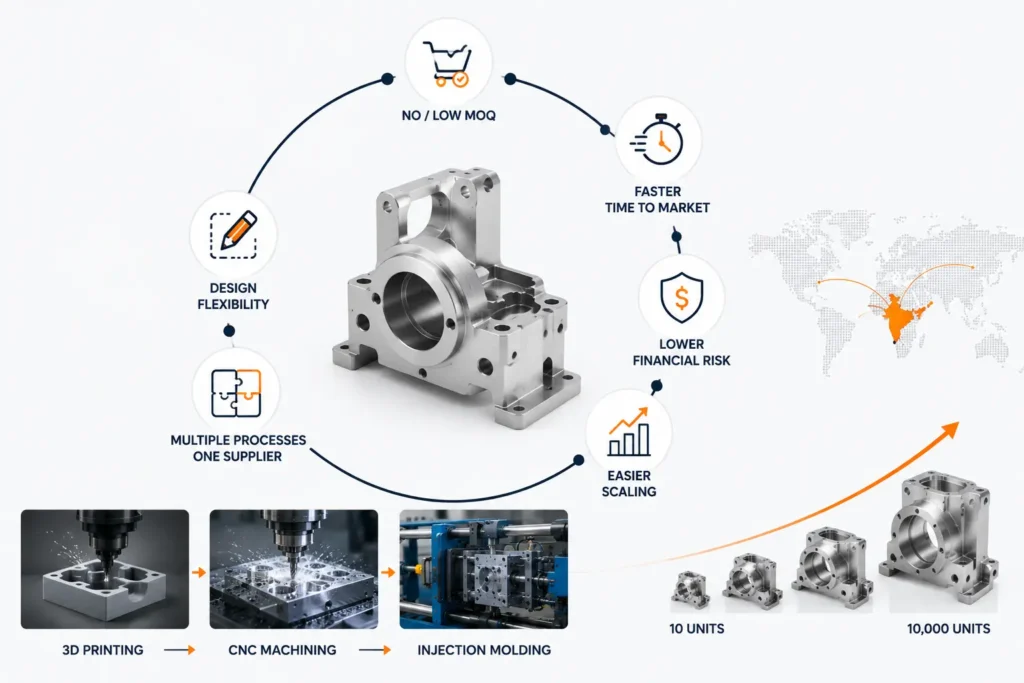
On-demand manufacturing’s advantages come down to removing commitments you don’t yet need to make — to a volume, a design, or a single technology.
- No or low minimum order quantity — order 1 piece or 10,000
- Faster time to market — quote in 24 hours, first parts in days rather than months
- Lower financial risk — no inventory built against a forecast that might not materialise
- Design flexibility — revise between orders without cancelling a long production contract
- Access to multiple processes under one supplier — move a part from 3D printing to CNC to injection molding without re-sourcing
- Easier scaling — the same relationship can carry a part from 10 units to 10,000
Who Uses On-Demand Manufacturing?
On-demand manufacturing serves any buyer who needs parts made without committing to a forecast or a long production contract first.
- Startups and product development teams validating a design before committing to volume
- Medical device companies needing traceable, low-volume production runs
- Automotive and industrial OEMs sourcing spare parts, tooling, and low-volume special components
- Robotics and automation companies building custom equipment in small batches
- Aerospace suppliers needing certified, traceable parts in variable quantities
- Electronics companies prototyping enclosures and assemblies ahead of a production decision
See how this plays out across sectors on our industries page, including robotics and automotive manufacturing.
How to Choose an On-Demand Manufacturing Partner
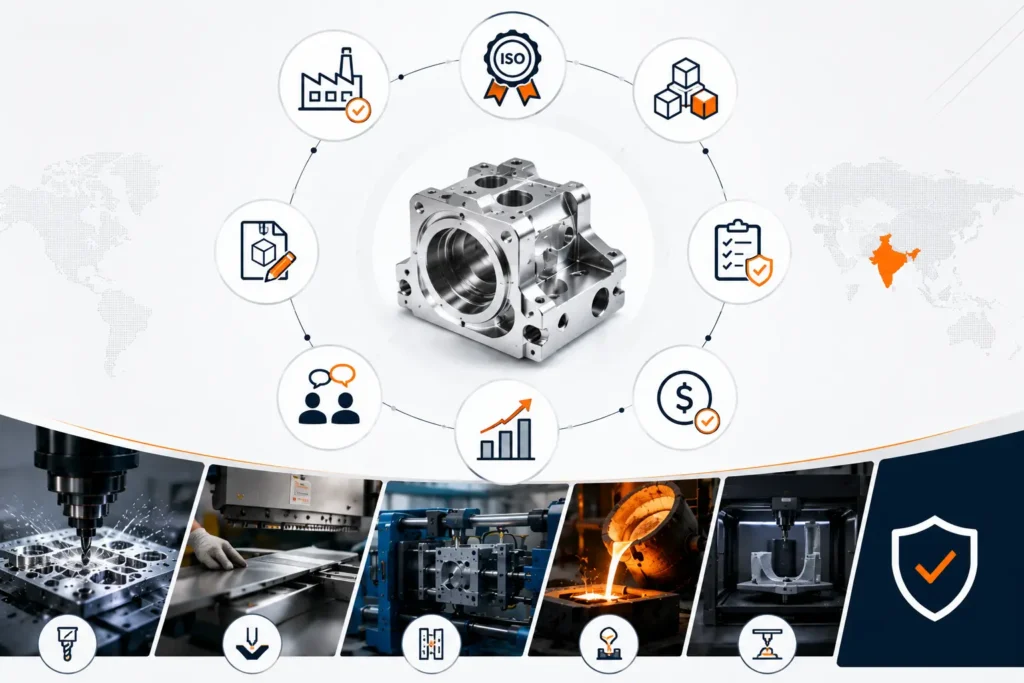
Because on-demand manufacturing has no long contract to protect you, supplier vetting matters more here than in traditional sourcing, not less.
- Verify in-house vs broker vs trading company — ask who actually owns the equipment
- Confirm ISO 9001 (and any sector certificate) directly with the issuing body
- Check the breadth of processes offered under one roof — fewer supplier handoffs means fewer risks
- Request a free DFM review before quoting — a supplier who skips this is pricing risk into your part, not removing it
- Ask for documented quality control — FAIR, material certificates, dimensional reports — by default, not on request
- Confirm minimum order quantity and pricing behaviour across at least three volumes
We cover this verification process in full, including the exact registrations to check, in our guide to finding a reliable manufacturing partner in India.
Red Flags in an On-Demand Manufacturing Quote
- No willingness to state which processes are in-house versus subcontracted
- A quote with no cavity count, tooling amortisation, or DFM feedback behind it
- No flexibility on order quantity, even for a first trial order
- Certifications that can’t be verified with the issuing body
Buyer takeaway: every flag above is cheap to check before a purchase order and expensive to discover after one.
How Manufyn Delivers On-Demand Manufacturing
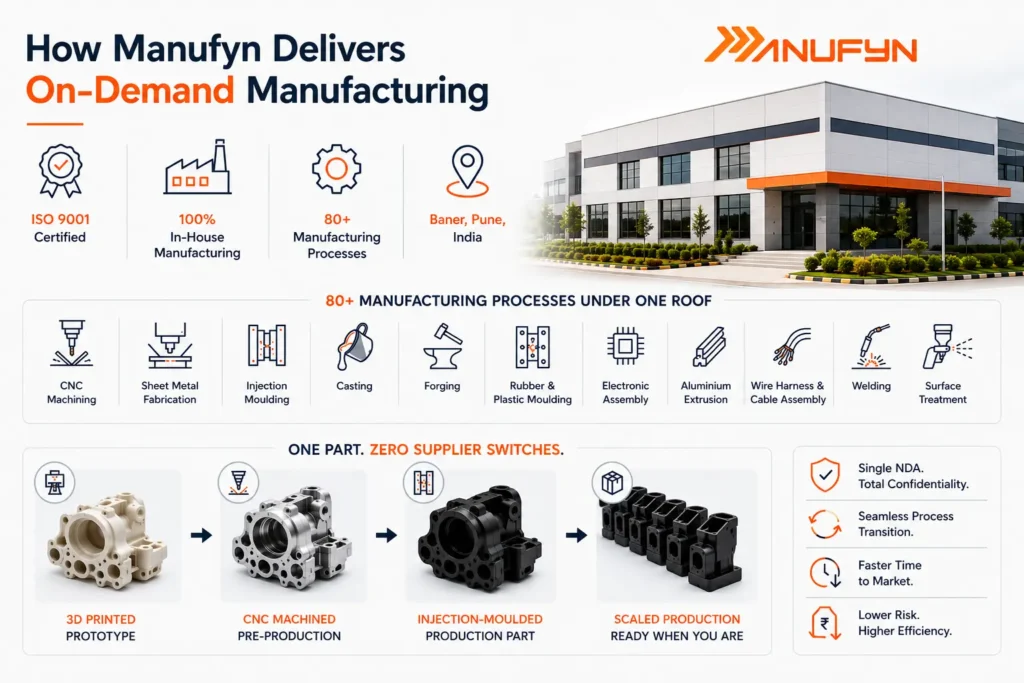
Manufyn is an ISO 9001 certified, strictly in-house on-demand manufacturer based in Baner, Pune, India, offering more than 80 manufacturing processes from one facility — CNC machining, sheet metal fabrication, injection moulding, casting, forging, rubber and plastic moulding, electronic assembly, aluminium extrusion, wire harness and cable assembly, welding, and surface treatment. Because every process runs in-house, a part can move from a 3D-printed prototype to a CNC-machined pre-production run to an injection-moulded production part without changing suppliers or re-sending drawings under a new NDA.
- No minimum order quantity — 1 piece to full production volumes
- Free DFM review on every quote, across every process
- Quote in 24 hours, engineer response within 4 working hours
- FAIR, material certificates, and dimensional reports as standard, not on request
- Serving 500+ clients across 30+ countries, including the US, UK, Australia, UAE, Canada, Germany, Singapore, and Malaysia
See our full process range on our commodities directory, documented results in our case studies, or read more about our approach on Why Manufyn.
Ready to order without committing to a forecast? Share your drawing and quantity with Manufyn — CNC, sheet metal, molding, casting, and more, all quoted in 24 hours with no minimum order.
FAQs
On-demand manufacturing is a production model where parts are made to order — against a confirmed purchase order and drawing — rather than built to a forecast and held as finished-goods inventory. It covers processes like CNC machining, sheet metal fabrication, injection molding, casting, and rapid prototyping, all quoted and produced per order.
Mass production builds a forecasted volume in advance, usually under a multi-year agreement, and sells from inventory. On-demand manufacturing produces only against a confirmed order, with no long-term contract required and no inventory risk — though at very high, stable volumes, mass production typically achieves a lower cost per part.
Most on-demand manufacturers, including Manufyn, quote from 1 piece with no minimum order quantity. Tooled processes like injection molding still carry a practical minimum where tooling cost is justified — typically a few hundred units — but the manufacturer itself does not require a contractual minimum.
Tool-less processes — CNC machining, sheet metal fabrication, 3D printing — typically ship a first part in 3–10 working days. Tooled processes like injection molding, casting, or forging require additional time for tooling design and trial, typically 4–12 weeks for the first production run.
Any manufacturing process that can be quoted and produced per order without a pre-built inventory position — commonly CNC machining, sheet metal fabrication, injection molding, casting, forging, rapid prototyping, electronic assembly, and aluminium extrusion.
Per part, often yes at very high volumes, because mass production amortises tooling and setup across a much larger forecasted run. Below that volume — which describes most prototype, low-volume, and evolving-design projects — on-demand manufacturing is usually cheaper overall once inventory risk and unsold stock are accounted for.
Yes. A supplier that runs on-demand manufacturing in-house across multiple processes can typically carry a part from a low-volume on-demand run into a dedicated production tool and batch production without changing suppliers, once volume is confirmed.
Verify whether the supplier is an in-house manufacturer, a broker, or a trading company; confirm ISO 9001 (and any sector certificate) directly with the issuing body; and request documented quality control — FAIR, material certificates — as a default, not an afterthought.
Yes — rapid prototyping (3D printing, CNC prototype machining, vacuum casting) is typically the fastest and lowest-commitment form of on-demand manufacturing, often used to validate a design before ordering a larger on-demand production run.
Yes, provided the supplier holds the relevant certifications and documentation processes — ISO 13485 for medical devices, AS9100 for aerospace — and can supply full material traceability and inspection reports per part. Confirm certification scope directly with the supplier before committing regulated work.
Have a specific part in mind? Send your drawing to our engineers — we respond within 4 working hours.
Planning a solar project and want to avoid EPC mistakes?
Get a project feasibility check and execution roadmap before you finalize your EPC partner.
Talk to Manufyn