
Injection molding cost breaks down into five components: mold tooling, raw material, machine time, labor and secondary operations, and quality documentation. Tooling is a one-time charge recovered across the entire production run; the other four repeat on every single part you mold — which is why the same design can cost $0.20 or $2.00 per part depending purely on volume.
Most quotes buyers receive show a single number per part with no breakdown behind it. That makes it impossible to tell whether a price is fair, where the money is actually going, or which lever to pull to bring the cost down. This guide breaks injection molding cost into its five real components, gives 2026 indicative price ranges for each, and works through a full example from tooling to landed cost per part.
The figures below reflect what Manufyn’s engineering team quotes against for injection molding projects run from our ISO 9001 certified, strictly in-house facility in Pune — the actual cost stack behind a real quote, not a reseller’s estimate.
What Are the Five Components of Injection Molding Cost?
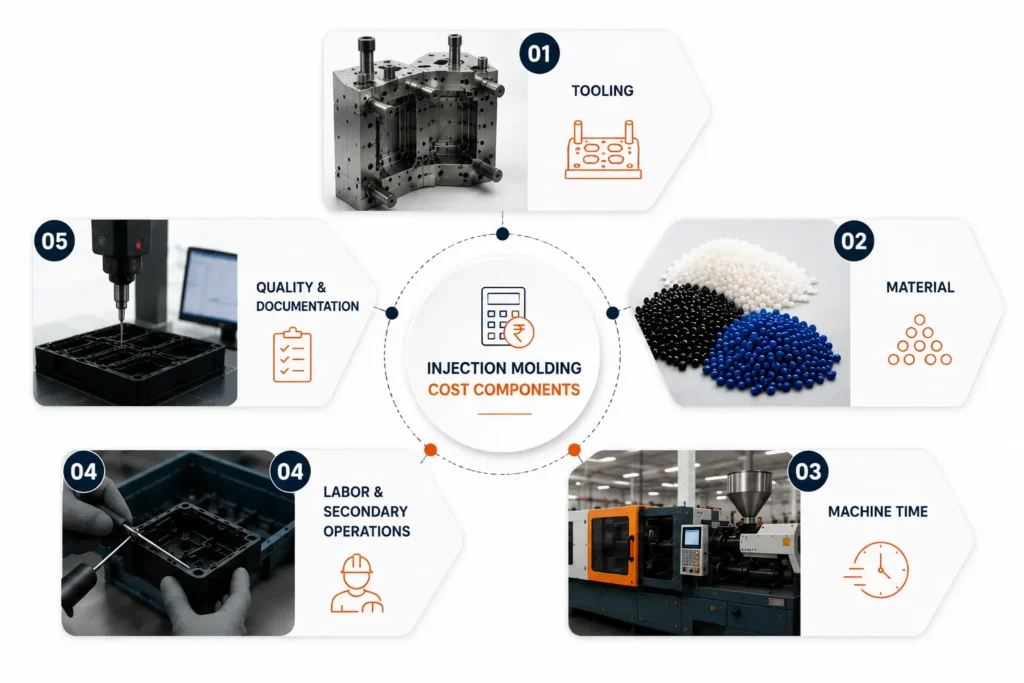
Every injection molding quote is built from the same five line items, even when a supplier only shows you the final number. Understanding each one is what lets you negotiate the right line, instead of just asking for a discount on a price you can’t take apart.
- Tooling — the mold itself; a one-time cost amortised across every part the tool ever produces.
- Material — resin price by weight, plus scrap and runner allowance.
- Machine time — press rate divided by cycle time, divided again by cavity count.
- Labor and secondary operations — assembly, marking, ultrasonic welding, packaging.
- Quality and documentation — first article inspection, material certificates, dimensional reports.
Mold Tooling Cost: The Biggest Upfront Variable
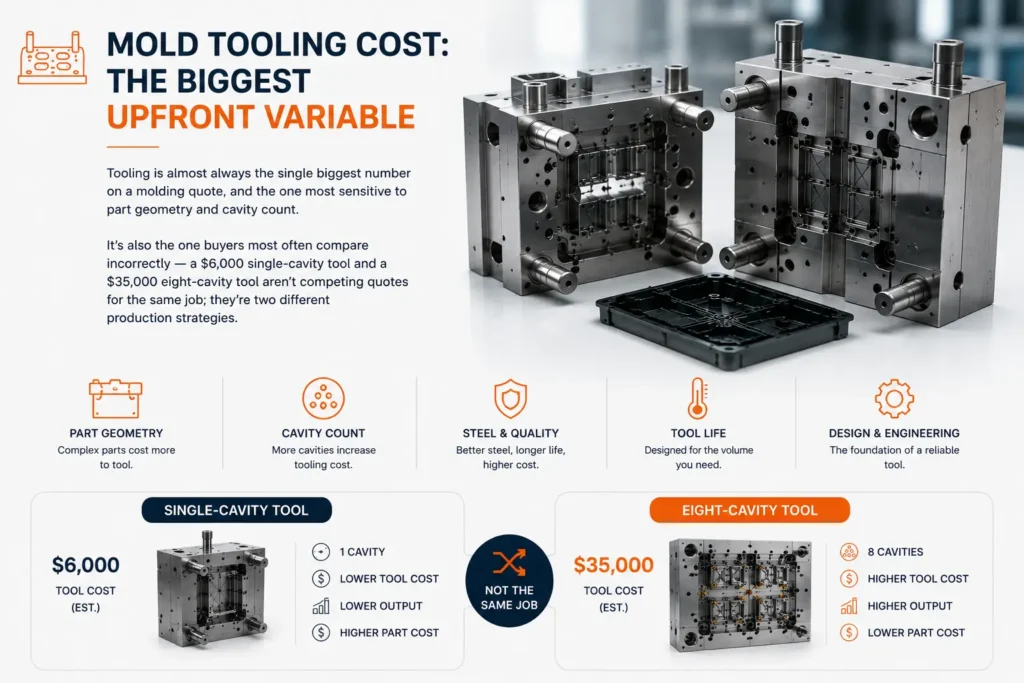
Tooling is almost always the single biggest number on a molding quote, and the one most sensitive to part geometry and cavity count. It’s also the one buyers most often compare incorrectly — a $6,000 single-cavity tool and a $35,000 eight-cavity tool aren’t competing quotes for the same job; they’re two different production strategies.
| Mold type | Indicative cost (USD) | Typical cavities | Typical tool life |
|---|---|---|---|
| Aluminium bridge / prototype tool | $3,000 – $15,000 | 1–2 | 100 – 10,000 shots |
| Single-cavity, simple geometry | $3,000 – $8,000 | 1 | 100,000 – 500,000 shots |
| Single-cavity, side actions / undercuts | $8,000 – $25,000 | 1 | 250,000 – 750,000 shots |
| Multi-cavity production mold | $15,000 – $60,000 | 4–16 | 500,000+ shots |
| Hot-runner, high-precision, high-cavitation | $40,000 – $150,000+ | 8–32+ | 1,000,000+ shots |
Buyer takeaway: tooling cost only matters divided by volume. A $30,000 tool amortised across 100,000 parts adds $0.30 per part; the same tool across 5,000 parts adds $6.00 per part. Always ask what lifetime volume a tool quote assumes. Our guide to injection moulding tooling types and materials covers how tool-steel grade and cavitation change this number further.
Material Cost: Resin Pricing by the Kilogram
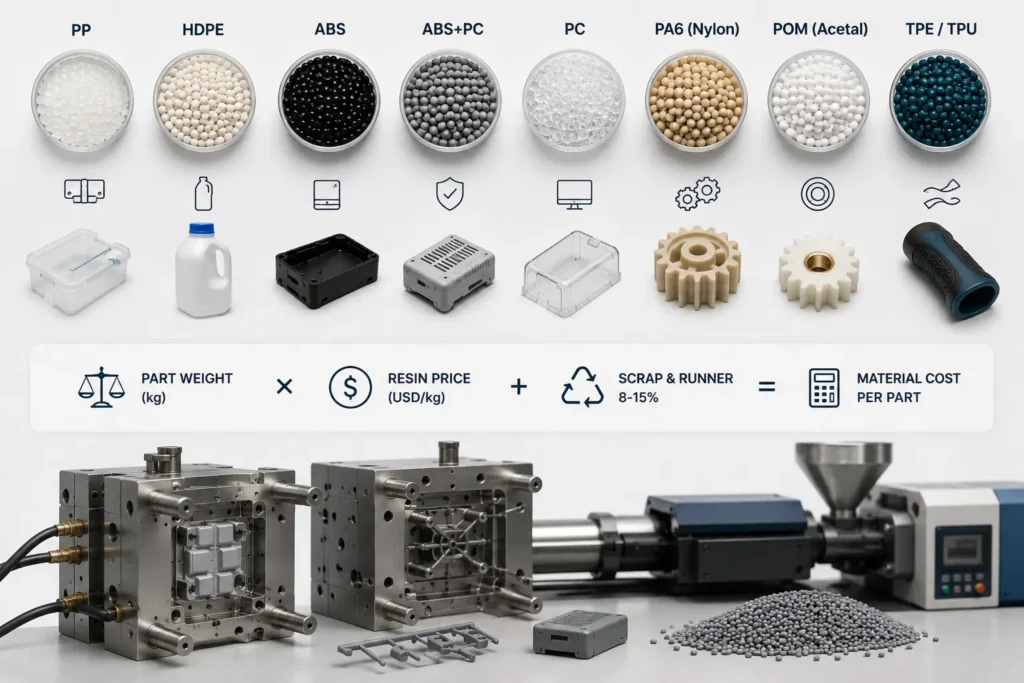
Resin is priced by weight, so material cost per part is simply part weight (in kg) multiplied by resin price, plus a scrap and runner allowance — typically 8–15% for a cold-runner mold, lower for hot-runner tooling that reuses the sprue automatically.
| Resin | Indicative price (USD/kg) | Common use |
|---|---|---|
| Polypropylene (PP) | $1.10 – $1.60 | Living hinges, packaging, chemical-resistant parts |
| HDPE / LDPE | $1.20 – $1.70 | Containers, caps, low-cost housings |
| ABS | $1.80 – $2.40 | General-purpose enclosures, consumer parts |
| ABS+PC blend | $2.40 – $3.20 | Electronics housings needing impact + heat resistance |
| Polycarbonate (PC) | $2.80 – $3.80 | High-clarity, high-strength housings |
| Nylon (PA6) | $2.60 – $3.60 | Gears, bushings, wear-resistant mechanical parts |
| POM / Acetal (Delrin) | $2.90 – $4.00 | Precision gears, low-friction moving parts |
| TPE / TPU | $3.50 – $5.50 | Soft-touch grips, seals, overmoulded components |
Treat these as planning bands, not quotes — resin prices move with crude oil, regional supply, and order volume. A part quoted with an unnamed “ABS-grade” resin and no kg price is a quote you can’t actually verify.
Machine Time: How Cycle Time Turns Into Cost Per Part
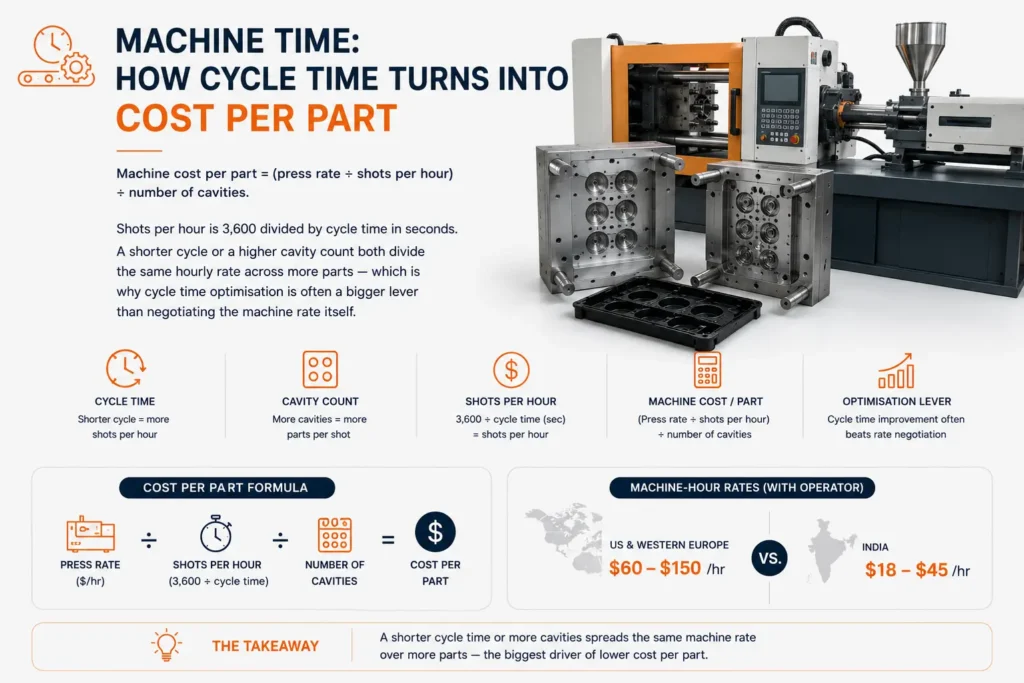
Machine cost per part = (press rate ÷ shots per hour) ÷ number of cavities. Shots per hour is 3,600 divided by cycle time in seconds. A shorter cycle or a higher cavity count both divide the same hourly rate across more parts — which is why cycle time optimisation is often a bigger lever than negotiating the machine rate itself.
Injection moulding machine-hour rates (with operator) typically run $60–$150/hr in the US and Western Europe versus $18–$45/hr in India — the same gap in labour and overhead cost seen across CNC and sheet metal fabrication.
A Full Worked Example: Cost Breakdown of a Sample Part
Take a small polycarbonate enclosure, 12 grams per part, moulded in a 4-cavity tool with a 25-second cycle time on an Indian press at $45/hour.
- Shots per hour: 3,600 ÷ 25 = 144 shots → 144 × 4 cavities = 576 parts/hour
- Machine cost per part: $45 ÷ 576 = $0.078
- Material cost per part: 0.012 kg × $3.20/kg = $0.038, plus 12% scrap allowance = $0.043
- Labor and QC overhead: $0.05 per part
- Variable cost per part: $0.078 + $0.043 + $0.05 = $0.171
| Order quantity | Tooling cost per part ($18,000 tool) | Variable cost per part | Total landed cost per part |
|---|---|---|---|
| 1,000 units | $18.00 | $0.171 | $18.17 |
| 10,000 units | $1.80 | $0.171 | $1.97 |
| 50,000 units | $0.36 | $0.171 | $0.53 |
Buyer takeaway: the variable cost per part never changes with volume — only the tooling line does. This is exactly why quoting a single quantity tells you almost nothing about your real cost curve; always request price breaks at three volumes. Our injection molding vs 3D printing cost comparison works through the same math against a tool-less alternative.
Want your own numbers instead of a worked example? Send Manufyn your drawing, resin choice, and target volume — we’ll return a full tooling-to-part cost breakdown within 24 hours.
How to Reduce Injection Molding Cost Without Hurting Quality
- Keep wall thickness uniform — variable walls cause sink marks and warping, which drives rework and scrap cost
- Add draft angles from the start — insufficient draft forces slower cycle times or added side-action tooling
- Avoid unnecessary undercuts — each one can add a slider or lifter, typically $1,500–$4,000 per feature
- Consolidate parts into a family mold where volumes justify it, spreading one tooling cost across several components
- Specify the loosest tolerance the function allows — tight tolerances slow cycle time and increase mold maintenance cost
Our injection molding design guide covers wall thickness, draft angles, and gate placement rules in full detail — most of the cost reductions above are caught in a single DFM review before the tool is ever cut.
Red Flags in an Injection Molding Cost Quote
- A per-part price with no tooling cost, cavity count, or amortisation volume stated
- A resin named only by generic type (“ABS”) with no grade or supplier
- No scrap or runner allowance disclosed in the material line
- Secondary operations (marking, assembly, packaging) added only after the quote is accepted
- A price dramatically below every other quote with no explanation of cavity count or cycle time
Buyer takeaway: a complete quote itemises all five cost components separately. A quote that only shows one number has not eliminated the other four — it has hidden them for later.
How Manufyn Prices Injection Molding
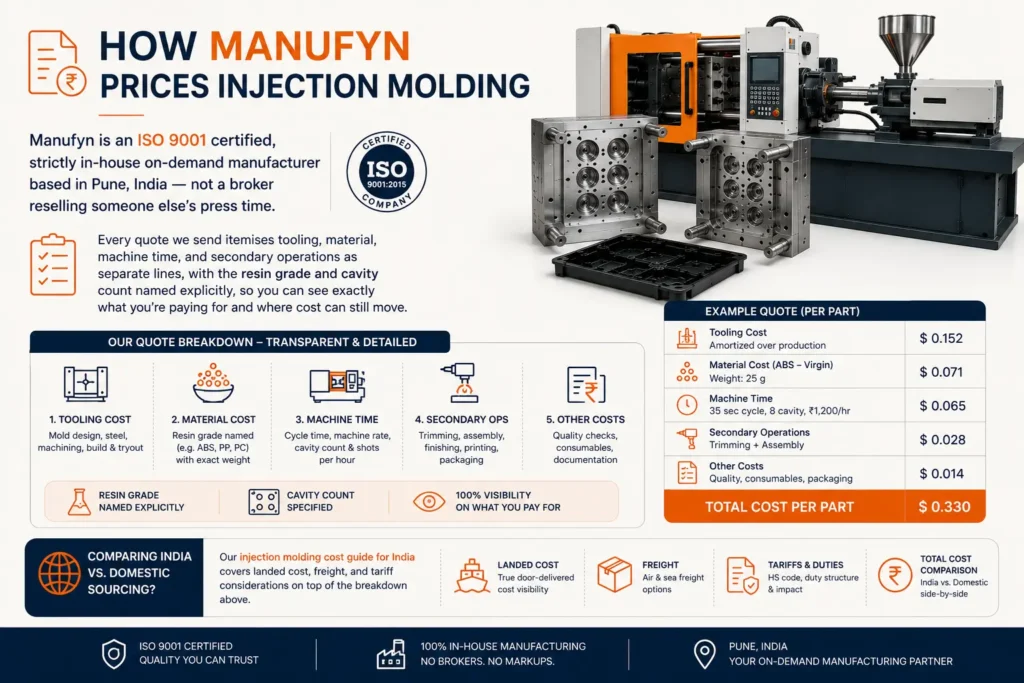
Manufyn is an ISO 9001 certified, strictly in-house on-demand manufacturer based in Pune, India — not a broker reselling someone else’s press time. Every quote we send itemises tooling, material, machine time, and secondary operations as separate lines, with the resin grade and cavity count named explicitly, so you can see exactly what you’re paying for and where cost can still move.
For buyers specifically comparing India against domestic sourcing, our injection molding cost guide for India covers landed cost, freight, and tariff considerations on top of the breakdown above.
Ready to see a fully itemised quote instead of a single number? Share your drawing, resin preference, and target volume with Manufyn’s engineers.
FAQs
There is no single average — cost per part for a simple small component can run $0.20–$2.00 at production volume, while tooling alone ranges from $3,000 for a simple single-cavity mold to $150,000+ for a high-cavitation hot-runner tool. The only meaningful number is your specific part’s total landed cost at your target volume.
At low to moderate volumes, tooling dominates total cost. At high volumes, once tooling is amortised, material and machine time (driven by cycle time and cavity count) become the deciding factors in cost per part.
A simple single-cavity mold typically costs $3,000–$8,000. Adding side actions or undercuts raises that to $8,000–$25,000. Multi-cavity production molds (4–16 cavities) run $15,000–$60,000, and high-precision, high-cavitation hot-runner tools can exceed $150,000.
Yes, significantly. Tooling cost is fixed and gets divided across every part produced, so cost per part drops sharply as volume rises — in a typical example, landed cost per part can fall from roughly $18 at 1,000 units to under $1 at 50,000 units on the same tool.
Polypropylene (PP) and polyethylene (HDPE/LDPE) are typically the least expensive common resins, running roughly $1.10–$1.70/kg. Engineering resins like polycarbonate, nylon, and POM cost two to three times more due to higher performance properties.
Cost per part = tooling cost ÷ total volume, plus material cost (part weight × resin price, plus scrap allowance), plus machine cost (press rate ÷ shots per hour ÷ cavity count), plus labor and secondary operations. Each component should be itemised separately in a proper quote.
Only past a certain volume, because injection molding requires tooling that 3D printing doesn’t. Below the crossover quantity — often a few hundred units, depending on part size and tooling cost — 3D printing or another rapid prototyping method is usually cheaper.
Budget for pad printing or laser marking, ultrasonic welding or assembly, packaging, and any inspection documentation such as first article inspection reports or material certificates. These typically add 10–30% on top of the base molded-part cost, depending on the part.
Yes — uniform wall thickness, adequate draft angles, and removing unnecessary undercuts or side actions are the most common cost reductions, and none of them require compromising the part’s function. A DFM review before the tool is cut catches most of these opportunities at no cost to you.
Machine-hour rates in India typically run $18–$45/hour versus $60–$150/hour in the US and Western Europe, and skilled labor costs follow a similar gap. Raw resin prices are broadly similar everywhere since they trade on global markets, so most of the India cost advantage comes from labor and machine-hour rates, not material.
Have a question about your specific part’s cost breakdown? Send it to our engineers — we respond within 4 working hours.
Need a fully itemised injection molding quote? Manufyn is India’s ISO 9001 certified, strictly in-house on-demand manufacturer — serving the US, UK, Australia, UAE, Canada, Germany, Singapore, Malaysia, and 30+ countries. Quote in 24 hours.