
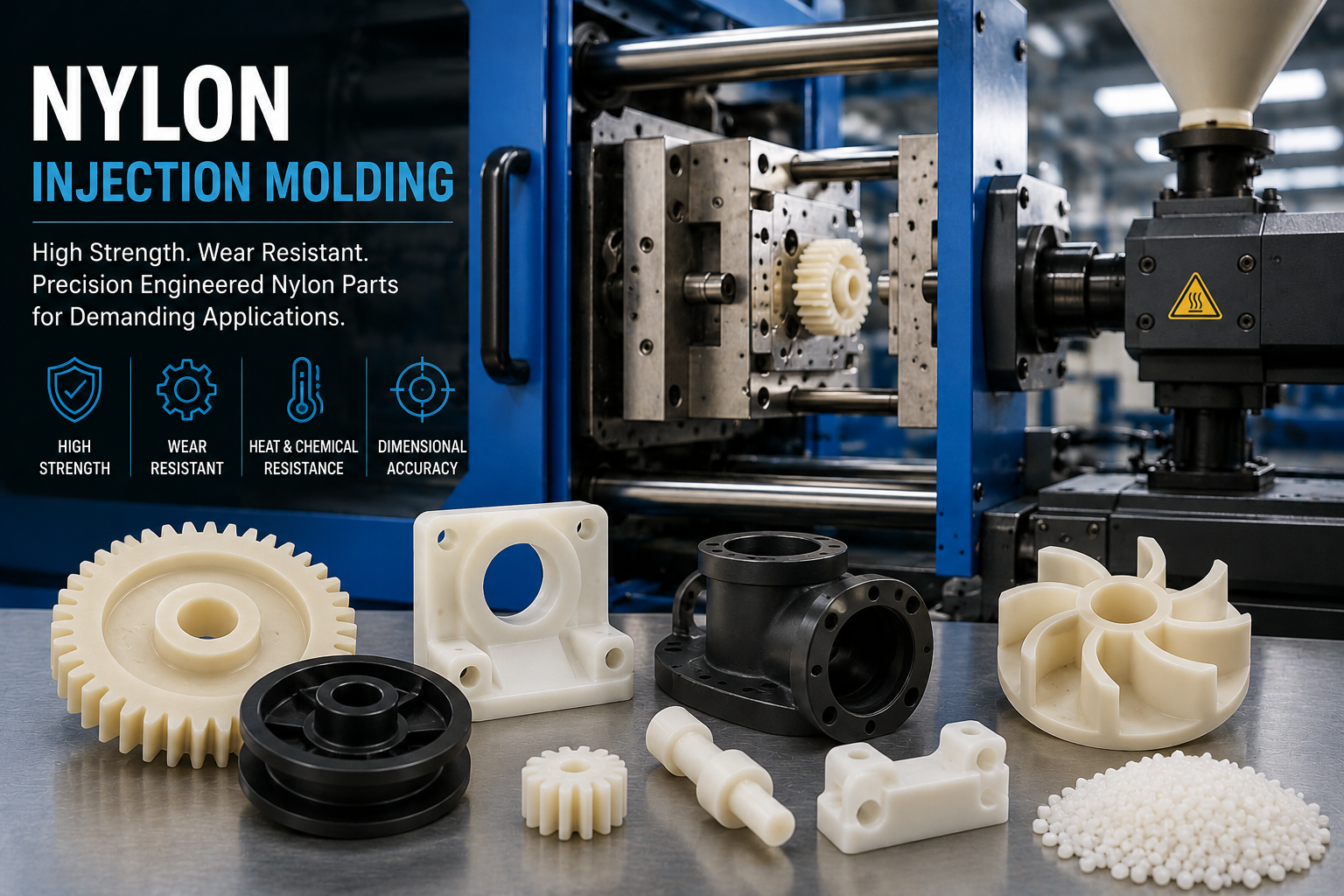
What is Nylon Injection Molding?
Nylon Injection Molding is a manufacturing process used to produce durable, lightweight and high precision plastic components by injecting molten polyamide (PA) into a precision mold. Nylon is among the most widely used engineering thermoplastics because it offers an excellent combination of strength, wear resistance, chemical resistance and dimensional stability.
The most commonly processed grades include PA6 (Polyamide 6), PA66 (Polyamide 66), Glass Filled Nylon, Heat Stabilized Nylon and Flame Retardant Nylon. These materials are widely used across automotive, aerospace, industrial machinery, medical equipment, consumer electronics and electrical industries.
At Manufyn, we support customers from prototype tooling to mass production while maintaining strict quality control, competitive pricing and global logistics. If you are evaluating different engineering plastics, you may also compare our guides on ABS Injection Molding, Polycarbonate Injection Molding and PEEK vs ULTEM to determine the right material for your application.
Why Choose Nylon Injection Molding?
Compared to commodity plastics, nylon provides significantly higher mechanical performance while remaining lightweight and cost effective. This makes it suitable for replacing metal components in many engineering applications.
Excellent Strength
Ideal for structural components subjected to repeated mechanical loading.
Wear Resistance
Perfect for gears, bushings, rollers and moving mechanical assemblies.
Chemical Resistance
Performs well against oils, greases, fuels and many industrial chemicals.
Lightweight
Reduces component weight while maintaining excellent mechanical performance.
Depending on your application, reinforced engineering plastics such as Glass Filled Nylon may outperform standard thermoplastics. You may also explore our resources on Injection Molding Design Guides, Rapid Prototyping with CNC Machining and 3 Axis vs 5 Axis CNC Machining if your project combines machined and molded parts.
Types of Nylon Materials Used in Injection Molding
Nylon is available in several engineering grades, each designed for different mechanical, thermal and chemical performance requirements. Selecting the correct material depends on your application’s strength requirements, operating temperature, wear resistance and dimensional stability. Our engineering team helps customers choose the most suitable material before tooling begins, reducing development time and production costs.
| Material | Advantages | Typical Applications |
|---|---|---|
| PA6 | Excellent toughness and wear resistance | Industrial gears, rollers, housings |
| PA66 | Higher strength and heat resistance | Automotive engine components |
| Glass Filled Nylon | Superior stiffness and dimensional stability | Structural brackets and engineering parts |
| Heat Stabilized Nylon | Performs well at elevated temperatures | Electrical and automotive applications |
| Flame Retardant Nylon | UL compliant electrical applications | Switchgear, connectors, enclosures |
For products requiring transparency, consider our Polycarbonate Injection Molding guide. If your design demands impact resistance at a lower cost, explore ABS Injection Molding. For ultra high performance applications operating in harsh environments, compare engineering plastics in our PEEK vs ULTEM article.
Applications of Nylon Injection Molded Parts
Automotive Industry
Air intake manifolds, clips, cable ties, engine covers, radiator tanks, gears, brackets and fuel system components.
Industrial Machinery
Bushings, rollers, wear pads, cams, pulleys and conveyor components designed for long service life.
Electrical Industry
Connectors, cable glands, electrical housings, switchgear and insulation components requiring excellent dielectric properties.
Medical Equipment
Equipment housings, handles, fixtures and precision engineering components manufactured with tight tolerances.
Consumer Products
Power tool housings, sporting goods, appliance components and durable consumer products.
Robotics & Automation
Lightweight robotic parts, guide rails, wear strips, gear mechanisms and precision automation assemblies.
Many products combine molded nylon components with precision machined aluminium or stainless steel parts. Learn more about our Rapid Prototyping with CNC Machining, 3 Axis vs 5 Axis CNC Machining, Precision CNC Machining Services and Injection Molding Services to streamline complete product manufacturing under one supplier.
Why Engineers Prefer Nylon Injection Molding
Nylon has become one of the most trusted engineering thermoplastics because it offers an exceptional balance of strength, toughness, wear resistance and cost efficiency. It is frequently selected as a lightweight replacement for metal components while maintaining excellent mechanical performance.
High Mechanical Strength
Nylon maintains excellent tensile strength and fatigue resistance, making it ideal for gears, brackets, structural supports, machine components and high-load applications.
Outstanding Wear Resistance
Its naturally low coefficient of friction makes Nylon perfect for moving assemblies including bushes, bearings, rollers, conveyor guides and industrial equipment.
Excellent Chemical Resistance
Performs well against lubricants, fuels, oils, greases and many industrial chemicals commonly found in manufacturing environments.
Lightweight Alternative to Metal
Many OEMs replace aluminium or steel parts with Glass Filled Nylon to reduce weight while lowering manufacturing costs.
Excellent Electrical Insulation
Nylon offers strong dielectric properties, making it suitable for electrical connectors, switchgear, terminal blocks and industrial electronics.
High Productivity
Injection molding enables repeatable production of thousands of precision parts with excellent dimensional consistency and minimal post processing.
Related Engineering Resources
Choosing the correct engineering plastic depends on the operating environment, temperature, mechanical loading and chemical exposure. If your application requires transparency, explore our Polycarbonate Injection Molding Guide. For economical impact-resistant components, read our ABS Injection Molding Guide. For extreme temperatures and aerospace-grade materials, compare PEEK vs ULTEM.
Many Nylon components are manufactured alongside precision metal parts. Learn how our CNC Machining Services, Rapid Prototyping with CNC Machining, 3 Axis vs 5 Axis CNC Machining and Custom Injection Molding Services can support complete product development from prototype through production.
Nylon Material Properties at a Glance
Understanding the physical and mechanical properties of Nylon helps engineers choose the right material for demanding applications. The values below represent typical ranges and may vary depending on resin grade, reinforcement and processing conditions.
| Property | PA6 | PA66 | Glass Filled Nylon |
|---|---|---|---|
| Density | 1.13 g/cm³ | 1.14 g/cm³ | 1.35–1.45 g/cm³ |
| Tensile Strength | 75 MPa | 85 MPa | 160–200 MPa |
| Heat Resistance | Good | Very Good | Excellent |
| Wear Resistance | Excellent | Excellent | Excellent |
| Chemical Resistance | Very Good | Excellent | Excellent |
| Typical Applications | General Engineering | Automotive | Structural Components |
When to Choose PA6
PA6 is an excellent choice for applications requiring high impact strength, wear resistance and economical production. It is commonly used in gears, rollers, machine guards and industrial housings.
When to Choose PA66
PA66 offers greater stiffness and higher operating temperature than PA6, making it suitable for automotive under-the-hood applications, electrical components and structural engineering parts.
When to Choose Glass Filled Nylon
Glass fiber reinforced Nylon provides superior dimensional stability and stiffness, making it ideal for replacing metal components while reducing overall weight and manufacturing cost.
Related Material Selection Guides
If your product requires higher impact resistance, compare Nylon with our ABS Injection Molding Guide. For transparent engineering components, visit our Polycarbonate Injection Molding Guide. For ultra high temperature plastics, explore PEEK vs ULTEM. Need metal prototypes before production tooling? Learn about our Rapid Prototyping with CNC Machining, 3 Axis vs 5 Axis CNC Machining, Precision CNC Machining Services and Custom Injection Molding Services.
Nylon Injection Molding Design Guidelines
A well-designed component reduces tooling complexity, improves mold filling, minimizes sink marks and warpage, shortens cycle time and lowers manufacturing costs. Following proven design practices ensures consistent part quality and repeatable production.
Wall Thickness
Maintain uniform wall thickness wherever possible. Sudden thickness changes increase the risk of sink marks, voids and differential cooling.
Draft Angle
Include adequate draft on vertical surfaces to allow smooth ejection while reducing scratches and mold wear.
Ribs & Gussets
Use reinforcing ribs instead of increasing wall thickness. This improves stiffness while minimizing material usage and cycle time.
Corner Radius
Rounded corners reduce stress concentration, improve material flow and increase fatigue life of the molded component.
| Design Feature | Recommended Value | Engineering Benefit |
|---|---|---|
| Wall Thickness | 1.0–3.5 mm | Improves filling and reduces sink marks |
| Draft Angle | 1°–2° minimum | Simplifies part ejection |
| Corner Radius | ≥ 0.5 × Wall Thickness | Reduces stress concentration |
| Rib Thickness | 50–60% of Wall | Prevents sink marks |
| Boss Diameter | ≈ 2 × Screw Diameter | Improves fastening strength |
Design Tip from Manufyn
The majority of molding defects originate during the design stage rather than the production stage. Optimizing wall thickness, gate location, rib design and cooling channels before tooling can significantly reduce manufacturing costs and improve part quality. At Manufyn, we provide Design for Manufacturing (DFM) reviews before tool fabrication to identify potential issues early in the product development cycle.
Continue Your Engineering Research
If your product combines molded plastic and precision machined components, explore our CNC Machining Services, Rapid Prototyping with CNC Machining, 3 Axis vs 5 Axis CNC Machining and Injection Molding Services. For selecting the most suitable engineering plastic, compare ABS Injection Molding, Polycarbonate Injection Molding and PEEK vs ULTEM to understand the performance differences between engineering thermoplastics.
Common Nylon Injection Molding Defects and Solutions
Even with high quality tooling and precision molding machines, defects can occur due to improper material preparation, mold design or incorrect processing parameters. Identifying the root cause early helps improve part quality, reduce scrap and increase production efficiency.
| Defect | Possible Cause | Recommended Solution |
|---|---|---|
| Sink Marks | Thick walls, insufficient packing pressure, poor cooling. | Maintain uniform wall thickness, optimize packing pressure and improve cooling channel design. |
| Warpage | Uneven cooling, residual stress, inconsistent wall thickness. | Improve mold cooling, redesign wall sections and optimize processing parameters. |
| Flash | Excessive injection pressure, worn mold, improper clamp force. | Reduce pressure, inspect tooling and increase clamping force where appropriate. |
| Short Shot | Insufficient material flow, low melt temperature or poor gate design. | Increase melt temperature, enlarge gate and improve runner balance. |
| Burn Marks | Air trapped inside cavity, excessive injection speed. | Improve venting and optimize filling speed. |
| Voids | Poor packing, thick cross sections or trapped gas. | Increase packing pressure and redesign thick sections. |
| Silver Streaks | Moisture in Nylon pellets before molding. | Dry Nylon resin thoroughly before processing. |
Why Moisture Control Matters
Nylon is hygroscopic, meaning it absorbs moisture from the surrounding environment. Processing wet material can cause silver streaks, reduced mechanical strength, poor surface finish and dimensional instability. Proper resin drying before molding is essential for achieving consistent part quality.
Design for Manufacturability (DFM)
Many molding defects originate during the design phase rather than during production. Optimized wall thickness, proper draft angles, balanced gate locations and efficient cooling channel layouts significantly improve manufacturability while reducing tooling modifications.
How Manufyn Ensures Consistent Quality
Every Nylon Injection Molding project undergoes Design for Manufacturability (DFM) review, mold flow consideration, first article inspection and production quality checks. Our qualified manufacturing partners follow controlled molding parameters to minimize defects and deliver repeatable production quality for prototype as well as high-volume programs.
Continue Exploring Engineering Resources
Looking for other engineering materials? Read our guides on ABS Injection Molding, Polycarbonate Injection Molding and PEEK vs ULTEM. If your product requires precision metal components alongside molded plastic parts, explore our CNC Machining Services, Rapid Prototyping with CNC Machining, 3 Axis vs 5 Axis CNC Machining and our complete Injection Molding Services to streamline product development from concept to production.
Industries That Rely on Nylon Injection Molded Components
Nylon’s excellent balance of strength, wear resistance, lightweight properties and chemical resistance makes it one of the most widely used engineering plastics across multiple industries. From automotive manufacturers to medical device companies, Nylon Injection Molding delivers reliable and cost effective production for complex plastic components.
Complete Manufacturing Support Beyond Injection Molding
Many engineered products combine precision machined metal components with high performance injection molded plastics. At Manufyn, we help customers source complete assemblies through a qualified manufacturing network across India, supporting prototype development, tooling, machining, molding, finishing and production.
Related Resources You May Find Helpful
Continue learning with our detailed guides on Injection Molding Design Guides, ABS Injection Molding, Polycarbonate Injection Molding, PEEK vs ULTEM, Rapid Prototyping with CNC Machining, 3 Axis vs 5 Axis CNC Machining and our Precision CNC Machining Services.
Nylon vs Other Engineering Plastics
Choosing the right engineering plastic depends on mechanical strength, operating temperature, chemical resistance, impact performance, dimensional stability and overall project budget. The comparison below provides a quick overview to help engineers and procurement teams make informed material selection decisions.
| Property | Nylon (PA6 / PA66) | ABS | Polycarbonate | PEEK |
|---|---|---|---|---|
| Mechanical Strength | ★★★★★ | ★★★☆☆ | ★★★★☆ | ★★★★★ |
| Wear Resistance | ★★★★★ | ★★☆☆☆ | ★★★☆☆ | ★★★★★ |
| Impact Resistance | ★★★★☆ | ★★★★☆ | ★★★★★ | ★★★★☆ |
| Heat Resistance | ★★★★☆ | ★★☆☆☆ | ★★★★☆ | ★★★★★ |
| Cost | Moderate | Low | Moderate | Premium |
| Typical Industries | Automotive, Industrial | Consumer Products | Electrical, Medical | Aerospace, Medical |
Choose Nylon When
- High mechanical strength is required.
- Components experience continuous wear.
- Weight reduction is important.
- Moving assemblies require low friction.
- Large production volumes demand cost efficiency.
Consider Other Materials When
- Optical clarity is essential (Polycarbonate).
- Lowest material cost is the priority (ABS).
- Extreme operating temperatures require advanced polymers (PEEK).
- Specific regulatory or chemical requirements dictate another material.
- Electrical performance or transparency outweighs wear resistance.
Explore Our Material Comparison Guides
Every engineering plastic offers unique advantages depending on the application. Explore our detailed resources on ABS Injection Molding, Polycarbonate Injection Molding, PEEK vs ULTEM, Injection Molding Design Guides, Injection Molding Services, CNC Machining Services, Rapid Prototyping with CNC Machining and 3 Axis vs 5 Axis CNC Machining.
How the Nylon Injection Molding Process Works
Manufacturing high-quality Nylon injection molded parts requires more than simply injecting molten plastic into a mold. Material preparation, tooling design, machine settings and quality control all influence the final product. At Manufyn, every project follows a structured manufacturing workflow to ensure consistent quality and repeatable production.
Material Drying
Nylon absorbs moisture from the atmosphere. The resin is dried under controlled conditions before molding to prevent defects such as silver streaks, voids and reduced mechanical strength.
Plasticizing
The dried Nylon pellets are heated inside the injection barrel until they reach the required melt temperature, ensuring uniform material flow throughout the mold cavity.
Injection
Molten Nylon is injected into the mold cavity at controlled pressure and speed to ensure complete filling of complex geometries and thin-wall features.
Packing & Holding
Holding pressure compensates for material shrinkage while minimizing sink marks, internal voids and dimensional variations.
Cooling
Efficient cooling channels maintain uniform part temperature, reduce cycle time and improve dimensional stability before the molded component is ejected.
Inspection & Finishing
Finished components undergo dimensional inspection, visual quality checks and any required secondary operations such as machining, ultrasonic welding, pad printing or assembly.
Quality Built into Every Manufacturing Stage
At Manufyn, every project begins with a Design for Manufacturability (DFM) review, followed by mold design validation, controlled production, first article inspection and ongoing quality checks. This systematic approach helps minimize defects, improve repeatability and deliver reliable components for both prototype and production volumes.
Related Manufacturing Resources
Learn more about our Injection Molding Services, Precision CNC Machining Services, Rapid Prototyping with CNC Machining, 3 Axis vs 5 Axis CNC Machining, ABS Injection Molding, Polycarbonate Injection Molding, PEEK vs ULTEM and browse our complete Injection Molding Design Guides for additional material and process insights.
Case Study: Redesigning a Nylon Gear Housing for Improved Performance
A customer developing an automated conveyor system required a lightweight, wear-resistant gear housing capable of operating continuously in an industrial environment. The challenge was to improve durability while reducing production costs and maintaining dimensional accuracy.
Project Challenge
The original machined plastic housing increased production costs and required multiple machining operations. The customer also experienced premature wear under continuous loading.
Engineering Solution
A glass-filled PA66 material was selected to improve stiffness and wear resistance. The component was redesigned for injection molding with optimized wall thickness, reinforcing ribs and proper draft angles to improve manufacturability.
Manufacturing Process
After Design for Manufacturability (DFM) review and tooling validation, production was carried out using controlled molding parameters. Critical dimensions were verified through first article inspection before volume production.
Why This Approach Worked
By combining material selection, Design for Manufacturability (DFM), optimized tooling and controlled process parameters, the customer achieved a durable, production-ready component with improved repeatability and lower manufacturing costs. This project highlights how engineering support early in the design stage can reduce long-term production risks.
Related Engineering Resources
Explore our Injection Molding Services, Precision CNC Machining Services, Rapid Prototyping with CNC Machining, 3 Axis vs 5 Axis CNC Machining, ABS Injection Molding, Polycarbonate Injection Molding and PEEK vs ULTEM to compare engineering materials and manufacturing processes.
Dimensional Tolerances, Surface Finishes & Secondary Operations
High-quality Nylon injection molded components often require more than molding alone. Tight dimensional tolerances, cosmetic finishes and value-added secondary operations help deliver production-ready parts that integrate seamlessly into larger assemblies.
Typical Manufacturing Tolerances
Actual tolerances depend on part geometry, material grade, tooling quality and process capability. For critical dimensions, tolerance analysis should be completed during the DFM stage.
| Feature | Typical Value |
|---|---|
| General Dimensions | ±0.10–0.25 mm |
| Critical Features | Project Specific |
| Flatness | Depends on Geometry |
| Roundness | Tool & Process Dependent |
Common Surface Finish Options
- SPI A High Gloss Finish
- SPI B Semi Gloss Finish
- SPI C Fine Matte Finish
- SPI D Textured Finish
- Custom Mold Textures
- Laser Etched Logos
- Customer Specific Cosmetic Requirements
The selected finish depends on functional requirements, appearance, mold design and resin characteristics.
Secondary Manufacturing Operations
CNC Machining
Critical holes, precision faces and tight tolerance features can be finished using CNC Machining after molding.
Ultrasonic Welding
Permanent joining of Nylon components without screws or adhesives, ideal for sealed housings and multi-piece assemblies.
Heat Staking & Inserts
Brass threaded inserts improve assembly strength and enable repeated fastening without damaging plastic threads.
Pad Printing & Laser Marking
Branding, part numbers, traceability marks, serial numbers and regulatory markings can be added after molding.
Assembly
Complete assemblies including metal inserts, fasteners, bearings, seals and sub-components are supplied ready for production.
Inspection & Quality Control
Dimensional inspection, visual inspection, functional testing and customer-specific documentation ensure consistent product quality.
Complete Manufacturing Support from Prototype to Production
Beyond injection molding, Manufyn supports tooling, CNC machining, assembly, inspection and supply chain management. Whether you require prototype quantities or high-volume production, our engineering team helps optimize cost, quality and lead time throughout the manufacturing process.
Continue Exploring Manufacturing Resources
Learn more about our Injection Molding Services, Precision CNC Machining Services, Rapid Prototyping with CNC Machining, 3 Axis vs 5 Axis CNC Machining, ABS Injection Molding, Polycarbonate Injection Molding, PEEK vs ULTEM and our complete Injection Molding Design Guides.
Nylon Injection Molding FAQs
Find answers to some of the most common questions engineers, product designers and procurement teams ask about Nylon Injection Molding.
1. What is Nylon Injection Molding?
2. What are the advantages of Nylon over ABS?
3. Why does Nylon need to be dried before molding?
4. Is Nylon suitable for outdoor applications?
5. What is the difference between PA6 and PA66?
6. Can Nylon parts be CNC machined after molding?
7. Does Nylon absorb water?
8. What industries commonly use Nylon Injection Molding?
9. Can glass fiber be added to Nylon?
10. What surface finishes are available?
11. What is the typical lead time for tooling?
12. Can Nylon be used for gears and bearings?
13. What secondary operations are available?
14. What tolerances can be achieved?
15. Can metal inserts be molded into Nylon parts?
16. Is Nylon chemically resistant?
17. Can prototype and production quantities both be supported?
18. What information is required to request a quotation?
19. Does Manufyn provide Design for Manufacturability (DFM) support?
20. How can I get started?
Looking for a Reliable Nylon Injection Molding Partner?
Whether you’re developing a new product, validating a prototype or scaling to high-volume production, Manufyn connects you with qualified manufacturing partners across India. From tooling and Design for Manufacturability (DFM) to production, inspection and global delivery, we help simplify your supply chain while maintaining quality, competitive pricing and dependable lead times.
Engineering Support
Material selection, DFM reviews, tooling recommendations and manufacturing guidance from prototype through production.
Qualified Manufacturing Network
Access experienced manufacturers for injection molding, CNC machining, tooling, assembly, finishing and quality inspection.
Prototype to Production
Support for low-volume prototypes, bridge production and high-volume manufacturing with consistent quality and dependable delivery.
Quality Assurance
Production monitoring, dimensional inspection, first article inspection, documentation and supply chain coordination for every project.
Ready to Discuss Your Project?
Share your CAD files, drawings or technical requirements with our engineering team. We will review your project, recommend the most suitable manufacturing process and provide a competitive quotation based on your specifications.