Manufyn helps you scale from prototype to production.
In injection molding, moldability is not a design preference—it is a manufacturing risk control mechanism. Globally, the most common cause of tooling rework, delayed launches, and unstable production is not material choice or machine capability, but poor moldability decisions made during design.
A part that looks acceptable in CAD can still fail in production due to uneven wall thickness, insufficient draft, poor gate access, or unrealistic tolerance expectations. These issues typically surface only after tooling trials, when changes are slow, expensive, and disruptive to timelines.
From a manufacturing perspective, poor moldability directly impacts:
- Tooling cost and complexity
- Cycle time and throughput
- Scrap and rework rates
- Maintenance frequency and mold life
- Time-to-market and production scalability
In the US, UK, Europe, and UAE, where tooling and labor costs are high, moldability failures are especially expensive. A single tooling revision caused by moldability issues can increase project cost by 20–50% and delay production by weeks.
At Manufyn, moldability is treated as a pre-tooling gate, not a post-trial fix. Designs are evaluated against real manufacturing constraints—tooling limits, material behavior, and volume economics—before steel is cut.
Not sure if your design is truly moldable for production?
Manufyn reviews moldability early to prevent tooling rework across global programs.

What Is Moldability in Injection Molding?
Moldability in injection molding refers to how easily, consistently, and economically a part can be manufactured using an injection mold without defects, excessive tooling complexity, or process instability.
From a production standpoint, a moldable part must:
- Fill completely under realistic pressure limits
- Cool uniformly without warping or sinking
- Eject cleanly without damaging the part or tool
- Maintain dimensional stability across thousands of cycles
Moldability is often confused with general DFM, but the two are not identical. Moldability focuses specifically on whether the part can be molded reliably, while DFM includes broader considerations such as assembly, tolerance stack-ups, and supply chain constraints.
A part can be “manufacturable” in theory yet not moldable at scale. For example:
- Extremely tight tolerances may be achievable on a few parts but fail in volume
- Zero-draft features may eject during trials but cause rapid tool wear
- Thick sections may mold initially but create sink and warpage over time
This is why moldability must be validated using engineering rules, metrics, and production experience, not assumptions.
At Manufyn, moldability evaluation combines:
- Geometry checks
- Material behavior analysis
- Tooling feasibility review
- Volume-based risk assessment
This ensures designs are not just moldable once—but repeatable, scalable, and commercially viable across global manufacturing environments.
Need a professional moldability check before tooling?
Manufyn evaluates moldability using production-validated DFM rules.
When Moldability Should Be Evaluated in the Manufacturing Process
Moldability must be evaluated before tooling decisions are locked. The cost and impact of changes rise exponentially once steel is cut. Globally, projects that delay moldability checks until tool trials face 20–50% higher total tooling costs and weeks of launch delays.
-
Concept / CAD Stage (Lowest Cost to Change)
At this stage, moldability checks focus on geometry feasibility: wall thickness uniformity, draft presence, parting line logic, and early gate access. Changes here are fast and inexpensive, often requiring only CAD updates.
-
Pre-Tooling DFM Stage (Most Critical Gate)
This is the most important checkpoint. Moldability is validated against tooling constraints, material behavior, and production volume. Decisions about undercuts, ribs, bosses, ejection, and cooling are finalized here. Fixes are still practical; skipping this gate is the most common cause of rework.
-
Tool Trial & Validation Stage (Highest Cost to Change)
By the time trials begin, moldability issues manifest as sink, warpage, flash, short shots, or ejection damage. Fixes now require tool modification, welding, re-machining, or inserts—adding cost, risk, and lead time.
Manufacturing reality:
In the US, UK, EU, and UAE—where tooling, labor, and downtime are expensive—late moldability changes are rarely “minor.” Manufyn enforces a pre-tooling moldability sign-off to prevent avoidable rework.
Haven’t done a moldability check before tooling?
Manufyn reviews moldability at the right stage to avoid costly rework.
Injection Molding Moldability Checklist – Core Framework
This checklist is the core framework Manufyn uses to evaluate whether a part will mold reliably at scale. It is organized into four categories—geometry, material, tooling, and process—because moldability failures almost always occur at the intersection of these factors.
4.1 Geometry Moldability Checks
Geometry drives how plastic flows, cools, and ejects. Even small geometric issues can destabilize production.
Key checks include:
- Uniform wall thickness to avoid sink and warpage
- Adequate draft angles on all vertical faces
- Fillets and radii at internal corners to reduce stress
- Ribs, bosses, and undercuts sized and placed for tooling access
Rule of thumb:
Non-uniform walls and zero draft are the top two geometry-related causes of moldability failure worldwide.
4.2 Material Moldability Checks
Material behavior determines flow, shrinkage, and cooling sensitivity.
Key checks include:
- Melt flow length vs wall thickness
- Shrinkage rate and anisotropy (especially for filled resins)
- Thermal sensitivity and degradation risk
- Availability and grade consistency for global sourcing
Manufacturing insight:
A geometry that molds well in unfilled ABS may fail in glass-filled nylon without redesign.
4.3 Tooling Moldability Checks
Tooling feasibility defines whether a design can be molded reliably and economically.
Key checks include:
- Parting line feasibility without excessive side actions
- Gate and runner access for balanced filling
- Ejection strategy that avoids part damage
- Cooling channel feasibility near thick sections
Skipping tooling checks early often leads to complex, fragile molds with high maintenance.
4.4 Process Moldability Checks
Process limits determine whether the design can run consistently.
Key checks include:
- Injection pressure within machine limits
- Cycle time feasibility for target volumes
- Automation readiness (insert handling, ejection)
- Repeatability at scale across cavities and cycles
Manufacturing reality:
A part that molds once is not moldable. Moldability means repeatable production, not trial success.
Want this moldability checklist applied to your actual part?
Manufyn evaluates geometry, material, tooling, and process together.
5. Moldability Checklist With Engineering Metrics
(Quantitative Rules Used in Production)
This section translates moldability from principles into numbers engineers actually use. These ranges are production-validated and should be checked before tooling.
-
Core Geometry & Tooling Metrics
| Feature | Recommended Range | Risk if Ignored |
|---|---|---|
| Nominal wall thickness | Material-specific (uniform) | Sink, warpage |
| Wall thickness variation | ≤ ±10–15% | Differential shrink |
| Draft angle (general) | ≥ 1–2° | Sticking, wear |
| Draft (textured) | ≥ 2–3° | Drag marks |
| Internal corner radius | ≥ 0.5× wall | Stress, cracks |
| Rib thickness | 40–60% of wall | Sink |
| Rib height | ≤ 3× wall | Buckling, warpage |
| Boss wall thickness | ≤ 60% of wall | Cracking |
| Undercuts | Minimize / justify | Tool cost |
| Gate land length | ~0.5–1.5 mm | Poor packing |
| Cooling proximity | Near thick sections | Hot spots |
Manufacturing insight:
Parts that violate more than 2–3 of the above typically require either redesign or significantly more complex tooling.
Process & Scalability Checks (Numbers That Matter)
| Parameter | Typical Target | Impact |
|---|---|---|
| Peak injection pressure | Within machine limit | Short shots |
| Cooling share of cycle | 40–70% | Throughput |
| Ejection force margin | Adequate safety factor | Part damage |
| Cavity balance | Near-equal fill | Weight variance |
At Manufyn, these metrics are reviewed together—isolated compliance doesn’t guarantee moldability.
Need a metrics-based moldability verdict?
Manufyn checks designs against production ranges before steel is cut.
6. Tolerances vs Moldability: Global Trade-offs
Tolerances are one of the most common reasons otherwise good designs become unmoldable at scale. Globally, over-specifying tolerances increases tooling complexity, cycle time, and scrap—often without functional benefit.
Why Tighter Tolerances Reduce Moldability
- Require higher packing pressure → more stress
- Increase sensitivity to temperature variation
- Amplify shrinkage and warpage effects
- Demand tighter cavity matching and maintenance
Typical Tolerance Expectations (Guideline)
| Feature Type | Practical Tolerance* | Notes |
|---|---|---|
| General molded dimensions | ±0.1–0.2 mm | Material & size dependent |
| Small features | ±0.05–0.1 mm | Higher risk |
| Cosmetic edges | Looser preferred | Avoid rework |
| Critical fits | Justify function | Cost trade-off |
*Actual capability depends on material, tool quality, and volume.
Regional Reality Check
- US / EU: Tighter specs are common; moldability gates are critical to avoid rework costs.
- UK: Strong focus on QA and documentation—clear tolerance justification helps approvals.
- UAE: Faster timelines favor designs with wider tolerance bands to reduce iterations.
Manufacturing insight:
Relaxing non-critical tolerances by even 0.05–0.1 mm can eliminate side actions, reduce cooling time, and improve yield.
Over-tight tolerances hurting moldability or cost?
Manufyn helps balance tolerance, tooling, and production economics.
7. Common Moldability Failures Seen in Production (Global)
Most moldability problems are predictable—and therefore preventable—when evaluated early. Across the US, UK, EU, and UAE, the same failure patterns repeat in production when moldability gates are skipped.
Production Failure Patterns & Root Causes
| Moldability Failure | Root Cause | Manufacturing Impact |
|---|---|---|
| Sink marks | Thick sections, oversized ribs/bosses | Scrap, cosmetic rejection |
| Warpage | Uneven cooling, unbalanced walls | Rework, tolerance drift |
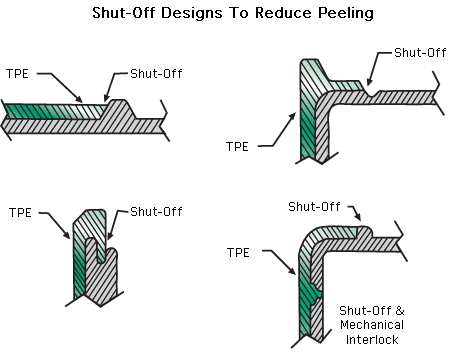
| Flash | Poor shut-offs, insufficient draft | Tool wear, downtime |
| Short shots | Poor flow paths, undersized gates | Delays, rejects |
| Drag marks | Low draft, textured faces | Cosmetic scrap |
| Part sticking | Weak ejection strategy | Part/tool damage |
| Dimensional variation | Over-tight tolerances | High Cpk fallout |
Manufacturing insight:
If a part exhibits two or more of the above in early trials, the issue is almost always design-driven, not process-driven. Fixing process parameters alone rarely stabilizes production.
At Manufyn, these failure modes are used as early-warning signals during DFM reviews to trigger redesign before tooling changes become necessary.
Seeing defects during trials or early production?
Manufyn identifies moldability failures and fixes them at the design level.
Moldability vs Design Intent: Resolving Conflicts
One of the hardest decisions in injection molding is resolving conflicts between design intent (aesthetics, function, branding) and moldability (tooling simplicity, stability, cost).
Where Conflicts Commonly Occur
- Aesthetics vs draft: Zero-draft surfaces look clean but cause sticking and wear.
- Function vs wall uniformity: Local thickening improves strength but creates sink/warpage.
- Branding vs parting lines: Hidden parting lines increase tooling complexity.
- Tolerances vs scalability: Tight specs pass prototypes but fail at volume.
How Engineers Resolve These Conflicts
Successful teams treat moldability as a constraint to design within, not an afterthought. Typical resolution strategies include:
- Adding subtle draft or texture to protect aesthetics while enabling release
- Redistributing material via ribs instead of thick walls
- Repositioning parting lines to reduce side actions
- Relaxing non-critical tolerances to stabilize production
Decision rule used by Manufyn:
If a design feature increases tooling complexity without proportional functional value, it should be redesigned.
Manufyn facilitates these trade-offs during DFM by presenting clear cost, risk, and lead-time impacts for each option—allowing stakeholders to make informed decisions early.
Struggling to balance design intent with moldability?
Manufyn helps resolve conflicts without compromising production or cost.
Moldability Checklist by Part Type
(Risk Profiles & What to Check First)
Different part types fail moldability checks for different reasons. Applying the same rules universally often leads to missed risks. Below is how moldability should be evaluated by part category.
-
Thin-Wall Parts
Thin-wall designs push flow limits and are highly sensitive to pressure and cooling imbalance.
Primary moldability checks
- Flow length vs wall thickness within material limits
- Gate location that minimizes pressure drop
- Uniform wall thickness (avoid sudden transitions)
- Venting near end-of-fill to prevent short shots
Typical failure modes: short shots, burn marks, warpage
-
Structural Parts
Structural components prioritize strength and stiffness, which often leads to thick sections.
Primary moldability checks
- Replace thick walls with ribs (40–60% of wall)
- Cooling channel proximity to thick regions
- Balanced packing to avoid sink and voids
Typical failure modes: sink marks, internal voids, long cycle times
-
Cosmetic / Class-A Parts
Cosmetic parts require surface perfection, making moldability less forgiving.
Primary moldability checks
- Draft sufficient for texture and release
- Parting line placement away from visible surfaces
- Gate vestige location and size
- Flow patterns that minimize weld lines
Typical failure modes: drag marks, gloss variation, visible weld lines
-
Tight-Tolerance Parts
These parts are most vulnerable to scalability issues.
Primary moldability checks
- Realistic tolerance bands for molded plastics
- Shrinkage consistency across features
- Cavity balance in multi-cavity molds
Typical failure modes: dimensional drift, high scrap at volume
Not sure which moldability risks apply to your part type?
Manufyn reviews moldability based on geometry, use case, and quality requirements.
Moldability Checklist by Production Volume
(Prototype → High-Volume Reality)
A design that molds successfully in prototypes may fail economically—or mechanically—at scale. Production volume changes what is considered “acceptable” from a moldability standpoint.
-
Prototype / Low Volume
At this stage, flexibility is prioritized over efficiency.
Acceptable moldability risks
- Manual handling or inserts
- Longer cycle times
- Minor cosmetic defects
Key focus: validate function and basic moldability, not optimization.
-
Medium Volume (10k–50k units)
This is where moldability discipline becomes critical.
Required moldability controls
- Stable ejection strategy
- Balanced filling and cooling
- Reduced reliance on manual operations
Common pitfall: designs that were “fine” in prototypes start failing on consistency and yield.
-
High Volume (>50k–100k units)
At scale, moldability tolerance is extremely low.
Non-negotiable requirements
- Uniform wall thickness and cooling
- Automation-ready ejection and handling
- Robust tooling with minimal side actions
- Conservative tolerances for repeatability
Manufacturing reality:
At high volume, labor and scrap dominate cost, not tooling. Designs must be optimized for uptime and yield.
Designing now but planning to scale production?
Manufyn validates moldability with volume economics in mind.
11. Moldability Impact on Lead Time & Time-to-Market
Moldability decisions made during design have a direct and measurable impact on time-to-market. Globally, the largest contributor to delayed launches in injection molding is tooling rework caused by late moldability fixes.
How Poor Moldability Extends Lead Time
- Tool redesigns: Thick sections, zero draft, or poor ejection strategies often require welding and re-machining after first trials.
- Multiple trials: Each additional trial adds days or weeks, especially when tools are moved between suppliers or regions.
- Process instability: Designs that barely pass trials often fail during ramp-up, delaying production readiness.
Typical impact seen in production programs:
- 1 tooling rework → +2–4 weeks
- 2+ iterations → +30–60% launch delay
- Late moldability changes → 20–50% tooling cost increase
How Early Moldability Improves Time-to-Market
When moldability is validated early:
- Tool designs are simpler and more robust
- First trials achieve higher yield
- Production ramp-up is smoother
- Supplier coordination is faster
Manufacturing insight:
For US, UK, EU, and UAE programs—where logistics, compliance, and approvals add complexity—early moldability validation is often the difference between on-time and missed launches.
At Manufyn, moldability checks are positioned as a time-to-market control step, not just a quality check.
Trying to hit a tight launch timeline?
Manufyn validates moldability early to reduce tooling iterations and delays.
Moldability Validation Using Simulation & DFM
Moldability validation combines engineering judgment (DFM) with predictive tools (simulation). Each plays a distinct role, and relying on only one creates blind spots.
What Simulation Helps Validate
- Flow behavior: filling patterns, pressure drop, weld lines
- Cooling balance: hot spots, differential shrinkage
- Warpage risk: deformation after ejection
- Gate and runner effectiveness
Simulation is especially valuable for thin-wall parts, large components, and multi-cavity molds.
What Simulation Cannot Replace
- Tooling feasibility (parting lines, ejection, side actions)
- Long-term wear and maintenance risks
- Automation readiness and handling logic
- Cost and volume trade-offs
Why DFM Is Still Critical
DFM evaluates moldability against real manufacturing constraints:
- Tool design complexity
- Material supply and consistency
- Machine capability
- Production economics
Best practice used by Manufyn:
Simulation is used to support DFM decisions—not replace them. Designs are approved only when both simulation results and DFM checks align.
Need moldability validation beyond simulation reports?
Manufyn combines DFM expertise with simulation for production-ready decisions.
Moldability Checklist vs Full DFM Checklist
(What Each Covers — and Why Both Matter)
Moldability and DFM (Design for Manufacturing) are closely related—but they are not the same. Confusing the two is one of the most common reasons parts pass early reviews yet fail in tooling or production.
What the Moldability Checklist Covers
The moldability checklist focuses specifically on whether a part can be molded reliably and repeatedly.
It answers questions such as:
- Will the part fill, cool, and eject without defects?
- Are geometry, draft, and wall thickness compatible with tooling?
- Can the part be produced consistently at the target volume?
Moldability is concerned with process stability, not downstream operations.
What a Full DFM Checklist Covers
A full DFM checklist goes beyond moldability and evaluates the entire manufacturing ecosystem.
It includes:
- Moldability (core requirement)
- Assembly feasibility
- Tolerance stack-ups
- Secondary operations
- Cost optimization
- Supply chain and material availability
A design can be moldable but still fail DFM due to high assembly cost, unrealistic tolerances, or poor scalability.
Why Moldability Comes First
Moldability is the foundation of DFM. If a part is not moldable, no amount of downstream optimization will fix it.
Manufacturing insight:
At Manufyn, moldability is validated first. Only after a part passes moldability gates do we proceed to full DFM and cost optimization.
Not sure if you need a moldability check or a full DFM review?
Manufyn helps choose the right level of validation for your project.
Moldability Readiness Score
(Self-Assessment Framework for Designers & Buyers)
To help teams quickly assess risk before tooling, Manufyn uses a Moldability Readiness Score. This framework highlights whether a design is ready to proceed—or needs revision—before steel is cut.
Moldability Readiness Categories
Geometry Readiness
- Uniform wall thickness
- Adequate draft on all faces
- Ribs, bosses, and undercuts justified
Material Readiness
- Material selected for flow and shrinkage
- Filled vs unfilled behavior accounted for
- Global availability confirmed
Tooling Readiness
- Parting line clearly defined
- Gate, runner, and ejection feasible
- Cooling strategy viable
Process Readiness
- Injection pressure within limits
- Cycle time aligned with volume goals
- Automation readiness assessed
Interpreting the Score
- High readiness: Safe to proceed to tooling
- Medium readiness: Minor changes recommended
- Low readiness: Redesign required before tooling
Manufacturing reality:
Most costly tooling rework happens when designs with medium or low readiness are pushed into tooling without correction.
At Manufyn, this score is used to guide conversations—not block progress—by clearly showing where risk lies and how to reduce it.
Want your part scored for moldability readiness?
Manufyn applies this framework to real designs before tooling.
Moldability Pre-Tooling Sign-Off Checklist
(What Must Be Approved Before Cutting Steel)
Before committing to mold manufacturing, the following moldability items should be formally signed off:
Geometry Sign-Off
- Wall thickness uniformity verified
- Draft present on all vertical faces
- Ribs, bosses, and undercuts justified
Material Sign-Off
- Material flow and shrinkage validated
- Filled vs unfilled behavior considered
- Material availability confirmed
Tooling Sign-Off
- Parting line finalized
- Gate, runner, and ejection strategy approved
- Cooling concept reviewed
Process & Volume Sign-Off
- Injection pressure within machine limits
- Cycle time aligned with volume goals
- Automation readiness assessed
Manufacturing insight:
Most tooling rework happens when one or more of the above is skipped or assumed.
Injection Molding Moldability Services by Manufyn
(Global Service SEO + Lead Conversion)
Manufyn provides professional moldability and DFM services for injection molded parts across the US, UK, Europe, and UAE.
What Manufyn Offers
- Moldability checklist review
- DFM-led design validation
- Moldflow and warpage analysis
- Injection mold design and manufacturing
- Prototype-to-production support
Manufyn’s moldability reviews are:
- Engineering-led (not template-based)
- Aligned to production volume and region
- Focused on cost, stability, and scalability
This section targets searches such as:
- injection molding DFM services
- moldability analysis services
- injection molding manufacturer USA / UK / Europe / UAE
Want a professional moldability review before tooling?
Work with Manufyn to validate design, tooling, and production readiness globally.
Final Takeaway: Moldability Is a Pre-Tooling Decision
Moldability determines whether an injection molded part can be produced consistently, economically, and at scale. Treating moldability as an early design gate—not a late fix—reduces tooling risk, improves yield, and accelerates time-to-market.
Manufyn’s moldability checklist and DFM process ensure designs are production-ready from day one, across global manufacturing programs.
FAQs: Moldability in Injection Molding
What is the difference between insert molding and overmolding?
A moldability checklist is a structured set of design and manufacturing checks used to verify whether a part can be injection molded reliably, without defects or excessive tooling complexity.
How do you check moldability?
Moldability is checked by reviewing geometry, material behavior, tooling feasibility, and process limits—ideally before tooling begins.
What makes a part not moldable?
Non-uniform wall thickness, zero draft, unrealistic tolerances, poor gate access, and inadequate ejection strategies are common causes of poor moldability.
Is moldability the same as DFM?
No. Moldability focuses specifically on injection molding feasibility, while DFM includes broader manufacturing considerations such as assembly and cost optimization.
When should moldability be checked?
Moldability should be evaluated during the CAD and pre-tooling stages. Late checks increase cost and delay production.