For most global buyers in 2026, China still offers the deepest supply chain and the fastest scaling for very high volumes, while India offers lower labour costs, stronger English-language engineering communication, easier IP protection, and a favourable position as the leading “China plus one” alternative. The right choice is rarely all-or-nothing — a growing number of companies now split production across both to reduce single-country risk.
This decision matters more in 2026 than it did five years ago, because supply-chain concentration risk, shifting tariffs, and geopolitical uncertainty have made “where do we manufacture” a board-level question rather than a purely procurement one. This guide compares China and India across cost, quality, lead time, communication, IP protection, and tariff exposure — honestly, including where China still holds the advantage — so you can match the right country to your specific parts.
The comparison below is written from the India side, but not as a sales pitch: Manufyn’s sourcing from India service exists precisely because India fits many — not all — sourcing needs. Manufyn is an ISO 9001 certified, strictly in-house manufacturer in Pune, so the assessment here is grounded in what actually reaches our RFQ desk from buyers comparing the two.
Why Buyers Are Comparing China and India in 2026
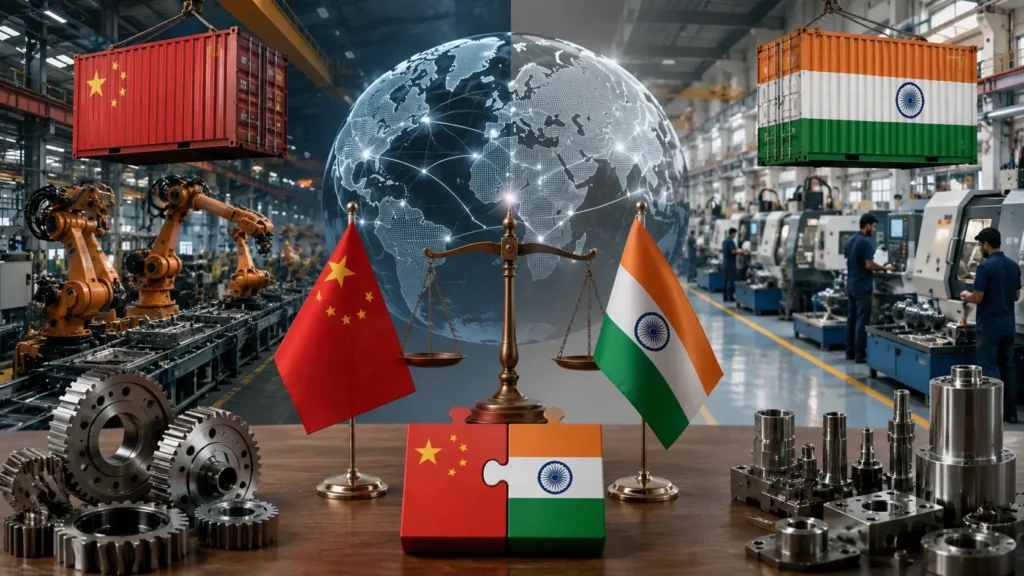
For two decades, “where do we manufacture” had one default answer: China. In 2026 that default is under active review. Tariff volatility, the cost and risk of concentrating an entire supply chain in one country, and rising Chinese labour costs have pushed buyers to diversify — and India has emerged as the primary alternative for a broad range of engineered parts. The strategy driving most of this movement is “China plus one”: rather than abandoning China, companies add a second sourcing country to cut single-point-of-failure risk. India’s scale, English-speaking engineering workforce, and growing base of ISO 9001 certified manufacturers make it the most common “plus one” choice. The question for most buyers is no longer “China or India” as an absolute, but “which parts belong where.”
China vs India Manufacturing: The Full Comparison
| Factor | China | India |
|---|---|---|
| Labour cost | Higher, rising over the past decade | Lower — typically $10–$25/hr skilled vs higher in China |
| Supply chain depth | Deepest in the world — components, materials, tooling | Growing fast, but less deep for some sub-components |
| Very high volume scaling | Exceptional — built for millions of units | Strong and improving, best for low-to-high volume |
| English communication | Variable — often via sales intermediaries | Strong — English is standard in engineering |
| IP protection | Improving, but a long-standing buyer concern | Common-law legal system, generally viewed as lower-risk |
| Time zone overlap (US/UK/EU) | Limited with US/EU | Better overlap with UK, EU, Gulf, and US mornings |
| Tariff exposure (US buyers) | Higher — subject to broad Section 301 and other tariffs | Generally lower than China for many categories |
| Best for | Ultra-high volume, deep component ecosystems | Cost-sensitive, IP-sensitive, communication-critical work |
Buyer takeaway: China’s edge is depth and ultra-high-volume scale; India’s edge is cost, communication, IP comfort, and tariff position. Match the country to the part, not to a blanket policy.
Cost Comparison: Where India Actually Saves You Money
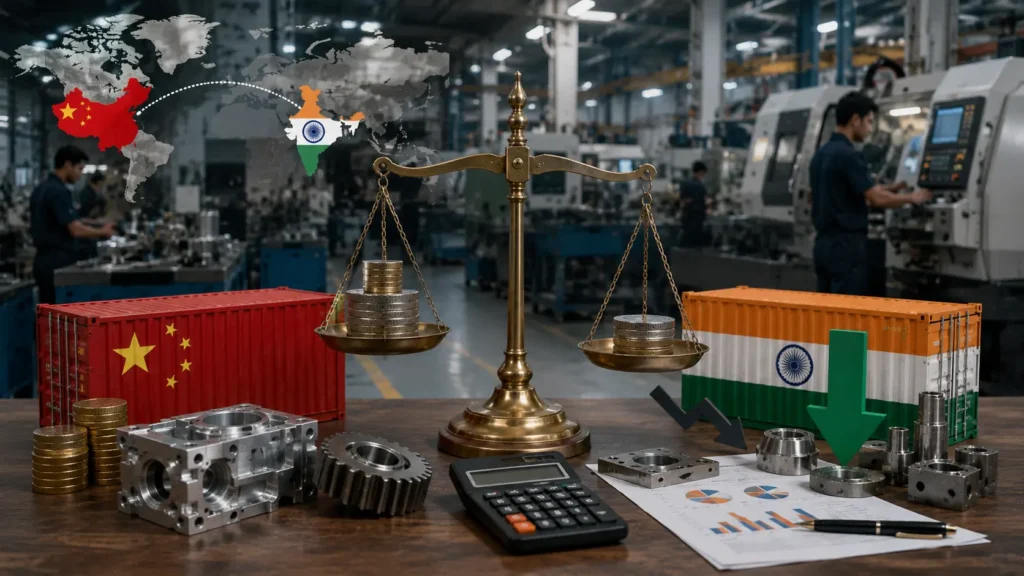
Raw materials trade on global exchanges, so the metal or resin line is broadly similar in both countries — the real cost difference sits in labour and machine-hour rates. Skilled fabrication and machining labour in India typically runs $10–$25 an hour, historically below China’s rising rates, and that gap flows straight into the finished-part price on labour-heavy work like multi-bend fabrication, welded assemblies, and machined components. For US buyers in 2026, tariffs change the math further: parts sourced from China often carry higher tariff exposure than the same parts from India, which can widen India’s landed-cost advantage on top of the labour saving. The honest caveat is that on very high-volume, low-labour parts — where China’s mature component ecosystem and scale dominate — China can still land cheaper. The savings are real, but they’re largest on labour-intensive engineered parts, not on simple commodity items.
Comparing a current China quote against India? Send Manufyn your drawing and we’ll return a like-for-like landed-cost quote — including duty and freight — within 24 hours, so the comparison is done for you.
When China Is Still the Better Choice
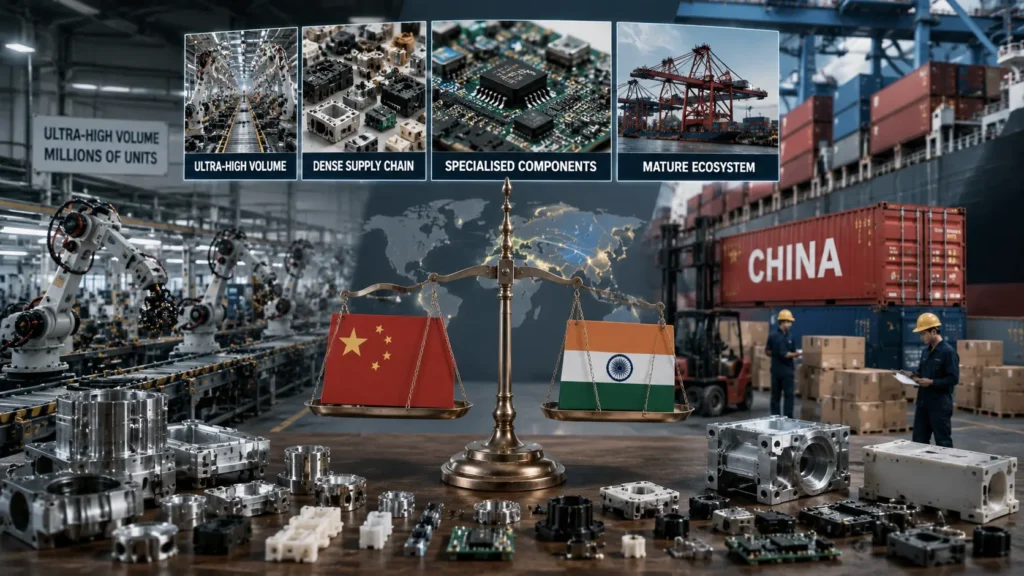
An honest comparison names where the other side wins. China remains the stronger choice when you need ultra-high volumes in the millions of units, when your product depends on a dense ecosystem of specialised sub-components sourced locally, or when a mature category-specific supply chain — consumer electronics being the clearest example — is concentrated there. China’s decades of infrastructure investment created component depth that India is still building. If your bill of materials pulls dozens of specialised parts that are predominantly made in one region, splitting that supply chain can cost more than it saves. Acknowledging this is not a weakness in the India case — it’s what makes the rest of the comparison trustworthy. For most engineered metal and plastic parts at low-to-high (rather than ultra-high) volume, India competes strongly; for the specific scenarios above, China still earns the order.
The “China Plus One” Strategy: Why It’s Not Either/Or
The most common 2026 sourcing decision isn’t “China or India” — it’s “China and India.” The “China plus one” strategy keeps existing Chinese suppliers while adding a second country to reduce the risk of depending on a single source for everything. It protects against tariff shocks, regional disruruptions, and capacity bottlenecks without the cost and disruption of moving an entire supply chain at once.
- Keep ultra-high-volume, component-dense products in China where its ecosystem dominates
- Move labour-heavy, IP-sensitive, or communication-critical parts to India
- Split a single high-risk part across both countries to guarantee supply continuity
- Use India as the tariff-advantaged route for US-bound shipments where the math favours it
Our guide on why global brands are moving manufacturing to India covers this shift in more depth.
How to Choose and Verify an Indian Manufacturer
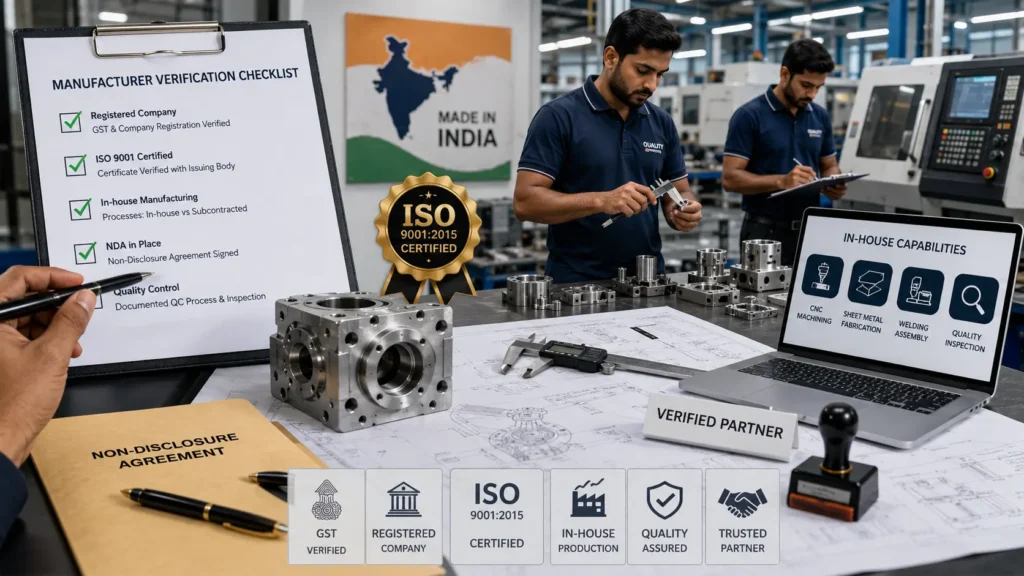
Choosing India means choosing a specific Indian manufacturer, and the verification bar is the same discipline you’d apply anywhere: confirm the company is a real, registered, in-house manufacturer rather than a trading company reselling someone else’s capacity. Ask for GST and company registration you can check independently, verify the ISO 9001 certificate with its issuing body, confirm which processes run in-house versus subcontracted, and insist on an NDA before any drawing is shared. A supplier that answers all of these without hesitation — and offers documented quality control by default — is one you can trust with the parts you move out of China. The single biggest sourcing mistake buyers make in India isn’t choosing the wrong country; it’s choosing an unverified intermediary that looks identical to a real manufacturer in a first email.
We cover the full verification process in our guide to finding a reliable manufacturing partner in India.
How Manufyn Fits a China-Plus-India Strategy
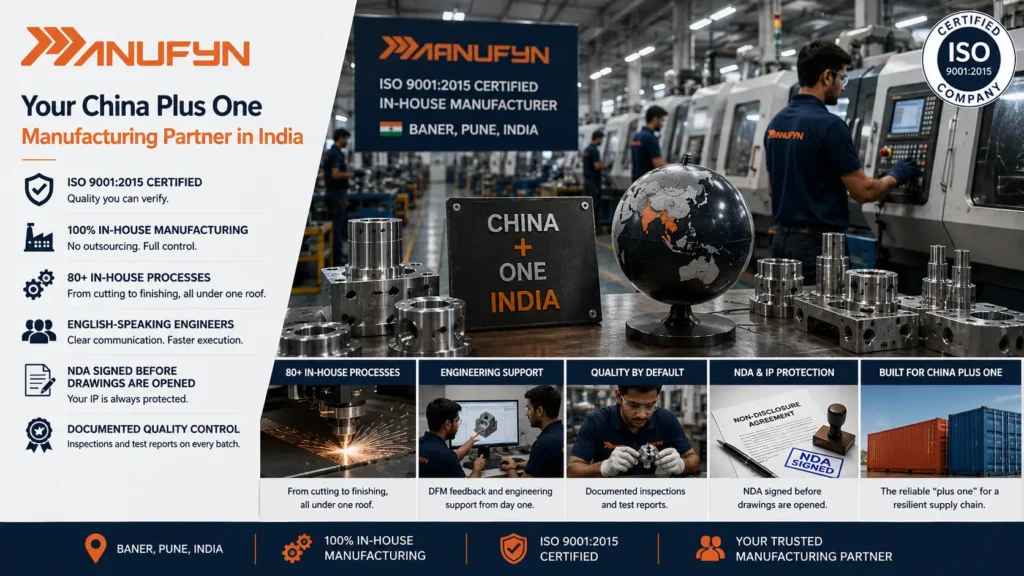
Manufyn is an ISO 9001 certified, strictly in-house on-demand manufacturer based in Baner, Pune, India — not a broker or trading company. For buyers running a “China plus one” strategy, Manufyn is built to be the “plus one”: more than 80 in-house processes, English-speaking engineers, an NDA signed before drawings are opened, and documented quality control on every batch. Because production is in-house, the certifications and factory you verify describe the same building your part is made in — the transparency that de-risks moving work out of a single-country supply chain.
- 80+ in-house processes — CNC, sheet metal, injection moulding, casting, forging, electronics assembly, and more
- No minimum order quantity — from a single trial part to full production
- Free DFM review and a firm quote within 24 hours
- NDA before drawings, FAIR and material certificates as standard
- Serving 500+ clients across 30+ countries, including the US, UK, Australia, UAE, Canada, Germany, Singapore, and Malaysia
See our full process range on our commodities directory, or read more about our approach on Why Manufyn.
Evaluating India as your “plus one”? Share a drawing with Manufyn and see the quality, communication, and landed cost for yourself — quoted in 24 hours, no minimum order.
FAQs
For labour-heavy engineered parts — machined components, welded assemblies, multi-bend fabrication — India is often cheaper in 2026, driven by lower labour and machine-hour rates plus, for US buyers, generally lower tariff exposure than China. For ultra-high-volume, component-dense products where China’s ecosystem and scale dominate, China can still land cheaper. The answer depends on the specific part, not the country alone.
Mainly to reduce single-country concentration risk — the “China plus one” strategy — alongside lower labour costs, stronger English-language engineering communication, easier IP protection under India’s legal system, and, for US buyers, more favourable tariff treatment on many categories. Most aren’t leaving China entirely; they’re adding India as a second source.
“China plus one” means keeping existing Chinese suppliers while adding a second manufacturing country to reduce the risk of depending on a single source. It protects against tariffs, regional disruptions, and capacity bottlenecks without the cost of relocating an entire supply chain. India is the most common “plus one” choice due to its scale and English-speaking engineering base.
Neither country has a monopoly on quality — it depends on the specific manufacturer, not the country. Both have world-class and poor suppliers. The reliable predictor of quality is verifiable ISO 9001 certification, in-house production, and documented per-batch inspection, which exist at strong manufacturers in both countries.
India’s common-law legal system and its enforcement environment are generally viewed by Western buyers as lower-risk for IP than China’s, though China has improved. In both countries, the practical protection that matters most is a signed NDA before drawings are shared and working with an in-house manufacturer rather than an intermediary that may propagate your files.
For ultra-high volumes in the millions with deep local component ecosystems, China remains exceptionally strong. India competes well across low-to-high volumes and is scaling its high-volume capability rapidly. For most engineered metal and plastic parts below the ultra-high-volume tier, India is highly competitive.
US tariffs generally weigh more heavily on China-sourced goods than on many India-sourced categories, which can widen India’s landed-cost advantage. However, tariff policy is moving quickly in 2026 — always confirm the current rate for your specific product category with a customs broker before finalising a sourcing decision.
Yes — this is exactly what the “China plus one” strategy does. Many buyers keep component-dense, ultra-high-volume products in China while moving labour-heavy, IP-sensitive, or communication-critical parts to India, and sometimes dual-source a single critical part across both to guarantee supply continuity.
Ask for GST and company registration you can check independently, verify the ISO 9001 certificate with its issuing body, confirm which processes are in-house versus subcontracted, and require an NDA before sharing drawings. A legitimate in-house manufacturer will provide all of this readily; a trading company or broker often cannot.
Labour-intensive engineered parts — CNC-machined components, sheet metal fabrication, welded assemblies, castings, and injection-moulded parts at low-to-high volume — suit India particularly well, as do IP-sensitive designs and projects needing close English-language engineering collaboration.
Have a specific part you’re comparing across countries? Send it to our engineers — we respond within 4 working hours.
Building a China-plus-India sourcing strategy?
Get a like-for-like landed-cost comparison and a supplier-verification checklist before you move any part.
Talk to Manufyn