
CNC Machining of PP Homopolymer Side Seal
How Manufyn helped an Italian industrial customer manufacture a challenging PP Homopolymer side seal with concentric features, angular geometry and thin sections — at US$15 per part.
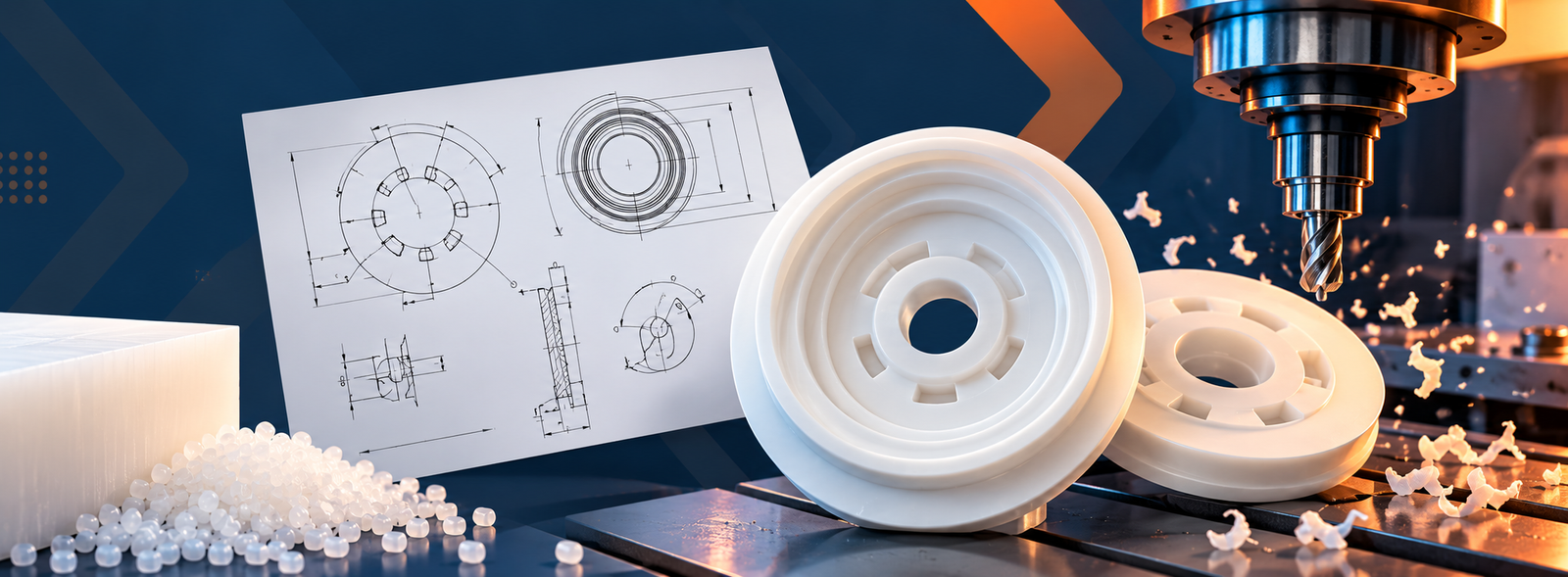
Manufacturing a Difficult Polymer Component Without Long Tooling Lead Times
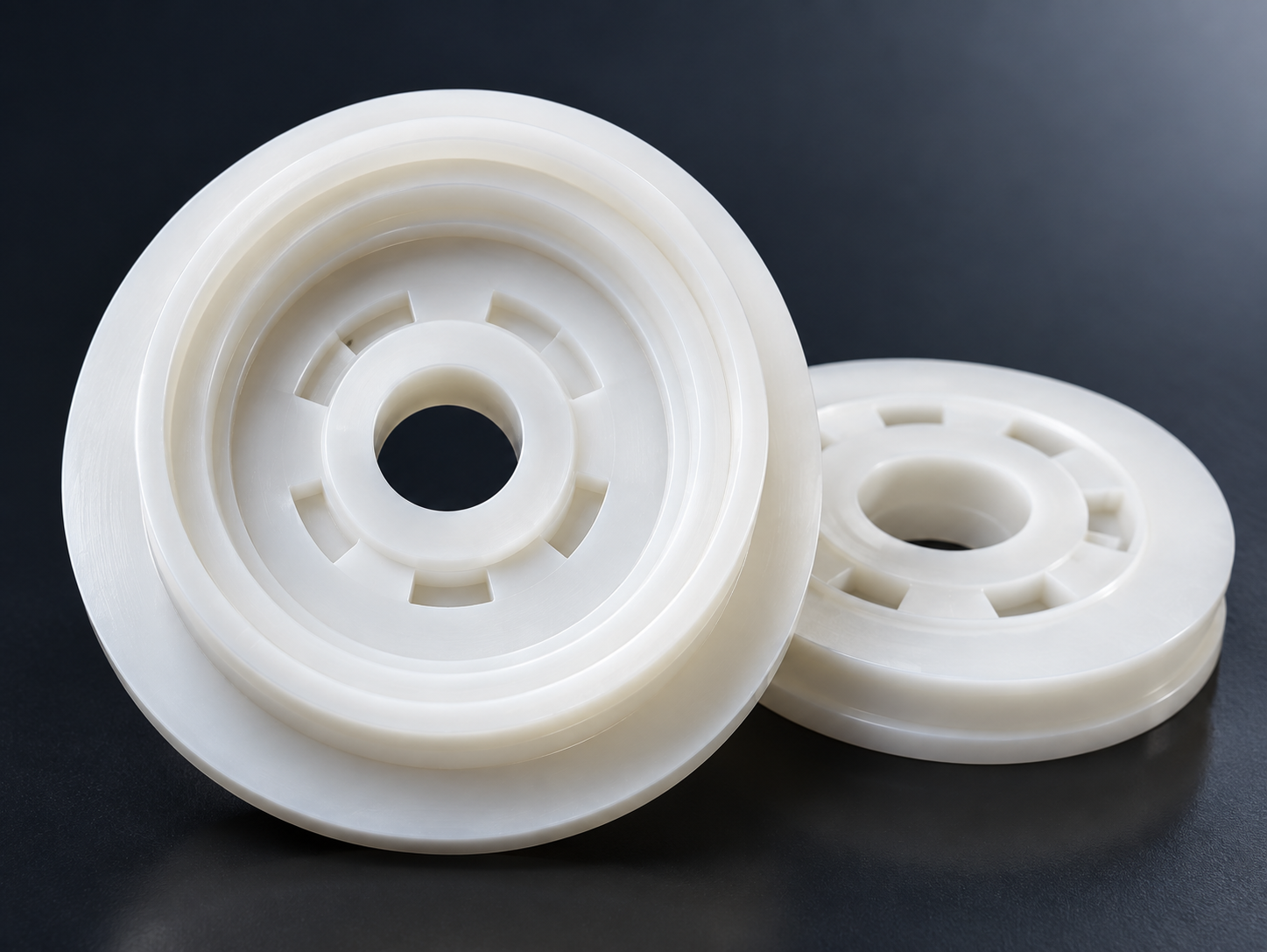
An Italian industrial customer approached Manufyn with an urgent requirement for a machined PP Homopolymer Side Seal.
The component was not a simple flat polymer disc. Its geometry combined concentric circular features, stepped surfaces, repeated angular features, small radii and relatively thin sections.
The material itself created another layer of manufacturing complexity. PP Homopolymer requires careful control of workholding, cutting conditions, heat generation, chip evacuation and finishing because the material behaves very differently from conventional metals.
Why Machining PP Homopolymer Was Challenging
Polymer machining requires a different process mindset from conventional metal cutting. The combination of material flexibility, thermal sensitivity and the component geometry meant that the manufacturing process had to be engineered before production.
The critical issue was maintaining dimensional relationships without introducing deformation, burrs, heat damage or surface defects.
Workpiece Deflection
Thin polymer sections can move under cutting forces, creating dimensional variation if workholding is not carefully controlled.
Heat Management
Excessive heat can soften PP, affect dimensions and create poor surface characteristics.
Chip Control
Polymer chips can become continuous and difficult to evacuate if cutting conditions are not optimized.
Surface Protection
The drawing specifically required protection against scratches and dents, making handling and finishing part of the quality process.
A Geometry That Required More Than Basic Profile Machining
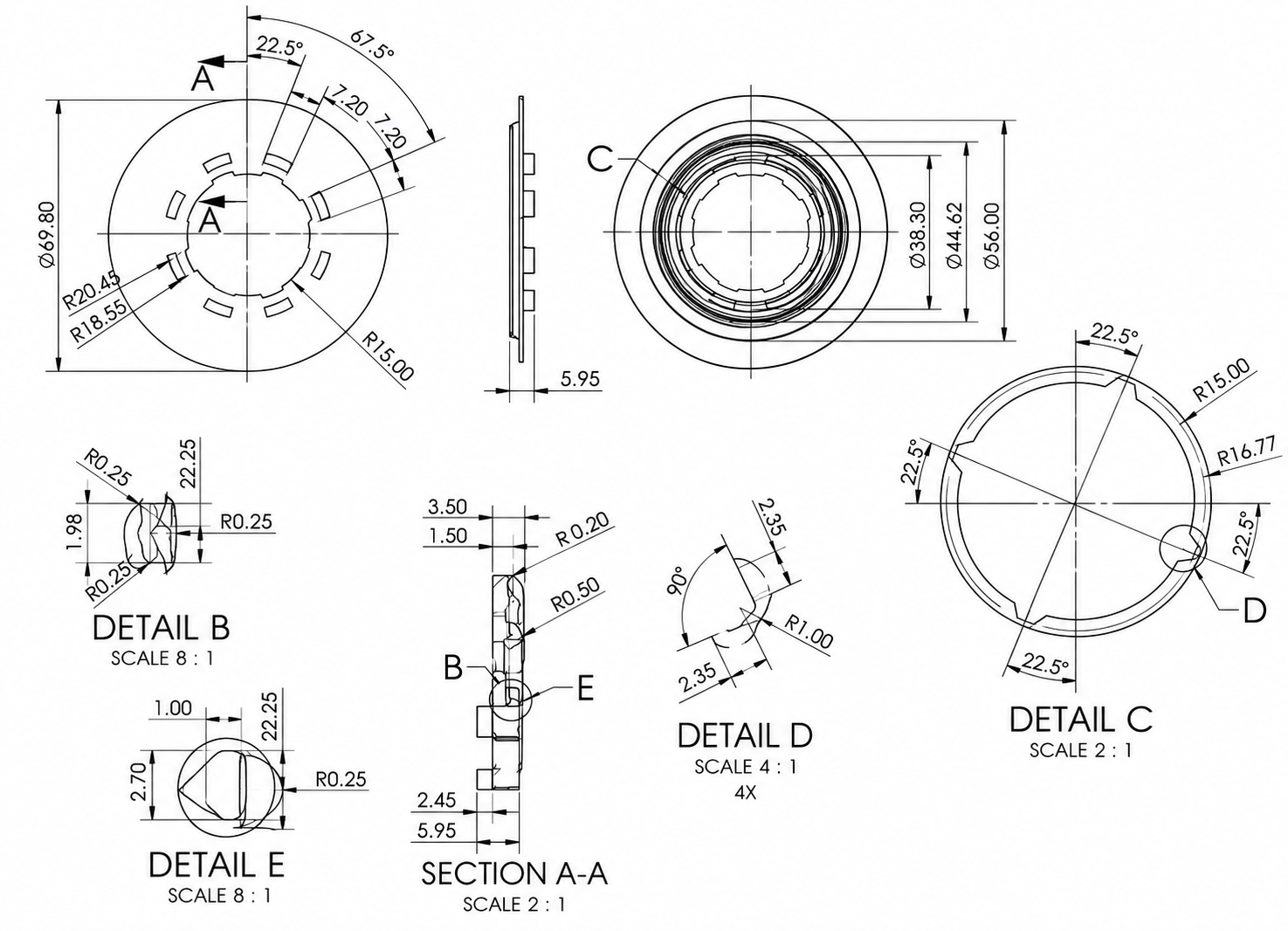
The engineering drawing defines several concentric features around the central axis together with repeated angular geometry.
The manufacturing challenge was therefore not only achieving individual dimensions. The machining process had to preserve the relationship between the central feature, surrounding grooves and repeated features.
- Multiple concentric diameters
- Stepped circular profiles
- Repeated 4X geometry
- 22.5° angular relationships
- Small-radius features
- Thin polymer sections
- Central opening and controlled radial relationships
- Surface requirements without scratches or dents
How Manufyn Approached the Part
The component was treated as a precision polymer machining project rather than simply a CNC cutting operation. The manufacturing route focused on stability, feature relationships and controlled material removal.
Controlled Fixturing
The component required sufficient support to prevent movement while avoiding excessive clamping pressure that could distort the PP material.
Progressive Material Removal
Material was removed progressively so that the final operations could focus on dimensional control and surface quality rather than aggressive stock removal.
Controlled Cutting Engagement
Cutting strategy was selected to reduce unnecessary rubbing, manage heat generation and maintain stable chip evacuation.
Common Machining Centre
The surrounding circular features were treated as a connected geometric system so that eccentricity between the central feature and grooves could be controlled.
Repeatable Positioning
The repeated angular features required controlled positioning to maintain consistency between the individual features around the component.
Burr & Surface Control
Final edge treatment and handling were controlled to prevent burrs, scratches, dents and unnecessary cosmetic damage.
Why Material Behaviour Matters in Plastic CNC Machining
Rigidity
Lower stiffness compared with metals means unsupported sections can deflect during machining. Workholding and machining direction therefore become important process variables.
Thermal Behaviour
Polymer machining requires attention to heat generation. Excessive thermal loading can influence dimensional stability and surface quality.
Cutting Edge Condition
Tool sharpness and appropriate cutting geometry are important because rubbing can generate heat and adversely affect the machined surface.
Chip Evacuation
Polymer chips can behave differently from metal chips. Effective evacuation helps prevent recutting and unnecessary thermal loading.
Inspection Focused on Functional Geometry
For a component containing multiple concentric features, checking only the overall outside diameter is not sufficient.
Inspection must consider the dimensional and geometric relationships that determine how the component performs in its final application.
- Critical diameters and radii
- Central opening
- Step heights and thicknesses
- Concentric feature relationships
- Angular feature locations
- Groove geometry
- Burr and edge condition
- Surface condition and handling damage
Four Days From Manufacturing Release to Completed Parts
Manufyn completed the required PP Homopolymer components within 4 days at a price of US$15 per unit.
Following production, the parts were shipped to the Italian customer and delivered in approximately 2 days.
The project demonstrated how CNC machining can provide an effective route for difficult polymer components when quantities or development requirements do not justify immediate investment in dedicated tooling.
CNC Machining Resources for Engineers & Procurement Teams
If you are evaluating CNC machining for prototypes, low-volume production or difficult engineering components, explore Manufyn’s technical resources before releasing your RFQ.
Manufacturing Resource Hub
Explore CNC machining, injection molding, rapid prototyping, quality and procurement guides.
CNC Machining Process
Understand the journey from CAD drawing through machining, inspection and finishing.
CNC Machining Workflow
Learn how drawing review, DFM, process planning, machining and inspection connect together.
CNC Machining for Rapid Prototyping
Understand when CNC machining is appropriate for prototypes and low-volume engineering validation.
CNC Production Machining in India
A practical guide for global buyers evaluating Indian CNC manufacturing suppliers.
CNC Workholding & Deflection
Understand how workholding influences stability, accuracy and repeatability during machining.
Explore More Manufyn Case Studies & Insights
CNC Turning Prototype Delivered to USA
See how an urgent CNC prototype was manufactured rapidly and delivered internationally.
Precision 5-Axis Medical Device Assembly
Explore a multi-component precision machining project involving PEEK, HDPE and PP.
Contract Manufacturing in India
Understand how global engineering teams can manage manufacturing, suppliers and quality in India.
Export-Ready Manufacturing Partner in India
Learn how Manufyn coordinates engineering, procurement, quality and international delivery.
Manufacturing Project Management
See how supplier coordination, production, inspection and logistics can be managed together.
Quality Inspection Services in India
Explore inspection and supplier-quality practices for international manufacturing programs.
Send Us Your Drawing. We Will Evaluate the Manufacturing Route.
Whether you need one prototype, a small batch or recurring production, Manufyn can coordinate the engineering, supplier, quality and delivery side of manufacturing in India.
- CNC machined engineering plastics
- Prototype and low-volume components
- Complex CNC machined geometries
- Drawing and DFM review
- Supplier selection and qualification
- Quality inspection coordination
- International packing and delivery
Request a CNC Machining Quote
Send your 2D drawing, 3D CAD file, material, quantity and required delivery date.
Send Your RFQCNC Machining PP Homopolymer
Can PP Homopolymer be CNC machined?
Yes. PP Homopolymer can be CNC machined when suitable tooling, workholding and cutting conditions are used. The machining strategy should account for its lower stiffness and thermal behaviour compared with metals.
Is CNC machining suitable for low-volume PP parts?
CNC machining can be particularly useful for prototypes, development parts and low-volume requirements where dedicated injection molding tooling may not yet be commercially justified.
What information should I send for a PP machining RFQ?
Ideally provide the latest 2D drawing, 3D CAD model, PP grade, quantity, tolerance requirements, surface requirements and target delivery date.
Can Manufyn deliver CNC machined plastic parts internationally?
Yes. Manufyn coordinates manufacturing in India together with quality follow-up, packing and international logistics for global customers.
Can Manufyn help if we are not sure whether CNC machining or injection molding is better?
Yes. The appropriate process depends on quantity, geometry, material, tooling economics, tolerance, surface requirements and production timeline. Manufyn can review the requirement and recommend a suitable manufacturing route.
Have a CNC Machining Requirement From India?
Share your drawing and requirements with Manufyn. We will review the component and coordinate the appropriate manufacturing route with qualified Indian suppliers.
Request a Free Quote