Medical device manufacturing in India gives global MedTech companies access to precision component machining, injection molding, and assembly at 30–50% below Western costs, from a large base of quality-certified manufacturers with English-language engineering. The critical distinction to understand up front: regulatory clearance for a market — FDA registration in the US, CE marking under EU MDR in Europe — legally belongs to the device owner, not the contract manufacturer. The manufacturer builds to your specification under a quality agreement and supplies the documentation and traceability that support your submission.
That responsibility split is the single most important thing a MedTech buyer needs to get right, and it’s the point most sourcing guides skip entirely. Sourcing medical components from India is fully compatible with a regulated device program — but only when you understand which obligations stay with you, choose a manufacturer whose quality system and documentation support them, and put a proper quality agreement in place. This guide covers why MedTech companies manufacture in India, the standards that actually matter, the materials and processes involved, and how to vet a medical device manufacturer properly.
It’s written from the manufacturer’s side of that relationship. Manufyn’s sourcing from India service produces precision medical device components and assemblies from an ISO 9001 certified, strictly in-house facility in Pune — so this reflects what medical device companies actually ask us for. Note: this is general guidance, not regulatory or legal advice; confirm your specific obligations with a regulatory professional or notified body.
Why Global MedTech Companies Manufacture in India
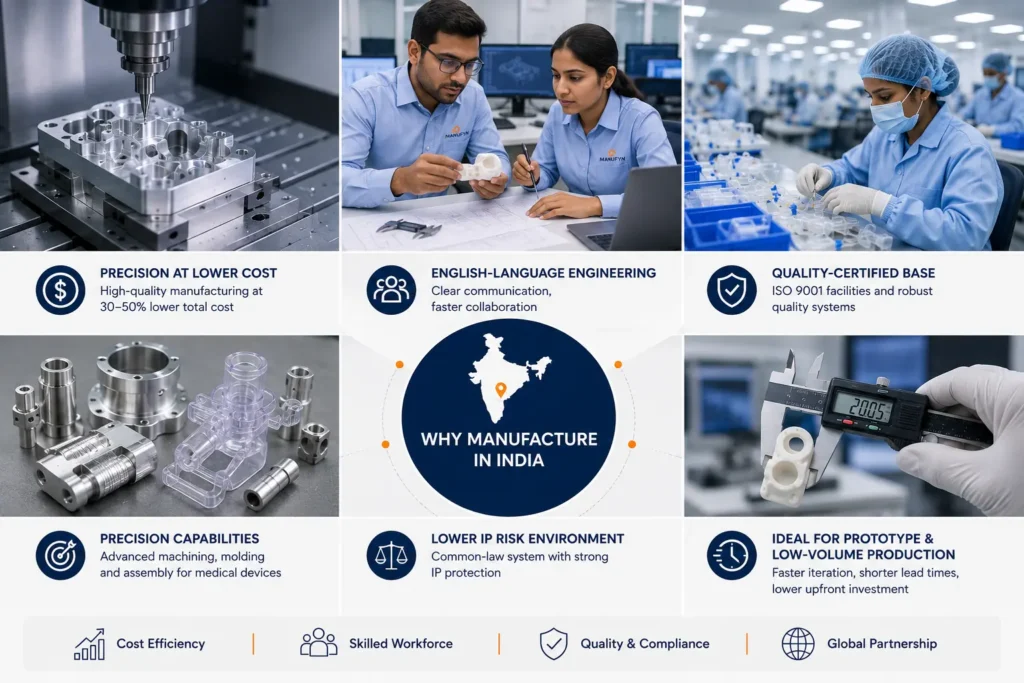
The draw is precision at lower cost, English-language engineering, and a growing quality-certified base — without the communication friction some low-cost regions carry.
Medical device programs are dominated by precision machined and molded components — housings, enclosures, fluidic parts, instrument bodies, and assemblies — that are labor- and skill-intensive to produce to tight tolerances. India offers that precision capability at labor and machine-hour rates a fraction of US and European levels, which matters most on the low-to-mid production volumes typical of many device lines. Beyond cost, India brings an English-speaking engineering workforce that removes the translation friction common in some sourcing regions, a common-law legal environment generally viewed as lower-risk for intellectual property, and a large and growing base of quality-certified manufacturers. For MedTech companies validating a design, building clinical or pilot quantities, or sourcing components for a cleared device, India has become a serious alternative to both domestic manufacturing and other offshore options — particularly for the prototype and low-volume stages where speed and iteration matter. Our guide to finding a reliable manufacturing partner in India covers how to identify one that documents to a medical standard.
The Standards That Matter in Medical Device Manufacturing
Medical manufacturing runs on a specific set of standards and regulations, and knowing what each one governs is what lets a buyer specify correctly and vet a supplier properly. The table below summarizes the ones that come up most.
| Standard / regulation | What it governs | Who holds responsibility |
|---|---|---|
| ISO 13485 | Quality management system for medical devices | The manufacturer’s certified QMS |
| FDA (US) — 21 CFR 820 / QMSR | US market registration and quality system | The device owner / legal manufacturer |
| EU MDR (2017/745) — CE marking | Placing a device on the EU market | The device owner / legal manufacturer |
| ISO 10993 | Biocompatibility of patient-contacting materials | Device owner, with supplier material data |
| ISO 14644 | Cleanroom classification for controlled builds | The manufacturer, where required |
| CDSCO (India) | India’s domestic device regulator | Relevant for the Indian market |
The key principle: ISO 13485 is the manufacturer’s quality system standard and the baseline you should look for in a medical supplier. But market clearance — FDA registration and 510(k)/PMA in the US, CE marking under MDR in Europe — is the legal responsibility of the device owner placing the product on that market, not the contract manufacturer. The manufacturer supports your submission with material data, validation records, and documentation; it does not obtain clearance on your behalf. Our resource on rapid prototyping for medical devices, FDA, ISO 13485, and material choices goes deeper on how this plays out at the development stage.
What Medical Device Manufacturing in India Covers
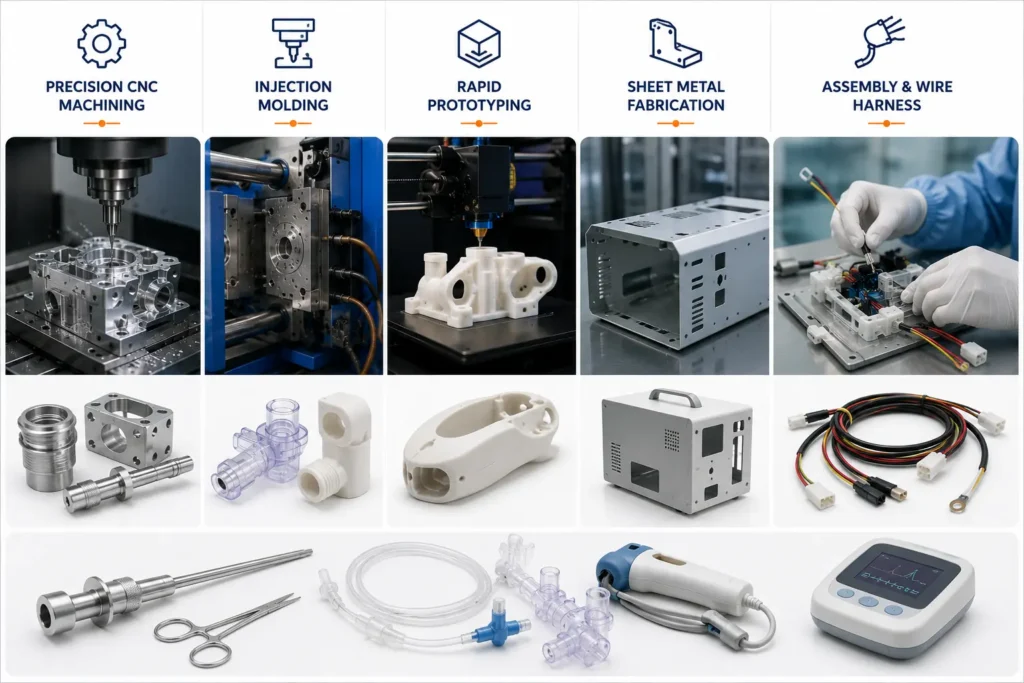
India’s strength is precision components and assemblies — machined parts, molded housings, and the sub-assemblies that make up a finished device.
| Capability | Typical medical applications |
|---|---|
| Precision CNC machining | Instrument bodies, surgical components, implu200bable-grade machined parts, housings |
| Injection molding | Device housings, fluidic components, disposables, connectors |
| Rapid prototyping | Design validation, form-and-fit, clinical prototypes |
| Sheet metal fabrication | Equipment enclosures, cart and cabinet chassis, brackets |
| Assembly & wire harness | Sub-assemblies, cable and harness assemblies for devices |
The processes most relevant to device programs are precision CNC machining for metal and engineering-plastic components held to micron tolerances, and injection molding for housings, fluidic parts, and disposables. Finished-device assembly, sterilization, and packaging for a regulated market often involve additional specialist steps and validated processes — confirm which stages a supplier performs in-house versus what remains your responsibility or a separate provider’s.
Materials and Traceability for Medical Devices
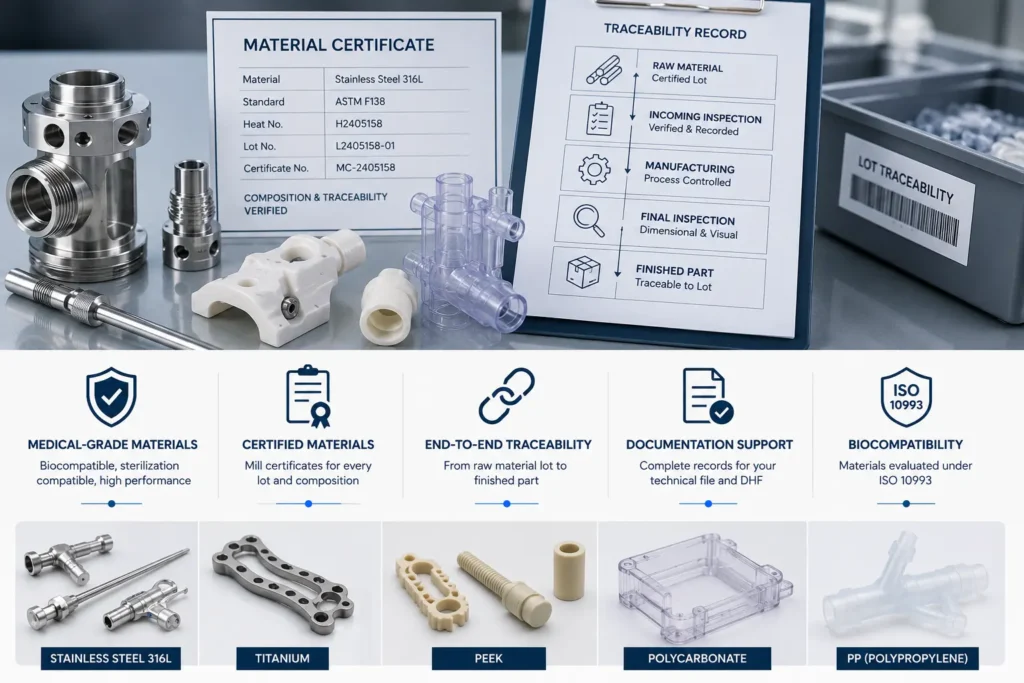
In medical manufacturing, the material and its paper trail are inseparable. Traceability from finished part back to a certified lot is as important as the part itself.
Medical device materials are chosen for biocompatibility, sterilization compatibility, and mechanical performance — common examples include medical-grade stainless steels (316L), titanium, and engineering plastics such as PEEK, medical-grade polycarbonate, and PP, with patient-contacting materials evaluated under ISO 10993. But in a regulated program, the material is only half the requirement: every lot needs traceability. A medical-capable manufacturer provides mill and material certificates tracing each material back to a certified composition and lot, retains records that link a finished part to the raw material it came from, and supplies the documentation your device history and technical file require. Selecting the right material is a design decision you own; proving what material actually went into the part is a documentation discipline the manufacturer must support. A supplier that can’t provide full lot traceability is a poor fit for medical work regardless of price or precision. Our medical device material and prototyping resource covers material selection in more depth.
Need precision medical components with full material traceability? Send Manufyn your drawing and material spec — we’ll confirm the documentation we can provide and quote within 24 hours. ISO 9001, strictly in-house, no minimum order.
How to Vet a Medical Device Manufacturer in India
Vetting a medical supplier is stricter than general sourcing, because the consequences of a quality escape are patient safety and regulatory exposure. Work through these before committing:
- Quality system: confirm the QMS standard the supplier holds — ISO 13485 for a certified medical QMS, or ISO 9001 with medical-grade documentation for component work under your quality agreement — and verify the certificate with its issuing body.
- Material traceability: require mill and material certificates and lot traceability as standard, not on request.
- Documentation: confirm they provide FAIR, dimensional and inspection reports, and certificates of conformance that can feed your device documentation.
- In-house production: verify processes run in-house, not through an unseen subcontractor network that breaks your control and traceability.
- Quality agreement: put a written quality agreement in place defining responsibilities, change control, and record retention.
- Cleanroom and validation: where your device needs controlled-environment builds or process validation, confirm the supplier’s cleanroom class and validation capability explicitly.
- NDA before drawings: insist on a signed NDA before any design is shared.
Buyer takeaway: the manufacturer’s job is to build to your specification under a controlled quality system and give you the evidence your regulatory submission needs. Your job — as device owner — is to hold the market clearance and the technical file. Keep that division clear in writing, and confirm your obligations with a regulatory professional.
How Manufyn Supports Medical Device Companies
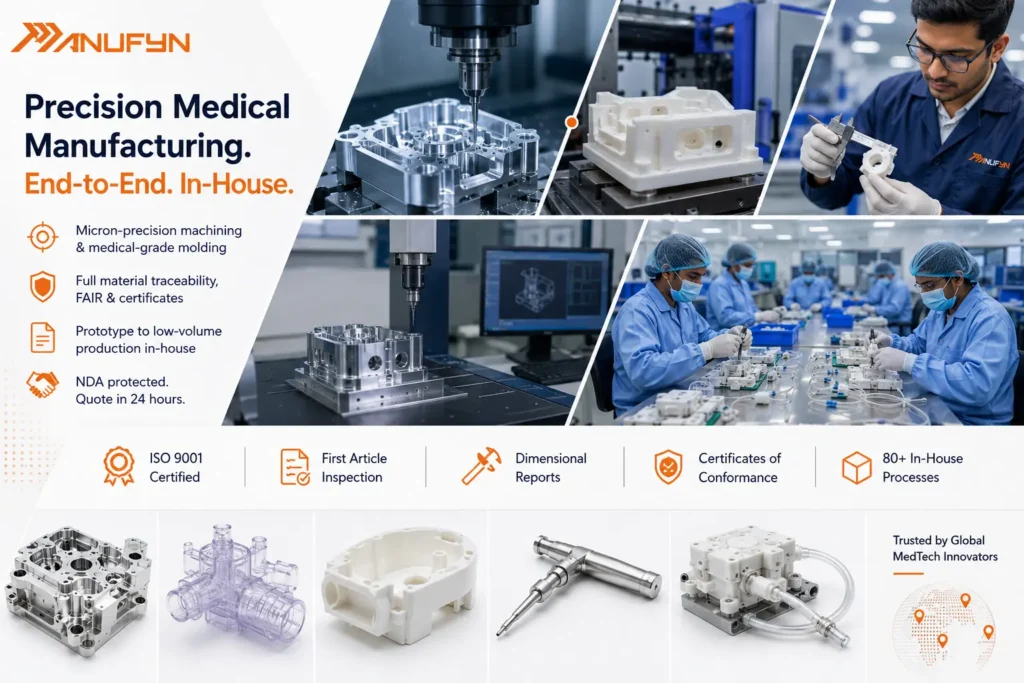
Manufyn is an ISO 9001 certified, strictly in-house manufacturer in Baner, Pune, producing precision medical components and assemblies with full material traceability — from prototype through low-volume production.
Manufyn manufactures precision machined and molded components and sub-assemblies for medical device companies, supported by an ISO 9001 quality system, full material and lot traceability, first article inspection reports, dimensional reports, and certificates of conformance. Because production runs in-house across more than 80 processes, a medical part can move from a validated prototype into low-volume production without changing suppliers or breaking its documentation trail, and an NDA is signed before any drawing is opened. For programs that require an ISO 13485-certified quality system, controlled-environment builds, or manufacturing under your own regulatory system, we’ll confirm the scope and quality-agreement terms with you directly — an honest fit assessment rather than an overstated claim.
- Precision CNC machining to micron tolerances and medical-grade injection molding
- Full material and lot traceability, FAIR, and certificates of conformance
- Prototype-to-low-volume path in-house, NDA before drawings, quote in 24 hours
- Documented medical work — see our case studies below
See real results: a 5-axis machined critical medical device assembly, a global medical startup validating an injection-molded assembly in record time, and a rapid-prototyped 5-axis medical device. Read more on Why Manufyn.
Ready to discuss a medical device component or assembly? Share your drawing with Manufyn — precision manufacturing, full traceability, and an honest capability assessment, quoted within 24 hours.
FAQs
Yes. India has a large base of quality-certified manufacturers producing precision medical components and assemblies for global MedTech companies. Sourcing from India is fully compatible with a regulated device program, provided the manufacturer’s quality system and documentation support your requirements and market clearance is held by the device owner. This is general guidance, not regulatory advice.
The device owner (legal manufacturer) placing the product on a market holds regulatory clearance responsibility — FDA registration and 510(k)/PMA in the US, CE marking under EU MDR in Europe. The Indian manufacturer builds to your specification under a quality agreement and supplies supporting documentation and traceability, but does not obtain clearance on your behalf.
ISO 13485 is the quality management system standard specific to medical devices — the baseline to look for in a medical manufacturer. A supplier producing finished or regulated devices should hold it; for component work performed under your own quality system and quality agreement, an ISO 9001 supplier with medical-grade documentation and traceability may be appropriate. Verify any certificate with its issuing body.
Commonly precision CNC-machined parts (instrument bodies, surgical components, housings), injection-molded parts (device housings, fluidic components, disposables, connectors), sheet metal enclosures and chassis, and sub-assemblies including wire harnesses. Finished-device assembly, sterilization, and packaging for a regulated market may involve additional specialist and validated steps.
It’s essential. Every lot needs traceability from the finished part back to a certified material composition and lot, supported by mill and material certificates. In a regulated program, proving what material went into a part is as important as the part meeting its dimensions — a supplier that can’t provide full lot traceability is a poor fit for medical work.
Common choices include medical-grade stainless steels such as 316L, titanium, and engineering plastics like PEEK, medical-grade polycarbonate, and polypropylene, selected for biocompatibility, sterilization compatibility, and mechanical performance. Patient-contacting materials are evaluated under the ISO 10993 biocompatibility series, using data the device owner compiles with supplier input.
It depends on the device and its risk class — sterile devices and certain components require controlled-environment (cleanroom) manufacturing classified under ISO 14644, while many non-sterile components do not. Confirm your device’s requirement with a regulatory professional, and verify any supplier’s cleanroom class and validation capability explicitly where it’s needed.
Confirm the quality system standard (ISO 13485, or ISO 9001 with medical-grade documentation for component work) and verify the certificate with its issuing body, require material and lot traceability and full documentation as standard, confirm in-house production, put a written quality agreement in place, and get an NDA signed before sharing drawings. Confirm cleanroom and validation capability where your device needs it.
Have a medical device question about a specific part? Send it to our engineers — we respond within 4 working hours.
Sourcing medical device components from India?
Get precision manufacturing, full material traceability, and an honest capability assessment — quoted in 24 hours, no minimum order.
Talk to Manufyn