
Soft Tooling For Injection Molding
Bring your product to market faster with Manufyn’s Soft Tooling services. We manufacture precision aluminum and low-volume injection molds that enable rapid prototyping, product validation, bridge production, and design verification before investing in high-volume production tooling. Our engineering team helps OEMs, startups, and industrial manufacturers reduce tooling costs, shorten development cycles, and launch products with confidence.
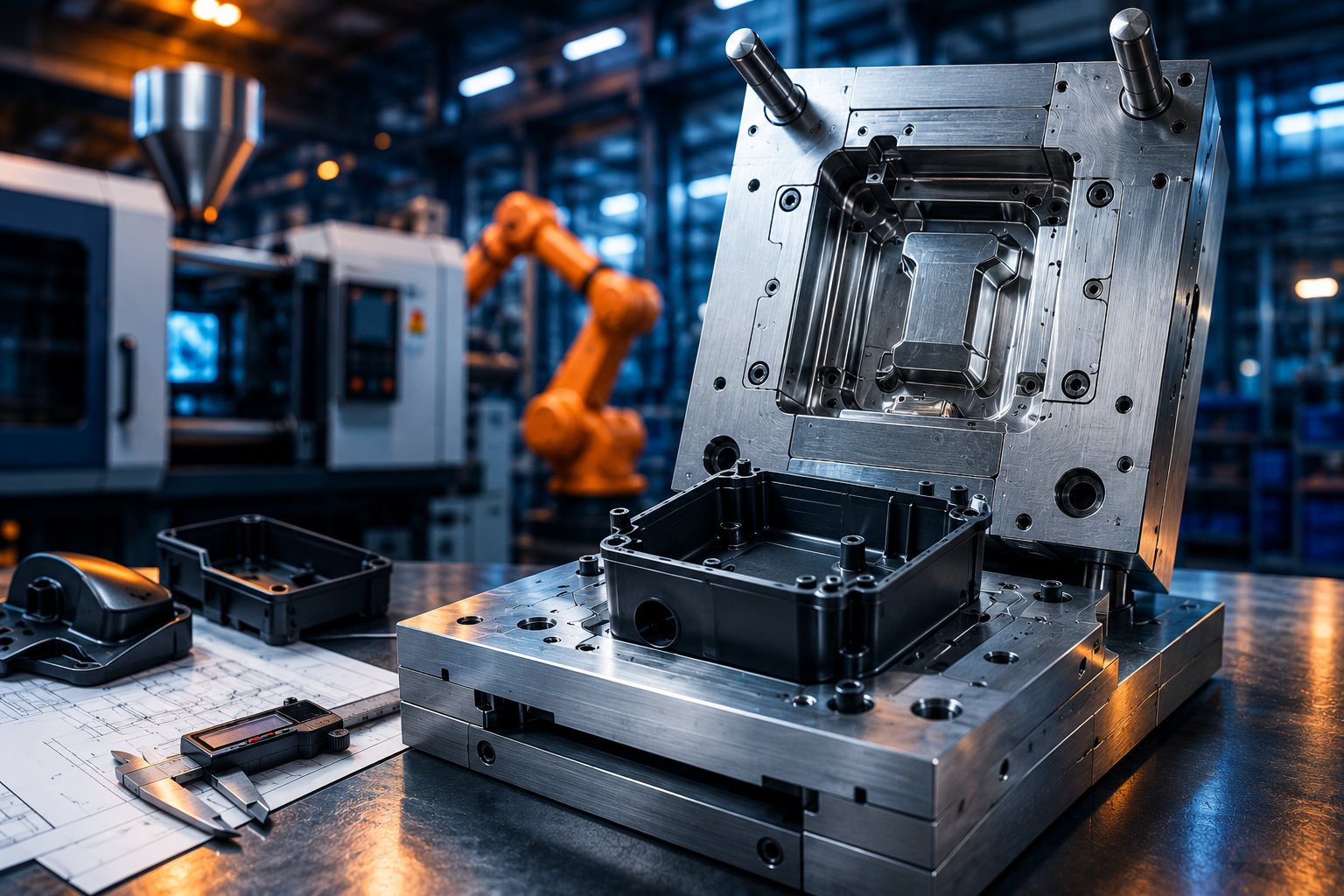
What is Soft Tooling?
Soft tooling is a cost-effective manufacturing solution that uses aluminum or other relatively soft metals to produce injection molds for low-volume production, prototype validation, pilot runs, bridge manufacturing, and product testing. Unlike hardened steel molds designed for millions of production cycles, soft tooling enables manufacturers to create high-quality molded components quickly while significantly reducing tooling investment.
Manufacturers often choose soft tooling during new product development because it provides production-grade plastic parts without waiting months for hardened steel tooling. This allows engineering teams to validate product performance, identify design improvements, test assemblies, gather customer feedback, and accelerate time to market before committing to full-scale production.
At Manufyn, we manufacture precision soft tooling for a wide range of engineering plastics, supporting startups, OEMs, industrial equipment manufacturers, automotive suppliers, electronics companies, and medical device manufacturers. Our engineering team also provides Design for Manufacturing (DFM) support to optimize moldability, reduce defects, and improve overall production efficiency.
Rapid Tool Manufacturing
Prototype molds are typically manufactured within a few weeks, helping businesses reduce development timelines and launch products faster.
Lower Tooling Cost
Soft tooling requires significantly less investment than hardened steel tooling, making it ideal for prototype and low-volume projects.
Production Quality Parts
Receive molded components with production-grade dimensional accuracy for functional testing, validation, and customer approval.
Easy Design Modifications
Engineering changes can often be implemented more quickly, reducing development risk and supporting continuous product improvement.
Why Companies Choose Soft Tooling
- Accelerate product development by reducing tooling lead time.
- Validate product design before investing in production tooling.
- Reduce prototype costs while maintaining production-quality components.
- Bridge production until hardened steel tooling is completed.
- Perform market testing with real production parts.
- Support engineering changes without expensive tooling modifications.
- Ideal for low-volume manufacturing ranging from dozens to several thousand parts.
- Compatible with numerous engineering plastics including ABS, PP, Nylon, PC, POM, HDPE, and many more.
Soft Tooling Vs Hard Tooling
Choosing the correct tooling strategy directly affects project cost, development speed, production flexibility, and return on investment. Soft tooling is ideal during product development and low-volume manufacturing, while hardened steel tooling becomes the preferred option once production volumes increase significantly.
| Comparison | Soft Tooling | Hard Tooling |
|---|---|---|
| Typical Mold Material | Aluminum or Pre-Hardened Steel | Hardened Tool Steel |
| Initial Investment | Low | High |
| Lead Time | 2–5 Weeks | 8–16 Weeks |
| Production Quantity | Prototype to Low Volume | Mass Production |
| Engineering Changes | Fast & Economical | Expensive |
| Tool Life | Thousands of Parts | Hundreds of Thousands to Millions |
| Product Validation | Excellent | Possible but Costly |
| Time to Market | Very Fast | Longer Development Cycle |
| Ideal For |
Prototype Development Bridge Production Market Testing Engineering Validation |
High Volume Manufacturing Long Production Runs Automotive Programs Consumer Products |
Which Tooling Solution is Right for Your Project?
If your product is still undergoing design validation, requires customer approval samples, or will be manufactured in relatively low quantities, soft tooling provides the fastest and most economical solution. Once the design is finalized and annual production volumes justify the investment, transitioning to hardened steel production tooling delivers the lowest long-term manufacturing cost. Manufyn supports both stages, enabling customers to move seamlessly from prototype tooling to full-scale production without changing manufacturing partners.
Advantages of Soft Tooling
Soft tooling enables manufacturers to validate product designs, reduce development costs, and launch products much faster than conventional production tooling. Whether you are developing a new consumer product, industrial component, automotive assembly, or medical device, soft tooling provides a practical solution for low-volume manufacturing while maintaining production-quality standards.
Faster Product Launch
Soft tooling significantly reduces mold manufacturing time, allowing businesses to move from CAD design to functional molded parts in just a few weeks. Faster tooling means quicker testing, faster customer approvals, and shorter product development cycles.
Lower Development Cost
Compared to hardened steel molds, soft tooling requires a much lower initial investment. This makes it an ideal solution for startups, OEMs, research teams, and manufacturers introducing new products with uncertain production volumes.
Production Quality Parts
Unlike 3D printing or CNC-machined prototypes, injection molded prototype parts closely replicate the final production components, enabling accurate testing of fit, function, strength, and assembly performance.
Easy Design Modifications
Engineering changes are easier and more economical with soft tooling. Design improvements can often be incorporated without the high modification costs associated with hardened steel production molds.
Bridge to Mass Production
Many companies use soft tooling to manufacture commercial products while waiting for high-volume production molds. This bridge manufacturing approach allows businesses to generate revenue sooner without delaying product launches.
Ideal for Global OEMs
Soft tooling supports international product development by providing fast sample approval, pilot production, customer validation, and pre-production testing before committing to full-scale manufacturing programs.
70%
Lower Tooling Cost
Reduce prototype tooling investment compared with hardened production molds.
2–5
Week Lead Time
Accelerate product development with rapid mold manufacturing.
100+
Engineering Materials
Compatible with ABS, Nylon, Polycarbonate, PP, POM, HDPE, TPU, PEEK and many more.
Global
Manufacturing Support
From prototype development through full-scale production, Manufyn supports customers worldwide.
Our Soft Tooling Manufacturing Process
Every successful soft tooling project starts with a well-planned engineering process. At Manufyn, our experienced engineering team follows a structured workflow to ensure every mold delivers excellent dimensional accuracy, repeatability, and production-ready molded components. From design review to final sample approval, every stage focuses on minimizing development risks while reducing lead time and overall tooling costs.
Design Review & DFM Analysis
Our engineers review your 3D CAD model, technical drawings, tolerances, material requirements, wall thickness, draft angles, gate locations, undercuts, and part geometry. Design for Manufacturing recommendations are provided to improve moldability, reduce defects, and optimize production efficiency before tooling begins.
Mold Design
After design approval, our tooling engineers develop a precision mold design incorporating runner systems, cooling channels, ejector layouts, venting, and cavity configurations. Every design is optimized for faster cycle times and consistent part quality.
CNC Machining of Tool
The mold components are precision machined using high-speed CNC machining, EDM, wire cutting, and finishing operations. Aluminum or pre-hardened steel blocks are accurately machined to achieve the required dimensional tolerances and surface finishes.
Tool Assembly & Validation
After machining, all mold components are assembled, inspected, and verified. Cooling circuits, ejector systems, guide pillars, sliders, and other mold elements are checked to ensure reliable production performance before sampling.
Sample Molding & Inspection
Trial production is carried out using the selected engineering plastic. Samples undergo dimensional inspection, visual inspection, functional testing, and customer-specific quality checks to verify that every requirement has been achieved.
Production & Delivery
Following customer approval, the soft tooling is used for prototype production, pilot runs, bridge manufacturing, or low-volume commercial production. Finished components are inspected, packed, and shipped globally with complete quality documentation where required.
Why a Structured Manufacturing Process Matters
A well-controlled tooling process minimizes costly design revisions, improves first-time sample acceptance, shortens development cycles, and ensures consistent molded part quality. By combining engineering expertise, precision machining, and rigorous quality control, Manufyn helps manufacturers move confidently from concept to production while reducing project risks and accelerating product launches.
Materials Compatible with Soft Tooling
Soft tooling supports a wide range of thermoplastics used across automotive, industrial equipment, consumer products, medical devices, and electronics. Selecting the right material depends on mechanical strength, operating temperature, chemical resistance, dimensional stability, wear performance, and end-use application. Manufyn assists customers in selecting the most suitable engineering resin for both prototype validation and low-volume production.
Commodity Plastics
Ideal for consumer products, packaging, electrical housings, and general industrial applications where cost efficiency is important.
- ABS
- Polypropylene (PP)
- High Density Polyethylene (HDPE)
- Low Density Polyethylene (LDPE)
- Polystyrene (PS)
- PVC
Engineering Plastics
Designed for applications requiring improved mechanical properties, wear resistance, dimensional stability, and higher operating temperatures.
- Polycarbonate (PC)
- Nylon PA6
- Nylon PA66
- POM (Acetal / Delrin)
- PBT
- PET
- TPU
High Performance Polymers
Used where extreme temperatures, aggressive chemicals, or demanding mechanical environments require superior performance.
- PEEK
- Torlon
- Ultem (PEI)
- PPS
- Glass Filled Nylon
- Carbon Filled Engineering Plastics
| Material | Key Benefits | Typical Applications |
|---|---|---|
| ABS | Excellent impact resistance and surface finish | Consumer products, housings, automotive interiors |
| Polycarbonate | High strength with optical clarity | Medical equipment, transparent covers, electrical enclosures |
| Nylon PA66 | Excellent wear resistance and mechanical strength | Automotive components, gears, bearings |
| POM | Low friction and dimensional stability | Precision mechanical parts and industrial assemblies |
| PEEK | Outstanding thermal and chemical resistance | Aerospace, medical and high-temperature applications |
| Glass Filled Nylon | Higher stiffness and improved structural performance | Structural industrial components |
Need Help Selecting the Right Material?
Choosing the correct plastic material is just as important as selecting the right tooling strategy. Factors such as operating environment, load requirements, temperature, chemical exposure, dimensional tolerance, and regulatory compliance all influence material selection. Manufyn’s engineering team evaluates your application requirements and recommends the most suitable resin to ensure optimal performance, manufacturability, and long-term reliability while keeping production costs under control.
Industries That Benefit from Soft Tooling
Soft tooling is widely used across industries where rapid product development, design validation, pilot production, and low-volume manufacturing are essential. Whether you are launching a new product or validating an engineering design, soft tooling provides production-quality plastic components without the cost and lead time associated with hardened steel molds.
Automotive
Automotive suppliers use soft tooling to validate new components before full-scale production and PPAP approval.
- Interior trim components
- Sensor housings
- Electrical connectors
- HVAC components
- Prototype assemblies
Medical Devices
Medical OEMs require accurate prototype parts for design verification, clinical evaluations, and regulatory testing before production tooling is commissioned.
- Medical housings
- Diagnostic equipment
- Laboratory devices
- Disposable plastic parts
- Instrument enclosures
Electronics
Electronics manufacturers rely on soft tooling for prototype enclosures and precision plastic components with excellent cosmetic finishes.
- Electronic enclosures
- Control panels
- Battery housings
- Connectors
- Consumer electronics
Industrial Equipment
Industrial manufacturers use prototype tooling to evaluate functionality before launching commercial production.
- Machine covers
- Pump components
- Valve parts
- Gear housings
- Safety covers
Agriculture & Construction
Durable engineering plastics manufactured using soft tooling help validate products used in demanding environments.
- Equipment covers
- Control handles
- Fluid reservoirs
- Protective guards
- Operator controls
Startups & Product Development
Startups benefit from reduced tooling investment while producing functional prototypes, investor samples, pilot batches, and market-ready products.
- Crowdfunding products
- Consumer products
- IoT devices
- Wearable technology
- New product launches
Typical Applications of Soft Tooling
Why Choose Manufyn for Soft Tooling?
Selecting the right tooling partner is just as important as selecting the right tooling strategy. At Manufyn, we combine engineering expertise, precision manufacturing, supplier management, and rigorous quality control to deliver prototype tooling that helps customers reduce risk, shorten development cycles, and transition smoothly into production.
Engineering First Approach
Every project begins with a comprehensive Design for Manufacturing (DFM) review. Our engineers evaluate wall thickness, draft angles, gate locations, cooling, material selection, shrinkage, and manufacturability to minimize tooling risks before production starts.
Qualified Manufacturing Partners
Our network includes carefully evaluated tooling and injection molding manufacturers capable of producing precision molds and consistent plastic components for demanding industrial applications.
Global Project Management
We support customers across North America, Europe, the United Kingdom, and other international markets through transparent communication, engineering coordination, production monitoring, and logistics management.
Quality at Every Stage
Dimensional inspections, mold validation, trial reports, first article inspections, and customer-specific quality documentation help ensure that every molded component meets project requirements before shipment.
What You Can Expect from Manufyn
Fast RFQ Response
Quick engineering review and detailed commercial quotations.
DFM Recommendations
Manufacturing feedback before tool production begins.
Prototype to Production
Support from concept validation through mass production.
Dedicated Project Team
Single point of contact throughout the complete project lifecycle.
Ready to Accelerate Your Product Development?
Whether you require prototype molds, bridge tooling, or low-volume injection molding, Manufyn can help you reduce tooling costs while delivering production-quality components. Share your CAD files, drawings, or project requirements, and our engineering team will recommend the most suitable tooling solution for your application.
Request a Soft Tooling QuoteFrequently Asked Questions
Find answers to some of the most common questions about soft tooling, prototype injection molding, tooling materials, production quantities, lead times, and manufacturing capabilities.
What is soft tooling?
How many parts can a soft tool produce?
When should I choose soft tooling instead of hard tooling?
Which materials can be molded using soft tooling?
How long does it take to manufacture a soft tool?
Can soft tooling be used for bridge production?
Does Manufyn provide Design for Manufacturing (DFM) support?
Still Have Questions?
Our engineering team can review your CAD models, drawings, production quantities, material requirements, and performance expectations to recommend the most suitable tooling solution for your application. Contact Manufyn to discuss your project and receive expert guidance before investing in tooling.
Related Resources
Explore our comprehensive knowledge hub to learn more about injection molding, tooling design, engineering plastics, and product development.
Prototype Injection Molding
Discover how prototype injection molding accelerates product development while reducing costs and improving design validation before production.
Read More →Bridge Tooling
Learn how bridge tooling fills the gap between prototype tooling and hardened production molds, enabling faster product launches.
Read More →Design for Manufacturing (DFM)
Understand how DFM reviews improve moldability, reduce defects, lower tooling costs, and shorten manufacturing lead times.
Read More →Injection Molding Services
Explore Manufyn’s complete injection molding capabilities, engineering support, tooling expertise, and quality management process.
Read More →Engineering Plastics Guide
Compare ABS, Nylon, Polycarbonate, PEEK, POM, Glass Filled Nylon, and other engineering plastics for your next project.
Read More →Contract Manufacturing
Discover how Manufyn supports global OEMs with procurement, supplier development, manufacturing, inspection, and logistics from India.
Read More →Let’s Discuss Your Soft Tooling Project
Send us your CAD files, drawings, production quantity, preferred material, or project specifications. Our engineering team will review your requirements and recommend the most suitable tooling strategy, helping you reduce costs while accelerating product development.
Get Your Project Reviewed