When a European company sources manufacturing from India, EU compliance responsibility stays with the European importer — not the Indian manufacturer. CE marking, RoHS, REACH, and the technical file are the importer’s legal obligation to ensure, so the right approach is to source from a manufacturer that supplies the material declarations, test data, and documentation you need to demonstrate conformity, while you retain control of the compliance itself.
This is the point most sourcing guides miss and most compliance failures start with: assuming the manufacturer “handles CE.” Under EU law, the economic operator placing a product on the EU market carries the compliance duty, wherever it was made. Sourcing from India is entirely compatible with EU compliance — but only if you understand which obligations are yours and insist on the supporting documentation from your supplier. This guide explains CE marking, RoHS, and REACH in the sourcing context, what documentation to require from an Indian manufacturer, and how to keep conformity watertight.
This is written from the manufacturer’s side of that relationship. Manufyn’s sourcing from India service supplies European buyers from an ISO 9001 certified, strictly in-house facility in Pune, providing the material and test documentation European importers need — so this reflects what compliance-focused EU buyers actually ask us for. Note: this is general guidance, not legal advice; confirm your specific obligations with a compliance professional.
Who Holds Compliance Responsibility When You Source from India?
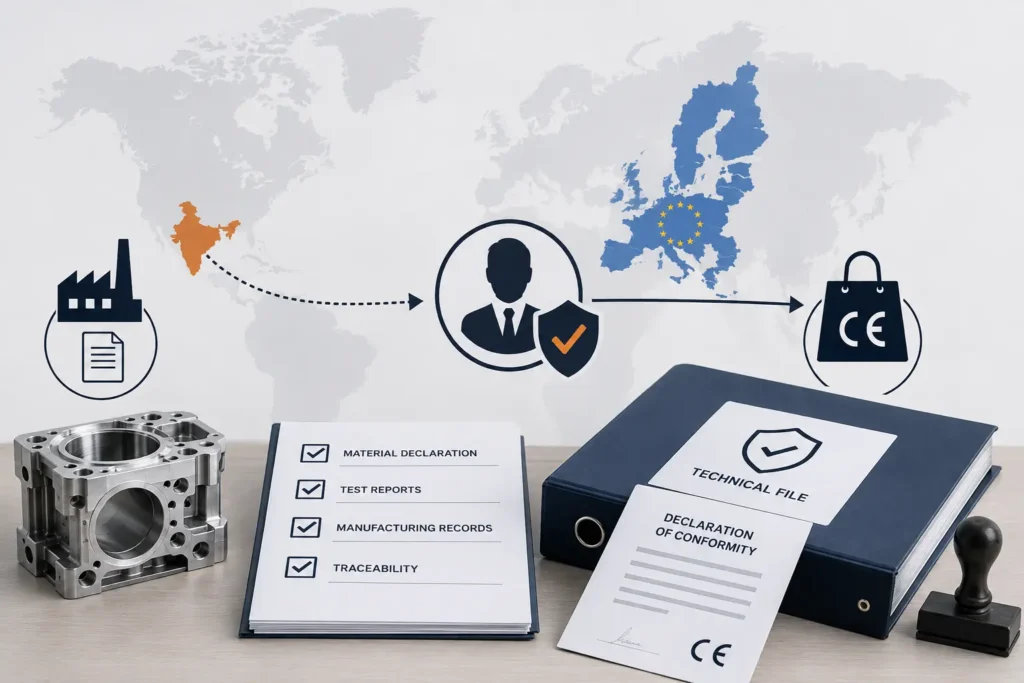
Under EU law, the importer placing a product on the market holds compliance responsibility — wherever it was manufactured. The maker supplies evidence; you own the conformity.
This is the single most important point for any European buyer sourcing abroad. EU product legislation assigns obligations to “economic operators” — the manufacturer, the importer, and the distributor — and when you import a product from outside the EU, you typically take on importer obligations, which for many product categories are extensive. You are responsible for ensuring the product meets the applicable directives and regulations, that a technical file exists, that a Declaration of Conformity is drawn up, and that the CE mark is correctly applied. The Indian manufacturer’s role is to build to your specification and provide the supporting evidence — material declarations, test reports, and manufacturing records — that let you demonstrate conformity. It does not, and cannot, transfer the legal responsibility to them. The practical implication: choose a manufacturer that willingly supplies compliance documentation, but never assume they carry the compliance burden for the EU market. Our guide to finding a reliable manufacturing partner in India covers how to identify one that documents properly.
The Core EU Compliance Frameworks
Three frameworks come up most often for engineered and electronic products sourced into the EU. Here’s what each covers and what it means for sourcing.
| Framework | What it covers | What to require from the maker |
|---|---|---|
| CE marking | Conformity with applicable EU directives | Test data and records for the technical file |
| RoHS | Restricts hazardous substances in electronics | RoHS material declarations, test reports |
| REACH | Controls chemicals and substances of concern | Material composition, SVHC declarations |
| Machinery Regulation | Safety of machinery placed on the EU market | Design, material, and manufacturing records |
CE marking is a declaration that a product meets all applicable EU requirements — it’s not a single test but the outcome of conforming to the relevant directives. RoHS restricts hazardous substances (lead, mercury, cadmium, and others) in electrical and electronic equipment. REACH governs chemical substances, including Substances of Very High Concern (SVHC), across materials and components. Each requires evidence you gather partly from your manufacturer.
What Documentation to Require from Your Indian Manufacturer
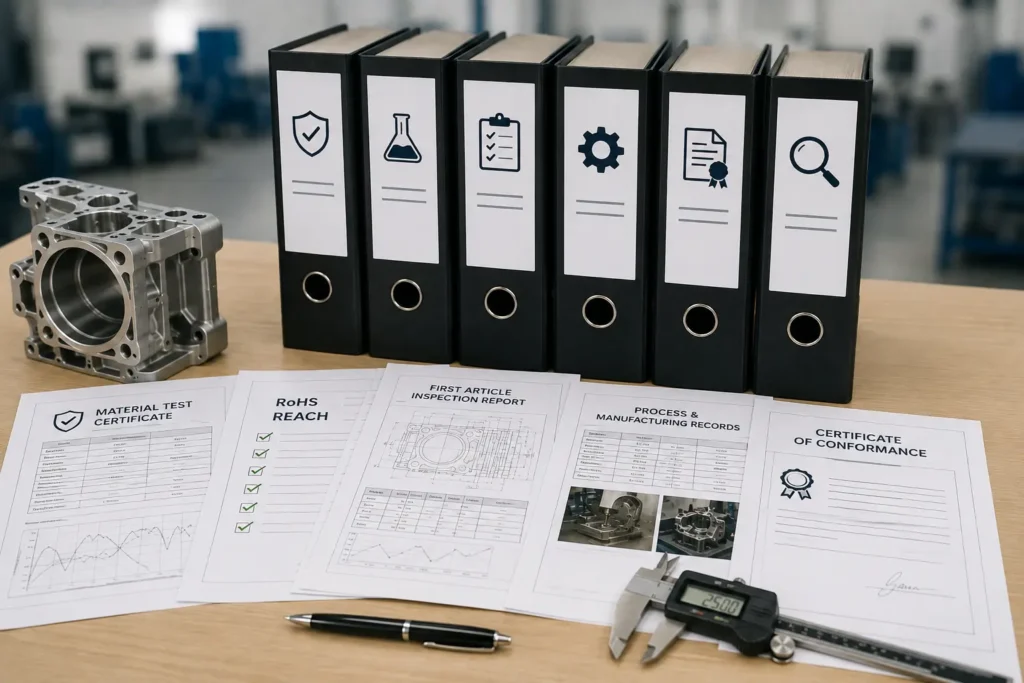
The maker can’t carry your compliance, but they can supply the evidence that underpins it. Insist on this documentation as a condition of the order.
A compliance-capable manufacturer should provide, as standard: material test certificates and mill certificates tracing every material back to a known composition; RoHS and REACH/SVHC declarations for materials and any electronic components used; first article inspection reports and dimensional records demonstrating the product was built to your drawing; process and manufacturing records that can feed your technical file; and certificates of conformance confirming the batch matches specification. For electronic assemblies, add test records and, where relevant, IPC-class workmanship confirmation. None of this makes the manufacturer your compliance guarantor — but together it gives you the evidence base to compile a technical file and draw up a Declaration of Conformity with confidence. A manufacturer that provides this documentation readily is one you can build a compliant EU product around; one that hesitates or can’t produce material traceability is a compliance risk regardless of price.
Need a manufacturer that supplies full compliance documentation? Send Manufyn your drawing and material spec — we’ll confirm the documentation we can provide and quote within 24 hours. ISO 9001, strictly in-house, no minimum order.
A Practical Compliance-Sourcing Checklist
Keep EU conformity watertight when sourcing from India by following this sequence before and during the order:
- Identify the applicable directives: determine which EU frameworks apply to your product (CE, RoHS, REACH, Machinery, and any product-specific directives) before you source.
- Specify compliant materials on the drawing: call out RoHS/REACH-compliant materials and finishes explicitly, so the manufacturer builds to a compliant spec from the start.
- Require documentation as a PO condition: make material certificates, RoHS/REACH declarations, and FAIR a contractual deliverable, not an afterthought.
- Verify the manufacturer: confirm ISO 9001, in-house production, and material traceability — a maker who can’t trace materials can’t support your compliance.
- Compile the technical file yourself: assemble the evidence into your technical file and draw up the Declaration of Conformity — this remains your responsibility as importer.
- Retain records: keep the technical file and declarations for the period required by the applicable legislation.
Buyer takeaway: compliance sourced from India works when you drive it — specify compliant materials, demand the documentation, and compile the technical file yourself. The manufacturer supplies evidence; you own conformity. This is general guidance, not legal advice — confirm your obligations with a compliance professional.
How Manufyn Supports European Compliance Sourcing
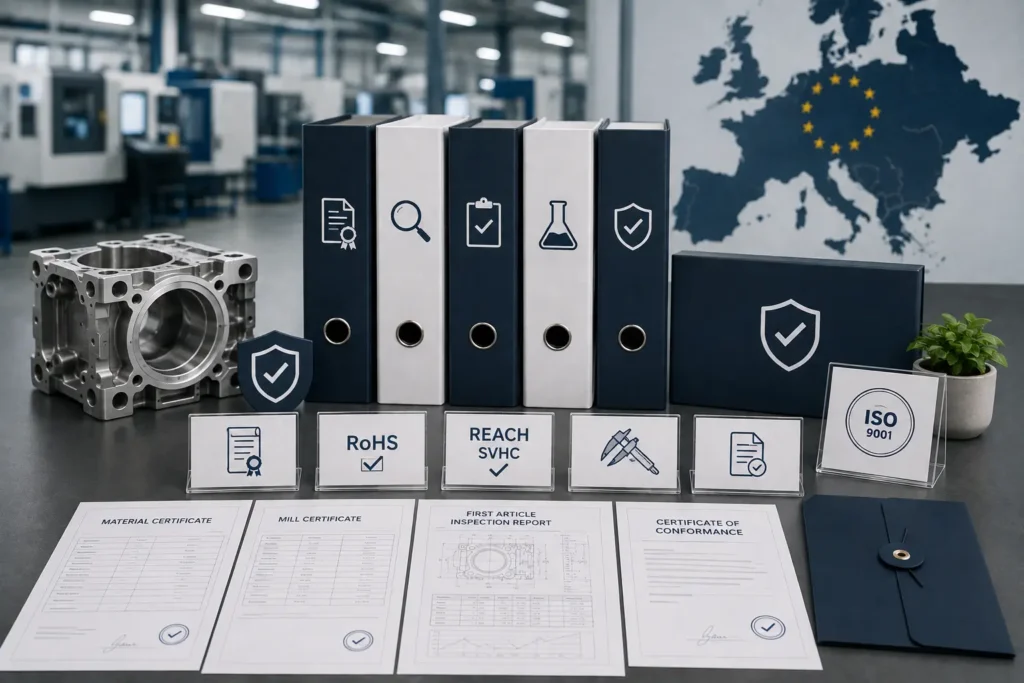
Manufyn is an ISO 9001 certified, strictly in-house manufacturer in Baner, Pune — not a broker. European buyers get material traceability and documentation that supports EU conformity.
Because production is in-house with full material traceability, Manufyn provides the evidence base European importers need to demonstrate conformity: material and mill certificates, RoHS and REACH/SVHC declarations on request, first article inspection reports, and certificates of conformance as standard. Compliant materials and finishes are built to your specification from the start, and every drawing is covered by an NDA before it’s opened. Manufyn supplies the documentation; you retain and own the compliance itself — the correct and legally sound division of responsibility.
- Material and mill certificates with full traceability
- RoHS and REACH/SVHC declarations on request
- FAIR, dimensional reports, and certificates of conformance as standard
- Compliant materials built to spec, NDA before drawings, quote in 24 hours
For prototype work in the region, see our rapid prototyping services for Germany, explore our full range on the commodities directory, or read more on Why Manufyn.
Ready to source with compliance documentation in place? Share your drawing and material spec with Manufyn — quote and documentation confirmation within 24 hours.
FAQs
The European importer placing the product on the EU market holds CE marking responsibility, not the Indian manufacturer. Under EU law, compliance duties fall on the economic operator importing the product. The manufacturer supplies supporting evidence — test data, material declarations, manufacturing records — but the importer ensures conformity, compiles the technical file, and applies the CE mark. This is general guidance, not legal advice.
Yes. Where a product is made doesn’t determine whether it can be CE marked — conformity with the applicable EU directives does. A product manufactured in India can be fully CE compliant provided it meets the relevant requirements and the EU importer compiles the technical file and Declaration of Conformity based on evidence including the manufacturer’s documentation.
RoHS restricts specific hazardous substances (like lead, mercury, and cadmium) in electrical and electronic equipment. REACH is broader, governing chemical substances across all materials and including Substances of Very High Concern (SVHC). A product may need to demonstrate compliance with both, supported by material declarations from the manufacturer.
Require material and mill certificates with full traceability, RoHS and REACH/SVHC declarations, first article inspection reports, certificates of conformance, and — for electronics — test records and IPC-class confirmation. Together these give you the evidence base to compile a technical file and draw up a Declaration of Conformity.
No. The manufacturer builds to your specification and supplies supporting documentation, but EU compliance responsibility legally stays with the European importer. A good manufacturer makes compliance easier by providing full material traceability and declarations, but it cannot assume the importer’s legal obligations.
Identify the applicable directives first, specify RoHS/REACH-compliant materials on the drawing, make documentation a contractual condition of the PO, verify the manufacturer’s ISO 9001 status and material traceability, and compile the technical file and Declaration of Conformity yourself. Confirm your specific obligations with a compliance professional.
For most CE-marked products a technical file is required, and the economic operator responsible for placing the product on the EU market compiles and retains it. When sourcing from India, that’s typically you as importer — using evidence including the manufacturer’s material certificates, test data, and manufacturing records.
Confirm ISO 9001 certification with its issuing body, verify the company is a genuine in-house manufacturer, and check that it can provide material traceability and RoHS/REACH declarations. A manufacturer that can trace every material and document its process supports your compliance; one that can’t is a risk regardless of price.
Have a compliance question about a specific part? Send it to our engineers — we respond within 4 working hours.
Sourcing for the EU market from India?
Get a quote and confirmation of the compliance documentation available before you commit to any supplier.
Talk to Manufyn