Australian manufacturers source from India for lower cost, ISO 9001 quality that maps to AS/NZS expectations, English-language engineering, and — since the India–Australia Economic Cooperation and Trade Agreement (AI-ECTA) — reduced or eliminated duty on many imported goods. With domestic Australian fabrication rates among the highest globally and a shortage of local capacity in some trades, India has become a leading offshore option for Australian engineering and manufacturing businesses.
The drivers for Australian buyers are sharper than most: high domestic labour costs, limited local fabrication capacity in some regions, and long distances to every major manufacturing hub anyway — which levels the playing field between a local shop and an offshore one once freight is factored in. India offers a strong combination of cost, quality, communication, and, thanks to AI-ECTA, favourable trade terms. This guide covers why Australian manufacturers are sourcing from India, the AUD cost comparison, quality and standards, shipping and the AI-ECTA trade advantage, and how to verify a supplier before committing.
This is written from the Indian manufacturer’s side. Manufyn’s sourcing from India service supplies Australian buyers from an ISO 9001 certified, strictly in-house facility in Pune — so the detail reflects what actually reaches our RFQ desk from Australia.
Why Australian Manufacturers Are Sourcing from India
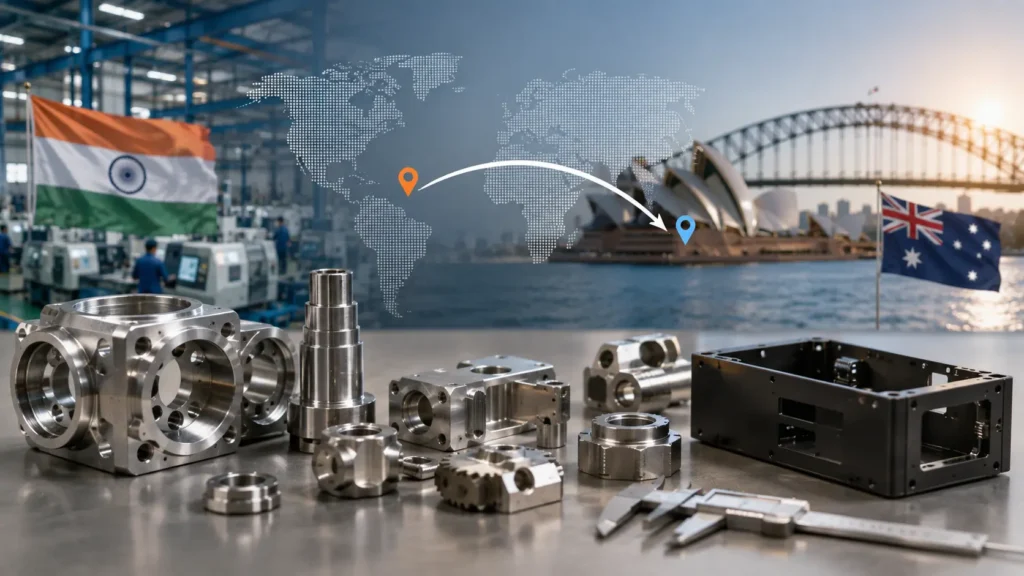
Australia’s high labour costs and limited local capacity make offshore sourcing compelling. India adds quality, English communication, and a trade agreement that lowers duty.
Australian manufacturing labour is among the most expensive in the world, and in several regions and trades local fabrication capacity is genuinely constrained — meaning even domestic buyers often wait in a queue. Because Australia is a long way from every major manufacturing centre, the freight penalty that deters some markets from offshoring is smaller in relative terms: a part travelling from Pune to Melbourne isn’t dramatically further than one from a distant Australian state. Into that gap, India offers labour and machine-hour rates a fraction of Australian levels, a large base of ISO 9001 certified manufacturers, English as the standard language of engineering, and — critically — the India–Australia Economic Cooperation and Trade Agreement (AI-ECTA), which has reduced or removed tariffs on a wide range of goods traded between the two countries. Our blog on why global brands are moving manufacturing to India covers the broader shift.
Australia vs India: The Cost Comparison in AUD
The advantage sits in labour and machine time — raw material trades globally and costs much the same everywhere. The table shows where the real gap is.
| Cost element | Australia typical | India (Manufyn) |
|---|---|---|
| Skilled fabrication labour (per hour) | A$45–A$80 | A$15–A$38 |
| All-in shop rate (per hour) | A$80–A$180 | A$25–A$60 |
| Raw material | Global market price | Broadly similar |
| Typical landed saving (labour-heavy parts) | — | 30–50% after freight |
Buyer takeaway: Australia’s high domestic labour rates make the offshore saving on labour-heavy parts particularly large — multi-bend fabrication, welded assemblies, and machined components benefit most. Simple heavy blanks save less. Compare on landed cost per part, and factor in AI-ECTA duty treatment.
The AI-ECTA Trade Advantage
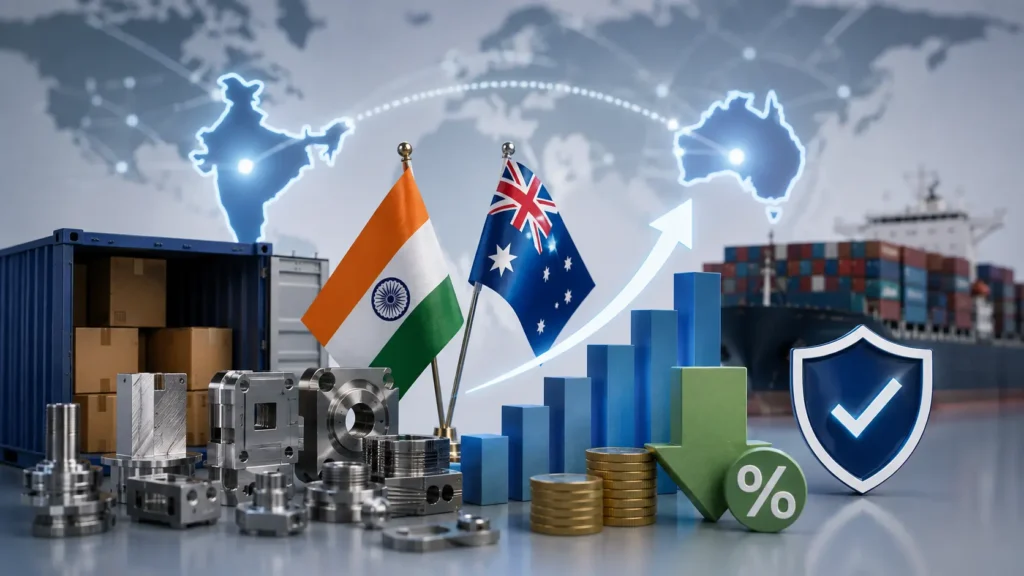
The India–Australia trade agreement is the factor most cost comparisons miss. It has reduced or eliminated duty on a wide range of goods, improving India’s landed-cost position for Australian buyers.
The India–Australia Economic Cooperation and Trade Agreement (AI-ECTA) came into force to strengthen trade between the two countries, and one of its direct effects has been the reduction or removal of tariffs on a broad range of goods traded in both directions. For an Australian manufacturer sourcing engineered parts from India, this can mean lower or zero import duty on many product categories — improving the landed-cost advantage on top of the labour saving. Because duty treatment depends on the specific product’s tariff classification, the exact benefit varies by part, and rates and coverage can change as the agreement is phased in. The practical step is to confirm the current duty treatment for your specific product category with a customs broker at the time of order — but the direction is clear: AI-ECTA makes India a more cost-competitive source for Australian buyers than a pre-agreement comparison would suggest.
Comparing an Australian quote against India? Send Manufyn your drawing and we’ll return an AUD-denominated landed-cost quote — including freight — within 24 hours. ISO 9001, strictly in-house, no minimum order.
Quality, Standards, and Shipping to Australia
On quality, the rule is the same everywhere: it depends on the manufacturer, not the country. A verifiable ISO 9001 certificate is the baseline, and its requirements align with the AS/NZS quality expectations Australian buyers work to — many AS/NZS standards adopt or reference the equivalent ISO standard directly. Serious Indian manufacturers provide first article inspection reports, material certificates, and certificates of conformance as standard. On shipping, the distance is manageable for most engineered parts:
| Method | Transit time (India → Australia) | Best for |
|---|---|---|
| Air freight | 5–7 days | First articles, urgent batches, high-value parts |
| Sea freight | 18–22 days | Production volumes, cost-sensitive orders |
A DDP (Delivered Duty Paid) arrangement lets the supplier handle freight, duty, and customs for a single landed price — the simplest way to compare like-for-like against an Australian quote. Manufyn ships to Melbourne, Sydney, Brisbane, Adelaide, Perth, and the Gold Coast.
How to Verify an Indian Supplier
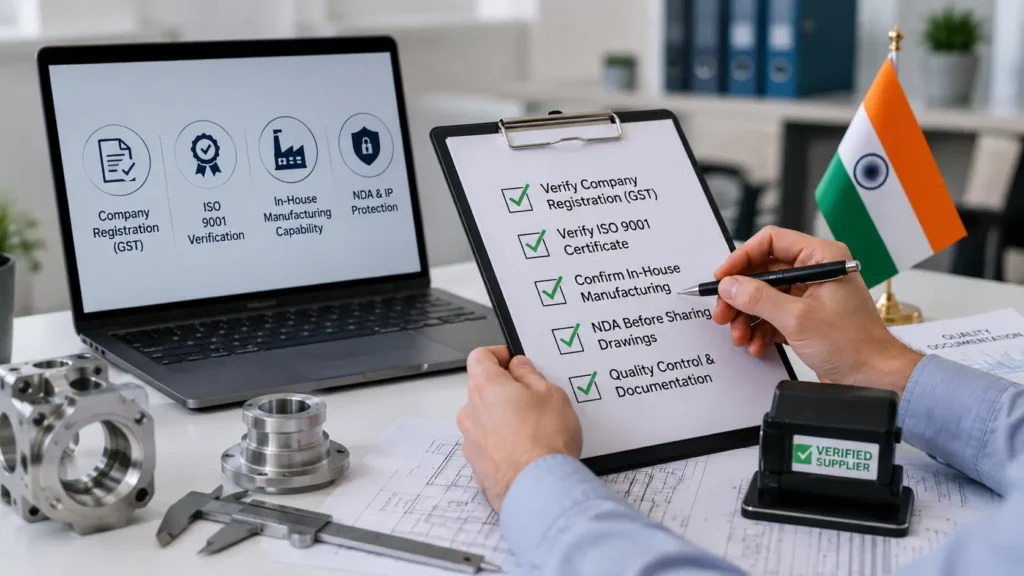
The biggest sourcing mistake isn’t choosing India — it’s choosing an unverified intermediary that looks like a manufacturer in a first email. Verification is straightforward and mostly desk-based.
Before sending a drawing, confirm the supplier is a genuine in-house manufacturer, not a trading company reselling capacity: ask for GST and company registration you can check independently, verify the ISO 9001 certificate directly with its issuing body, confirm which processes run in-house versus subcontracted, and insist on an NDA before drawings change hands. A supplier that answers all of these readily and provides documented quality control by default is one an Australian buyer can trust. Working with an in-house manufacturer also protects your IP, because your files never pass through a subcontractor network. Our guide to finding a reliable manufacturing partner in India covers the full checklist.
How Manufyn Serves Australian Buyers
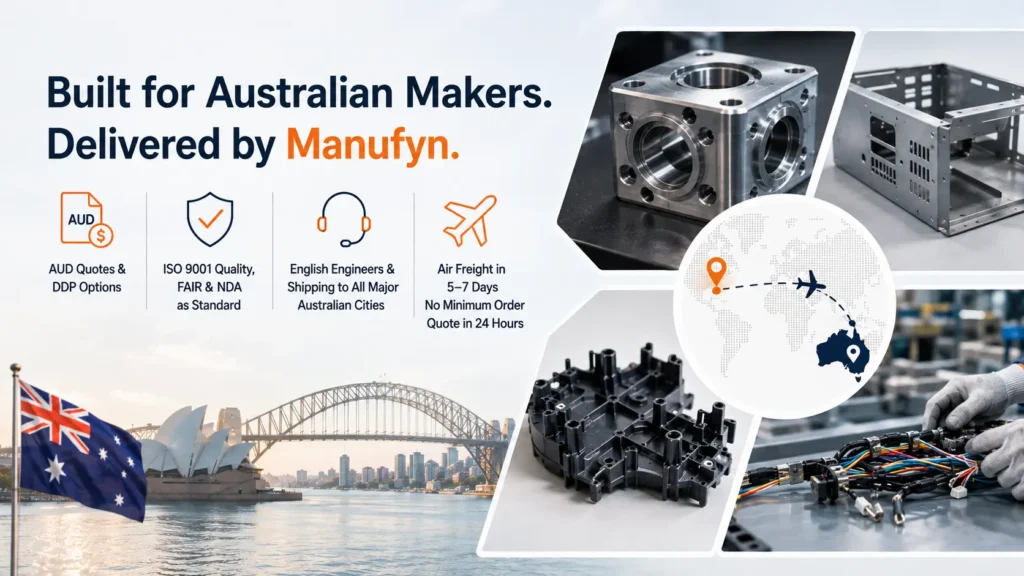
Manufyn is an ISO 9001 certified, strictly in-house manufacturer in Baner, Pune — not a broker. Australian buyers get English-language engineering, AUD quotes, and documented quality as standard.
With more than 80 processes under one roof, an Australian company can source machined parts, sheet metal enclosures, moulded components, and assemblies from one accountable supplier. Every quote includes a free DFM review, AUD pricing and DDP options are available for like-for-like comparison, and every drawing is covered by an NDA before it’s opened. Air freight reaches Australian cities in 5–7 days, and there’s no minimum order — a prototype is quoted the same way as a production run.
- AUD quotes and DDP options for direct comparison with local suppliers
- ISO 9001 quality, FAIR, material certificates, and NDA as standard
- English-language engineers and shipping to all major Australian cities
- Air freight in 5–7 days, no minimum order, quote in 24 hours
See our full process range on our commodities directory, or read more on Why Manufyn.
Ready to see the numbers for your own parts? Share a drawing with Manufyn — AUD quote, quality documentation, and Australian delivery timelines, all within 24 hours.
FAQs
For lower cost — Indian labour and machine-hour rates are a fraction of Australia’s high domestic rates — plus ISO 9001 quality, English-language engineering, limited local Australian capacity in some trades, and the AI-ECTA trade agreement, which has reduced or removed duty on many goods traded between India and Australia.
The India–Australia Economic Cooperation and Trade Agreement (AI-ECTA) has reduced or eliminated tariffs on a wide range of goods traded between the two countries. For Australian manufacturers sourcing from India, this can mean lower or zero import duty on many product categories, improving the landed-cost advantage. Confirm the current treatment for your product with a customs broker.
Typically 30–50% on labour-heavy engineered parts after freight, and Australia’s high domestic labour rates make this saving particularly large. Material costs are broadly similar globally, so simple heavy parts save less. Compare on landed cost per part and factor in AI-ECTA duty treatment.
Quality depends on the manufacturer, not the country. A verifiable ISO 9001 certificate is the baseline, and its requirements align with the AS/NZS standards Australian buyers work to — many of which adopt or reference the equivalent ISO standard. Serious Indian manufacturers provide FAIR, material certificates, and certificates of conformance as standard.
Air freight takes 5–7 days and suits first articles, urgent batches, and high-value parts; sea freight takes 18–22 days and suits cost-sensitive production volumes. Manufyn ships to Melbourne, Sydney, Brisbane, Adelaide, Perth, and the Gold Coast.
Ask for GST and company registration you can check independently, verify the ISO 9001 certificate with its issuing body, confirm which processes are in-house versus subcontracted, and require an NDA before sharing drawings. A genuine in-house manufacturer provides all of this readily; a trading company or broker often cannot.
It’s safe with the right safeguards: sign an NDA before any file is shared and work with an in-house manufacturer whose files don’t propagate through a subcontractor network. India’s common-law legal system is generally viewed as a lower-risk IP environment than some other low-cost regions.
Labour-intensive engineered parts suit India best — CNC-machined components, sheet metal fabrication and enclosures, welded assemblies, castings, and injection-moulded parts — across sectors including mining equipment, industrial machinery, engineering, and the automotive aftermarket.
Have a specific part to compare against your Australian quote? Send it to our engineers — we respond within 4 working hours.
Sourcing manufacturing for your Australian business?
Get an AUD landed-cost quote and a supplier-verification checklist before you commit to any supplier.
Talk to Manufyn