UK companies source manufacturing from India for a clear set of reasons: labour and machine-hour costs 30–50% below UK rates, a large base of ISO 9001 certified manufacturers whose quality systems map cleanly to BS EN standards, English-language engineering communication as standard, and air freight that puts finished parts in the UK within 3–5 days. For engineered metal and plastic parts, India has become the leading alternative to both UK domestic fabrication and Chinese sourcing.
The pressure driving this shift is familiar to any UK procurement or engineering team: domestic fabrication rates have risen, lead times at UK shops have stretched, and single-country supply chains have proven risky. India offers a way to cut cost and diversify sourcing without sacrificing the quality standards and communication a UK buyer expects. This guide covers exactly why UK companies are making the move, the real GBP cost comparison, how quality and standards line up, shipping and customs, and how to verify an Indian supplier before committing.
This is written from the Indian manufacturer’s side of the relationship. Manufyn’s sourcing from India service supplies UK buyers from an ISO 9001 certified, strictly in-house facility in Pune — so the detail below reflects what actually crosses our RFQ desk from the UK, not a broker’s summary.
Why UK Companies Are Turning to India
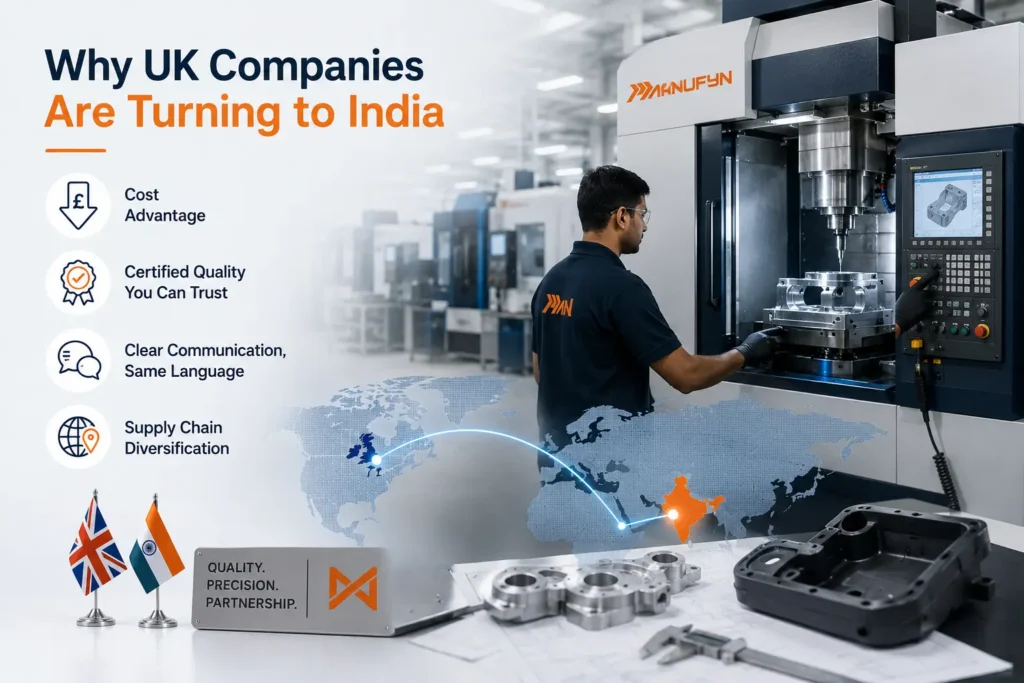
The move is driven by four things at once: cost, quality, communication, and supply-chain diversification. India delivers on all four in a way few other sourcing options manage together.
UK fabrication and machining rates have climbed steadily, while Indian shops now run the same fiber lasers, CNC machining centres, and injection moulding presses at a fraction of the labour and overhead cost. That gap alone would attract attention, but it’s the combination that makes India compelling for UK buyers: a growing base of ISO 9001 certified manufacturers whose quality documentation UK engineers recognise, English as the standard language of Indian engineering, and time-zone overlap that allows same-day communication with UK working hours. Add the post-pandemic drive to diversify away from single-country supply chains — the “China plus one” strategy — and India has emerged as the natural choice for UK companies wanting lower cost without the communication friction or IP concerns some associate with other low-cost regions. Our blog on why global brands are moving manufacturing to India covers this shift in depth.
UK vs India: The Cost Comparison in GBP
The cost advantage is real, but it’s concentrated in labour and machine time rather than material — raw metal and resin trade on global markets and cost broadly the same everywhere. The table below shows where the gap actually sits.
| Cost element | UK typical | India (Manufyn) |
|---|---|---|
| Skilled fabrication labour (per hour) | £25–£45 | £8–£20 |
| All-in shop rate (per hour) | £40–£100 | £12–£32 |
| Raw material | Global market price | Broadly similar |
| Typical landed saving (labour-heavy parts) | — | 30–50% after freight |
Buyer takeaway: the savings are largest on labour-intensive parts — multi-bend fabrication, welded assemblies, machined components. Simple heavy blanks with little labour content save less, because material dominates their cost. Always compare on landed cost per part, not headline unit price.
Quality and Standards: Does Indian Manufacturing Meet UK Requirements?
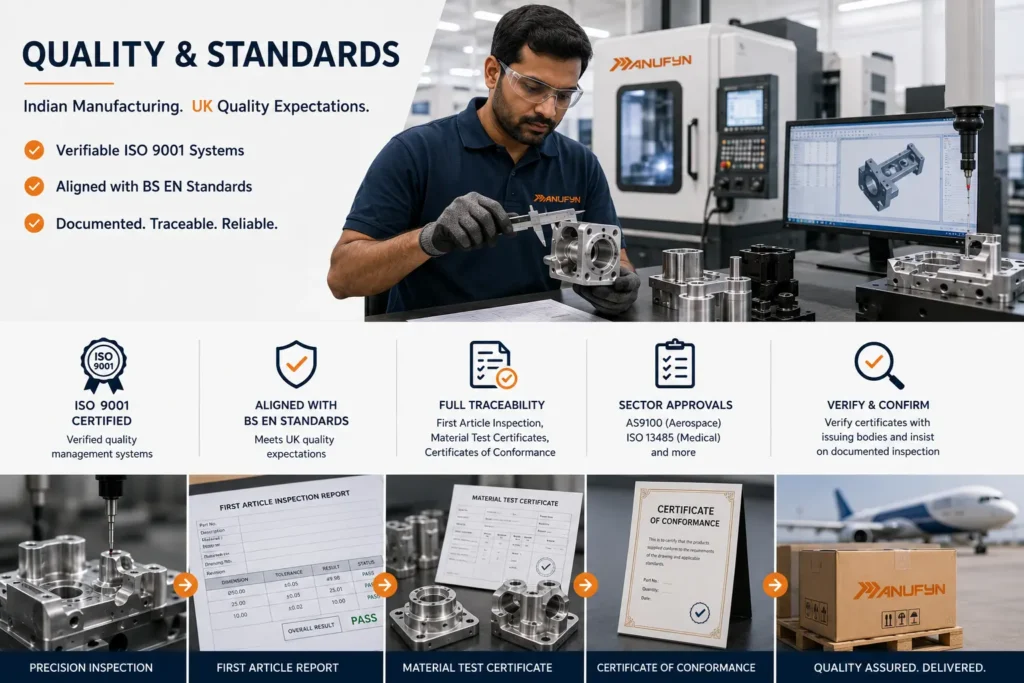
Quality depends on the specific manufacturer, not the country. A verifiable ISO 9001 system is the baseline UK buyers should insist on — and it maps directly to the documentation they already expect.
The concern UK engineers raise most often is whether Indian manufacturing meets UK quality expectations — and the honest answer is that it depends entirely on the manufacturer, exactly as it does in the UK. A verifiable ISO 9001 certificate is the baseline: it demonstrates a documented, audited quality management system, and its requirements align closely with the BS EN standards UK buyers work to (ISO 9001 is published in the UK as BS EN ISO 9001). Serious Indian manufacturers provide first article inspection reports, material test certificates, and certificates of conformance as standard — the same traceability documentation a UK supplier would. Where a programme needs sector-specific approval such as AS9100 for aerospace or ISO 13485 for medical devices, that should be confirmed explicitly rather than assumed. The key is to verify the certificate with its issuing body and to insist on documented inspection, not to assume quality from the country label either way.
Comparing a UK quote against India? Send Manufyn your drawing and we’ll return a GBP-denominated landed-cost quote — including freight — within 24 hours, so the comparison is done for you. ISO 9001, strictly in-house, no minimum order.
Shipping and Customs: India to the UK
Distance is the objection UK buyers raise second-most, and for most engineered parts it’s smaller than expected. Air freight brings first articles and urgent batches to the UK in days; sea freight carries production volumes economically.
| Method | Transit time (India → UK) | Best for |
|---|---|---|
| Air freight | 3–5 days | First articles, urgent batches, high-value parts |
| Sea freight | 20–28 days | Production volumes, cost-sensitive orders |
On customs, a UK buyer imports parts from India under standard UK import procedures, paying import VAT (usually reclaimable by VAT-registered businesses) and any applicable duty. A DDP (Delivered Duty Paid) arrangement lets the supplier handle freight, duty, and customs so you receive a single landed price — the simplest option for comparing like-for-like against a UK quote. The pattern most UK buyers settle into: first articles and urgent orders by air, production volumes by sea, with a small buffer stock covering the transit gap.
How to Verify an Indian Supplier Before You Commit
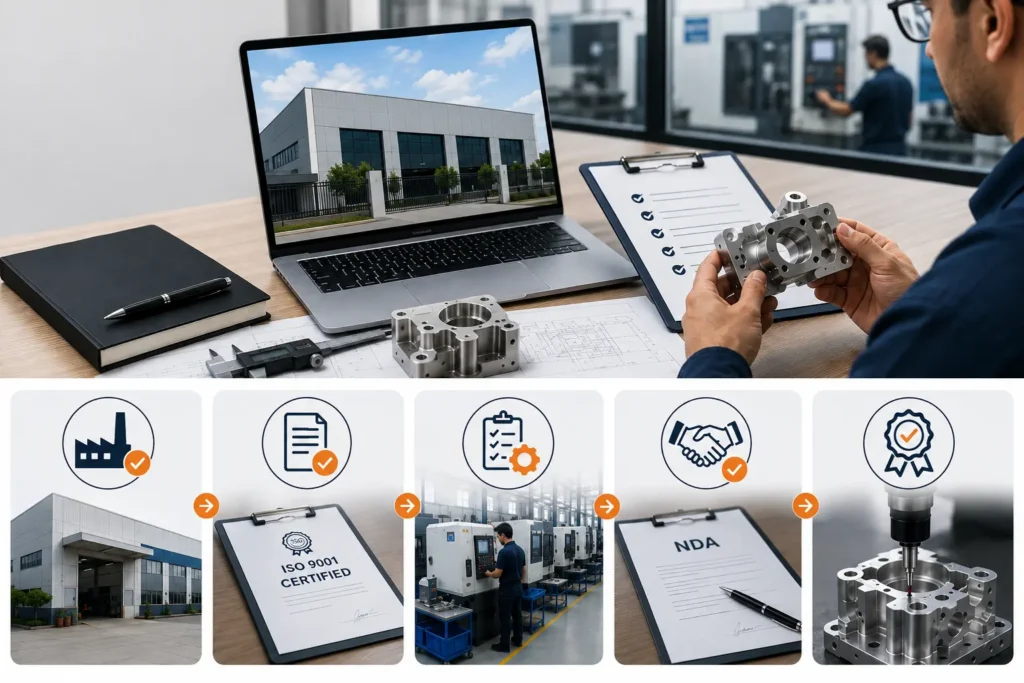
The single biggest sourcing mistake isn’t choosing India — it’s choosing an unverified intermediary that looks like a manufacturer in a first email. Verification is straightforward and mostly done from your desk.
Before sending any drawing, confirm the supplier is a genuine in-house manufacturer rather than a trading company reselling capacity: ask for GST and company registration you can check independently, verify the ISO 9001 certificate directly with its issuing body, confirm which processes run in-house versus subcontracted, and insist on an NDA before drawings are shared. A supplier that answers all of these readily — and offers documented quality control by default — is one a UK buyer can trust. Working with an in-house manufacturer also protects your IP, because your files never propagate through a subcontractor network the way they can on a broker platform. Our guide to finding a reliable manufacturing partner in India covers the full verification checklist, including the exact registrations to check.
How Manufyn Serves UK Buyers
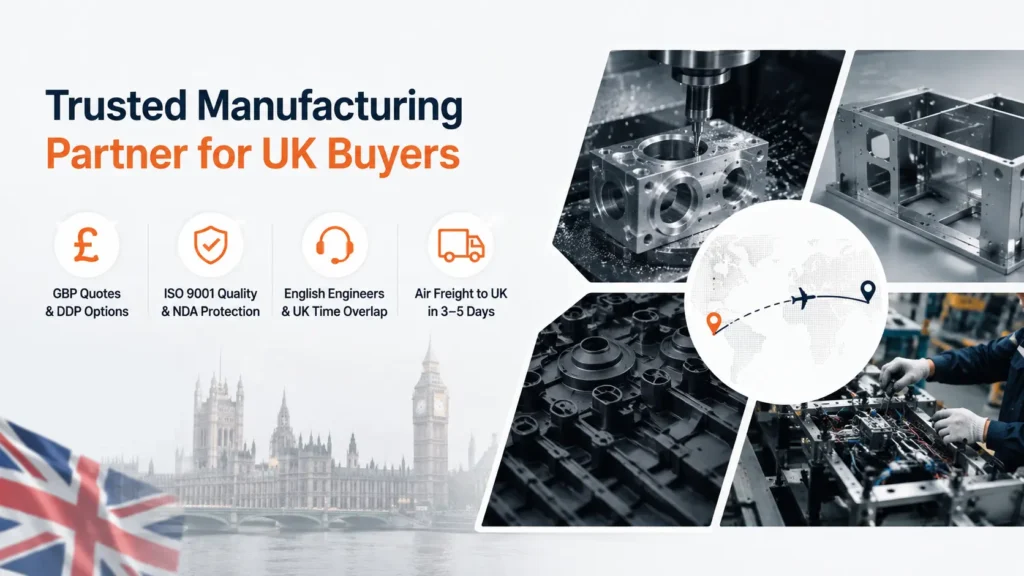
Manufyn is an ISO 9001 certified, strictly in-house manufacturer in Baner, Pune — not a broker or trading company. UK buyers get English-language engineering, GBP quotes, and documented quality as standard.
Because more than 80 processes run under one roof, a UK company can source machined parts, sheet metal enclosures, moulded components, and assemblies from a single accountable supplier rather than coordinating several. Every quote includes a free DFM review, GBP pricing and DDP options are available for like-for-like comparison against UK quotes, and every drawing is covered by an NDA signed before it’s opened. Air freight puts first articles in the UK within days, and there’s no minimum order — a prototype is quoted the same way as a production batch.
- GBP quotes and DDP options for direct comparison with UK suppliers
- ISO 9001 quality, FAIR, material certificates, and NDA as standard
- English-language engineers with UK working-hour overlap
- Air freight to the UK in 3–5 days, no minimum order, quote in 24 hours
See our full process range on our commodities directory, or read more on Why Manufyn.
Ready to see the numbers for your own parts? Share a drawing with Manufyn — GBP quote, quality documentation, and UK delivery timelines, all within 24 hours.
FAQs
Mainly for cost — Indian labour and machine-hour rates run 30–50% below UK rates on labour-heavy parts — alongside a large base of ISO 9001 certified manufacturers, English-language engineering communication, air freight to the UK in 3–5 days, and the ability to diversify away from single-country supply chains.
Quality depends on the specific manufacturer, not the country. A verifiable ISO 9001 certificate — published in the UK as BS EN ISO 9001 — is the baseline, and serious Indian manufacturers provide FAIR, material certificates, and certificates of conformance as standard. Verify the certificate with its issuing body and insist on documented inspection.
Typically 30–50% on labour-heavy engineered parts after freight, because Indian labour and machine-hour rates are far lower while material costs are broadly similar globally. Savings are smaller on simple heavy parts where material dominates cost. Always compare on landed cost per part, not headline unit price.
Air freight takes 3–5 days and suits first articles, urgent batches, and high-value parts; sea freight takes 20–28 days and suits cost-sensitive production volumes. Many UK buyers use air for first articles and urgent orders and sea for production, with a small buffer stock covering the transit gap.
UK buyers import under standard UK procedures, paying import VAT (usually reclaimable by VAT-registered businesses) and any applicable duty. A DDP (Delivered Duty Paid) arrangement lets the supplier handle freight, duty, and customs for a single landed price — the simplest way to compare like-for-like against a UK quote. Confirm current rates with your customs broker.
Ask for GST and company registration you can check independently, verify the ISO 9001 certificate with its issuing body, confirm which processes are in-house versus subcontracted, and require an NDA before sharing drawings. A genuine in-house manufacturer provides all of this readily; a trading company or broker often cannot.
It’s safe with the right safeguards: sign an NDA before any file is shared and work with an in-house manufacturer whose files don’t propagate through a subcontractor network. India’s common-law legal system is generally viewed by UK buyers as a lower-risk environment for IP than some other low-cost regions.
Labour-intensive engineered parts suit India best — CNC-machined components, sheet metal fabrication and enclosures, welded assemblies, castings, and injection-moulded parts — across sectors including engineering, HVAC, electronics, and industrial equipment.
Have a specific part to compare against your UK quote? Send it to our engineers — we respond within 4 working hours.
Sourcing manufacturing for your UK business?
Get a GBP landed-cost quote and a supplier-verification checklist before you commit to any supplier.
Talk to Manufyn