A wire harness is an organised assembly of wires, cables, terminals, and connectors bound together into a single unit that transmits power and signals through a machine or device. Wire harness assembly is the process of building that unit — cutting and stripping wire, crimping terminals, inserting them into connectors, bundling the routes, and testing continuity — so that a complex web of individual wires becomes one reliable, installable part.
Harnesses exist because loose individual wires inside a product are a liability: they chafe, they’re slow to install, they’re hard to trace when something fails, and they’re prone to wiring errors. Binding wires into a defined harness makes assembly faster, routing repeatable, and faults far easier to diagnose. This guide covers what a wire harness is, the components inside it, the full assembly process step by step, how harnesses are tested, and how to source a reliable harness manufacturer.
The detail here comes from a shop that builds electrical assemblies to order. Manufyn’s electronic assembly service runs from an ISO 9001 certified, strictly in-house facility in Pune, India — so this is written from the assembly bench, not a catalogue.
What Is a Wire Harness?
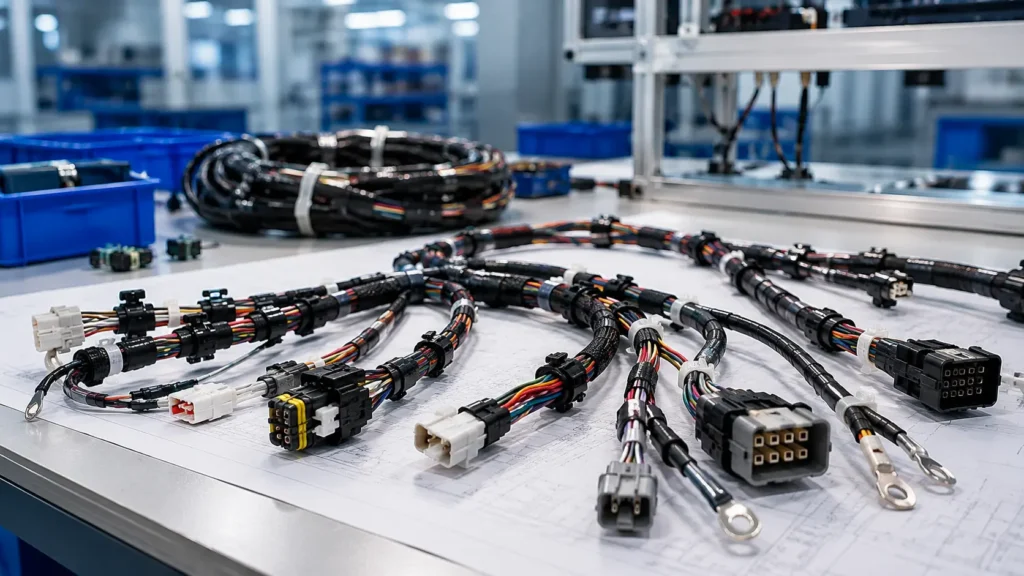
A wire harness bundles many wires into one organised, routed unit. It carries power and signals through a product while keeping the wiring protected, traceable, and quick to install.
Wire Harness vs Cable Assembly: The Difference
The two terms are often used interchangeably, but they’re distinct. A cable assembly is a group of wires inside a single outer jacket, built to protect the wires from a harsh external environment — moisture, abrasion, heat. A wire harness is a broader assembly of wires and cables bound together with tape, sleeving, or ties, designed to organise and route wiring inside a product rather than to shield it from the outside world. In short: a cable assembly protects wires from the environment; a wire harness organises wires within an enclosure. Many products use both — cable assemblies for external connections and a harness for internal routing.
Components of a Wire Harness
A finished harness is built from a defined set of components, each with a specific role. Understanding them is the first step to specifying a harness correctly.
| Component | Role |
|---|---|
| Wires and cables | Carry the power and signals; gauge set by current |
| Terminals | Crimped to wire ends to make the electrical contact |
| Connectors | Housings that terminals plug into for mating |
| Sleeving and conduit | Protect and bundle wires along the route |
| Tape and ties | Bind the bundle and hold branch points |
| Heat-shrink and labels | Insulate joints and identify circuits |
| Grommets and strain reliefs | Protect wires at panel pass-throughs and connectors |
The Wire Harness Assembly Process: Step by Step
Building a harness follows a defined sequence, and each step feeds the next. Skipping or rushing any of them shows up later as a continuity failure or a field fault.
| Step | Stage | What happens |
|---|---|---|
| 1 | Design & wire list | Schematic turned into a wire list and layout board |
| 2 | Cutting | Each wire cut to its exact specified length |
| 3 | Stripping | Insulation removed from wire ends without nicking strands |
| 4 | Crimping | Terminals crimped to stripped ends to spec force |
| 5 | Connector insertion | Terminals seated into connector housings in the right cavities |
| 6 | Routing & bundling | Wires laid out on the board, bundled, taped, sleeved |
| 7 | Testing | Continuity and, where needed, hi-pot testing |
The two steps that most affect reliability are crimping and testing. A crimp that’s too loose creates resistance and heat; too tight, and it cuts strands and weakens the joint — which is why crimp force is controlled and often pull-tested. For fine-pitch and specialised interconnection work, wire bonding handles connections a standard crimp can’t.
Need a custom wire harness built to your schematic? Send your wire list and connector spec to Manufyn — we’ll review it and return a firm quote within 24 hours. ISO 9001, strictly in-house, no minimum order.
How Wire Harnesses Are Tested
A harness that looks right can still be wrong internally, so testing is not optional — it’s what turns a built assembly into a verified one. The main tests are:
- Continuity testing: confirms every wire connects the correct two points and that there are no open circuits or miswires — the core electrical check on every harness.
- Crimp pull testing: a sample crimp is pulled to verify it meets the required retention force, confirming the crimp process is set correctly.
- Hi-pot (dielectric) testing: applies high voltage to confirm insulation integrity between circuits — used on harnesses carrying significant voltage or in safety-critical applications.
- Visual and dimensional inspection: checks connector seating, label placement, branch lengths, and bundle routing against the drawing.
Buyer takeaway: a harness supplier that continuity-tests 100% of units and documents it is giving you proof the harness works, not just an assurance. For anything beyond a handful of units, ask what percentage is tested and how it’s recorded.
Where Wire Harnesses Are Used
Wire harnesses appear in almost every powered product, but a few sectors depend on them heavily:
- Automotive and EV — engine, dashboard, battery, and lighting harnesses
- Industrial machinery and automation — control panels, sensors, and motors
- Appliances and consumer electronics — internal power and signal routing
- Robotics — flexible harnesses routed through moving joints
- Medical devices — traceable, tested harnesses to strict documentation standards
- Renewable energy — solar and battery-storage wiring assemblies
Harnesses are a core part of electronic and appliance manufacturing, and Manufyn has delivered related electrical development work such as a documented wire bonding product development project.
How to Choose a Wire Harness Manufacturer
A harness is only as reliable as the shop that builds it, so vetting the manufacturer matters. Key checks:
- Verify they build in-house rather than routing to an unseen subcontractor
- Confirm ISO 9001, and ask whether they build to IPC/WHMA-A-620 (the wire harness workmanship standard)
- Ask what percentage of harnesses are continuity-tested and how it’s documented
- Check crimp process control — calibrated tooling and pull-testing
- Confirm they can source or accept your specified connectors and wire gauges
- Ask about minimum order quantity — many harness shops require large minimums
Buyer takeaway: the IPC/WHMA-A-620 standard and 100% continuity testing are the two clearest signals of a serious harness manufacturer. A supplier that can’t speak to either is one to be cautious with.
How Manufyn Builds Wire Harnesses
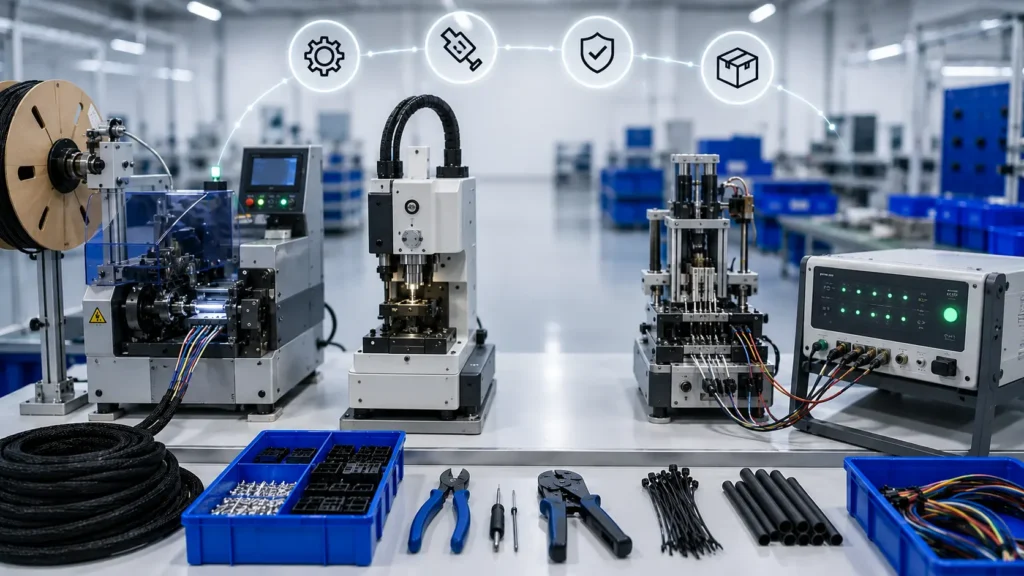
Manufyn is an ISO 9001 certified, strictly in-house manufacturer in Baner, Pune, India — not a broker. Wire harness and cable assembly run alongside 80+ other processes under one accountable roof.
Because harness assembly sits in the same facility as machining, sheet metal, and electronic assembly, a complete product — an enclosure, its internal harness, and the assembled electronics — can come from one supplier rather than three. Crimps are made with calibrated tooling, harnesses are continuity-tested against the wire list, and the build is documented so you receive verified assemblies, not just bundled wire. There’s no minimum order, so a first prototype harness is quoted the same way as a production batch.
- Cutting, stripping, crimping, connector insertion, bundling, and testing in-house
- Continuity testing against your wire list with documented results
- Harness, enclosure, and electronic assembly available from one supplier
- No minimum order and a firm quote within 24 hours
Read more about our approach on our Why Manufyn page.
Ready to build your harness? Send your wire list and connector spec to Manufyn — in-house build, continuity-tested, no minimum order, and a firm quote in 24 hours.
FAQs
Wire harness assembly is the process of building an organised bundle of wires, terminals, and connectors into a single installable unit. It involves cutting and stripping wire, crimping terminals, inserting them into connectors, bundling and routing the wires, and testing continuity — turning a web of individual wires into one reliable, traceable part.
A cable assembly is a group of wires inside a single protective outer jacket, built to shield them from a harsh environment. A wire harness is a broader assembly of wires and cables bound with tape or sleeving to organise and route wiring inside a product. In short: a cable assembly protects wires from the environment; a harness organises wires within an enclosure.
The main steps are: turning the schematic into a wire list and layout, cutting each wire to length, stripping the insulation, crimping terminals, inserting terminals into connectors, routing and bundling the wires, and testing for continuity. Crimping and testing are the two steps that most affect reliability.
Harnesses are tested primarily for continuity — confirming every wire connects the correct points with no open circuits or miswires. Additional tests include crimp pull testing (verifying retention force), hi-pot testing (checking insulation integrity at high voltage), and visual inspection of connector seating and routing against the drawing.
IPC/WHMA-A-620 is the industry standard for the requirements and acceptance of cable and wire harness assemblies. It defines workmanship criteria for crimping, soldering, and assembly, and building to it is one of the clearest signals that a harness manufacturer works to a recognised quality standard.
Wire harnesses are used across automotive and EV, industrial machinery and automation, appliances and consumer electronics, robotics, medical devices, and renewable energy. Essentially any powered product with more than a few wires benefits from a harness for faster assembly, repeatable routing, and easier fault diagnosis.
The crimp is the electrical joint between wire and terminal. A crimp that’s too loose adds resistance and generates heat, risking failure; too tight, and it cuts strands and weakens the joint. This is why crimp force is controlled with calibrated tooling and often verified by pull-testing a sample.
Many harness manufacturers require large minimum orders, but not all. Manufyn quotes from a single prototype harness through to production batches with no minimum order, so a first article can be built and tested before committing to volume.
Have a harness spec or schematic to discuss? Send it to our engineers — we respond within 4 working hours.
Need custom wire harnesses built and tested?
Get an in-house build, 100% continuity testing, and a firm quote in 24 hours — no minimum order.
Talk to Manufyn