
A reliable manufacturing partner in India is one you can verify independently before you ever place a purchase order — a real ISO 9001 certificate you can check with the issuing body, a registered company you can look up on India’s MCA portal, a named factory address, and documented quality control on every batch, not just promises in an email.
India has become one of the fastest-growing alternative sourcing destinations for CNC machining, injection molding, sheet metal fabrication, and casting, as global buyers diversify away from single-country supply chains. That growth has also attracted trading companies and unregistered brokers who look identical to a real manufacturer in a Google search and a first email reply. The difference only shows up once your purchase order is placed — in lead time, in quality, and in whether your drawings stay confidential.
This guide gives you a practical, document-based way to verify a supplier before you commit — the same standard Manufyn’s sourcing from India service is built to pass, because we are an ISO 9001 certified, strictly in-house manufacturer, not a trading company reselling someone else’s capacity.
What Does “Reliable” Actually Mean When Sourcing from India?
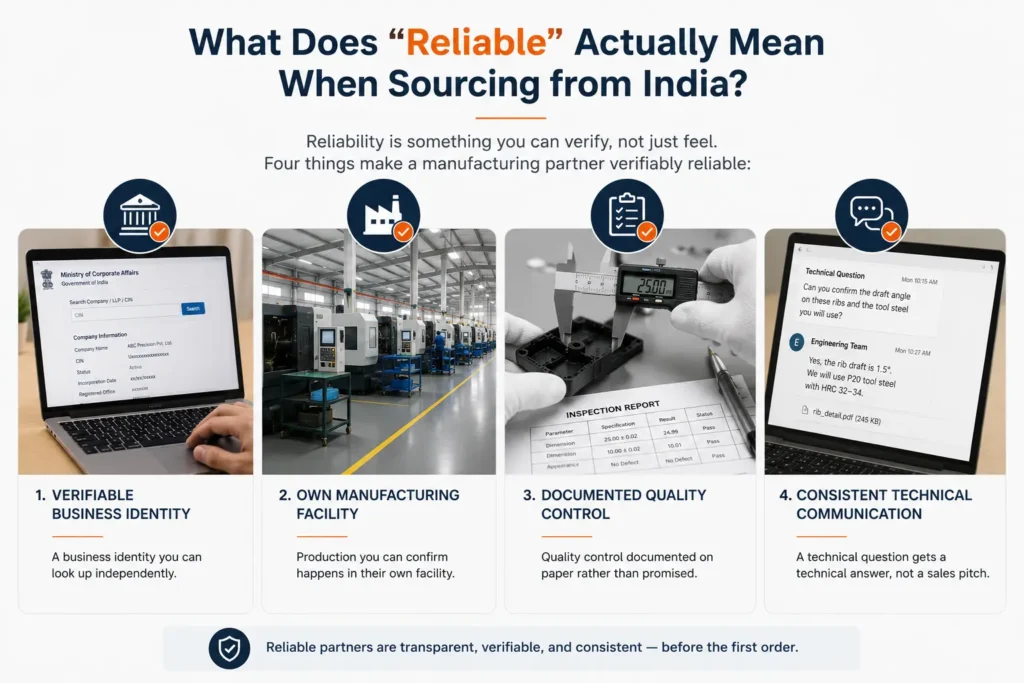
Reliability isn’t a feeling you get from a polished website or a fast first email reply — it’s something you can check against a public record before you ever send a drawing. Four things make a manufacturing partner verifiably reliable: a business identity you can look up independently, production you can confirm happens in their own facility, quality control documented on paper rather than promised on a call, and communication consistent enough that a technical question gets a technical answer, not a sales pitch.
The Four Pillars of a Verifiable Supplier
- Verifiable identity — government registration numbers that match the company name and address on their quote
- Production control — machines and processes you can confirm are inside their own building, not a subcontracted network
- Documented quality — inspection reports and material certificates offered by default, not produced only when you insist
- Consistent communication — a named engineer or account manager, not a rotating sales inbox
Why Global Buyers Are Increasingly Sourcing Manufacturing from India

Skilled fabrication and machining labour in India typically runs $10–$25 an hour against $30–$60 an hour in the US and Western Europe, and that gap holds even as Indian shops adopt the same fiber lasers, CNC machining centres, and injection moulding presses used everywhere else. Add an English-speaking engineering workforce and a growing base of ISO 9001 certified facilities, and India has become one of the primary destinations for companies running a “China plus one” strategy — diversifying production across more than one country rather than depending on a single source for every part.
Our blog on why global brands are moving manufacturing to India covers this shift in more depth.
The Manufacturing Partner Verification Checklist
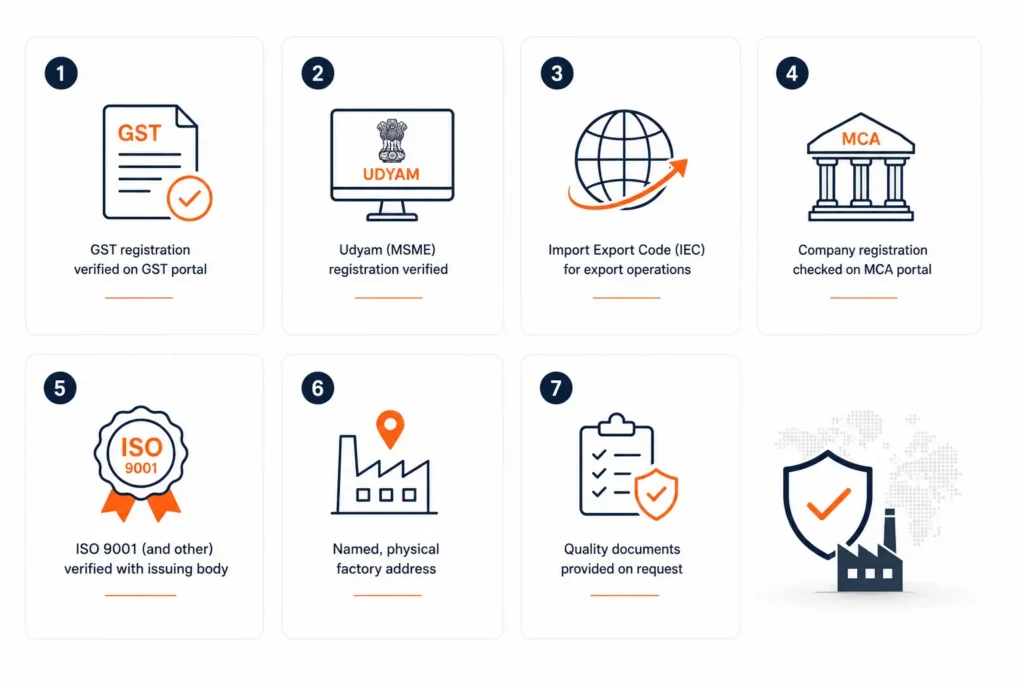
You do not need to visit India to verify most of this. Every item below can be checked from a document the supplier sends you or a government portal you look up yourself.
7 Checks You Can Run Before You Send a Drawing
- GST registration — ask for the supplier’s GST number and confirm it on the GST portal; an active registration that matches the company name on the quote is your first check.
- Udyam (MSME) registration — most legitimate small and mid-size Indian manufacturers hold an Udyam certificate, verifiable on the government’s Udyam Registration portal.
- Import Export Code (IEC) — a company shipping directly to you as an exporter should hold an IEC issued by the Directorate General of Foreign Trade.
- Company registration on the MCA portal — for a private limited company, the Ministry of Corporate Affairs’ MCA21 portal publicly shows incorporation date, registered address, and directors.
- ISO 9001 (and any sector certificate) — verify the certificate number with the issuing certification body directly, not just the PDF attached to the quote.
- A named, physical factory address — confirmed by a video facility tour if an in-person visit isn’t practical yet.
- Quality documentation on request — first article inspection reports, material test certificates, and certificates of conformance offered without being chased.
Company Structure and Reliability: In-House Manufacturer vs Broker vs Trading Company
Every supplier you shortlist runs one of three models, and the model decides how much of this checklist you can actually verify. An in-house manufacturer owns its machines, so its GST registration, factory address, and quality system all describe the same building your part is made in. A marketplace or broker platform quotes instantly, then routes your order to a network shop you never see — the documents you verify may belong to the platform, not the factory. A trading company owns no production and adds a margin for coordination, which means the certifications you’re shown may not even belong to the entity holding your PO.
See how Manufyn operates as a strictly in-house manufacturer for a working example of what that verification looks like when the model is right.
| Reliability Signal | In-House Manufacturer | Broker / Marketplace | Trading Company |
|---|---|---|---|
| Owns the production machinery | Yes | No | No |
| GST, Udyam, and factory address all match one building | Usually | Sometimes | Rarely |
| Accountable for a defect directly | Yes | Indirect | Indirect |
| Same facility runs your reorder | Yes | Not guaranteed | Not guaranteed |
| Can answer a DFM question from the shop floor | Yes | Rarely | Rarely |
Buyer takeaway: none of these three models is automatically dishonest, but only one of them can show you the exact machine your part will run on. Make the model itself a direct question in every RFQ.
Want a shortcut through this checklist? Ask Manufyn for our GST certificate, Udyam registration, ISO 9001 certificate, and MCA extract directly — we send the full verification package before you ever need to ask twice.
A Practical Due-Diligence Process Before You Place a Purchase Order
Verification works best as a sequence, not a one-time background check. Follow these five steps before your first purchase order, and repeat the first two whenever a supplier’s ownership or facility changes.
- Request GST, Udyam, IEC, and ISO 9001 certificate numbers before sending any drawing, and check each one independently.
- Sign a mutual NDA before any design file changes hands.
- Ask for a live video facility tour, or a third-party inspection report, if an in-person visit isn’t possible yet.
- Place a small trial order first, and inspect the parts against your drawing before committing to full volume.
- Get a named point of contact and a stated response-time commitment in writing, not just in a sales call.
Red Flags When Evaluating a Manufacturing Partner in India
- A price dramatically below every other quote with no engineering explanation
- No GST number, or a GST number that doesn’t match the company name on the quote
- Reluctance to share a factory address or allow any form of facility verification
- No willingness to sign an NDA before drawings are shared
- Vague or shifting answers about which processes are subcontracted
- Payment terms that only offer 100% advance with no milestone or inspection option
Buyer takeaway: every flag on this list is inexpensive to check before a PO and expensive to discover after one.
How Manufyn Meets This Reliability Standard
Manufyn is an ISO 9001 certified, strictly in-house on-demand manufacturer based in Baner, Pune, India — not a broker or trading company. Every verification point in this guide is one we expect buyers to check on us directly: our GST and company registration, our ISO 9001 certificate, and our own factory floor.
Read more about our background on our About Us page, and see documented proof of how we’ve delivered for clients across 30+ countries in our case studies.
Ready to verify a real in-house manufacturer instead of another reseller? Share your drawing with Manufyn’s engineers and see our documentation for yourself.
FAQs
Ask for their GST number, Udyam (MSME) registration, and ISO 9001 certificate number, then check each independently — GST on the GST portal, Udyam on the government’s Udyam Registration portal, and the ISO certificate with the issuing certification body. A legitimate manufacturer will have all three, and they will match the company name on your quote.
GST (Goods and Services Tax) registration is India’s mandatory tax registration for businesses above a turnover threshold. An active, matching GST number confirms the company is a real, tax-registered legal entity rather than an informal reseller — it’s one of the fastest independent checks you can run before sending a drawing.
Udyam is the Indian government’s registration for micro, small, and medium enterprises (MSMEs). Most legitimate small and mid-size Indian manufacturers hold one, and it’s verifiable on the official Udyam Registration portal. Its absence isn’t automatically disqualifying for a larger company, but for a small or mid-size shop, it’s a useful cross-check.
It’s safe once you’ve verified the company’s identity and signed a mutual NDA before any file changes hands. Working with a strictly in-house manufacturer also reduces risk, since your drawing never propagates through a subcontractor network the way it can on a broker or marketplace platform.
An in-house manufacturer owns and operates its own machines, so the certifications and facility you verify belong to the same building making your part. A trading company owns no production and adds a coordination margin — the certifications it shows you may describe a factory it doesn’t control and can’t guarantee for your reorder.
An in-person visit is ideal for large or long-term programs, but a live video facility tour is a reasonable substitute when travel isn’t practical. Either way, confirm the address you’re shown matches the address on the company’s GST and MCA registration.
For a private limited company, the Ministry of Corporate Affairs’ MCA21 portal publicly shows incorporation date, registered address, and director details for any registered company using its CIN or company name — it’s a free, independent check that takes a few minutes.
Milestone-based terms are standard for serious suppliers — commonly a deposit on order confirmation and a balance on inspection or dispatch, with adjustments for repeat customers. A supplier who will only accept 100% advance payment with no inspection option is a reasonable point to slow down and ask why.
Ask directly, in writing, which processes are performed in-house versus subcontracted, and request a facility tour or photos of the specific machines running your part. A supplier who owns their production can answer this without hesitation; vague or shifting answers are the clearest sign of undisclosed subcontracting.
ISO 9001 confirms a documented, audited quality management system exists, which is a meaningful baseline — but it doesn’t by itself confirm ownership of production, tight tolerances, or sector-specific approvals. Verify the certificate with the issuing body, and combine it with the other checks in this guide rather than relying on it alone.
Still have questions about vetting a manufacturing partner in India? Send us your specific concern — we respond within 4 working hours.
Ready to work with a manufacturer you can verify end to end? Manufyn is India’s ISO 9001 certified, strictly in-house on-demand manufacturer — GST and Udyam registered, serving the US, UK, Australia, UAE, and 30+ countries. Quote in 24 hours.