
Nylon 6 Injection Molding Services for Precision PA6 Plastic Components
Manufyn delivers custom Nylon 6 (PA6) injection molding solutions for OEMs, startups, and industrial manufacturers worldwide. From prototype tooling and low-volume production to high-volume manufacturing, we produce precision engineering plastic components with exceptional dimensional accuracy, material consistency, and global quality standards. Our certified manufacturing network across India enables cost-effective production supported by DFM, tooling expertise, quality inspection, and worldwide logistics.
100+
Qualified Manufacturing Partners
±0.02 mm
Precision Based on Part Geometry
30%
Glass Filled Nylon Grades Available
Global
Export Support for OEMs Worldwide
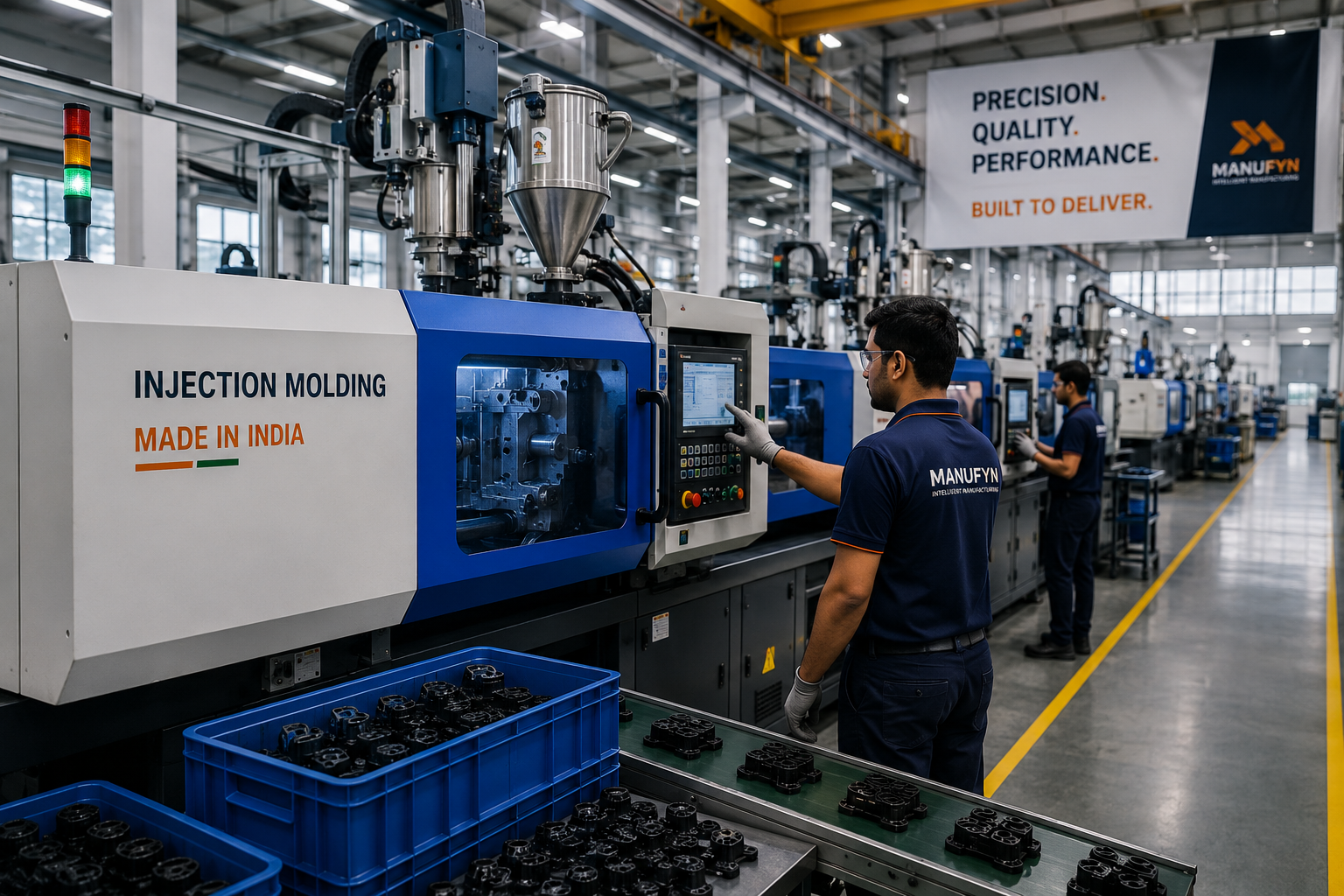
What is Nylon 6 (PA6) Injection Molding?
Nylon 6 Injection Molding is a manufacturing process used to produce high-strength engineering plastic components by injecting molten Polyamide 6 (PA6) into precision-machined molds under controlled temperature and pressure. Due to its excellent balance of mechanical strength, wear resistance, impact resistance, and chemical stability, Nylon 6 has become one of the most widely specified engineering thermoplastics for automotive, industrial machinery, electrical systems, robotics, medical devices, and consumer products. Whether manufacturing a few prototype parts or scaling to high-volume production, PA6 delivers reliable performance for applications that demand durability and dimensional accuracy.
Compared to commodity plastics, Nylon 6 offers significantly higher tensile strength, excellent fatigue resistance, and superior abrasion resistance, making it an ideal material for functional components subjected to repeated mechanical loading. Engineers frequently choose PA6 for gears, bushings, bearing cages, cable ties, electrical connectors, clips, brackets, housings, pulleys, and structural assemblies because it combines lightweight performance with excellent mechanical properties.
One of the biggest advantages of Nylon 6 is its versatility. The material can be reinforced with glass fibers for increased stiffness, modified with impact additives for enhanced toughness, heat stabilized for elevated operating temperatures, or flame-retardant for electrical applications. This flexibility enables manufacturers to tailor the material to meet specific product performance requirements while maintaining efficient and repeatable injection molding processes.
At Manufyn, we support customers throughout the complete product lifecycle—from Design for Manufacturing (DFM) reviews and mold development to prototype validation, production tooling, quality inspection, and global logistics. By leveraging our network of qualified manufacturing partners across India, we help OEMs and industrial buyers reduce procurement risk while achieving consistent quality and competitive production costs.
Why Engineers Prefer Nylon 6
- Excellent strength-to-weight ratio
- Outstanding wear and abrasion resistance
- High fatigue resistance for moving components
- Good chemical and oil resistance
- Available in glass-filled, heat-stabilized, UV-resistant, and flame-retardant grades
- Suitable for prototype, low-volume, and mass production
- Excellent machinability for secondary operations
- Ideal for automotive, industrial, electrical, and consumer products
High Mechanical Strength
PA6 provides excellent tensile and impact strength, making it suitable for load-bearing engineering components.
Wear Resistance
Its low friction characteristics and abrasion resistance make Nylon 6 ideal for gears, rollers, bearings, and sliding parts.
Design Flexibility
Complex geometries, integrated clips, ribs, bosses, and lightweight structures can be molded with excellent repeatability.
Cost-Effective Production
Injection molding enables economical manufacturing from prototype quantities to millions of production parts with consistent quality.
Material Properties of Nylon 6 (PA6)
Nylon 6 (Polyamide 6 or PA6) is one of the world’s most widely used engineering thermoplastics because it combines excellent mechanical strength, wear resistance, impact performance, and chemical resistance in a lightweight material. Compared with many commodity plastics, PA6 delivers significantly better structural performance while remaining highly suitable for precision injection molding, making it an excellent choice for demanding engineering applications across automotive, industrial equipment, electrical systems, consumer products, and robotics.
Mechanical Strength
High tensile strength, excellent toughness, and outstanding fatigue resistance make PA6 suitable for structural engineering components subjected to repeated loading.
Wear Resistance
Low friction characteristics and excellent abrasion resistance make Nylon 6 ideal for gears, bearings, bushings, pulleys, rollers, and sliding mechanisms.
Chemical Resistance
Resists oils, greases, fuels, hydraulic fluids, and many industrial chemicals, making it suitable for harsh operating environments.
Thermal Stability
Maintains excellent mechanical performance across a broad operating temperature range, especially when heat-stabilized grades are used.
| Property | Typical Performance | Engineering Benefit |
|---|---|---|
| Density | Approximately 1.13 g/cm³ | Lightweight replacement for metal components |
| Tensile Strength | High | Excellent structural integrity |
| Impact Resistance | Good | Suitable for dynamic applications |
| Abrasion Resistance | Excellent | Long service life in moving assemblies |
| Wear Resistance | Excellent | Ideal for gears and bearing surfaces |
| Chemical Resistance | Very Good | Suitable for industrial environments |
| Electrical Insulation | Good | Widely used in electrical connectors and housings |
| Processing Method | Injection Molding | Excellent repeatability for high-volume production |
Advantages of Nylon 6 Injection Molding
Nylon 6 is one of the most versatile engineering thermoplastics available for injection molding. Its excellent combination of strength, toughness, wear resistance, and processability enables manufacturers to replace heavier metal components while reducing production costs and maintaining outstanding mechanical performance. These advantages make PA6 the preferred material for numerous precision-engineered applications.
Excellent Strength-to-Weight Ratio
Nylon 6 provides exceptional mechanical strength while remaining significantly lighter than aluminum or steel. This makes it ideal for lightweight automotive, robotics, industrial automation, and consumer product applications where weight reduction improves efficiency without compromising durability.
Outstanding Wear & Fatigue Resistance
Repeated mechanical movement gradually wears many plastics. Nylon 6 exhibits excellent abrasion resistance and fatigue life, making it suitable for gears, bearings, bushings, rollers, pulleys, and moving assemblies operating over extended service periods.
Excellent Design Flexibility
Complex geometries including ribs, clips, snap-fits, thin walls, bosses, and intricate internal features can be manufactured consistently through precision injection molding, reducing assembly operations and overall manufacturing costs.
Suitable for High-Volume Production
After tooling is completed, Nylon 6 injection molding enables highly repeatable production with short cycle times, minimal material waste, excellent dimensional consistency, and competitive piece-part pricing for medium and high-volume manufacturing.
Wide Range of Material Grades
Manufacturers can select from unfilled, glass-filled, mineral-filled, heat-stabilized, UV-resistant, flame-retardant, impact-modified, and lubricated PA6 grades to achieve specific mechanical, thermal, and electrical performance requirements.
Global Manufacturing & Supply Chain Support
With Manufyn’s qualified manufacturing network across India, customers benefit from Design for Manufacturing (DFM), precision tooling, quality inspection, production management, export documentation, and reliable global logistics under a single sourcing partner.
Why Global OEMs Choose Manufyn
From prototype development to serial production, Manufyn combines engineering expertise, qualified manufacturing partners, rigorous quality control, and international supply chain management to deliver precision Nylon 6 injection molded components for customers across automotive, electrical, industrial equipment, medical devices, robotics, and consumer products.
Popular Nylon 6 (PA6) Material Grades
Nylon 6 is available in multiple engineered formulations to meet specific performance requirements. Selecting the appropriate grade is essential for achieving the desired strength, dimensional stability, thermal performance, wear resistance, and long-term durability. At Manufyn, we help customers identify the most suitable PA6 material based on product function, operating environment, manufacturing requirements, and cost objectives.
Unfilled Nylon 6
Standard PA6 offers an excellent balance of toughness, impact resistance, and flexibility for general engineering applications.
- Excellent toughness
- Good impact strength
- Lightweight engineering plastic
- Cost-effective solution
Glass Filled Nylon 6
Glass fibre reinforcement significantly increases stiffness, strength, dimensional stability, and heat resistance, making it suitable for demanding structural applications.
- 15%, 30% & 35% glass-filled grades
- Higher rigidity
- Improved dimensional stability
- Automotive structural components
Heat Stabilized Nylon 6
Designed for continuous operation at elevated temperatures while maintaining mechanical performance over long service life.
- Improved thermal ageing
- Suitable for engine compartments
- Longer product life
- Industrial equipment
Flame Retardant Nylon 6
Used in electrical and electronic applications where enhanced fire performance and regulatory compliance are required.
- Electrical connectors
- Switchgear components
- Consumer electronics
- Safety applications
Impact Modified Nylon 6
Special impact modifiers increase toughness under sudden loading while maintaining excellent mechanical properties.
- Higher impact strength
- Better low-temperature performance
- Protective housings
- Industrial equipment
Lubricated & Mineral Filled Grades
Engineered for applications requiring lower friction, improved wear resistance, or enhanced dimensional stability.
- Lower coefficient of friction
- Improved wear life
- Precision moving components
- Industrial automation
Need Help Selecting the Right Nylon 6 Grade?
Choosing the correct PA6 grade during the design stage can significantly improve product performance, reduce manufacturing costs, and extend service life. Manufyn’s engineering team supports material selection, Design for Manufacturing (DFM), mold design reviews, and production planning to help OEMs achieve reliable, cost-effective injection molded components.
Applications of Nylon 6 Injection Molded Components
Nylon 6 is one of the most versatile engineering thermoplastics available today. Its outstanding combination of strength, wear resistance, lightweight construction, fatigue resistance, and excellent processability makes it the preferred choice for thousands of engineering applications. From automotive assemblies to industrial automation equipment, PA6 injection molded components provide reliable long-term performance in demanding environments while helping manufacturers reduce weight, improve efficiency, and lower production costs.
Automotive Components
Nylon 6 is widely used throughout modern vehicles because of its excellent mechanical properties and lightweight characteristics.
- Engine compartment components
- Air intake systems
- Cable clips & fasteners
- Electrical connectors
- Sensor housings
- Cooling system parts
Industrial Machinery
Excellent wear resistance and low friction make PA6 ideal for moving mechanical assemblies operating under continuous loads.
- Gears
- Bushings
- Bearings
- Pulleys
- Rollers
- Guide components
Electrical & Electronics
Engineering-grade Nylon 6 offers excellent insulation and dimensional stability for electrical products.
- Switchgear components
- Terminal blocks
- Circuit breaker housings
- Connector bodies
- Cable management systems
- Electrical enclosures
Robotics & Automation
Lightweight yet durable PA6 components improve robot performance while reducing inertia and maintenance requirements.
- Robot joints
- End-of-arm tooling
- Cable guides
- Protective covers
- Automation fixtures
- Sensor brackets
Consumer Products
Nylon 6 delivers excellent aesthetics, durability, and impact performance for everyday products.
- Power tool housings
- Sporting equipment
- Furniture hardware
- Appliance components
- Garden equipment
- Hand tools
Medical & Laboratory Equipment
Special engineering grades are used where dimensional accuracy, strength, and long service life are essential.
- Diagnostic equipment
- Instrument handles
- Equipment housings
- Fluid handling components
- Laboratory fixtures
- Mechanical supports
Nylon 6 Injection Molding Design Guidelines
A successful Nylon 6 injection molded component begins with good product design. Even the highest quality tooling cannot compensate for poor wall thickness distribution, incorrect draft angles, inadequate rib design, or improper gate location. Designing with manufacturing in mind reduces tooling costs, improves mold filling, minimizes defects, shortens cycle time, and increases long-term product reliability. At Manufyn, our Design for Manufacturing (DFM) reviews help engineers optimize components before tooling begins, reducing development risks while improving production efficiency.
Maintain Uniform Wall Thickness
Consistent wall thickness is one of the most important design principles in Nylon 6 injection molding. Uniform sections promote even material flow, predictable cooling, and lower internal stresses, reducing the likelihood of sink marks, voids, warpage, and dimensional variation.
- Keep wall thickness as uniform as possible.
- Avoid sudden transitions between thick and thin sections.
- Use gradual tapers when thickness changes are necessary.
- Reduce heavy sections by adding ribs instead of increasing wall thickness.
Provide Adequate Draft Angles
Draft angles allow molded parts to release smoothly from the mold, reducing ejection forces and preventing scratches or cosmetic damage. Draft also extends tool life and improves production consistency.
- Include draft on all vertical walls.
- Increase draft for textured surfaces.
- Deep features generally require additional draft.
- Review draft during mold flow analysis.
Need a DFM Review Before Tooling?
Our engineering team reviews wall thickness, draft angles, gate location, cooling strategy, mold complexity, and manufacturability before production tooling begins. This helps reduce tooling modifications, shorten development cycles, and improve first-time production success.
Optimize Rib Design
Ribs improve stiffness and structural integrity without significantly increasing wall thickness. Proper rib design minimizes sink marks while providing additional support for load-bearing components. Well-designed ribs also help reduce material consumption and shorten molding cycle times.
- Use ribs instead of increasing wall thickness.
- Maintain uniform rib spacing throughout the part.
- Blend ribs smoothly into adjacent walls.
- Avoid excessive rib thickness to reduce cosmetic defects.
Design Strong Bosses
Bosses provide locations for screws, inserts, and fasteners. Properly designed bosses improve assembly strength while reducing stress concentrations that may lead to cracking during installation or service.
- Support tall bosses using reinforcing ribs.
- Maintain adequate clearance from external walls.
- Avoid excessively thick boss walls.
- Use generous fillets at the base.
Use Generous Corner Radii
Sharp internal corners create stress concentrations and interrupt material flow. Rounded corners improve mold filling, increase part strength, reduce residual stress, and extend fatigue life for engineering components.
- Avoid sharp inside corners.
- Maintain consistent radii where possible.
- Improve resin flow through smooth transitions.
- Reduce the risk of crack initiation.
Select Proper Gate Location
Gate placement directly affects material flow, weld line formation, dimensional stability, packing pressure, and cosmetic appearance. Early gate optimization significantly improves production consistency.
- Fill thick sections before thin sections.
- Minimize visible gate marks.
- Reduce weld lines in highly stressed areas.
- Balance cavity filling for multi-cavity tools.
Account for Material Shrinkage
Nylon 6 experiences dimensional change as it cools after molding. Shrinkage depends on part geometry, processing conditions, and the selected material grade. Glass-filled grades generally provide better dimensional stability than unfilled materials.
- Consider shrinkage during CAD design.
- Validate critical dimensions through sampling.
- Use mold flow simulation where appropriate.
- Review tolerance requirements before tooling.
Minimize Undercuts
Undercuts increase tooling complexity by requiring sliders, lifters, or collapsible cores. Eliminating unnecessary undercuts reduces mold cost, simplifies maintenance, and improves production reliability.
- Simplify part geometry whenever possible.
- Use side actions only when functionally required.
- Reduce tooling complexity.
- Improve cycle time and mold reliability.
Engineering Best Practices for Nylon 6 Injection Molding
Successful Nylon 6 injection molded products are developed through collaboration between product designers, tooling engineers, material specialists, and manufacturing experts. A Design for Manufacturing (DFM) review performed early in product development can significantly reduce tooling revisions, shorten development time, improve dimensional consistency, and lower total manufacturing costs.
DFM Checklist
- Uniform wall thickness
- Proper draft angles
- Optimized gate location
- Adequate venting
- Balanced rib design
- Optimized cooling layout
- Appropriate material grade selection
- Tool maintenance planning
Why Manufyn?
Manufyn provides comprehensive engineering support before production begins. Our Design for Manufacturing reviews evaluate part geometry, tooling feasibility, material selection, cooling strategy, cycle time optimization, quality risks, and production scalability to ensure that your Nylon 6 components are manufactured efficiently with consistent quality.
Schedule a DFM ConsultationProcessing Parameters for Nylon 6 Injection Molding
Consistent part quality depends not only on mold design and material selection but also on maintaining appropriate processing conditions throughout the injection molding cycle. Nylon 6 is a hygroscopic engineering thermoplastic, meaning it readily absorbs moisture from the surrounding environment. Proper material drying, stable melt temperature, optimized mold temperature, controlled injection pressure, and effective cooling are all essential to producing dimensionally accurate, high-performance components with excellent surface finish and mechanical properties.
Material Drying
Moisture control is one of the most critical requirements when processing Nylon 6. Excess moisture may cause hydrolytic degradation during molding, reducing mechanical properties and producing cosmetic defects such as silver streaks, splay marks, and poor surface finish.
- Dry material before processing.
- Store resin in moisture-controlled conditions.
- Avoid prolonged exposure to ambient humidity.
- Verify moisture levels before production.
Melt Temperature
Maintaining a stable melt temperature promotes proper material flow, complete cavity filling, and consistent mechanical performance. The optimum temperature depends on the selected PA6 grade, reinforcement level, and component geometry.
- Follow resin supplier recommendations.
- Maintain uniform barrel temperature profile.
- Avoid excessive residence time.
- Prevent material degradation caused by overheating.
Mold Temperature
Proper mold temperature improves crystallization, dimensional stability, surface finish, and mechanical properties while reducing internal stresses and warpage.
- Maintain consistent mold temperature.
- Use balanced cooling channels.
- Monitor cavity temperature throughout production.
- Optimize cycle time without compromising quality.
Injection Pressure & Packing
Appropriate injection and packing pressures ensure complete mold filling, compensate for material shrinkage, and minimize sink marks or void formation in thicker sections.
- Optimize injection speed.
- Balance holding pressure.
- Prevent flash formation.
- Maintain dimensional consistency.
| Processing Parameter | Purpose | Impact on Part Quality |
|---|---|---|
| Material Drying | Remove absorbed moisture before molding. | Improves strength, appearance, and consistency. |
| Melt Temperature | Ensure complete material flow. | Reduces short shots and improves weld line strength. |
| Mold Temperature | Control cooling and crystallization. | Improves dimensional stability and surface finish. |
| Injection Pressure | Fill the cavity efficiently. | Prevents incomplete filling and voids. |
| Packing Pressure | Compensate for material shrinkage. | Minimizes sink marks and improves density. |
| Cooling Time | Allow proper solidification before ejection. | Reduces warpage and dimensional variation. |
Cooling & Cycle Time Optimization
Cooling is one of the longest phases of the injection molding cycle and has a significant influence on productivity, dimensional accuracy, and overall manufacturing cost. A properly designed cooling system promotes uniform heat removal, reduces residual stresses, minimizes warpage, and shortens production cycle time without compromising part quality.
- Design balanced cooling channels throughout the mold.
- Maintain consistent mold surface temperatures.
- Optimize cooling time based on wall thickness.
- Avoid excessive cooling that reduces productivity.
- Monitor mold temperature during production.
Moisture Management
Since Nylon 6 readily absorbs moisture from the surrounding environment, proper storage and handling are essential before processing. Poor moisture control can reduce mechanical strength, create cosmetic defects, and increase scrap rates.
- Store resin in sealed moisture-proof containers.
- Limit exposure to humid shop-floor conditions.
- Use hopper dryers during production.
- Implement moisture testing before molding.
- Follow material supplier recommendations.
Process Monitoring & Quality Control
Stable processing conditions ensure repeatable production quality. Modern injection molding machines continuously monitor process parameters to reduce variation and improve production consistency across every manufacturing batch.
- Monitor cavity pressure during molding.
- Track melt and mold temperatures.
- Verify injection and holding pressures.
- Record cycle time for every production run.
- Maintain documented process validation records.
Machine & Tool Maintenance
Preventive maintenance of injection molding machines and tooling helps maintain dimensional consistency, reduces unexpected downtime, and extends mold life during long production programs.
- Inspect gates, runners and vents regularly.
- Clean cooling channels periodically.
- Calibrate processing equipment.
- Maintain hydraulic and electrical systems.
- Document preventive maintenance schedules.
Common Processing Challenges & Recommended Solutions
Even with high-quality tooling and premium engineering-grade materials, injection molding defects can occur if processing conditions are not properly controlled. Understanding common challenges enables manufacturers to improve product quality, reduce scrap, and maintain consistent production efficiency.
| Processing Challenge | Possible Cause | Recommended Solution |
|---|---|---|
| Silver Streaks | Moisture contamination | Improve resin drying and storage practices. |
| Short Shot | Insufficient filling pressure or poor gate design | Optimize injection parameters and review mold design. |
| Warping | Uneven cooling or inconsistent wall thickness | Improve cooling system design and optimize part geometry. |
| Sink Marks | Thick sections with inadequate packing | Improve packing pressure and redesign heavy sections. |
| Flash | Excessive injection pressure or worn tooling | Adjust processing conditions and inspect mold condition. |
| Burn Marks | Trapped air or excessive injection speed | Improve venting and optimize filling profile. |
| Voids | Poor packing or thick wall sections | Optimize holding pressure and redesign heavy features. |
| Dimensional Variation | Process instability | Standardize processing parameters and implement Statistical Process Control (SPC). |
Engineering Excellence with Manufyn
At Manufyn, our engineering team works closely with customers to establish validated molding parameters before production begins. Through Design for Manufacturing (DFM), Mold Flow Analysis, Production Planning, PPAP documentation, First Article Inspection (FAI), and comprehensive quality control, we help manufacturers achieve consistent Nylon 6 component quality while reducing production risk and total manufacturing cost.
Common Nylon 6 Injection Molding Defects and Their Prevention
Even with advanced injection molding equipment and high-quality Nylon 6 materials, defects may occur if tooling, material handling, or processing parameters are not properly controlled. Understanding the root causes of these issues enables manufacturers to improve product quality, reduce scrap, lower production costs, and achieve consistent manufacturing performance. At Manufyn, every production program is supported by Design for Manufacturing (DFM), process validation, and comprehensive quality inspections to minimize production risks.
Silver Streaks (Splay)
Silver streaks appear as shiny lines or streaks on the molded surface and are commonly caused by excessive moisture in Nylon 6 before processing.
Main Causes- Improper material drying
- High moisture content
- Material degradation
- Excessive melt temperature
- Dry resin correctly before molding
- Store material in sealed containers
- Monitor dryer performance
- Optimize barrel temperature profile
Warping
Warping occurs when different areas of the part shrink unevenly during cooling, resulting in distortion and dimensional inaccuracies.
Main Causes- Uneven wall thickness
- Poor cooling system design
- Uneven mold temperature
- Incorrect gate location
- Maintain uniform wall sections
- Balance cooling channels
- Optimize mold design
- Perform Mold Flow Analysis
Sink Marks
Localized depressions usually develop over thick sections where internal material shrinkage is not adequately compensated during the packing phase.
Main Causes- Excessive wall thickness
- Insufficient packing pressure
- Inadequate holding time
- Replace thick sections with ribs
- Increase holding pressure where appropriate
- Improve gate location
- Optimize cooling time
Short Shot
A short shot occurs when the mold cavity is not completely filled, producing incomplete components that cannot meet functional or dimensional requirements.
Main Causes- Low injection pressure
- Restricted material flow
- Poor gate design
- Insufficient venting
- Increase injection pressure
- Review gate dimensions
- Improve venting
- Optimize melt temperature
Flash Formation
Flash appears as thin excess material along the parting line or around inserts when molten resin escapes from the mold cavity.
Main Causes- High injection pressure
- Worn mold surfaces
- Improper clamping force
- Inspect tooling condition
- Optimize processing parameters
- Maintain mold regularly
- Verify machine clamping capacity
Burn Marks & Voids
Burn marks result from trapped gases, while internal voids are usually caused by inadequate packing of thick sections during cooling.
Main Causes- Poor venting
- Excessive injection speed
- Thick wall sections
- Insufficient packing pressure
- Improve mold venting
- Optimize filling profile
- Review part geometry
- Adjust holding pressure and cooling
Preventing Defects Starts Before Tool Manufacturing
Most molding defects originate during the product design or tooling development stage rather than during production itself. A comprehensive Design for Manufacturing (DFM) review evaluates wall thickness, draft angles, gate locations, runner balance, cooling layout, venting, shrinkage, and material selection before tooling is manufactured. At Manufyn, our engineering team collaborates with customers throughout product development to minimize manufacturing risks, improve part quality, and achieve repeatable production performance from prototype tooling through full-scale production.
Quality Inspection for Nylon 6 Injection Molded Parts
Delivering precision Nylon 6 components requires more than advanced tooling and optimized molding parameters. A comprehensive quality management system ensures that every molded component consistently meets dimensional, mechanical, cosmetic, and functional requirements. At Manufyn, quality is integrated throughout the manufacturing process—from raw material verification and first article inspection to in-process controls, final inspection, documentation, and export packaging. This systematic approach helps OEMs reduce quality risks, improve product reliability, and maintain confidence in every production batch.
Incoming Material Inspection
Every production lot begins with verification of the supplied Nylon 6 grade, material certification, batch identification, and visual condition to ensure the correct resin is used before manufacturing starts.
First Article Inspection (FAI)
Initial production samples are evaluated against approved drawings to verify critical dimensions, fit, appearance, and functional requirements before serial production begins.
In-Process Quality Control
Regular inspections during production help detect process variation early, allowing corrective actions before defects affect large production quantities.
Dimensional Inspection
Critical dimensions are verified using calibrated inspection equipment such as digital calipers, height gauges, coordinate measuring machines (CMM), gauges, and custom inspection fixtures.
Visual & Cosmetic Inspection
Each production batch is evaluated for flash, sink marks, burn marks, weld lines, colour consistency, gate quality, and other cosmetic requirements before shipment.
Final Inspection & Packaging
Finished components undergo final verification, traceability review, quantity confirmation, protective packaging, and shipment documentation before dispatch to customers worldwide.
| Inspection Stage | Inspection Activities | Primary Objective |
|---|---|---|
| Incoming Inspection | Material verification, resin certification, batch identification | Ensure correct material before production |
| First Article Inspection | Dimensional verification and functional validation | Approve production readiness |
| In-Process Inspection | Critical dimensions, process monitoring, SPC | Maintain production consistency |
| Final Inspection | Visual, dimensional and quantity verification | Confirm shipment quality |
| Documentation | Inspection reports, PPAP, FAI, CoC, traceability records | Support customer compliance requirements |
Nylon 6 vs Nylon 66 Injection Molding
Nylon 6 (PA6) and Nylon 66 (PA66) are among the most widely used engineering thermoplastics for injection molding. Although both belong to the polyamide family and share many characteristics, their mechanical performance, moisture absorption, dimensional stability, thermal resistance, and processing behavior differ. Selecting the appropriate material depends on the operating environment, mechanical loading, manufacturing requirements, and overall product cost.
Nylon 6 (PA6)
Nylon 6 offers an excellent balance of strength, toughness, processability, and cost, making it one of the most versatile engineering plastics available for injection molding.
- Excellent impact resistance
- Outstanding surface finish
- Superior mold filling capability
- Lower tooling complexity
- Excellent wear resistance
- Good chemical resistance
- Ideal for complex molded geometries
- Cost-effective engineering solution
Nylon 66 (PA66)
Nylon 66 generally provides higher stiffness, improved heat resistance, and greater tensile strength, making it suitable for demanding structural and under-the-hood automotive applications.
- Higher heat resistance
- Greater rigidity
- Improved dimensional stability
- Higher tensile strength
- Excellent fatigue performance
- Suitable for elevated temperatures
- Preferred for heavy-duty applications
- Higher material cost
Which Material Should You Choose?
For most engineering applications requiring excellent toughness, wear resistance, good appearance, and economical manufacturing, Nylon 6 is an outstanding choice. When components must withstand continuous high temperatures, increased mechanical loads, or demanding automotive under-hood environments, Nylon 66 may provide additional performance advantages. At Manufyn, our engineering team evaluates your application’s operating conditions, mechanical requirements, production volumes, tooling considerations, and cost targets before recommending the most suitable engineering plastic.
Detailed Comparison: Nylon 6 vs Nylon 66
Although Nylon 6 and Nylon 66 share many similarities, subtle differences in their molecular structure result in distinct mechanical, thermal, and processing characteristics. Understanding these differences helps engineers select the most suitable material for performance, durability, manufacturability, and cost objectives.
| Property | Nylon 6 (PA6) | Nylon 66 (PA66) |
|---|---|---|
| Tensile Strength | High | Very High |
| Impact Resistance | Excellent | Very Good |
| Heat Resistance | Good | Excellent |
| Continuous Service Temperature | Suitable for many engineering applications | Better suited for higher operating temperatures |
| Wear Resistance | Excellent | Excellent |
| Chemical Resistance | Very Good | Very Good |
| Moisture Absorption | Higher | Moderate |
| Surface Finish | Excellent | Very Good |
| Injection Molding Flow | Excellent flow for complex geometries | Slightly lower flow than PA6 |
| Shrinkage Control | Good | Very Good |
| Machinability | Excellent | Very Good |
| Relative Material Cost | Generally Lower | Generally Higher |
| Typical Industries | Industrial Equipment, Robotics, Consumer Products, Electrical Components | Automotive, Aerospace, Heavy Engineering, Electrical Connectors |
| Best Choice | Cost-effective engineering components with excellent toughness | High-temperature, high-load structural applications |
Choose Nylon 6 When
- Your application requires excellent impact resistance.
- Complex part geometry demands superior material flow.
- High-quality cosmetic surface finish is important.
- You need a balance between performance and cost.
- Wear resistance is a primary design requirement.
- Large production volumes require efficient processing.
- Rapid tooling validation and production are priorities.
- Procurement cost optimization is a key objective.
Choose Nylon 66 When
- Higher operating temperatures are expected.
- Structural stiffness is more important than impact toughness.
- Automotive under-the-hood environments are involved.
- Continuous mechanical loading is anticipated.
- Enhanced dimensional stability is required.
- Premium material performance justifies higher cost.
- Long-term thermal aging resistance is critical.
- Components operate in demanding industrial environments.
Need Help Selecting the Right Polyamide Material?
Choosing between Nylon 6 and Nylon 66 involves evaluating operating temperatures, mechanical loads, dimensional tolerances, production volumes, tooling complexity, and overall project cost. Manufyn’s engineering team works closely with OEMs and product developers to recommend the most appropriate engineering polymer for each application. We also provide Design for Manufacturing (DFM), material selection support, tooling development, prototype manufacturing, and full-scale production to help reduce risk and accelerate product launch.
Industries Using Nylon 6 Injection Molded Components
Nylon 6 is one of the most versatile engineering thermoplastics available today. Its combination of mechanical strength, wear resistance, dimensional stability, lightweight construction, and cost-effectiveness makes it suitable for applications across numerous industries. At Manufyn, we support OEMs, Tier suppliers, and product developers with custom Nylon 6 injection molded components ranging from prototypes to high-volume production.
Automotive
Nylon 6 is widely used in passenger vehicles, commercial vehicles, and electric vehicles where lightweight, durable, and wear-resistant components improve overall performance.
- Engine compartment components
- Sensor housings
- Cable clips and retainers
- Cooling system parts
- Interior mounting brackets
- Air intake components
Industrial Equipment
Industrial machinery benefits from Nylon 6 due to its excellent abrasion resistance, low friction, and long service life under demanding operating conditions.
- Machine guards
- Rollers
- Guide rails
- Wear pads
- Bushings
- Mechanical housings
Electrical & Electronics
Electrical applications often require materials offering insulation performance together with dimensional stability and reliable molding characteristics.
- Terminal housings
- Switch components
- Connector bodies
- Electrical enclosures
- Cable management products
- Control panel accessories
Robotics & Automation
The combination of low weight, high strength, and excellent wear resistance makes Nylon 6 an ideal engineering plastic for robotic systems, automated production lines, and precision motion equipment.
- Robot arm covers
- Sensor mounting brackets
- Linear guide components
- Automation fixtures
- Wear strips
- Conveyor components
Medical & Laboratory Equipment
Selected grades of Nylon 6 are used in laboratory and medical equipment where dimensional stability, precision, and reliable performance are required. Material selection depends on regulatory and application-specific requirements.
- Instrument housings
- Laboratory fixtures
- Equipment handles
- Fluid management components
- Protective covers
- Mechanical supports
Consumer Products
Nylon 6 provides excellent durability, surface finish, and impact resistance for consumer products requiring long service life and consistent appearance.
- Power tool housings
- Sports equipment components
- Appliance parts
- Furniture hardware
- Outdoor equipment
- Protective accessories
Aerospace & Defense
Lightweight engineering polymers help reduce overall system weight while maintaining strength and durability. Nylon 6 is used in suitable non-flight-critical applications based on design and qualification requirements.
- Equipment brackets
- Cable routing components
- Protective covers
- Maintenance fixtures
- Interior hardware
- Support components
Agriculture Equipment
Agricultural machinery operates in abrasive and demanding environments. Nylon 6 offers excellent wear resistance and mechanical strength for long-term field performance.
- Seeder components
- Bushings
- Rollers
- Chain guides
- Protective guards
- Wear pads
Renewable Energy
Renewable energy equipment requires durable engineering plastics capable of operating in challenging environmental conditions while supporting lightweight designs.
- Solar mounting accessories
- Cable management systems
- Electrical housings
- Wind turbine auxiliary components
- Inspection covers
- Support brackets
Recommended Nylon 6 Grades by Industry
Different industries require specific Nylon 6 grades depending on mechanical performance, thermal requirements, chemical exposure, and regulatory expectations. Selecting the appropriate grade during product development improves reliability, manufacturing efficiency, and long-term product performance.
| Industry | Recommended Grade | Typical Applications |
|---|---|---|
| Automotive | Glass Filled Nylon 6 | Structural brackets, housings, clips, under-hood components |
| Industrial Machinery | Unfilled or Lubricated Nylon 6 | Bushings, guides, rollers, wear components |
| Electrical & Electronics | Flame Retardant Nylon 6 | Connectors, switchgear, electrical enclosures |
| Medical Equipment | Application-specific engineering grades | Instrument housings, laboratory equipment, mechanical supports |
| Robotics & Automation | Glass Filled Nylon 6 | Robot fixtures, sensor mounts, conveyor parts |
| Consumer Products | Standard Nylon 6 | Power tools, appliance parts, hardware |
Partner with Manufyn for Custom Nylon 6 Components
Whether you require prototype quantities or high-volume production, Manufyn supports every stage of your manufacturing journey—from material selection and Design for Manufacturing (DFM) to tooling, injection molding, quality inspection, and global supply chain management. Our network of qualified manufacturing partners enables us to deliver precision Nylon 6 components for demanding industrial applications with consistent quality and reliable lead times.
Frequently Asked Questions About Nylon 6 Injection Molding
Below are answers to some of the most common questions engineers, procurement professionals, and product developers ask about Nylon 6 injection molding. If your project has unique technical requirements, the Manufyn engineering team can help you select the right material, tooling strategy, and manufacturing process.
1. What is Nylon 6 injection molding?
2. What are the advantages of Nylon 6?
3. Is Nylon 6 stronger than ABS?
4. Does Nylon 6 absorb moisture?
5. Can Nylon 6 be reinforced with glass fiber?
6. Which industries commonly use Nylon 6?
7. What is the difference between Nylon 6 and Nylon 66?
8. What operating temperatures can Nylon 6 withstand?
9. What dimensional tolerances can be achieved with Nylon 6 injection molding?
10. Can Nylon 6 parts be CNC machined after molding?
11. Can Nylon 6 components be ultrasonically welded?
12. Is Nylon 6 recyclable?
13. What surface finishes are available for Nylon 6 molded parts?
14. How long does injection mold tooling typically take?
15. Can Manufyn support both prototype and production quantities?
16. What quality documentation can Manufyn provide?
17. How do I request a quotation for a Nylon 6 injection molding project?
Ready to Start Your Nylon 6 Injection Molding Project?
Whether you’re developing a new product, transferring an existing mold, or scaling to high-volume production, Manufyn provides end-to-end support. Our services include Design for Manufacturing (DFM), material selection, mold development, prototype production, serial manufacturing, quality inspection, supplier management, and international logistics. We work with qualified manufacturing partners across India to deliver precision-engineered Nylon 6 components with reliable quality, competitive pricing, and dependable lead times.
Why Global OEMs Choose Manufyn
Manufyn is more than an injection molding supplier. We act as your manufacturing and procurement partner, helping companies source precision-engineered components from qualified Indian manufacturers. From supplier selection and Design for Manufacturing (DFM) through tooling, production, quality assurance, and international logistics, we simplify the complete manufacturing process while reducing supply chain risk.
Qualified Manufacturing Partners
Our supplier network includes carefully evaluated manufacturers with capabilities in precision injection molding, tool manufacturing, insert molding, overmolding, CNC machining, and secondary assembly processes.
Engineering Support
Our engineering team assists with Design for Manufacturing (DFM), material selection, tolerance reviews, mold optimization, and cost reduction opportunities before production begins.
Prototype to Production
Whether you require prototype tooling, bridge tooling, or high-volume production molds, we support every stage of your product development journey.
Quality Assurance
Every project is supported with structured quality planning, dimensional inspection, First Article Inspection (FAI), PPAP support, traceability, and production monitoring to deliver consistent quality.
Global Supply Chain Support
From procurement and production planning to export documentation and international logistics, Manufyn helps customers streamline global sourcing from India.
Single Point of Contact
Customers benefit from dedicated project management throughout development, production, quality control, shipment coordination, and post-delivery support.
From RFQ to Global Delivery
At Manufyn, we simplify manufacturing by providing engineering support, supplier management, quality assurance, and logistics under one roof. Whether you’re launching a new product or transferring an existing production program, our structured process helps reduce risk while ensuring consistent quality and dependable lead times.
1
RFQ Review
2
Engineering & DFM
3
Material Selection
4
Tool Manufacturing
5
Production & Inspection
6
Packaging & Export
What You Can Expect from Manufyn
- Qualified manufacturing partners across India
- Injection molding tooling development
- Rapid prototype and bridge tooling
- High-volume production support
- Glass Filled Nylon 6 expertise
- Insert molding and overmolding
- Ultrasonic welding and secondary assembly
- Design for Manufacturing (DFM)
- PPAP and APQP documentation support
- First Article Inspection (FAI)
- CMM dimensional inspection
- Supplier qualification and audits
- Global logistics coordination
- Dedicated project management
Ready to Manufacture Your Nylon 6 Components?
Whether you need prototype parts, production tooling, or high-volume Nylon 6 injection molding, Manufyn provides engineering support, supplier management, quality assurance, and international procurement services to help bring your product to market with confidence.
Typical RFQ response within 1 business day • Prototype & Production Support • Global Shipping
Related Manufacturing Resources
Explore More Injection Molding Resources
Continue exploring engineering resources from Manufyn to help you select materials, optimize part designs, improve manufacturability, and simplify global procurement. These resources are designed for product designers, purchasing teams, and manufacturing engineers looking for practical guidance.
Glass Filled Nylon 6
Learn how glass reinforcement improves stiffness, dimensional stability, heat resistance, and structural performance for demanding industrial and automotive applications.
Read More →Insert Molding Guide
Discover how metal inserts are integrated into molded plastic components to improve strength, reduce assembly time, and enhance product reliability.
Read More →Rapid Prototyping
Understand the different rapid tooling and prototype manufacturing options available before committing to full production tooling.
Read More →Injection Mold Tool Design
Explore tooling concepts including gate design, cooling channels, ejector systems, runners, vents, and Design for Manufacturing (DFM).
Read More →Quality Inspection Services
See how PPAP, APQP, First Article Inspection (FAI), dimensional verification, and supplier quality management reduce manufacturing risk.
Read More →Contract Manufacturing in India
Learn how international OEMs leverage India’s manufacturing ecosystem for precision engineering, cost optimization, and supply chain diversification.
Read More →Nylon 6 Injection Molding Design Checklist
Successful injection molded components begin with thoughtful product design. Following Design for Manufacturing (DFM) principles early in the development process helps reduce tooling costs, improve production efficiency, minimize defects, and shorten time to market. The checklist below highlights important engineering considerations for Nylon 6 components.
Geometry & Part Design
- Maintain uniform wall thickness wherever practical.
- Include appropriate draft angles for smooth ejection.
- Use generous radii to reduce stress concentration.
- Avoid abrupt wall thickness transitions.
- Replace thick sections with reinforcing ribs where possible.
- Design bosses with adequate support ribs.
- Consider gate location during product design.
- Minimize undercuts to reduce tooling complexity.
Manufacturing & Quality
- Select the correct Nylon 6 grade for the application.
- Review moisture sensitivity during material handling.
- Validate tooling with Mold Flow Analysis where appropriate.
- Plan critical dimensions for inspection.
- Define cosmetic acceptance criteria before tooling.
- Specify packaging requirements for export shipments.
- Identify documentation requirements (FAI, PPAP, CoC).
- Perform Design for Manufacturing (DFM) before tool release.