
Supplier Scorecards for Smarter Procurement & Better Supplier Performance
Build a resilient and high performing supply chain with data driven Supplier Scorecards. Evaluate supplier quality, on time delivery, procurement KPIs, cost competitiveness, supplier audits, vendor evaluation, engineering support, responsiveness, and continuous improvement using real time performance dashboards. Manufyn helps global manufacturers improve procurement decisions through supplier audits, RFQ management, project management, quality inspection, and strategic sourcing from India.
Procurement KPIs
Measure supplier performance using procurement metrics and KPI dashboards.
Supplier Audits
Evaluate supplier capability through process, quality and manufacturing audits.
Quality Inspection
Incoming, in process and final inspection services to ensure product quality.
RFQ Management
Compare supplier quotations, negotiate pricing and manage RFQs efficiently.
Project Management
Track supplier progress from prototype to production with dedicated project managers.
Injection Molding
Source precision plastic injection molded components from qualified Indian manufacturers.
Precision CNC Machining
High precision CNC machined parts with stringent quality control and inspection.
Strategic Sourcing
Reduce costs and build resilient global supply chains through strategic sourcing.
What is a Supplier Scorecard?
A Supplier Scorecard is one of the most effective procurement tools used by manufacturers to evaluate supplier performance using measurable Key Performance Indicators (KPIs). Instead of relying on assumptions, businesses use data-driven supplier scorecards to monitor quality, delivery, cost, responsiveness, engineering capability, and continuous improvement.
A modern Supplier Scorecard enables procurement teams to compare suppliers objectively by assigning measurable scores across predefined performance metrics. These scorecards help purchasing managers identify high-performing suppliers, minimize supply chain risks, improve supplier relationships, and make informed sourcing decisions based on real performance data rather than opinions.
For manufacturers sourcing components such as Injection Molded Parts, Precision CNC Machined Components, Sheet Metal Fabrication, Castings, Forgings, and custom-engineered products, supplier scorecards play a critical role in maintaining quality, reducing lead times, and improving overall procurement efficiency.
At Manufyn, supplier scorecards are integrated with our Supplier Audit Services, Quality Inspection Services, Procurement KPI Tracking, RFQ Management Services, and Project Management Services. This holistic approach allows our customers to continuously evaluate supplier performance throughout the complete product lifecycle—from supplier selection and prototype development to serial production and after-sales support.
Whether you are sourcing from India for automotive, aerospace, medical devices, industrial equipment, renewable energy, or consumer products, implementing a structured supplier scorecard system helps improve supplier accountability, increase delivery reliability, reduce quality issues, and build a stronger, more resilient global supply chain.
Typical Supplier Scorecard Metrics
- ✔ Supplier Quality Performance
- ✔ On Time Delivery (OTD)
- ✔ Parts Per Million (PPM)
- ✔ Cost Competitiveness
- ✔ RFQ Response Time
- ✔ Corrective Action Closure
- ✔ Engineering Support
- ✔ Supplier Audit Score
- ✔ Documentation Accuracy
- ✔ Overall Supplier Rating
Why Supplier Scorecards Matter in Modern Procurement
Successful procurement is no longer based only on selecting the lowest-cost supplier. Leading manufacturers continuously measure supplier performance using structured supplier scorecards to improve quality, delivery, supplier relationships, and overall supply chain performance.
Improve Supplier Performance
Supplier scorecards provide measurable insights into quality, delivery, responsiveness, and engineering capability. Continuous monitoring encourages suppliers to improve performance while supporting long-term supplier development initiatives.
Reduce Quality Issues
By integrating scorecards with Quality Inspection Services and Supplier Audits, manufacturers can identify recurring quality problems before they impact production.
Improve Delivery Performance
Track On Time Delivery (OTD), production lead time, shipment accuracy, and supplier responsiveness to reduce delays and improve customer satisfaction.
Lower Procurement Costs
Data-driven supplier evaluation helps procurement teams identify cost-saving opportunities, negotiate better pricing, and reduce the total cost of ownership without compromising quality.
Support Better Procurement Decisions
Supplier scorecards complement Procurement KPIs, RFQ Management, and supplier selection processes by providing objective performance data.
Build a Resilient Supply Chain
A structured supplier evaluation system helps organizations diversify suppliers, reduce risks, improve business continuity, and strengthen global sourcing strategies.
Key Supplier Scorecard KPIs Every Manufacturer Should Track
A successful Supplier Scorecard measures supplier performance using objective Key Performance Indicators (KPIs). These metrics help procurement teams identify top-performing suppliers, reduce operational risks, improve quality, optimize costs, and strengthen long-term supplier relationships.
On Time Delivery
Monitor supplier delivery performance to ensure production schedules remain uninterrupted.
Quality Performance
Track rejection rates, PPM, customer complaints, and product conformity.
Cost Competitiveness
Measure pricing consistency, productivity improvements, and cost reduction initiatives.
Supplier Responsiveness
Evaluate engineering support, communication, quotation turnaround, and issue resolution.
An effective Supplier Scorecard Dashboard combines procurement, quality, manufacturing, and engineering metrics into a single performance management system. Instead of evaluating suppliers solely on price, leading manufacturers monitor delivery reliability, process capability, responsiveness, quality performance, corrective action closure, supplier audits, and continuous improvement initiatives.
At Manufyn, supplier scorecards are integrated with our Procurement KPI Services, Supplier Audit Services, Quality Inspection Services, Project Management Services, and RFQ Management Services. This integrated approach enables procurement teams to identify high-performing suppliers while proactively addressing potential supply chain risks.
Supplier scorecards are especially valuable for manufacturers sourcing Injection Molded Components, Precision CNC Machined Parts, Sheet Metal Components, Castings, Forgings, rubber parts, plastic components, and custom-engineered assemblies from India.
12 Essential Supplier Scorecard Metrics Every Procurement Team Should Measure
An effective Supplier Scorecard evaluates suppliers using measurable KPIs instead of assumptions. Monitoring these metrics helps procurement professionals improve supplier quality, delivery performance, manufacturing efficiency, and overall supply chain resilience.
1. On Time Delivery (OTD)
On Time Delivery measures how consistently a supplier delivers products according to the committed schedule. Late deliveries can disrupt production, increase inventory costs, delay customer shipments, and impact overall business performance. Procurement teams should continuously monitor OTD trends and combine this KPI with Project Management Services to improve production planning and supplier accountability.
2. Quality Performance (PPM & Rejection Rate)
Quality is one of the most critical supplier evaluation criteria. Measure Parts Per Million (PPM), rejection rates, customer complaints, and defect trends to identify suppliers requiring corrective actions. Combining supplier scorecards with Quality Inspection Services and Supplier Audits helps reduce manufacturing defects and improve product reliability.
3. Cost Competitiveness
Cost should never be evaluated independently. Compare pricing with productivity improvements, tooling efficiency, manufacturing capability, logistics costs, and total cost of ownership. Effective RFQ Management ensures suppliers remain competitive while maintaining quality standards.
4. Lead Time Performance
Monitoring manufacturing lead times enables procurement teams to identify bottlenecks and improve planning. Stable lead times are particularly important for custom products such as Injection Molded Components, Precision CNC Machining, castings, forgings, and fabricated assemblies.
5. Supplier Responsiveness
Evaluate how quickly suppliers respond to RFQs, engineering changes, technical queries, corrective actions, and urgent production requirements. Fast communication significantly improves project execution and customer satisfaction.
6. Engineering & Technical Support
A strategic supplier should provide engineering support, DFM recommendations, tooling improvements, material selection assistance, and cost optimization ideas. Engineering collaboration often results in better manufacturability and lower lifecycle costs.
7. Corrective Action Closure
Monitor how effectively suppliers investigate root causes and implement corrective actions after quality issues. Faster CAPA closure demonstrates a mature quality management system and commitment to continuous improvement.
8. Supplier Audit Score
Supplier audit results provide valuable insight into manufacturing capability, process controls, quality systems, production capacity, and risk management. Integrating audit scores into Supplier Scorecards creates a more objective supplier evaluation process.
9. Documentation Accuracy
Evaluate the accuracy of inspection reports, PPAP documentation, certificates of conformity, material test certificates, and shipping documentation. Proper documentation reduces delays, non-conformities, and compliance risks.
10. Continuous Improvement
Measure supplier initiatives related to productivity improvements, waste reduction, automation, process optimization, cost savings, and Lean Manufacturing practices. Continuous improvement is a strong indicator of a long-term strategic supplier.
11. Manufacturing Capacity & Scalability
Evaluate whether suppliers can increase production capacity during demand fluctuations without compromising quality or delivery. Capacity planning is especially important for high-volume manufacturing and global sourcing programs.
12. Overall Supplier Rating
Combine all KPIs into a weighted Supplier Scorecard to classify suppliers as Preferred, Approved, Conditional, or Development Required. At Manufyn, supplier ratings support strategic sourcing, supplier development, procurement decision-making, and long-term supply chain optimization.
How Manufyn Develops Data Driven Supplier Scorecards
At Manufyn, supplier scorecards are not standalone spreadsheets. They are part of an end-to-end procurement and supplier performance management framework that continuously evaluates suppliers throughout the complete manufacturing lifecycle. Our structured methodology combines supplier qualification, procurement KPIs, quality inspection, supplier audits, RFQ management, engineering collaboration, and project management to deliver measurable procurement results.
Supplier Identification & Qualification
We identify manufacturing partners based on technical capability, production capacity, certifications, export experience, industry expertise, and financial stability. Every supplier undergoes a structured qualification process before becoming part of our approved supplier network.
Supplier Audits
Our engineering team performs comprehensive Supplier Audits to evaluate manufacturing processes, quality systems, machine capability, inspection infrastructure, process controls, and continuous improvement culture before production begins.
RFQ Evaluation & Cost Analysis
Using our RFQ Management Services, we compare supplier quotations, manufacturing methods, tooling costs, lead times, and total landed cost to identify the best procurement solution instead of simply selecting the lowest quotation.
Quality Planning
Production planning includes inspection planning, control plans, process validation, PPAP documentation, first article inspection, and quality checkpoints to ensure consistent manufacturing performance.
Project Management
Dedicated Project Managers monitor tooling development, production schedules, engineering changes, delivery milestones, supplier communication, and customer requirements throughout the project lifecycle.
Quality Inspection & Supplier Performance Monitoring
Our Quality Inspection Services continuously monitor incoming quality, in-process inspection, final inspection, PPM trends, corrective actions, and supplier performance KPIs that feed directly into Supplier Scorecards.
Monthly KPI Reviews
Supplier performance is reviewed using measurable KPIs such as On Time Delivery, Quality Performance, Cost Competitiveness, Engineering Support, Audit Scores, Responsiveness, Lead Time, and Continuous Improvement initiatives.
Supplier Development
Rather than replacing suppliers after every issue, we work collaboratively to improve manufacturing capability, optimize production processes, reduce quality defects, lower costs, shorten lead times, and build long-term strategic partnerships that strengthen our customers’ global supply chains.
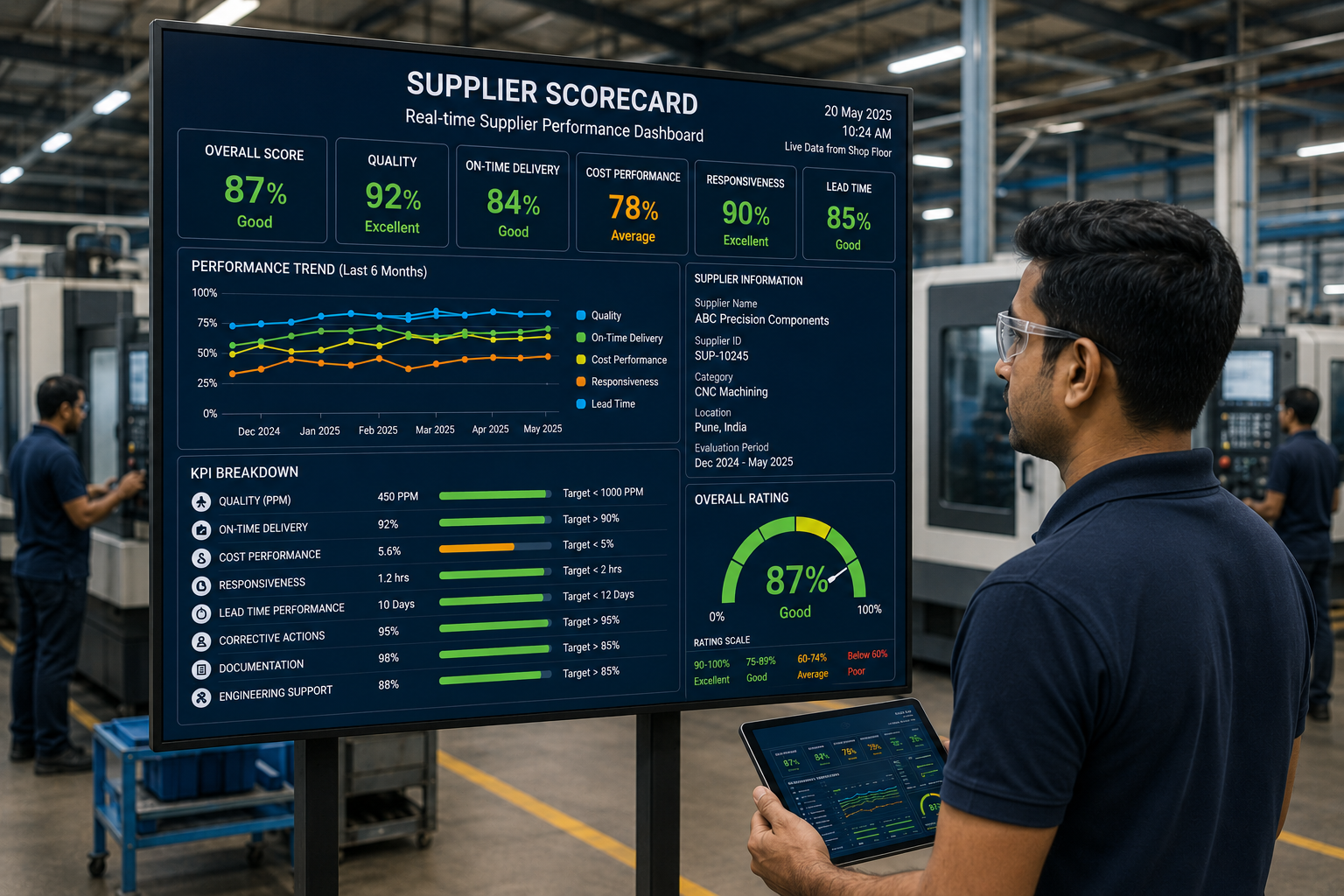
Example of a Supplier Scorecard Dashboard
A Supplier Scorecard Dashboard transforms procurement data into meaningful business insights. Procurement managers can monitor supplier performance, compare multiple vendors, identify risks early, and continuously improve quality, delivery, and cost performance across the supply chain.
| KPI | Weight | Target | Actual | Performance |
|---|---|---|---|---|
| On Time Delivery | 20% | 98% | 99.1% | Excellent |
| Quality (PPM) | 20% | <500 | 180 | Excellent |
| Cost Competitiveness | 15% | Target Cost | Achieved | Excellent |
| Lead Time | 10% | 4 Weeks | 3.8 Weeks | Excellent |
| Supplier Audit Score | 15% | 90% | 94% | Excellent |
| Engineering Support | 10% | Excellent | Very Good | Good |
| Corrective Action Closure | 5% | 7 Days | 5 Days | Excellent |
| Documentation Accuracy | 5% | 100% | 100% | Excellent |
95.6%
Overall Supplier Performance
A+
Supplier Rating
Low
Supply Chain Risk
Preferred
Supplier Classification
At Manufyn, Supplier Scorecards are integrated with Procurement KPIs, Supplier Audits, Quality Inspection Services, RFQ Management, and Project Management Services. This enables procurement teams to make informed sourcing decisions for Injection Molding, Precision CNC Machining, castings, forgings, sheet metal fabrication, plastic components, rubber parts, and custom-engineered assemblies manufactured in India.
Why Global Manufacturers Choose Manufyn
Choosing the right procurement partner is just as important as choosing the right supplier. At Manufyn, we go beyond supplier sourcing by continuously measuring supplier performance, reducing supply chain risks, and ensuring every supplier consistently meets quality, delivery, cost, and engineering expectations.
Verified Manufacturing Partners
Our supplier network consists of carefully evaluated manufacturers specializing in Injection Molding, Precision CNC Machining, Castings, Forgings, Sheet Metal Fabrication, Rubber Components, Plastic Components, Tooling and Engineering Assemblies.
Supplier Audits & Qualification
Every supplier undergoes structured Supplier Audits, technical capability assessments, manufacturing evaluations, quality system reviews, and process verification before becoming part of our approved supplier network.
Data Driven Procurement
Supplier performance is measured through Procurement KPIs, Supplier Scorecards, manufacturing KPIs, delivery trends, quality metrics, engineering responsiveness, and continuous improvement initiatives.
Quality Assurance
Our Quality Inspection Services include incoming inspection, in-process inspection, final inspection, dimensional verification, PPAP support, and corrective action monitoring.
Complete Project Management
Dedicated Project Managers coordinate supplier communication, tooling development, production planning, engineering changes, logistics, and customer reporting throughout the manufacturing lifecycle.
Global Procurement Support
We support customers across Automotive, Aerospace, Medical Devices, Industrial Equipment, Renewable Energy, Consumer Products, Robotics, and Electrical Industries by simplifying procurement from India.
Frequently Asked Questions About Supplier Scorecards
Learn how Supplier Scorecards improve procurement performance, supplier quality, delivery reliability, and supply chain resilience through measurable supplier performance metrics.
What is a Supplier Scorecard?
Why are Supplier Scorecards important?
What KPIs should be included in a Supplier Scorecard?
How often should Supplier Scorecards be updated?
How do Supplier Audits differ from Supplier Scorecards?
Can Supplier Scorecards reduce procurement costs?
Which industries benefit from Supplier Scorecards?
How does Manufyn help improve supplier performance?
Build a Stronger Supply Chain with Data Driven Supplier Scorecards
Whether you are sourcing Injection Molded Components, Precision CNC Machined Parts, Castings, Forgings, Sheet Metal Fabrication, Rubber Components, Plastic Parts, or complete engineering assemblies from India, Manufyn helps you evaluate, monitor, and continuously improve supplier performance through Supplier Scorecards, Supplier Audits, Procurement KPIs, Quality Inspection, RFQ Management, and dedicated Project Management.
Supplier Audits
Evaluate supplier capability, quality systems, manufacturing processes, and production readiness.
Learn More →Procurement KPIs
Track supplier performance using measurable procurement metrics and KPI dashboards.
Explore KPIs →Quality Inspection
Incoming, in process, and final inspection services for reliable manufacturing quality.
Inspection Services →RFQ Management
Compare supplier quotations, optimize sourcing costs, and accelerate procurement decisions.
View Service →