
Polycarbonate Injection Molding
Manufacture high impact, transparent and heat resistant polycarbonate components with Manufyn’s global injection molding network. From rapid prototyping to production volumes, we deliver precision molded parts with strict quality control and worldwide shipping.
Get Instant Quote Explore Injection Molding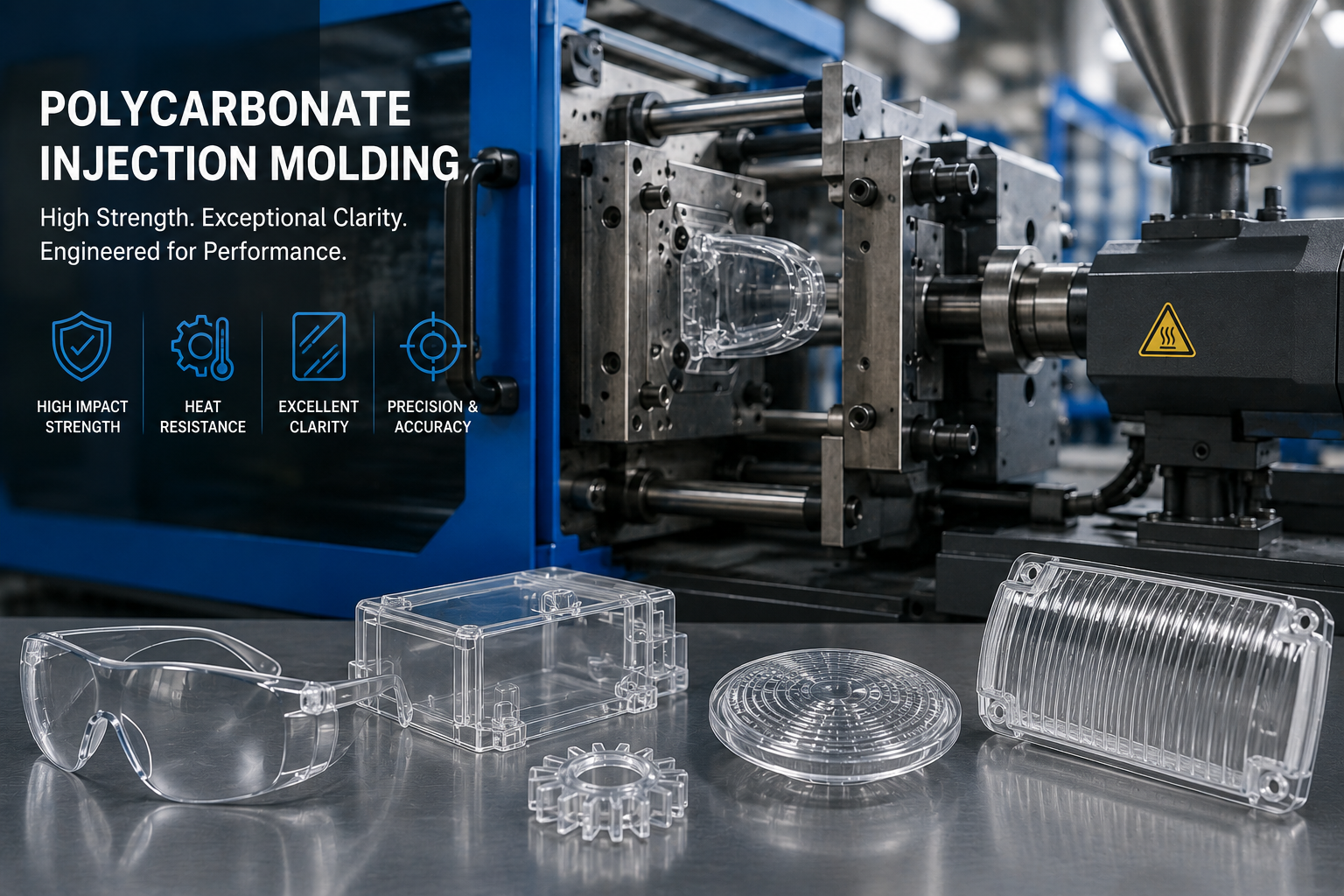
250+
Qualified Manufacturing Partners
±0.05mm
Typical Production Tolerance
Low to High
Production Volumes
Global
Delivery Across North America & Europe
What is Polycarbonate Injection Molding?
Polycarbonate Injection Molding is a precision manufacturing process used to produce durable, transparent and high impact plastic components. Molten polycarbonate (PC) resin is injected into a precision engineered mold under high pressure, cooled, and ejected to create complex parts with excellent dimensional accuracy and repeatability.
Polycarbonate is one of the most widely used engineering thermoplastics because of its exceptional impact strength, optical clarity, heat resistance and dimensional stability. It is commonly selected for products that must withstand demanding mechanical loads while maintaining a premium appearance. Manufacturers rely on polycarbonate for automotive lighting, medical devices, electrical enclosures, industrial equipment and consumer products. Proper drying of PC resin before molding is critical because it readily absorbs moisture, which can affect part quality. :contentReference[oaicite:0]{index=0}
At Manufyn, our engineering team supports customers from Design for Manufacturability (DFM) through tooling development, rapid prototyping, pilot production and full scale manufacturing. We help optimize wall thickness, gate locations, draft angles and material selection to improve part quality while reducing manufacturing cost. :contentReference[oaicite:1]{index=1}
Many customers combine Prototype Injection Molding with our Rapid Prototyping, CNC machining and production tooling services to accelerate product development and reduce time to market. Whether you require a few prototypes or high volume production, our global manufacturing network provides scalable solutions backed by quality assurance. :contentReference[oaicite:2]{index=2}
Why Engineers Choose Polycarbonate
- Exceptional impact resistance up to 250 times stronger than glass of similar thickness.
- Excellent optical clarity for transparent products.
- High dimensional stability for precision assemblies.
- Heat resistance suitable for demanding industrial applications.
- Excellent electrical insulation properties.
- Can be molded into highly complex geometries.
- Compatible with textured, polished and optical grade finishes.
- Suitable for both prototype and production quantities.
• Injection Molding Services
• CNC Machining
• Rapid Prototyping
• Tooling Design
• Design for Manufacturability (DFM)
• Manufacturing Services
Advantages of Polycarbonate Injection Molding
Polycarbonate is one of the most versatile engineering plastics available today. Its outstanding combination of strength, transparency and heat resistance makes it a preferred material across automotive, medical, industrial and electronics industries.
Outstanding Impact Resistance
Polycarbonate can withstand extreme impacts without cracking, making it ideal for machine guards, automotive components, protective covers, industrial equipment and safety applications where durability is critical.
Excellent Optical Clarity
Unlike many engineering plastics, polycarbonate offers exceptional transparency while maintaining high mechanical strength. It is widely used for transparent housings, lenses, light covers and medical equipment.
High Heat Resistance
Polycarbonate maintains its mechanical properties even at elevated temperatures, making it suitable for electrical components, automotive lighting and industrial products exposed to heat.
Excellent Electrical Insulation
The material provides reliable electrical insulation and dimensional stability, making it a preferred choice for electrical enclosures, connectors and switchgear manufactured using precision Injection Molding Services.
Complex Part Manufacturing
Polycarbonate can be molded into intricate geometries with ribs, bosses, snap fits and thin walls. Combined with Manufyn’s Design for Manufacturability (DFM), complex products can be produced efficiently while minimizing manufacturing defects.
Prototype to Production
Whether you need rapid prototypes or large production batches, Manufyn supports the complete manufacturing journey through Prototype Injection Molding, production tooling, quality inspection and worldwide delivery.
Polycarbonate Material Properties
Polycarbonate (PC) combines exceptional toughness, optical clarity and dimensional stability. These properties make it one of the most widely used engineering plastics for injection molding across automotive, electronics, medical, aerospace and industrial applications.
| Property | Typical Value | Benefit |
|---|---|---|
| Density | 1.20 g/cm³ | Lightweight engineering plastic |
| Tensile Strength | 60–70 MPa | Excellent structural performance |
| Impact Strength | Very High | Ideal for safety and protective parts |
| Continuous Service Temperature | Up to 115°C | Suitable for elevated temperature applications |
| Heat Deflection Temperature | 125–135°C | Maintains shape under load |
| Optical Clarity | Excellent | Perfect for transparent products |
| Electrical Insulation | Excellent | Used in electrical and electronic devices |
| Moisture Absorption | Moderate | Requires proper resin drying before molding |
| Dimensional Stability | Excellent | High precision molded components |
| Recyclability | Recyclable | Supports sustainable manufacturing |
Superior Mechanical Performance
Polycarbonate offers one of the highest impact strengths among transparent thermoplastics. Its excellent toughness makes it ideal for machine guards, protective shields, industrial housings and automotive lighting components manufactured using Injection Molding Services.
Designed for Precision Manufacturing
With excellent dimensional stability and low shrinkage, polycarbonate produces highly accurate components. Combined with Manufyn’s Design for Manufacturability (DFM) and CNC Machining Services, customers achieve superior product quality and repeatability.
Ideal for Product Development
Many companies begin with Prototype Injection Molding before transitioning into production tooling. Our engineering team helps optimize mold design, gate placement, wall thickness and cooling to reduce cycle time and manufacturing cost.
Polycarbonate Injection Molding Design Guidelines
Proper component design improves mold filling, reduces internal stresses, minimizes sink marks and warpage, and extends mold life. Following proven design practices helps achieve consistent part quality and lower manufacturing costs.
Uniform Wall Thickness
Maintain consistent wall thickness throughout the component whenever possible. Uniform walls promote balanced cooling, reduce shrinkage variations and minimize internal stresses. Sudden thickness changes can lead to sink marks and warpage.
Draft Angles
Provide draft angles of approximately 1° to 2° per side for smooth ejection. Textured surfaces or deep cavities may require additional draft to prevent scratching and reduce mold wear.
Ribs and Bosses
Ribs improve structural stiffness without increasing wall thickness. Bosses should be properly reinforced to prevent sink marks while maintaining excellent dimensional accuracy.
Corner Radii
Avoid sharp internal corners. Generous radii reduce stress concentrations, improve material flow and increase fatigue resistance in high-performance polycarbonate components.
Gate Location
Proper gate placement ensures balanced filling, minimizes weld lines and improves cosmetic appearance. Gate design should be optimized based on part geometry and functional requirements.
Ventilation
Well-designed vents allow trapped air to escape during injection, preventing burn marks, short shots and incomplete filling while improving overall part quality.
| Design Parameter | Recommended Value |
|---|---|
| Typical Wall Thickness | 1.0 – 4.0 mm |
| Draft Angle | 1° – 2° minimum |
| Corner Radius | ≥ 0.5 × Wall Thickness |
| Rib Thickness | 50 – 60% of Wall Thickness |
| Boss Wall Thickness | 60% of Nominal Wall |
| Shrinkage | 0.5 – 0.7% |
| Recommended Drying Temperature | 120°C |
| Typical Drying Time | 3–4 Hours |
Engineering Support from Manufyn
Every successful injection molded component begins with a well-engineered design. Manufyn works closely with OEMs, startups and product development teams to optimize component geometry before tooling begins. Our engineers perform Design for Manufacturability (DFM) reviews to identify opportunities for cost reduction, improved moldability and enhanced product performance.
For projects requiring functional prototypes, we also offer Rapid Prototyping with CNC Machining, followed by Prototype Injection Molding and production tooling. Depending on your application, our team can also recommend materials such as ABS, PEEK or ULTEM, ensuring the right balance of strength, temperature resistance and cost.
Learn more about our CNC Machining Services, Injection Molding Services, Case Studies and Contact Us page to discuss your next manufacturing project.
Polycarbonate Injection Molding Process
Producing high-quality polycarbonate components requires more than simply injecting molten plastic into a mold. Proper material preparation, optimized processing parameters and robust tooling are essential for achieving transparent, dimensionally accurate and defect-free parts.
Material Drying
Polycarbonate is hygroscopic, meaning it absorbs moisture from the surrounding environment. Before molding, the resin is dried under controlled conditions to prevent defects such as splay marks, bubbles and reduced mechanical strength. Proper material preparation is critical for high-quality production.
Mold Preparation
A precision mold is installed, cleaned and brought to the required operating temperature. Cooling channels, venting and gate design play a significant role in ensuring consistent filling and minimizing cycle times. Learn more about our Design for Manufacturability (DFM) services.
Injection
The dried polycarbonate pellets are heated until molten and injected into the mold cavity under controlled pressure and speed. Proper processing parameters ensure complete cavity filling while reducing internal stress and cosmetic defects.
Packing and Cooling
Additional pressure is applied during the packing phase to compensate for material shrinkage. The component is then cooled uniformly to maintain dimensional stability and prevent warpage.
Part Ejection
Once the part reaches the required temperature, ejector pins remove the molded component from the cavity. Proper draft angles and polished mold surfaces help prevent scratches, especially on transparent polycarbonate parts.
Inspection and Secondary Operations
Every component undergoes dimensional and visual inspection before packaging. Depending on the application, additional processes such as CNC machining, ultrasonic welding, pad printing, laser marking or assembly may be required. Explore our CNC Machining Services and manufacturing capabilities for complete production solutions.
End-to-End Manufacturing Support
Manufyn supports customers throughout the complete product development lifecycle, from concept and design validation to prototype tooling, production tooling and full-scale manufacturing. Our expertise extends beyond injection molding to include Rapid Prototyping with CNC Machining, 3-Axis and 5-Axis CNC Machining, sheet metal fabrication, casting, forging and quality inspection.
If you are evaluating different engineering plastics, you may also find our guides on ABS Injection Molding and PEEK vs ULTEM helpful when selecting the right material for your application.
Need assistance with your next project? Visit our Contact Us page or request a quote to discuss your manufacturing requirements with our engineering team.
Applications of Polycarbonate Injection Molding
Polycarbonate is trusted across multiple industries because of its exceptional impact resistance, optical clarity, dimensional stability and heat resistance. Whether you require prototype components or high-volume production, Manufyn delivers precision molded polycarbonate parts backed by engineering support and global manufacturing capabilities.
Automotive Industry
Polycarbonate is widely used in modern vehicles where lightweight, durability and transparency are essential.
- Headlamp lenses
- Interior trim components
- Instrument cluster covers
- Lighting systems
- Sensor housings
- Electric vehicle components
Medical Devices
Medical-grade polycarbonate offers excellent strength, transparency and dimensional stability, making it suitable for demanding healthcare applications.
- Diagnostic equipment
- Medical housings
- Surgical device components
- Fluid handling systems
- Laboratory equipment
- Transparent covers
Electrical & Electronics
Excellent electrical insulation combined with heat resistance makes polycarbonate a preferred engineering plastic for electrical products.
- Electrical enclosures
- Circuit breaker housings
- Switchgear components
- Connectors
- Consumer electronics
- LED lighting covers
Industrial Equipment
Industrial machinery requires durable plastic components capable of withstanding repeated mechanical loading.
- Machine guards
- Protective covers
- Inspection windows
- Control panel housings
- Automation equipment
- Robotic components
Aerospace & Defense
The combination of lightweight construction and high impact strength makes polycarbonate suitable for selected aerospace and defense applications.
- Cabin interior parts
- Protective shields
- Equipment covers
- Display windows
- Instrument housings
- Transparent panels
Consumer Products
Polycarbonate enables durable, attractive and long-lasting consumer products with excellent appearance and mechanical performance.
- Appliance housings
- Power tool covers
- Sporting goods
- Safety helmets
- Reusable bottles
- Smart home products
Complete Manufacturing Solutions from Manufyn
Many products combine Injection Molding with additional manufacturing processes to achieve the final design. Depending on your application, Manufyn can provide CNC Machining, precision assembly, ultrasonic welding, finishing, inspection and packaging through a single manufacturing partner.
If you are still evaluating materials, explore our technical guides on ABS Injection Molding, PEEK vs ULTEM, Rapid Prototyping with CNC Machining and 3-Axis vs 5-Axis CNC Machining to determine the best manufacturing process for your project.
Looking for a reliable manufacturing partner? Visit our Case Studies, learn about our engineering capabilities or Contact Us to discuss your next product development project.
Polycarbonate vs Other Engineering Plastics
Selecting the right engineering plastic depends on your application’s mechanical, thermal and optical requirements. Polycarbonate is known for its outstanding impact strength and transparency, but other materials may offer advantages for specific environments.
| Property | Polycarbonate (PC) | ABS | PEEK | ULTEM (PEI) |
|---|---|---|---|---|
| Impact Strength | ★★★★★ | ★★★★☆ | ★★★★☆ | ★★★★☆ |
| Optical Clarity | ★★★★★ | ★★☆☆☆ | ★☆☆☆☆ | ★★★☆☆ |
| Heat Resistance | ★★★★☆ | ★★★☆☆ | ★★★★★ | ★★★★★ |
| Chemical Resistance | ★★★☆☆ | ★★★☆☆ | ★★★★★ | ★★★★☆ |
| Electrical Insulation | ★★★★★ | ★★★★☆ | ★★★★★ | ★★★★★ |
| Cost | Moderate | Low | Very High | High |
| Typical Applications | Transparent Parts | Consumer Products | Aerospace | Medical & Electronics |
Polycarbonate vs ABS
ABS is economical and easy to mold, making it a popular choice for consumer products and general-purpose applications. Polycarbonate provides significantly higher impact resistance, better heat resistance and excellent optical clarity, making it ideal for transparent and structural components.
Read our detailed guide on ABS Injection Molding .
Polycarbonate vs PEEK
PEEK delivers exceptional chemical resistance and continuous high-temperature performance but comes at a much higher material cost. Polycarbonate is often the preferred option when transparency, toughness and cost efficiency are the primary requirements.
Compare engineering plastics in our PEEK vs ULTEM Guide .
Polycarbonate vs ULTEM
ULTEM offers superior flame resistance and higher operating temperatures, making it suitable for aerospace, medical and electrical applications. Polycarbonate provides better transparency and impact performance for many commercial products.
Need Help Selecting a Material?
Choosing the right plastic depends on mechanical loading, operating temperature, UV exposure, chemical resistance, regulatory requirements and budget. Our engineering team provides Design for Manufacturability (DFM), prototype development and production support to help you select the most suitable material.
Explore our Design for Manufacturability (DFM) , Injection Molding Services , CNC Machining Services and Contact Us page to discuss your project.
Common Polycarbonate Injection Molding Defects & Their Solutions
Polycarbonate delivers outstanding performance when processed correctly. Since it is a moisture-sensitive engineering plastic, maintaining proper drying conditions, mold design and processing parameters is essential to achieving high-quality molded components.
| Defect | Possible Cause | Recommended Solution |
|---|---|---|
| Splay Marks | Moisture in polycarbonate resin. | Dry the material thoroughly before molding and maintain proper hopper conditions. |
| Sink Marks | Excessive wall thickness or inadequate packing pressure. | Maintain uniform wall thickness and optimize packing pressure and holding time. |
| Warping | Uneven cooling or inconsistent wall thickness. | Improve cooling channel design and follow recommended design guidelines. |
| Burn Marks | Trapped air or insufficient venting. | Improve mold venting and optimize injection speed. |
| Flow Lines | Low melt temperature or improper gate design. | Increase melt temperature within recommended limits and optimize gate location. |
| Short Shot | Insufficient injection pressure or poor mold filling. | Increase injection pressure, improve venting and review gate design. |
| Bubbles | Entrapped moisture or trapped gases. | Ensure proper resin drying and optimize injection parameters. |
| Weld Lines | Multiple flow fronts meeting inside the cavity. | Modify gate location and improve mold flow during DFM analysis. |
How Manufyn Minimizes Injection Molding Defects
Our engineering team performs comprehensive Design for Manufacturability (DFM) reviews before tooling begins. We evaluate gate location, wall thickness, cooling layout, venting and mold flow considerations to reduce manufacturing risks and improve part quality.
For new product development, customers often combine Rapid Prototyping with CNC Machining and Prototype Injection Molding before investing in production tooling. This approach helps validate the design, identify potential issues early and reduce overall development costs.
Explore our Injection Molding Services, CNC Machining Services, Case Studies or Contact Us to discuss your manufacturing requirements with our engineering team.
Why Choose Manufyn for Polycarbonate Injection Molding?
At Manufyn, we help OEMs, startups and procurement teams transform product ideas into production-ready components. Our engineering expertise, vetted manufacturing partners and strict quality control enable us to deliver precision polycarbonate injection molded parts for customers across North America, Europe and other global markets.
Trusted Manufacturing Network
Access a qualified network of manufacturing partners specializing in precision Injection Molding, tooling, machining and secondary operations. Every supplier is selected based on capability, quality systems and production experience.
Engineering & DFM Support
Our engineering team performs Design for Manufacturability (DFM) reviews to optimize part geometry, wall thickness, gate locations and tooling before production begins, helping reduce cost and improve quality.
Rapid Product Development
Accelerate development with Rapid Prototyping with CNC Machining, prototype tooling and low-volume production before transitioning to full-scale manufacturing.
Precision Quality Control
Every project is supported by inspection planning, dimensional verification and process control to ensure consistent quality for functional and cosmetic components.
Global Supply Chain Support
From sourcing and supplier development to production management and international logistics, Manufyn provides end-to-end manufacturing support for customers worldwide.
Complete Manufacturing Solutions
Beyond injection molding, we offer CNC Machining, sheet metal fabrication, casting, forging, assemblies and value-added manufacturing services through a single trusted partner.
Ready to Manufacture Your Polycarbonate Components?
Whether you need functional prototypes, bridge tooling or high-volume production, Manufyn delivers engineering-driven manufacturing solutions tailored to your requirements. Our team supports material selection, mold design, DFM reviews, quality assurance and global logistics to help bring your product to market efficiently. Explore our ABS Injection Molding Guide, PEEK vs ULTEM Comparison, 3-Axis vs 5-Axis CNC Machining and Rapid Prototyping with CNC Machining to learn more about our manufacturing capabilities.
Request a Quote Explore Injection Molding ServicesFrequently Asked Questions
Find answers to some of the most common questions about Polycarbonate Injection Molding, material selection, design considerations and manufacturing services offered by Manufyn.