
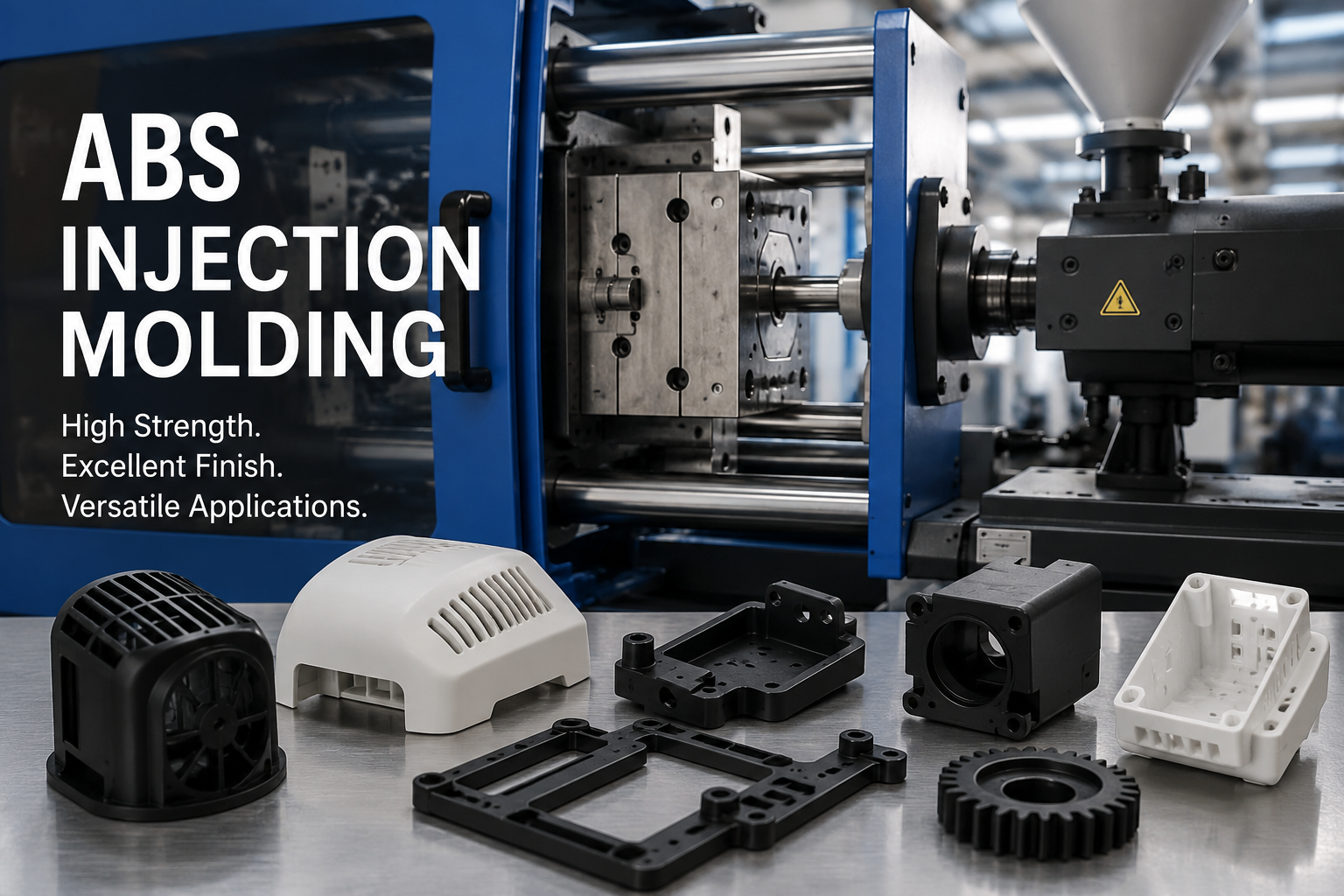
What is ABS Injection Molding?
ABS Injection Molding is a manufacturing process used to produce durable, lightweight, and dimensionally accurate plastic components by injecting molten Acrylonitrile Butadiene Styrene (ABS) into a precision mold under high pressure. The process is ideal for manufacturing complex parts with excellent surface finish, high repeatability, and tight tolerances for industries such as automotive, electronics, consumer products, medical devices, and industrial equipment.
Excellent Impact Strength
ABS offers outstanding impact resistance, making it one of the most widely used engineering plastics for components exposed to everyday wear, vibration, and mechanical loads.
High Precision Manufacturing
Injection molding enables high-volume production of complex ABS parts with consistent dimensions, minimal variation, and excellent repeatability.
Superior Surface Finish
ABS provides smooth cosmetic finishes and can be textured, painted, chrome plated, laser marked, or printed to meet product appearance requirements.
Scalable Production
Whether you require prototype quantities or millions of production parts, ABS injection molding delivers a cost-effective solution with fast production cycles.
Why Manufacturers Choose ABS
ABS combines strength, toughness, dimensional stability, affordability, and excellent processability, making it one of the most popular thermoplastics for injection molded components. It is widely used for automotive interiors, electrical housings, power tool casings, consumer electronics, appliance parts, and industrial products where durability and appearance are equally important.
Why Choose ABS Plastic for Injection Molding?
ABS (Acrylonitrile Butadiene Styrene) is one of the world’s most widely used engineering thermoplastics. It combines excellent mechanical strength, impact resistance, attractive appearance, and cost effectiveness, making it an ideal material for both functional and cosmetic plastic components.
🛡 High Impact Resistance
ABS can withstand repeated impacts without cracking, making it suitable for automotive interiors, protective covers, machine housings, and consumer products.
📐 Excellent Dimensional Stability
Precision molded ABS parts maintain tight tolerances and consistent dimensions, making them ideal for engineering assemblies.
✨ Superior Surface Finish
ABS naturally produces smooth cosmetic surfaces and accepts textures, painting, chrome plating, pad printing, and laser marking.
⚙ Easy to Process
The excellent flow characteristics of ABS allow manufacturers to mold intricate geometries while maintaining short production cycle times.
💰 Cost Effective
Compared to many engineering plastics, ABS offers an outstanding balance between performance and manufacturing cost, making it a preferred material for large production volumes.
🎨 Multiple Finishing Options
ABS parts can be polished, textured, painted, vacuum metallized, electroplated, silk screened, or laser engraved to achieve premium aesthetics.
✔
Automotive
Dashboards, trims, switch housings, HVAC components and interior panels.
✔
Electronics
Electrical enclosures, battery housings, control panels and device casings.
✔
Consumer Products
Kitchen appliances, luggage, toys, office equipment and handheld products.
✔
Industrial Equipment
Machine covers, protective guards, control boxes and engineering assemblies.
ABS Material Properties
ABS offers an excellent balance of toughness, stiffness, dimensional stability, and processability. The values below represent typical properties of general-purpose ABS grades. Actual values may vary depending on the resin manufacturer and specific formulation.
| Property | Typical Value | Unit |
|---|---|---|
| Material Type | Amorphous Thermoplastic | — |
| Density | 1.03 – 1.07 | g/cm³ |
| Tensile Strength | 40 – 50 | MPa |
| Flexural Strength | 65 – 90 | MPa |
| Flexural Modulus | 2.0 – 2.5 | GPa |
| Izod Impact Strength | 150 – 400 | J/m |
| Rockwell Hardness | R95 – R115 | HRR |
| Heat Deflection Temperature | 85 – 100 | °C |
| Glass Transition Temperature | 105 | °C |
| Mold Shrinkage | 0.4 – 0.7 | % |
| Water Absorption (24 hrs) | 0.2 – 0.4 | % |
| Continuous Service Temperature | 80 – 90 | °C |
| Electrical Insulation | Excellent | — |
| Chemical Resistance | Moderate | — |
Key Engineering Highlights
- Excellent balance between strength, toughness, and affordability.
- Outstanding impact resistance compared to many commodity plastics.
- Good dimensional stability for precision molded components.
- Excellent cosmetic appearance with glossy or textured finishes.
- Suitable for painting, electroplating, pad printing, and laser marking.
- Ideal for medium-temperature engineering applications.
- Available in flame-retardant, UV-stabilized, high-impact, and glass-filled grades.
Advantages of ABS Injection Molding
ABS is one of the most widely specified engineering thermoplastics because it combines durability, excellent appearance, easy processing, and economical manufacturing. Whether producing prototypes or high-volume production parts, ABS offers consistent quality with lower production costs.
Fast Production Cycles
ABS flows efficiently inside injection molds, enabling shorter cycle times and higher production output. This makes it ideal for both low-volume and mass production programs.
High Dimensional Accuracy
ABS maintains excellent dimensional stability after molding, allowing precision parts to meet tight engineering tolerances with minimal post-processing.
Excellent Cosmetic Finish
ABS naturally produces smooth surfaces that can be polished, textured, painted, chrome plated, or laser marked to meet demanding appearance requirements.
Cost Effective Manufacturing
Compared with many engineering polymers, ABS provides excellent performance at a competitive material cost, helping reduce total production expenses.
Complex Part Geometry
Intricate features such as ribs, bosses, snap fits, clips, living features, and textured surfaces can be molded in a single operation, reducing assembly time.
Scalable Production
ABS injection molding supports everything from prototype tooling and bridge production to high-volume manufacturing with consistent quality across every batch.
Looking for Reliable ABS Injection Molding?
From design review and tooling to production and quality inspection, Manufyn provides complete ABS injection molding solutions for OEMs, startups, and industrial manufacturers worldwide.
ABS Injection Molding Process
The ABS injection molding process transforms thermoplastic resin into high-quality plastic components through a controlled manufacturing sequence. Each stage is optimized to ensure dimensional accuracy, repeatability, and excellent surface finish.
Material Selection
The appropriate ABS grade is selected based on the application’s mechanical strength, flame resistance, UV stability, color, and surface finish requirements. Material certifications are verified before production begins.
Material Drying
ABS pellets are dried before molding to remove moisture. Proper drying minimizes defects such as silver streaks, bubbles, and poor surface quality while improving overall part performance.
Injection & Mold Filling
The dried ABS resin is melted inside the injection molding machine and injected into a precision steel mold under high pressure, accurately filling every cavity and intricate feature.
Packing & Holding Pressure
Additional pressure is applied after cavity filling to compensate for material shrinkage and ensure uniform density, dimensional accuracy, and minimal sink marks.
Cooling
The molded component cools inside the tool until it reaches sufficient rigidity. Proper cooling improves dimensional stability and reduces internal stresses.
Part Ejection & Trimming
The mold opens and ejector pins remove the finished component. Gates, runners, and flash are trimmed before the part moves to the inspection stage.
Inspection & Packaging
Finished ABS components undergo dimensional inspection, cosmetic checks, and functional verification before being packaged for domestic or international shipment.
Why Process Control Matters
Maintaining precise control over melt temperature, injection pressure, holding pressure, cooling time, and mold temperature is essential for producing high-quality ABS components with excellent dimensional accuracy, repeatability, and surface finish. At Manufyn, every production batch is monitored to ensure consistent quality from prototype development through full-scale manufacturing.
ABS Injection Molding Design Guidelines
Designing parts specifically for injection molding improves manufacturability, reduces tooling costs, shortens cycle times, and produces stronger, more reliable ABS components. The following guidelines are widely used during product development.
| Design Feature | Recommended Value | Design Recommendation |
|---|---|---|
| Wall Thickness | 1.2 – 3.5 mm | Maintain uniform wall thickness to minimize sink marks and warpage. |
| Draft Angle | 1°–2° per side | Increase draft for textured surfaces. |
| Corner Radius | 0.5 × Wall Thickness | Avoid sharp corners to reduce stress concentration. |
| Rib Thickness | 50–60% of wall thickness | Helps prevent sink marks while improving stiffness. |
| Boss Diameter | 2 × Screw Diameter | Support bosses with ribs for better strength. |
| Shrinkage | 0.4–0.7% | Consider during tool design and tolerance calculations. |
| Surface Finish | SPI A to SPI D | Choose finish according to functional and cosmetic requirements. |
| Tolerance | ±0.10–0.25 mm | Depends on part size and tooling capability. |
| Undercuts | Avoid when possible | Use sliders or lifters only where necessary. |
| Gate Position | Near thick sections | Promotes balanced filling and minimizes weld lines. |
✓ Best Practices
- Maintain consistent wall thickness.
- Add generous draft angles.
- Round internal corners.
- Use ribs instead of thick walls.
- Design for uniform cooling.
- Reduce unnecessary undercuts.
- Plan gate location early.
⚠ Common Design Mistakes
- Excessively thick walls.
- Sharp internal corners.
- Poor rib proportions.
- Insufficient draft angles.
- Improper gate placement.
- Ignoring shrinkage.
- Large unsupported bosses.
Need Design Support?
Our engineering team reviews your CAD model before tooling begins and provides Design for Manufacturability (DFM) recommendations to improve part quality, reduce tooling complexity, and optimize production costs.
REQUEST A DFM REVIEWApplications of ABS Injection Molding
ABS plastic is widely used across multiple industries because it combines strength, impact resistance, dimensional stability, and an excellent cosmetic finish. It is suitable for both structural and aesthetic components.
🚗 Automotive
- Dashboard components
- HVAC housings
- Interior trims
- Mirror housings
- Switch bezels
- Instrument panel components
- Glove box assemblies
💻 Electronics
- Electronic enclosures
- Battery housings
- Control panels
- Power supply covers
- Computer accessories
- Consumer electronic housings
- Network equipment cases
🏭 Industrial Equipment
- Machine covers
- Protective guards
- Operator panels
- Industrial control boxes
- Automation equipment
- Robot covers
- Fixture components
🏥 Medical Devices
- Diagnostic equipment housings
- Portable medical devices
- Laboratory equipment
- Instrument handles
- Protective covers
- Healthcare accessories
🏠 Consumer Products
- Vacuum cleaner parts
- Kitchen appliances
- Luggage shells
- Power tool housings
- Toys
- Office equipment
- Sporting goods
⚡ Electrical Industry
- Electrical junction boxes
- Switchgear housings
- Distribution panel covers
- Cable management products
- Electrical connectors
- Protective electrical enclosures
Custom ABS Parts for Every Industry
Whether you require functional prototypes, bridge tooling, or high-volume production, Manufyn delivers precision ABS injection molded components tailored to your application. Our manufacturing partners support industries ranging from automotive and electronics to medical devices, industrial automation, and consumer products.
Types of ABS Grades
ABS is available in multiple grades to meet different mechanical, thermal, electrical, and cosmetic requirements. Selecting the correct material grade helps improve product performance while optimizing manufacturing costs.
| ABS Grade | Key Features | Typical Applications |
|---|---|---|
| General Purpose ABS | Excellent balance of strength, toughness and cost. | Consumer products, appliance housings, toys, office equipment. |
| High Impact ABS | Superior impact resistance and toughness. | Automotive interiors, luggage, protective covers. |
| Flame Retardant ABS | UL94 compliant with improved fire resistance. | Electrical enclosures, switchgear, electronic products. |
| UV Stabilized ABS | Improved resistance to sunlight and outdoor exposure. | Outdoor equipment, signage, exterior housings. |
| Glass Filled ABS | Higher stiffness and dimensional stability. | Industrial equipment, structural components. |
| Medical Grade ABS | Manufactured for healthcare applications with strict quality standards. | Medical devices, diagnostic equipment, laboratory products. |
| Electroplating Grade ABS | Excellent adhesion for chrome plating and decorative finishes. | Automotive trims, sanitary fittings, premium consumer products. |
| High Gloss ABS | Superior cosmetic appearance with glossy finish. | Consumer electronics, home appliances, display products. |
Automotive
High Impact ABS and Electroplating Grade ABS are commonly selected for automotive interior trims, dashboards, bezels, mirror housings, and decorative components.
Electronics
Flame Retardant ABS provides improved safety for electrical enclosures, battery housings, switchgear, and electronic products.
Industrial
Glass Filled ABS offers greater rigidity and dimensional stability for industrial machinery, automation equipment, and engineering assemblies.
Not Sure Which ABS Grade Is Right?
Our engineering team can recommend the most suitable ABS material based on your application’s mechanical requirements, operating environment, cosmetic expectations, and production volume.
SPEAK WITH AN ENGINEERABS vs Other Engineering Plastics
Choosing the right plastic depends on mechanical performance, operating temperature, impact resistance, chemical resistance, appearance, and cost. The comparison below highlights the differences between ABS and other commonly used engineering plastics.
| Property | ABS | Polycarbonate | Nylon (PA6) | Polypropylene |
|---|---|---|---|---|
| Impact Resistance | ★★★★★ | ★★★★★+ | ★★★★☆ | ★★★☆☆ |
| Surface Finish | Excellent | Excellent | Good | Good |
| Heat Resistance | Medium | High | High | Medium |
| Chemical Resistance | Moderate | Moderate | Excellent | Excellent |
| Dimensional Stability | Excellent | Excellent | Good | Good |
| Machinability | Excellent | Good | Good | Good |
| Cost | $$ | $$$$ | $$$ | $ |
| Best Applications | General Engineering | High Impact Parts | Mechanical Components | Chemical Applications |
Choose ABS When…
- Excellent appearance is required.
- High impact resistance is needed.
- Production volumes are high.
- Cost efficiency is important.
- Painting or chrome plating is required.
Choose Polycarbonate When…
- Transparency is required.
- Very high impact strength is needed.
- Higher operating temperatures are expected.
- Optical components are being produced.
Choose Nylon or PP When…
- Excellent wear resistance is needed.
- Chemical exposure is significant.
- Low friction properties are required.
- Lightweight structural components are required.
Need Help Selecting the Right Plastic?
Our engineering team can recommend the most suitable material based on your mechanical requirements, operating environment, manufacturing process, and budget. We support prototype development through high-volume production.
Your Trusted ABS Injection Molding Partner
At Manufyn, we connect global OEMs, startups, and industrial manufacturers with carefully vetted injection molding partners across India. From prototype tooling to high-volume production, we manage the complete manufacturing lifecycle while maintaining quality, cost efficiency, and on-time delivery.
Prototype to Production
Whether you need prototype tooling, bridge tooling, or mass production, we provide scalable manufacturing solutions tailored to your production requirements.
Design for Manufacturability (DFM)
Our engineering team reviews every design before tooling begins, helping reduce manufacturing risks, tooling costs, and production defects.
Quality Assurance
Dimensional inspection, CMM inspection, first article inspection (FAI), PPAP documentation, and production quality control ensure every shipment meets customer requirements.
Global Supply Chain
We support customers across North America, Europe, and other international markets with reliable manufacturing, export documentation, and logistics coordination.
Modern Manufacturing
Our manufacturing partners utilize advanced injection molding machines, automated production systems, and precision tooling for consistent part quality.
Dedicated Project Management
Every project is managed by a dedicated team responsible for communication, production planning, supplier coordination, inspections, and on-time delivery.
500+
Manufacturing Projects
ISO
Certified Manufacturing Partners
100%
Engineering Support
Global
Export Capabilities
Ready to Start Your ABS Injection Molding Project?
Whether you require functional prototypes, production tooling, or high-volume ABS plastic components, our engineering team is ready to support your project from concept to production.
ABS Injection Molding FAQs
Find answers to some of the most common questions engineers, buyers, and product designers ask about ABS injection molding.
What is ABS injection molding?
ABS injection molding is a manufacturing process in which molten Acrylonitrile Butadiene Styrene (ABS) is injected into a precision mold to produce durable, lightweight, and dimensionally accurate plastic components.
Why is ABS commonly used for injection molded parts?
ABS offers an excellent balance of strength, toughness, impact resistance, surface finish, dimensional stability, and cost, making it one of the most popular engineering plastics.
What industries use ABS injection molding?
ABS is widely used in automotive, electronics, industrial equipment, medical devices, consumer products, electrical equipment, robotics, and home appliances.
Can ABS be painted or chrome plated?
Yes. ABS has excellent surface characteristics and can be painted, textured, silk screened, laser marked, vacuum metallized, or electroplated for decorative finishes.
What is the typical wall thickness for ABS parts?
A wall thickness between 1.2 mm and 3.5 mm is commonly recommended. Maintaining uniform wall thickness helps minimize sink marks, warpage, and internal stresses.
Can ABS be used outdoors?
Standard ABS has limited UV resistance. For outdoor applications, UV-stabilized ABS grades are recommended to improve weatherability and color retention.
Is ABS recyclable?
Yes. ABS is recyclable and can often be reprocessed for suitable applications, depending on quality requirements and local recycling capabilities.
What tolerances can be achieved with ABS injection molding?
Typical molding tolerances range from approximately ±0.10 mm to ±0.25 mm, depending on part size, geometry, tooling quality, and processing conditions.
Still Have Questions?
Our engineering team is happy to answer your questions, review your CAD files, and recommend the most suitable ABS material and manufacturing approach for your project.
CONTACT OUR ENGINEERS