
PEEK vs ULTEM
Which Engineering Plastic Should You Choose?
Choosing between PEEK and ULTEM® can significantly affect your product’s mechanical strength, temperature resistance, manufacturing cost, chemical compatibility and long term reliability. This guide compares both engineering plastics to help engineers and procurement teams select the right material.
Request a Quote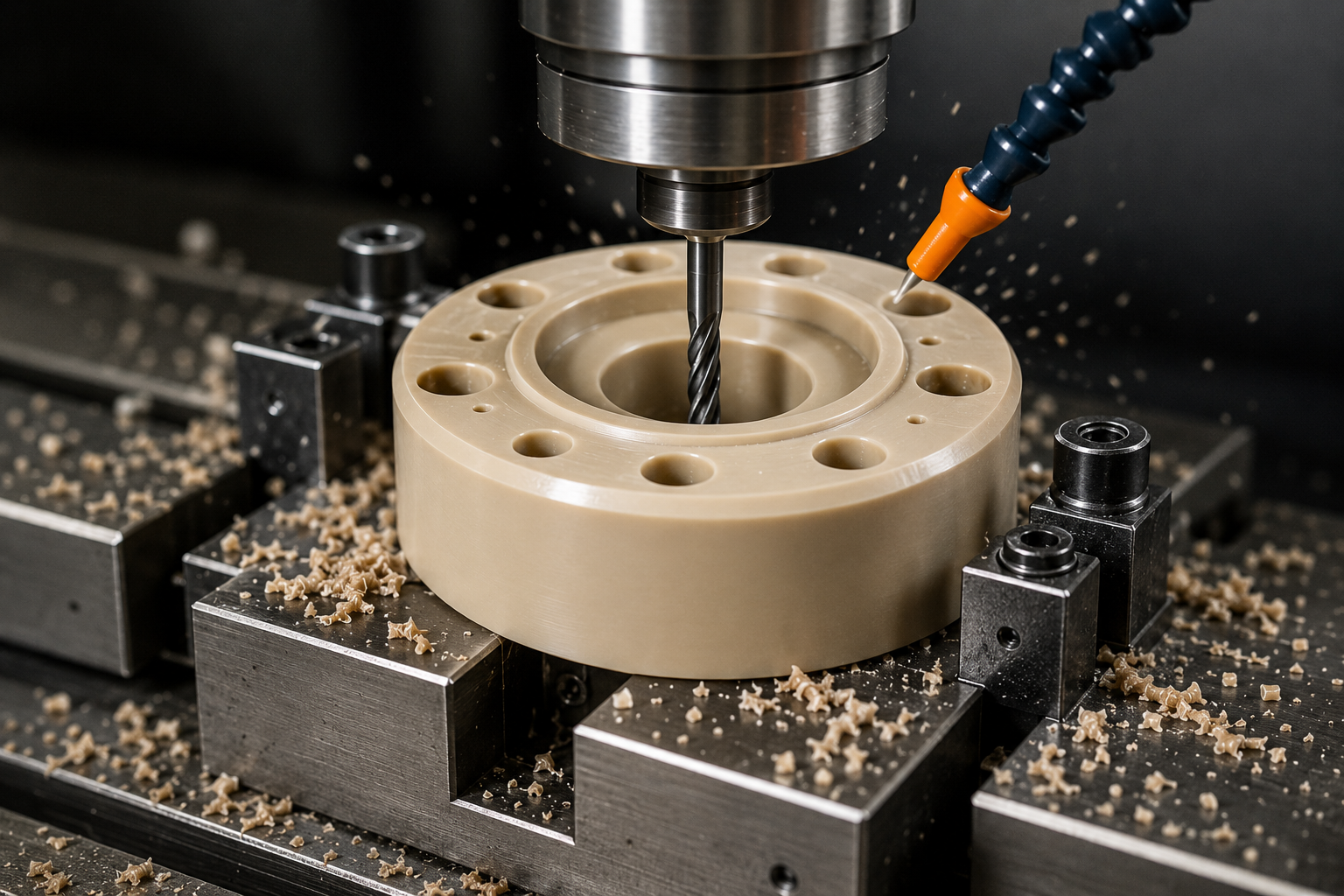
High Temperature Resistance
Compare continuous operating temperatures, heat distortion performance and thermal stability.
CNC Machining
Learn which engineering plastic delivers superior machinability, dimensional accuracy and surface finish.
Chemical Resistance
Understand how PEEK and ULTEM perform in aggressive chemicals, steam, solvents and harsh environments.
Industry Applications
Explore where these engineering plastics are used in aerospace, medical, semiconductor and industrial automation.
Why Compare PEEK and ULTEM?
Material selection directly affects product reliability, manufacturing cost and long-term performance. Choosing the wrong engineering plastic can lead to premature wear, dimensional instability or unnecessary manufacturing expenses.
PEEK (Polyether Ether Ketone) and ULTEM® (Polyetherimide) are among the most widely specified high-performance thermoplastics for demanding engineering applications. Although they share several characteristics, they differ significantly in mechanical strength, thermal resistance, chemical compatibility, electrical insulation and overall cost.
Whether you are designing components for aerospace, medical devices, semiconductor equipment, industrial automation or electronics, understanding these differences helps you select the right material based on your application rather than price alone.
At Manufyn, we support global OEMs with CNC Machining, Injection Molding, and Prototype Manufacturing for high-performance engineering plastics.
In This Guide
- ✔ What is PEEK?
- ✔ What is ULTEM?
- ✔ Material Property Comparison
- ✔ CNC Machining Guide
- ✔ Injection Molding Guide
- ✔ Aerospace Applications
- ✔ Medical Applications
- ✔ Cost Comparison
- ✔ Frequently Asked Questions
What is PEEK?
PEEK (Polyether Ether Ketone) is a high performance semi-crystalline engineering thermoplastic developed for applications where conventional plastics cannot withstand extreme temperatures, heavy mechanical loads, continuous wear or aggressive chemicals. It is widely regarded as one of the highest-performing engineering plastics available for industrial manufacturing.
Because of its exceptional strength-to-weight ratio, PEEK is frequently used to replace aluminium and stainless steel in applications where reducing weight, improving corrosion resistance and extending service life are critical. Industries such as aerospace, medical, semiconductor, oil & gas, industrial automation and automotive rely on PEEK for precision engineered components that must perform reliably under demanding operating conditions.
PEEK is compatible with both CNC Machining and On Demand Manufacturing, making it suitable for everything from one-off prototypes to full production programs. Companies developing new products often combine PEEK with Prototype Manufacturing to validate designs before investing in production tooling.
Why Engineers Specify PEEK
PEEK offers one of the best combinations of mechanical strength, dimensional stability, chemical resistance and continuous operating temperature available in any thermoplastic. These characteristics make it an excellent choice for mission-critical components where failure is not an option.
At Manufyn, PEEK components are commonly manufactured through precision CNC machining for prototype and low-volume requirements, while higher production quantities can be produced through Injection Molding. Our engineering team also supports Design for Manufacturability (DFM), supplier selection, quality inspection and global logistics through our On Demand Manufacturing platform.
For customers developing complete assemblies, PEEK components are frequently combined with Sheet Metal Fabrication, Aluminium Extrusion, Forging, Casting and Electronics Assembly to deliver complete manufacturing solutions from prototype through serial production.
| Typical PEEK Properties | |
|---|---|
| Polymer Type | Semi Crystalline |
| Continuous Service Temperature | 250°C |
| Short Term Temperature | 300°C |
| Tensile Strength | Excellent |
| Wear Resistance | Outstanding |
| Chemical Resistance | Excellent |
| Steam Resistance | Excellent |
| FDA Grades | Available |
| Medical Grades | Available |
| CNC Machining | Excellent |
| Injection Molding | Suitable |
Common Applications of PEEK Across Industries
PEEK has become one of the preferred engineering plastics for manufacturers seeking lightweight, high-strength components capable of operating in demanding environments. Below are some of the industries where PEEK is widely used and where Manufyn supports customers with precision manufacturing, sourcing, and production.
✈ Aerospace
PEEK replaces aluminium and other metals in aircraft interiors, brackets, bushings, cable supports and engine-adjacent components where weight reduction and high temperature resistance are essential.
Explore Aerospace Manufacturing →🏥 Medical Devices
Medical-grade PEEK is widely used for surgical instruments, orthopaedic implants, sterilisation trays and diagnostic equipment because of its biocompatibility and repeated sterilisation capability.
Medical Case Study →⚙ Industrial Automation
Precision gears, rollers, wear strips, bearings and robotic components manufactured from PEEK deliver long service life with minimal maintenance.
Precision CNC Machining →💻 Semiconductor
PEEK is commonly selected for wafer handling equipment, vacuum chamber fixtures and cleanroom tooling due to its excellent dimensional stability and low contamination characteristics.
Manufacturing Services →🚗 Automotive
Automotive manufacturers use PEEK in transmission systems, under-the-hood components, electrical connectors and lightweight assemblies that operate under elevated temperatures.
Automotive Manufacturing →🛢 Oil & Gas
PEEK withstands aggressive chemicals, high pressures and elevated temperatures, making it ideal for valve seats, seals, compressor components and pump parts.
Manufacturing Solutions →What is ULTEM® (PEI)?
ULTEM®, also known as Polyetherimide (PEI), is a high performance amorphous thermoplastic developed for applications requiring excellent mechanical strength, dimensional stability, electrical insulation and flame resistance. Unlike semi-crystalline materials such as PEEK, ULTEM maintains exceptional dimensional accuracy while offering easier processing and lower material cost for many engineering applications.
ULTEM is widely used in aerospace interiors, electrical enclosures, medical equipment, food processing machinery, laboratory instruments and semiconductor manufacturing where lightweight, high strength components are required. Its naturally flame-retardant properties and excellent dielectric strength make it particularly suitable for electrical and electronic applications.
Manufacturers commonly process ULTEM using Injection Molding for medium and high-volume production, while CNC Machining is preferred for prototypes, fixtures and low-volume custom components. When launching new products, many companies also utilise Prototype Manufacturing to reduce development time and validate part performance before production tooling.
Why Engineers Choose ULTEM
ULTEM offers an excellent balance of strength, heat resistance, electrical insulation and cost. It is often selected when applications require flame-retardant materials, tight dimensional tolerances and reliable performance without the premium cost associated with PEEK.
At Manufyn, ULTEM components are manufactured using precision CNC Machining, production Injection Molding and complete On Demand Manufacturing Services. We also support material selection, DFM reviews, tooling, supplier qualification, quality inspection and global procurement for OEMs across aerospace, medical and industrial sectors.
If your project requires complete assemblies, Manufyn also provides Sheet Metal Fabrication, Casting, Forging, Surface Finishing and end-to-end sourcing support through our qualified manufacturing network.
| Typical ULTEM Properties | |
|---|---|
| Polymer Type | Amorphous |
| Continuous Service Temperature | 170°C |
| Heat Distortion Temperature | High |
| Mechanical Strength | Excellent |
| Electrical Insulation | Outstanding |
| Flame Resistance | UL94 V-0 |
| Dimensional Stability | Excellent |
| Chemical Resistance | Very Good |
| CNC Machining | Excellent |
| Injection Molding | Excellent |
PEEK vs ULTEM® Material Comparison
Although both PEEK and ULTEM belong to the family of high performance engineering thermoplastics, they are designed for different applications. PEEK excels in extreme environments involving high temperatures, wear and aggressive chemicals, while ULTEM provides an excellent balance of mechanical strength, electrical insulation and affordability.
| Property | PEEK | ULTEM® (PEI) |
|---|---|---|
| Polymer Structure | Semi Crystalline | Amorphous |
| Continuous Operating Temperature | 250°C | 170°C |
| Maximum Short Term Temperature | 300°C | 217°C |
| Mechanical Strength | Excellent | Very Good |
| Wear Resistance | Outstanding | Good |
| Friction Performance | Excellent | Moderate |
| Chemical Resistance | Outstanding | Very Good |
| Steam Resistance | Excellent | Moderate |
| Hydrolysis Resistance | Excellent | Very Good |
| Electrical Insulation | Excellent | Outstanding |
| Flame Resistance | Excellent | UL94 V0 (Natural) |
| Dimensional Stability | Excellent | Outstanding |
| Moisture Absorption | Very Low | Low |
| Creep Resistance | Excellent | Very Good |
| Fatigue Resistance | Excellent | Very Good |
| CNC Machining | Excellent | Excellent |
| Injection Molding | Suitable | Excellent |
| Surface Finish | Excellent | Excellent |
| Medical Applications | Excellent | Very Good |
| Aerospace Applications | Excellent | Excellent |
| Semiconductor Applications | Excellent | Very Good |
| Food Contact Grades | Available | Available |
| Relative Material Cost | $$$$ | $$$ |
| Best For | Extreme performance applications | Electrical, aerospace and structural applications |
Mechanical Properties: PEEK vs ULTEM®
Mechanical performance is often the deciding factor when selecting an engineering plastic. While both PEEK and ULTEM provide excellent strength compared to conventional plastics, each material has distinct advantages depending on load conditions, wear requirements, dimensional accuracy and service environment.
💪 Tensile Strength
PEEK generally provides higher tensile strength and superior load-bearing capability, making it ideal for structural components exposed to continuous mechanical stress.
- Excellent structural integrity
- High load carrying capacity
- Suitable for metal replacement
- Outstanding fatigue performance
⚙ Wear & Friction Resistance
PEEK significantly outperforms ULTEM in sliding applications. It is widely used for gears, bearings, bushes and wear strips operating without lubrication.
- Low coefficient of friction
- Excellent wear resistance
- Long service life
- Reduced maintenance
📏 Dimensional Stability
ULTEM offers exceptional dimensional stability because of its amorphous molecular structure. It maintains tight tolerances during machining and injection molding.
- Minimal warpage
- Excellent dimensional accuracy
- Ideal for electrical housings
- High precision assemblies
🔄 Fatigue Resistance
PEEK performs exceptionally well under repeated loading cycles, making it suitable for dynamic mechanical systems including robotics and automation equipment.
- High fatigue strength
- Repeated cyclic loading
- Industrial automation
- Robotic components
🧪 Impact Strength
ULTEM exhibits very good impact resistance while maintaining stiffness. It is commonly selected for aerospace interior components and electronic enclosures where lightweight strength is important.
- Excellent toughness
- Good impact absorption
- Structural housings
- Electrical equipment
🏭 Manufacturing Performance
Both materials machine exceptionally well. ULTEM is generally easier to injection mold, whereas PEEK is preferred for demanding machined components requiring extreme performance.
- CNC Machining
- Injection Molding
- Prototype Manufacturing
- Production Parts
Mechanical Performance Summary
Choose PEEK when your application requires maximum strength, wear resistance, fatigue life and continuous operation under demanding mechanical loads. It is particularly well suited for aerospace, semiconductor equipment, industrial automation, oil & gas and medical components where long-term durability is critical.
Choose ULTEM® when dimensional stability, electrical insulation, flame resistance and cost efficiency are the primary design requirements. ULTEM is widely used for aerospace interiors, electrical connectors, laboratory equipment, medical devices and high-performance plastic enclosures.
At Manufyn, we help OEMs select the most appropriate engineering plastic based on application requirements, manufacturing process, production volume and total cost of ownership. Our capabilities include Precision CNC Machining, Injection Molding, Rapid Prototyping, supplier qualification, quality inspection and global manufacturing support.
Thermal Properties Comparison: PEEK vs ULTEM®
High operating temperatures can significantly affect the performance, dimensional stability and service life of engineering plastics. Both PEEK and ULTEM are designed for elevated-temperature applications, but PEEK provides superior thermal performance in the most demanding environments. Selecting the right material depends on continuous operating temperature, exposure time and application requirements.
🔥 Continuous Service Temperature
PEEK is one of the few engineering plastics capable of continuous operation at temperatures up to approximately 250°C while maintaining excellent mechanical properties. ULTEM performs reliably up to around 170°C, making it suitable for many industrial and electrical applications.
- PEEK: Continuous use up to 250°C
- ULTEM: Continuous use up to 170°C
- Ideal for high-temperature machinery
- Reduced thermal degradation
🌡 Heat Resistance
Where components are exposed to repeated heating and cooling cycles, PEEK offers superior resistance to thermal fatigue and retains its mechanical strength over longer operating periods.
- Excellent heat ageing
- High thermal stability
- Suitable for harsh environments
- Excellent long-term durability
📐 Thermal Expansion
ULTEM exhibits excellent dimensional stability, while PEEK combines low thermal expansion with superior mechanical strength. Both materials are suitable for precision components requiring tight manufacturing tolerances.
- High dimensional accuracy
- Low expansion characteristics
- Precision engineered parts
- Reliable fit and function
| Thermal Property | PEEK | ULTEM® |
|---|---|---|
| Continuous Service Temperature | 250°C | 170°C |
| Short-Term Temperature | 300°C | 217°C |
| Heat Deflection Resistance | Excellent | Very Good |
| Thermal Ageing | Excellent | Very Good |
| Thermal Cycling | Outstanding | Good |
| Dimensional Stability at Elevated Temperature | Excellent | Excellent |
| Steam Sterilisation | Excellent | Very Good |
| Autoclave Compatibility | Excellent | Good |
Which Material Performs Better at High Temperatures?
For applications involving continuous exposure to temperatures above 170°C, PEEK is generally the preferred engineering plastic because it maintains its mechanical strength, wear resistance and dimensional stability even in harsh thermal environments. This makes it a popular choice for aerospace components, semiconductor equipment, medical devices and industrial automation systems.
If the operating temperature remains below approximately 170°C, ULTEM® offers an excellent balance of heat resistance, mechanical performance and cost. It is commonly selected for electrical housings, aerospace interiors, laboratory equipment and flame-retardant components manufactured using Injection Molding or Precision CNC Machining.
At Manufyn, our engineering team helps customers select the right high-performance plastic based on thermal requirements, manufacturing process, production volume and cost targets. Whether you require Rapid Prototyping, production tooling or complete manufacturing support, we provide end-to-end solutions for precision plastic components. You can also explore our Manufacturing Resources and Industries pages for additional engineering insights.
Chemical Resistance: PEEK vs ULTEM®
Many engineering components operate in environments where they are exposed to acids, alkalis, fuels, oils, cleaning agents, steam and industrial solvents. Selecting a plastic with the appropriate chemical resistance improves product reliability, reduces maintenance and extends component life. While both PEEK and ULTEM offer excellent resistance to many chemicals, PEEK performs better in highly aggressive environments.
🧪 Acids & Alkalis
PEEK offers exceptional resistance to a wide range of acids, alkalis and corrosive chemicals, making it suitable for chemical processing equipment and demanding industrial environments.
- Excellent acid resistance
- Excellent alkali resistance
- Suitable for chemical plants
- Long service life
🛢 Oils, Fuels & Lubricants
Both PEEK and ULTEM resist oils, hydraulic fluids and many industrial lubricants. PEEK generally offers better long-term performance under continuous exposure.
- Automotive fluids
- Hydraulic oils
- Industrial lubricants
- Fuel system components
💨 Steam & Hot Water
Repeated steam sterilisation and exposure to hot water have minimal impact on PEEK. ULTEM also performs well but prolonged exposure at elevated temperatures may reduce long-term performance.
- Autoclave compatible
- Steam resistant
- Medical equipment
- Food processing
🏭 Industrial Cleaning Chemicals
PEEK maintains excellent dimensional stability after repeated cleaning cycles using industrial detergents and many aggressive cleaning chemicals used in manufacturing environments.
- Factory cleaning systems
- CIP applications
- Medical sterilisation
- Laboratory equipment
⚡ Semiconductor Chemicals
PEEK is widely used in semiconductor equipment because of its excellent chemical stability, low contamination characteristics and compatibility with demanding processing environments.
- Wafer handling
- Cleanroom tooling
- Vacuum systems
- Chemical processing
🍽 Food & Medical Applications
Food-grade and medical-grade versions of both materials are available. PEEK is generally preferred where repeated sterilisation and aggressive cleaning are required.
- FDA compliant grades
- Medical devices
- Food processing
- Laboratory instruments
| Chemical Environment | PEEK | ULTEM® |
|---|---|---|
| Strong Acids | Excellent | Good |
| Strong Alkalis | Excellent | Very Good |
| Hydraulic Oils | Excellent | Excellent |
| Petroleum Fuels | Excellent | Very Good |
| Steam Sterilisation | Excellent | Very Good |
| Hot Water | Excellent | Good |
| Alcohols | Excellent | Excellent |
| Industrial Solvents | Excellent | Good to Very Good |
| Medical Cleaning Chemicals | Excellent | Very Good |
| Food Processing Chemicals | Excellent | Very Good |
Which Material Should You Choose for Chemically Aggressive Environments?
If your application involves continuous exposure to corrosive chemicals, high-temperature steam, aggressive cleaning agents or industrial solvents, PEEK is typically the preferred material due to its outstanding chemical resistance and long-term durability. It is widely specified for semiconductor manufacturing equipment, chemical processing systems, medical devices and oil & gas components.
ULTEM® remains an excellent choice for many electrical, aerospace and industrial applications where chemical exposure is moderate and cost efficiency is an important consideration. Its combination of dimensional stability, mechanical strength and chemical resistance makes it suitable for a broad range of engineering applications.
At Manufyn, we help customers choose the right engineering plastic based on the operating environment, production volume and manufacturing process. Whether your project requires Precision CNC Machining, Injection Molding, Rapid Prototyping, or complete On Demand Manufacturing Services, our engineering team supports you from material selection through production and quality assurance. You can also explore our Medical Prototype Case Study, browse our Manufacturing Resources, or learn more about the industries we serve on our Industries page.
PEEK vs ULTEM® for CNC Machining
Both PEEK and ULTEM are excellent materials for precision CNC machining, making them popular choices for prototypes, low-volume production and highly engineered components. The right material depends on the application’s operating environment, dimensional requirements, production volume and budget. At Manufyn, our Precision CNC Machining services support tight tolerances, complex geometries and rapid turnaround for high-performance engineering plastics.
⚙ CNC Machining of PEEK
PEEK is widely machined for mission-critical components requiring exceptional strength, wear resistance and high-temperature performance. Although it is more expensive than many engineering plastics, its long-term reliability often reduces the total cost of ownership.
- Excellent dimensional stability
- High precision machining
- Ideal for complex components
- Outstanding wear resistance
- Suitable for aerospace and medical parts
🛠 CNC Machining of ULTEM®
ULTEM machines cleanly and delivers excellent dimensional accuracy, making it a preferred choice for electrical components, fixtures, laboratory equipment and lightweight structural parts. It also offers a more economical solution for many engineering applications.
- Excellent machinability
- Stable tolerances
- Smooth surface finish
- Good productivity
- Lower material cost than PEEK
📐 Typical Machined Components
Both materials are commonly used to manufacture precision components where injection molding is not economical or design changes are expected during product development.
- Precision bushes
- Bearings and wear pads
- Valve seats
- Electrical insulators
- Medical device components
- Semiconductor fixtures
- Custom prototype parts
| Machining Parameter | PEEK | ULTEM® |
|---|---|---|
| Machinability | Excellent | Excellent |
| Surface Finish | Excellent | Excellent |
| Dimensional Accuracy | Excellent | Excellent |
| Tight Tolerances | ★★★★★ | ★★★★★ |
| Prototype Manufacturing | Excellent | Excellent |
| Low Volume Production | Excellent | Excellent |
| Complex Geometries | Excellent | Excellent |
| Thin Wall Features | Very Good | Excellent |
| Wear Components | Outstanding | Good |
| Overall Material Cost | Higher | Lower |
When Should You CNC Machine PEEK or ULTEM?
Choose PEEK when manufacturing components that operate under high mechanical loads, elevated temperatures or chemically aggressive environments. It is the preferred material for aerospace systems, semiconductor equipment, medical devices, pumps, valves, bearings and industrial automation components where long-term performance is essential.
Choose ULTEM® when your project requires excellent dimensional stability, electrical insulation, flame resistance and a more economical material without sacrificing engineering performance. ULTEM is frequently used for electrical housings, laboratory equipment, aerospace interiors, inspection fixtures and structural components.
For new product development, Manufyn recommends combining Rapid Prototyping with Precision CNC Machining to validate designs before transitioning to Injection Molding for production. This approach reduces tooling risk, shortens development cycles and accelerates product launches.
Beyond CNC machining, Manufyn also provides Sheet Metal Fabrication, Casting, Forging, Surface Finishing, quality inspection and global sourcing solutions. Browse our Manufacturing Resources, explore the Industries We Serve, or review our Rapid Prototyping Case Study to learn how we support OEMs from concept to production.
PEEK vs ULTEM® for Injection Molding
Injection molding is the preferred manufacturing process for producing high volumes of plastic components with consistent quality and repeatability. Both PEEK and ULTEM® can be injection molded, but they require different tooling strategies, processing temperatures and production considerations. Selecting the right material depends on part geometry, annual production volume, operating environment and overall project budget.
🏭 Injection Molding of PEEK
PEEK is processed at significantly higher melt and mold temperatures than conventional engineering plastics. Specialized tooling, advanced molding equipment and strict process control are required to achieve optimum crystallinity and mechanical performance.
- Excellent mechanical strength
- Superior chemical resistance
- High temperature capability
- Ideal for demanding industrial applications
- Suitable for medical and aerospace components
⚙ Injection Molding of ULTEM®
ULTEM offers excellent moldability while maintaining outstanding dimensional stability and flame resistance. It is widely used for electrical enclosures, medical equipment and lightweight structural components.
- Excellent dimensional accuracy
- Good flow characteristics
- Lower processing temperatures than PEEK
- Excellent cosmetic appearance
- Ideal for medium and high-volume production
📐 Design for Manufacturability (DFM)
Proper part design improves mold filling, minimizes warpage and reduces production costs. Early DFM analysis helps optimize wall thickness, gate location, draft angles and cooling efficiency.
- Uniform wall thickness
- Adequate draft angles
- Optimized gate design
- Reduced sink marks
- Improved cycle time
| Injection Molding Parameter | PEEK | ULTEM® |
|---|---|---|
| Processing Difficulty | High | Moderate |
| Melt Temperature | Very High | High |
| Mold Temperature | High | Moderate |
| Flow Characteristics | Good | Very Good |
| Dimensional Stability | Excellent | Excellent |
| Surface Finish | Excellent | Excellent |
| Thin Wall Components | Good | Excellent |
| High Volume Production | Excellent | Excellent |
| Tooling Complexity | Higher | Moderate |
| Relative Manufacturing Cost | Higher | Lower |
Selecting the Right Material for Injection Molding
Choose PEEK when your molded component must withstand extreme temperatures, continuous mechanical loads or aggressive chemicals. Although tooling and processing costs are higher, PEEK delivers exceptional long-term performance for aerospace, semiconductor, oil & gas and medical applications.
Choose ULTEM® when you require high strength, excellent dimensional stability, electrical insulation and flame resistance at a lower material and processing cost. It is commonly specified for electrical housings, aerospace interiors, healthcare equipment and industrial machinery.
Manufyn provides complete Injection Molding Services, including mold design support, DFM analysis, prototype tooling, bridge tooling and production tooling. We also assist with Rapid Prototyping using CNC machining before transitioning to mass production, reducing development risk and accelerating time to market.
In addition to injection molding, our manufacturing capabilities include Precision CNC Machining, supplier qualification, quality inspection, logistics management and end-to-end On Demand Manufacturing Services. Explore our Medical Injection Molding Case Study, browse our Manufacturing Resources, or discover the industries we support on our Industries page.
Cost Comparison: PEEK vs ULTEM®
Material price is only one part of the overall manufacturing cost. Engineers and procurement teams should also evaluate machining time, tooling investment, production volume, expected service life and maintenance requirements. Although PEEK has a higher upfront cost, its durability and performance can significantly reduce lifecycle costs in demanding applications.
💰 Raw Material Cost
PEEK is one of the most expensive engineering thermoplastics due to its complex manufacturing process and exceptional performance. ULTEM® generally offers a lower material cost while still delivering excellent mechanical and thermal properties.
- ULTEM has lower raw material cost
- PEEK commands a premium price
- Cost varies by grade and supplier
- Glass-filled and carbon-filled grades cost more
⚙ Manufacturing Cost
Processing PEEK requires higher machining and molding temperatures, specialised tooling and longer production cycles. ULTEM is generally easier to manufacture, reducing production costs for medium and high-volume parts.
- Higher machining cost for PEEK
- Lower moulding cost for ULTEM
- Tool wear differs by material
- Cycle time impacts production cost
📈 Total Cost of Ownership
While PEEK is more expensive initially, its longer service life, superior wear resistance and reduced maintenance often make it the most economical solution over the lifetime of the product.
- Longer operating life
- Reduced downtime
- Lower maintenance costs
- Improved equipment reliability
| Cost Factor | PEEK | ULTEM® |
|---|---|---|
| Raw Material Cost | ★★★★★ (Highest) | ★★★☆☆ (Moderate) |
| CNC Machining Cost | Higher | Moderate |
| Injection Molding Cost | Higher | Lower |
| Prototype Cost | Higher | Moderate |
| Production Cost | Higher | Lower |
| Maintenance Cost | Lowest | Moderate |
| Expected Service Life | Longest | Long |
| Return on Investment | Excellent for demanding applications | Excellent for cost-sensitive projects |
Which Material Offers Better Value?
For highly demanding applications where downtime, component failure or frequent replacement can result in significant operational costs, PEEK often delivers the lowest total cost of ownership despite its higher purchase price. Its superior wear resistance, chemical compatibility and long service life help reduce maintenance and improve equipment reliability.
For applications with moderate operating temperatures, lower mechanical loads and larger production volumes, ULTEM® provides an excellent balance of performance and affordability. It is frequently selected for electrical housings, aerospace interiors, medical equipment and industrial components where engineering performance is required without the premium cost of PEEK.
At Manufyn, we help OEMs optimise both manufacturing cost and product performance by recommending the right material, process and supplier. Whether you require Precision CNC Machining, Injection Molding, Rapid Prototyping, supplier qualification or complete On Demand Manufacturing Services, our engineering team works with qualified manufacturing partners across India to deliver high-quality components with competitive lead times. You can also explore our Manufacturing Resources, browse the Industries We Serve, or review our Rapid Prototyping Case Study to see how we support customers from concept through production.
Which Material Should You Choose?
Selecting the right engineering plastic depends on your operating environment, mechanical requirements, production volume and budget. The following decision matrix provides practical recommendations for common engineering applications.
| Application | Recommended Material | Reason |
|---|---|---|
| Continuous operation above 200°C | ✔ PEEK | Outstanding thermal stability and mechanical strength. |
| Electrical enclosures | ✔ ULTEM® | Excellent dielectric strength and flame resistance. |
| Medical implants & sterilisation | ✔ PEEK | Excellent chemical resistance and repeated autoclave capability. |
| Aerospace interior components | ✔ ULTEM® | Lightweight, flame-retardant and dimensionally stable. |
| Bearings, bushes & wear pads | ✔ PEEK | Exceptional wear resistance and low friction. |
| Prototype CNC machined parts | ✔ Both | Material selection depends on end-use performance requirements. |
| High-volume injection moulding | ✔ ULTEM® | Easier processing and lower production cost. |
| Semiconductor equipment | ✔ PEEK | Excellent chemical compatibility and cleanroom performance. |
| Food processing equipment | ✔ Both | Depends on operating temperature and compliance requirements. |
| Cost-sensitive engineering projects | ✔ ULTEM® | Excellent balance between cost and performance. |
| Oil & Gas applications | ✔ PEEK | Outstanding resistance to pressure, chemicals and heat. |
| Industrial automation | ✔ PEEK | High fatigue life and long-term reliability. |
| Inspection fixtures & jigs | ✔ ULTEM® | Excellent dimensional stability and machinability. |
| Lightweight structural parts | ✔ ULTEM® | Strong, lightweight and economical. |
| Extreme chemical environments | ✔ PEEK | Superior resistance to aggressive chemicals and solvents. |
Engineering Recommendation from Manufyn
Choose PEEK when your application demands the highest level of performance. It is the preferred choice for components exposed to extreme temperatures, aggressive chemicals, continuous mechanical loads and demanding wear conditions. Typical applications include aerospace systems, semiconductor equipment, oil & gas components, medical devices and high-performance industrial machinery.
Choose ULTEM® when you need excellent dimensional stability, electrical insulation, flame resistance and lower manufacturing costs. ULTEM is widely used for electrical housings, laboratory equipment, aerospace interiors, medical devices and precision structural components.
If you are still evaluating which material best suits your application, Manufyn’s engineering team can assist with material selection, Design for Manufacturability (DFM), supplier qualification and production planning. We support projects from concept through production with Rapid Prototyping, Precision CNC Machining, Injection Molding, quality inspection and complete On Demand Manufacturing Services.
To learn more about our capabilities, explore our Manufacturing Resources, browse the Industries We Serve, review our Rapid Prototyping Case Study, or contact our team for a customised manufacturing solution.
Frequently Asked Questions
Below are answers to the most common questions engineers, buyers and product designers ask when comparing PEEK and ULTEM®. If you still need assistance selecting the right engineering plastic, Manufyn’s engineering team can help.
Related Manufacturing Resources
Looking to learn more about precision manufacturing, rapid prototyping and engineering plastics? Explore our most popular resources to help you choose the right manufacturing process, optimise product development and reduce production costs.
Precision CNC Machining
Learn about our CNC machining capabilities for aluminium, stainless steel, titanium and engineering plastics including PEEK, ULTEM®, Delrin, Nylon and PTFE. Discover how precision machining supports prototypes, bridge production and low-volume manufacturing.
Explore CNC Machining →Injection Molding Services
Discover our complete injection molding capabilities including prototype tooling, bridge tooling, production molds, insert molding, overmolding and engineering plastic components for automotive, medical and industrial applications.
Explore Injection Molding →Rapid Prototyping
Accelerate product development with CNC machining, 3D printing and prototype injection molding. Validate designs before investing in production tooling and reduce time to market.
Explore Rapid Prototyping →Industries We Serve
See how Manufyn supports customers in aerospace, automotive, robotics, semiconductor, industrial automation, consumer products, medical devices, electronics and energy sectors.
View Industries →Manufacturing Resources
Read expert articles on CNC machining, injection molding, engineering plastics, supplier selection, design for manufacturability, quality inspection and procurement best practices.
Browse Resources →Medical Prototype Case Study
Learn how Manufyn helped a medical technology startup rapidly develop functional prototypes through CNC machining and injection molding before scaling to production.
Read Case Study →Need Help Choosing Between PEEK and ULTEM®?
Selecting the right engineering plastic can significantly impact your product’s performance, manufacturing cost and long-term reliability. Whether you’re developing a prototype or preparing for full-scale production, choosing the correct material early in the design process helps reduce risk and improve overall product quality.
At Manufyn, our engineering team works closely with OEMs, startups and procurement professionals to recommend the most suitable material and manufacturing process. From design review and material selection to production planning and supplier qualification, we support every stage of your project.
Our capabilities include Precision CNC Machining, Injection Molding, Rapid Prototyping, Quality Inspection, Vendor Development, Global Procurement and End-to-End Manufacturing Support from India.
Share your CAD model, drawing or technical requirements and our engineering team will recommend the most suitable manufacturing process and material for your project.