
Commercial solar is one of the most cost-effective ways for businesses in India to cut electricity expenses, improve energy reliability, and meet sustainability goals. From offices and IT parks to malls, hospitals, hotels, and educational institutions, commercial solar installation is helping organizations shift to sustainable energy solutions without disrupting daily operations.
This guide explains what commercial solar is, how commercial solar installation works, the types of commercial solar panels and systems available, and how businesses can evaluate ROI, payback, and the right solar EPC partner. If you’re exploring solar power for businesses, this resource gives you a practical, decision-ready overview.
What is Commercial Solar? (Solar Power for Businesses Explained)
Commercial solar refers to solar power systems designed for non-residential buildings and enterprises such as offices, malls, hospitals, hotels, schools, warehouses, and retail chains. These systems are engineered to handle higher loads than residential solar and are optimized for business operating hours and commercial compliance norms.
How Commercial Solar Installation Works
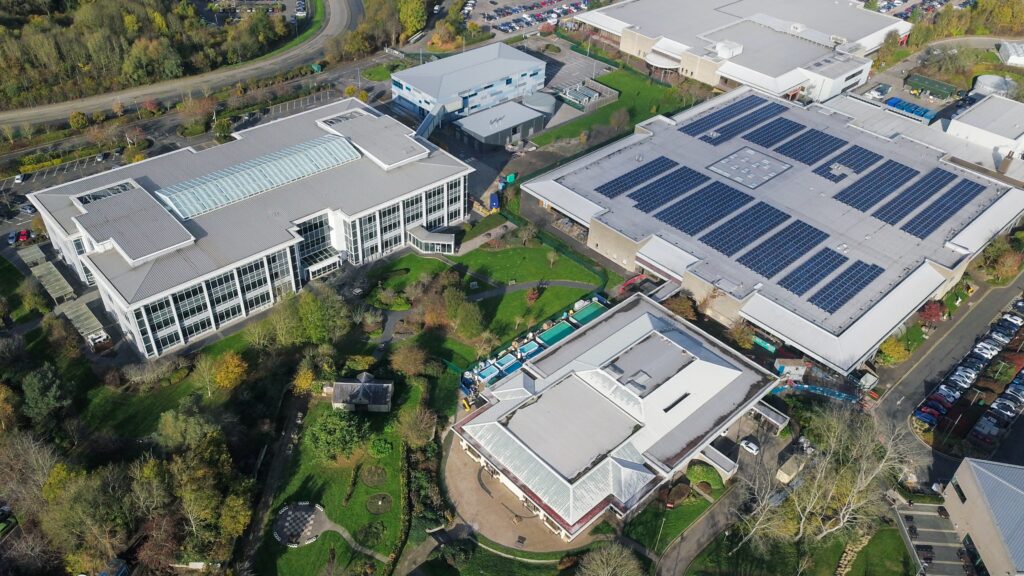
Commercial solar panels are typically installed on rooftops of commercial buildings or on adjacent land. The generated electricity is used to power daily business operations, with excess power exported to the grid under net-metering policies (where applicable).
Commercial solar allows businesses to generate clean electricity using rooftop or ground-mounted solar panels, reducing power bills, improving energy security, and supporting sustainability goals.
Common Commercial Buildings Using Solar Power
| Commercial Building Type | Typical Use Case | Key Considerations |
|---|---|---|
| Offices & IT Parks | Corporate offices, business parks | Power quality, UPS integration |
| Hospitals & Clinics | Healthcare facilities | Backup requirements, safety compliance |
| Malls & Retail Chains | Shopping centers, retail outlets | Fire safety norms, aesthetics |
| Hotels & Hospitality | Hotels, resorts | Peak load management, rooftop access |
| Schools & Institutions | Campuses, training centers | Long operating hours, safety access |
Why Businesses in India Are Investing in Commercial Solar (Cost, CSR & Reliability)
Indian businesses are increasingly adopting commercial solar panels not just to cut costs, but to future-proof their energy strategy against rising tariffs and ESG pressures.
Key Drivers for Commercial Solar Adoption
| Driver | Why It Matters for Businesses |
|---|---|
| Rising Electricity Costs | Solar reduces long-term dependence on grid tariffs |
| Daytime Power Consumption | Commercial loads align well with solar generation hours |
| CSR & ESG Commitments | Supports sustainability and carbon reduction goals |
| Power Reliability | Hybrid systems reduce impact of outages |
| Brand Perception | Positions businesses as environmentally responsible |
Businesses invest in commercial solar to lower electricity costs, improve energy reliability, and strengthen sustainability and CSR commitments.
Types of Commercial Solar Systems in India (On-Grid, Hybrid & Off-Grid)
On-grid commercial solar systems offer the best ROI for most businesses with reliable grid access, while hybrid systems are ideal for facilities that need power backup.
Choosing the right commercial solar system depends on your building’s power reliability needs, operating hours, and backup requirements. In India, most commercial solar installations fall into three system types.
Comparison of Commercial Solar System Types
| System Type | Best For | How It Works | Key Benefit | Key Limitation |
|---|---|---|---|---|
| On-Grid Commercial Solar | Offices, malls, schools with stable grid | Uses solar during the day; exports excess via net metering | Lowest cost, fastest ROI | No backup during outages |
| Hybrid Commercial Solar | Hospitals, IT parks, data centers | Solar + batteries + grid | Backup power + bill reduction | Higher upfront CAPEX |
| Off-Grid Commercial Solar | Remote campuses, off-grid facilities | Solar + batteries operate independently | Full energy independence | Highest cost due to storage |
How to Choose the Right Commercial Solar System
| Business Scenario | Recommended System |
|---|---|
| Stable grid, daytime operations | On-grid commercial solar |
| Critical loads, frequent outages | Hybrid commercial solar |
| No grid access | Off-grid commercial solar |
Cost of Commercial Solar Installation in India: EPC Pricing, ROI & Payback
One of the most searched questions is: “How much does commercial solar installation cost in India?”
While pricing varies by project size and design, the benchmarks below help businesses plan budgets realistically.
Typical Commercial Solar Installation Cost in India (Indicative)
| Project Type | Approx Cost Range (₹/kW) | Key Cost Drivers |
|---|---|---|
| Office & IT Park Rooftop Solar | ₹38,000 – ₹55,000 per kW | High-efficiency panels, AI-driven inverters, fire safety walkways |
| Mall & Retail Rooftop Solar | ₹40,000 – ₹60,000 per kW | Structural reinforcement for PEB roofs, aesthetic mounting |
| Hospital Rooftop Solar | ₹42,000 – ₹65,000 per kW | Hybrid integration for critical life-support loads, CEIG compliance |
| Hybrid Commercial Solar | ₹50,000 – ₹80,000 per kW | LFP/Sodium-ion battery capacity, smart EMS (Energy Management System) |
⚠️ Costs depend on roof condition, compliance requirements, component quality, and evacuation distance.
ROI & Payback for Commercial Solar Projects
| Metric | Typical Range for Businesses | 2026 Value Driver |
|---|---|---|
| Payback Period | 3 – 5 years | Front-loaded via 40% Accelerated Depreciation & lower CapEx |
| Plant Life | 25+ years | Advanced N-Type TOPCon modules with < 0.4% annual degradation |
| Electricity Cost Savings | 40% – 70% | Direct offset of peak-hour commercial grid tariffs |
| IRR (Internal Rate of Return) | 14% – 22% | Predictable energy yields vs. 5–7% annual utility price hikes |
Most commercial solar projects in India recover their investment within 3–5 years, delivering long-term savings and stable energy costs for businesses.
Commercial Solar Plant Capacity Guide: 1 MW, 2 MW, 3 MW & 5 MW Projects (India)
Large commercial solar projects are often planned by capacity (MW) rather than just rooftop area. Below is a practical planning guide for businesses evaluating 1 MW to 5 MW commercial solar installations in India.
1 MW Commercial Solar Plant – Cost, Area & Output
| Parameter | Typical Value (India) |
|---|---|
| Approx Capacity | 1,000 kW |
| Rooftop / Land Area Required | ~90,000 – 100,000 sq. ft. |
| Indicative EPC Cost | ₹3.5 – ₹5 crore |
| Annual Energy Generation | ~14–16 lakh units (kWh) |
| Ideal For | Large offices, malls, hospitals, mid-sized campuses |
| Payback Period | 3 – 5 years |
Planning a 1 MW+ commercial solar project?
2 MW Commercial Solar Plant – Cost, Area & Output
| Parameter | Typical Value (India) |
|---|---|
| Approx Capacity | 2,000 kW |
| Rooftop / Land Area Required | ~1.8 – 2.0 lakh sq. ft. |
| Indicative EPC Cost | ₹7 – ₹10 crore |
| Annual Energy Generation | ~28–32 lakh units (kWh) |
| Ideal For | IT parks, large hospitals, commercial campuses |
| Payback Period | 3 – 5 years |
3 MW Commercial Solar Plant – Cost, Area & Output
| Parameter | Typical Value (India) |
|---|---|
| Approx Capacity | 3,000 kW |
| Rooftop / Land Area Required | ~2.7 – 3.0 lakh sq. ft. |
| Indicative EPC Cost | ₹10.5 – ₹14 crore |
| Annual Energy Generation | ~42–48 lakh units (kWh) |
| Ideal For | Large retail chains, multi-building campuses |
| Payback Period | 3 – 5 years |
5 MW Commercial Solar Plant – Cost, Area & Output
| Parameter | Typical Value (India) |
|---|---|
| Approx Capacity | 5,000 kW |
| Rooftop / Land Area Required | ~4.5 – 5.0 lakh sq. ft. |
| Indicative EPC Cost | ₹17 – ₹22 crore |
| Annual Energy Generation | ~70–80 lakh units (kWh) |
| Ideal For | Large commercial parks, mixed-use campuses |
| Payback Period | 3 – 5 years |
How to Size the Right Commercial Solar Capacity for Your Business
Commercial solar capacity is typically sized to offset 50%–80% of a building’s daytime electricity consumption, based on available rooftop area and sanctioned load.
| Business Electricity Load | Suggested Solar Capacity |
|---|---|
| 10–15 lakh units/year | ~1 MW |
| 25–30 lakh units/year | ~2 MW |
| 40–45 lakh units/year | ~3 MW |
| 65–75 lakh units/year | ~5 MW |
Planning a 1 MW+ commercial solar project?
Get a capacity sizing, rooftop feasibility, and ROI estimate for your building.
Commercial Rooftop Solar Design Considerations (Safety, Structure & Compliance)
A successful commercial solar installation depends heavily on proper rooftop engineering, safety planning, and regulatory compliance. Commercial buildings have stricter norms than residential properties, especially for fire safety, access pathways, and electrical integration.
Key Design Factors for Commercial Solar Panels on Rooftops
| Design Factor | What to Evaluate | Why It Matters |
|---|---|---|
| Structural Load Capacity | Roof strength, slab condition, purlin spacing | Prevents structural risks and ensures long-term safety |
| Roof Type & Waterproofing | RCC vs metal roofs, waterproofing layers | Impacts mounting method and leak prevention |
| Shading & Obstructions | HVAC units, lift rooms, signage | Affects generation and layout efficiency |
| Wind Load & Safety | Wind zone compliance, anchoring systems | Prevents panel damage in extreme weather |
| Fire Safety Norms | Fire corridors, access pathways | Mandatory for malls, hospitals, hotels |
| Electrical Integration | HT/LT panels, UPS/DG coordination | Avoids power quality issues |
Commercial rooftop solar design must account for structural safety, shading, wind loads, fire safety access, and electrical integration to ensure compliant and high-performing installations.
Commercial Rooftop Solar Suitability by Building Type
| Building Type | Rooftop Solar Suitability | Notes |
|---|---|---|
| Office Buildings | High | Large contiguous rooftops |
| Malls & Retail Complexes | Medium–High | Fire access and aesthetics critical |
| Hospitals | Medium | Backup integration & safety critical |
| Hotels | High | Daytime load alignment |
| Educational Campuses | High | Large roof area, predictable load |
Not sure if your rooftop is suitable for solar panels?
How to Install Commercial Solar Without Disrupting Business Operations
One of the biggest concerns for businesses is downtime during commercial solar installation. With the right EPC execution plan, solar can be deployed with minimal disruption to daily operations.
Zero-Disruption Commercial Solar Installation Framework
| Phase | What Happens | How Business Disruption Is Minimized |
|---|---|---|
| Feasibility & Energy Audit | Load profiling, site surveys | Conducted during working hours without downtime |
| Engineering & Planning | Layout, safety planning | Scheduled around building operations |
| Phased Installation | Section-wise rooftop work | No full-building shutdown required |
| Electrical Integration | Panel connections & synchronization | Planned during low-load or off-hours |
| Testing & Commissioning | Performance checks | Parallel run without interrupting operations |
Best Practices for Seamless Commercial Solar Deployment
- Coordinate installation schedules with facility management
- Use night or weekend windows for electrical integration
- Prefabricate mounting structures to reduce on-site time
- Implement strict safety barricading for occupied buildings
- Set up real-time monitoring before full handover
Commercial solar systems can be installed with minimal business disruption using phased rooftop installation and off-hour electrical integration.
Why Manufyn for Commercial Solar EPC? (Reliable Installation + Procurement Advantage)
Manufyn’s commercial solar EPC approach integrates engineering, procurement, and execution to deliver reliable, compliant solar installations for business-critical facilities.
Choosing the right commercial solar EPC partner determines project quality, timelines, and long-term system performance. Manufyn combines engineering-led commercial solar installation with strong procurement and supply chain execution, helping businesses avoid common risks like material delays, substandard components, and compliance gaps.
What Differentiates Manufyn’s Commercial Solar Solutions
| Capability | Typical Solar Installer | Manufyn’s Commercial Solar EPC |
|---|---|---|
| Commercial Engineering Depth | ⚠️ Generic designs | ✅ Building-specific layouts & compliance |
| Component Sourcing | ⚠️ Limited vendor options | ✅ Multi-vendor sourcing with QA checks |
| Timeline Reliability | ⚠️ Delay-prone | ✅ Phased execution with clear milestones |
| Compliance Handling | ⚠️ Partial | ✅ DISCOM, net metering & fire safety support |
| Post-Installation Support | ⚠️ Basic | ✅ Monitoring & O&M planning |
Future of Commercial Solar & Sustainable Energy Solutions for Businesses
Commercial solar adoption is accelerating as organizations prioritize sustainable energy solutions to manage costs and meet ESG commitments.
Key Trends Shaping Commercial Solar Adoption
| Trend | Impact on Businesses |
|---|---|
| ESG & Net-Zero Targets | Solar becoming a core CSR & compliance pillar; mandatory reporting for SMEs and suppliers. |
| High-Efficiency Solar Panels | N-Type TOPCon and Perovskite-Tandem cells (reaching 25%+) provide more output from limited rooftops. |
| Solar + Storage Systems | LFP and Sodium-ion batteries improve resilience for 24/7 critical manufacturing and data centers. |
| Digital Monitoring (AI/IoT) | Predictive maintenance through AIoT reduces downtime and optimizes energy dispatch accuracy by 20%. |
| Green Procurement Norms | Supply chain mandates (like India’s GeM 2026 targets) make solar adoption a prerequisite for vendor eligibility. |
Commercial solar is becoming a core part of business energy strategy as companies adopt high-efficiency panels, storage integration, and digital monitoring to meet sustainability goals.
FAQs: Commercial Solar Installation for Businesses
Commercial solar installation involves setting up solar power systems for businesses such as offices, malls, hospitals, hotels, and institutions to reduce electricity costs and improve sustainability.
Commercial solar installation in India typically costs ₹38,000–₹65,000 per kW depending on roof type, system design, and compliance requirements.
Commercial solar panels are similar in technology but systems are engineered for higher loads, stricter safety norms, and commercial electrical integration.
Most commercial solar projects achieve payback within 3–5 years, after which businesses benefit from 20+ years of low-cost power.
On-grid systems stop during outages. Hybrid commercial solar systems with batteries can provide backup power for critical loads.
Yes. Commercial solar installations may require DISCOM permissions, net metering approval, and fire safety compliance depending on local regulations.
Yes, subject to landlord approval and rooftop rights agreements. Many businesses adopt shared solar or third-party ownership models for leased properties.
Planning a solar project and want to avoid EPC mistakes?
Get a project feasibility check and execution roadmap before you finalize your EPC partner.
Talk to Manufyn