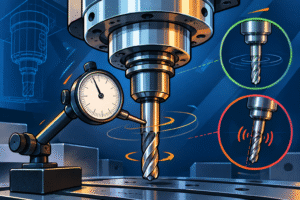
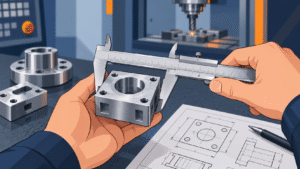
Manufyn validates designs for high-precision machining.
High-Precision CNC Design Rules for Accurate & Repeatable Parts
High-precision CNC machining isn’t about calling tighter tolerances — it’s about designing parts that can hold those tolerances repeatedly, across machines, fixtures, batches, temperatures, and inspection methods. Precision doesn’t come from hope; it comes from engineering rules that respect physics, metrology, and manufacturability.
Most designers treat accuracy like a number: ±0.02mm, ±0.01mm, ±0.005mm.
In reality, precision is a system controlled by:
- Datum and constraint logic
- Workholding and clamp direction
- Tool engagement and harmonic behavior
- Thermal distortion and post-process movement
- Inspection hierarchy & measurement repeatability
This is where CNC machine design separates ambitious CAD from manufacturable reality.
This page is not a beginner’s guide. It is a precision-based CNC guide engineered for:
- CNC programmers fixing recurring tolerance drift
- Product designers scaling prototypes to production
- Mechanical engineers responsible for repeatable supply
- OEMs & startups exporting parts with compliance requirements
If a design can’t hold tolerance across 10 parts, 100 parts, or 1,000 parts, it is not high-precision — it’s luck. We remove luck from the equation.
At Manufyn, we don’t just machine accurate parts — we design accuracy into the part before machining begins. That’s the difference.
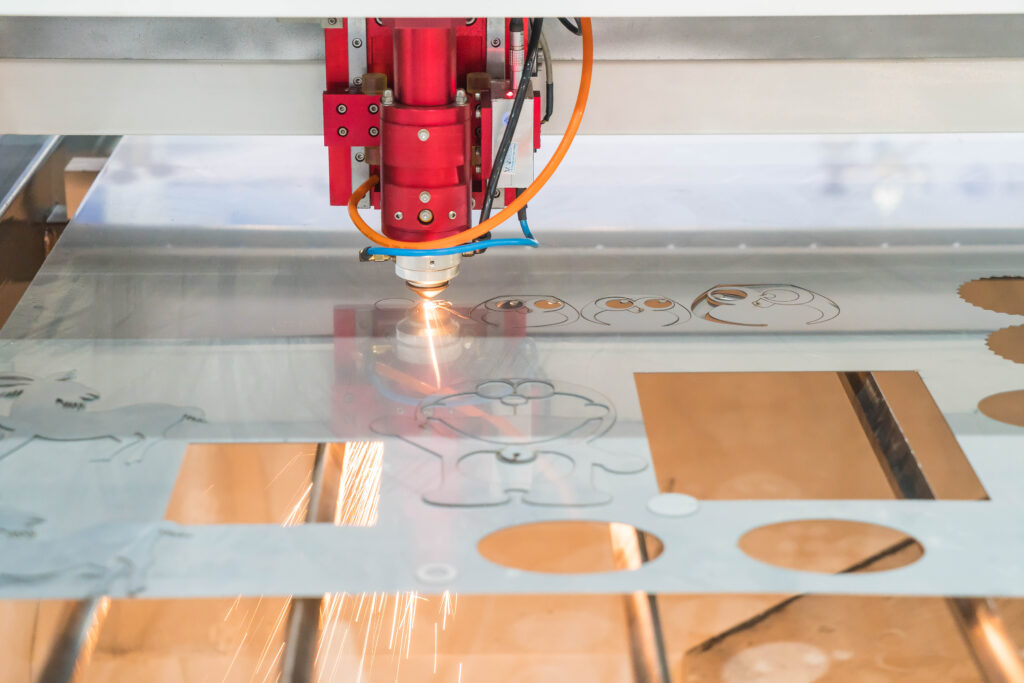
Precision Principle #1 — Accuracy Begins at the Datum, Not the Dimension
Most tolerance failures have nothing to do with machining quality — they come from a broken datum strategy in CAD. If the functional surfaces don’t reference the correct datums, no CMM report, operator correction, or surface rework will save the part.
Correct Datum Hierarchy for Precision
- Primary Datum – Defines the stability plane (flatness + orientation)
- Secondary Datum – Controls direction + alignment (perpendicularity)
- Tertiary Datum – Locks location & feature relationship
If your CAD dimensions violate this order, precision collapses under load, clamp pressure, or thermal shift.
Rules for Datum-Driven CNC Machine Design
- Never use cosmetic or curved faces as primary datums
- Align critical features to the datum, not to each other
- Do not mix functional and visual datums
- Reference faces the fixture can actually hold (physical reality > CAD symmetry)
- Avoid “floating dimensions” with no controlling constraint
If the datum is wrong, the tolerance is a lie.
This is the foundation of modern CNC machine design because accuracy comes from constraint logic, not from forcing numbers onto the drawing.
Upload your drawing — Manufyn will check if your datum and dimension strategy can hold ±0.02mm before machining.
Precision Principle #2 — Design for Repeatability, Not Just Tolerance
Any supplier can hit a tight number once. High-precision design ensures it can be hit every time — first-off, mid-run, final-off.
This is where designers confuse tolerance with precision:
- Tolerance = permitted variation
- Precision = repeatable control of that variation
Repeatability Factors Designers Must Consider
- Thermal expansion of material after cutting
- Tool pressure deflection in deep pockets
- Clamp-induced distortion on thin sections
- Burr formation that shifts functional surfaces
- Finishing or coating that changes dimensions
If your design doesn’t anticipate these behaviors, it will pass CAD, fail machining, and collapse in QA.
Practical Rules for Repeatable Precision
- Design load paths to match clamp pressure vectors
- Reinforce areas opposite cutting forces
- Avoid “micro-features” smaller than tool physics allow
- Run pre-stress models for long/thin geometries
- Call out GD&T only where functional — not everywhere
A true CNC guide for precision teaches repeatability before tolerance, not after rejection.
Precision Principle #3 — Geometry Must Respect Tool Physics (Not the Other Way Around)
Designing for high precision means designing for the cutter — because every tool has a physical limit. If the geometry demands things the tool cannot do, precision collapses into vibration, chatter, scalloping, tapering, and dimension drift.
High-precision CNC isn’t just “designing with radii” — it is designing around:
- cutter length-to-diameter ratios
- harmonic vibration risk
- chip evacuation paths
- entry and exit strategies
- deflection zones in thin walls
- flute engagement angles vs stability
Rules for Geometry in Precision CNC Machine Design
- Internal radii must match standard end mill sizes — avoid custom micro tools unless justified
- Pocket depth should not exceed 3.5–4× tool diameter without reinforcement
- No blind cavities with no evacuation path — chips = heat = dimensional instability
- Thin ribs require load support opposite cutter direction
- If the cutter enters at an angle, the fixture must resist rotational torque
What Happens When Geometry Ignores Tool Physics
- Micro-chatter destroys surface finish → ruins sealing surfaces
- Pressure causes thin walls to bow inward → tolerance shifts
- Burr buildup alters mating faces → inconsistent assembly
- Unreachable corners → fake tolerances that can’t be held
If the cutter is fighting the part, the tolerance is already lost.
A high-precision CNC machine design must be built around tool capability, not tool compromise. That’s how accuracy becomes repeatable — not accidental.
If you want precision, geometry must respect tooling.
Upload CAD — Manufyn will mark features that can’t hold tolerance with real-world toolpaths.
Precision Principle #4 — Material, Heat & Dimensional Drift Control
Precision collapses when designers forget one word: heat.
Every material expands, contracts, warps, or breathes under thermal load. Metals, plastics, and composites all move differently under spindle heat, coolant flow, clamping pressure, and post-process temperature changes.
This is what separates “accurate on the table” from accurate after cooling, which is what actually matters.
CTE (Thermal Expansion) Awareness by Material
| Material | Behavior Under Heat | Design Impact |
|---|---|---|
| Aluminum 6061 / 7075 | Expands quickly, stabilizes fast | Needs post-cool inspection for precision |
| Stainless Steel | Slow, steady expansion | Holds tolerance but needs clamp compensation |
| Titanium | High heat sensitivity | Tool deflection & clamp plan required |
| Delrin / Plastics | Softens, moves, distorts | Threads & edges need support zones |
| Composites | Expansion varies by fiber orientation | Must design around directional stability |
Thermal Rules for High-Precision CNC
- Dimension for post-cool measurement, not hot-state measurement
- Avoid mixing materials with different CTEs in the same assembly
- If tolerance is <±0.02mm → assume a controlled temperature requirement
- Design clamp surfaces that don’t concentrate thermal pressure
- Never finalize tolerances before understanding heat path + fixture load
If the material moves after machining, the tolerance is fake — it only existed at spindle temperature.
Any serious CNC guide must include thermal compensation rules; otherwise, precision becomes a one-off event instead of a repeatable outcome.
Tolerances drifting after machining?
Manufyn predicts thermal movement before cutting so the part stays accurate after cooling.
Precision Principle #5 — Workholding Controls Microns, Not the Machine
High-precision parts don’t lose tolerance at the cutter — they lose tolerance at the clamp. If the part moves even a few microns under fixturing load, the machine can’t compensate. Workholding is part of the tolerance system, not a post-setup accessory.
What Precision Workholding Must Control
- Micron-level part movement under tool load
- Angular distortion during simultaneous axis movement
- Datum alignment consistency between operations
- Thermal pressure + clamp deformation
- Edge protection on cosmetic/critical surfaces
If workholding isn’t engineered into the CNC machine design, you’re not machining accurately — you’re machining hopefully.
Micron-Grade Fixture Rules
- Align clamping vectors with the direction of cutting force
- Use soft jaws or profile nests to distribute pressure evenly
- Avoid clamping across thin or tapered faces (distorts instantly)
- Use locating pins for datum, clamps for pressure (never vice versa)
- For 5-axis precision: leave rotational clearance for articulation
If your fixture isn’t stable, your tolerance is fiction.
This is where CNC machine design must intersect with fixture engineering. Precision is not what the tool cuts — it’s what the fixture allows the tool to cut.
Precision Principle #6 — Surface Finish is a Functional Dimension
Most teams treat surface finish as “cosmetic,” but in high-precision CNC it is a functional dimension. Finish affects sealing, sliding motion, friction, wear, heat transfer, and assembly. If surface finish is an afterthought, precision fails during use — not during machining.
Finish Targets by Application
| Application | Target Finish (Ra) | Why It Matters |
|---|---|---|
| Sliding / Bearing Surfaces | Ra 0.2–0.6 μm | Reduces friction, prevents galling |
| Sealing / Fluid Interfaces | Ra 0.4–0.8 μm | Prevents micro-leaks + imperfect seating |
| Optical / Clarity Parts | Ra 0.05–0.2 μm | Visual clarity + light path stability |
| Medical / Instrumentation | Ra 0.4–1.0 μm | Cleanability + consistent sterilization |
| General Structural Parts | Ra 1.2–3.2 μm | Adequate for non-contact precision faces |
Finish-Precision Compensation Logic
- Always tolerance after finish specification
- Coatings add dimension → compensate before machining
- Polishing rounds edges → adjust mating feature geometry
- Blasting reduces reflectivity but can shift flatness on thin walls
If finish changes dimension, and dimension changes assembly, then finish is precision.
A serious CNC guide cannot separate finish from function — because surface prep alters dimensional reality.
Not sure if your finish will break tolerance or assembly?
Manufyn evaluates finish impact before you approve production.
Precision Principle #7 — Precision Dies Without Metrology & Measurement Hierarchy
Precision parts don’t fail at machining — they fail at measurement. If inspection methods don’t match tolerance intent, false passes and false fails occur. That’s why metrology is part of the design phase, not a post-machining “check.”
Measurement Hierarchy for Precision CNC
| Stage | Tool | Why It Matters |
|---|---|---|
| Setup Validation | Digital Indicators / Gauge Blocks | Establish real datums |
| In-Process Checks | Probing / Height Gauge | Prevent drift during machining |
| Final Verification | CMM / Optical Scan | Confirm GD&T — not just size |
| Repeatability Audit | First-off vs Mid-run vs Last-off | Detect tolerance drift in batches |
Design Rules for Inspectability
- Don’t dimension features that are impossible to measure
- Add access for stylus/optical contact points
- Avoid hidden datums that cannot be probed repeatably
- Use GD&T only where functional benefit exists
If it can’t be measured, it can’t be proven. If it can’t be proven, it isn’t precision.
Uncertain if your tolerances can be verified at inspection?
Manufyn validates measurement access, inspection methods & GD&T.
Precision Principle #8 — Precision Is Repeatability Across Batches
A part that’s accurate once isn’t high-precision — it’s a coincidence. Precision is proven when:
- the first-off
- the 100th-off
- and the last-off in the batch
…all match within tolerance.
Batch Stability Rules
- Design locating features for consistent fixturing
- Minimize re-clamping between operations
- Reduce “human correction points” during setup
- Manage thermal state before final measurement
- Align finish process with critical dimensions
High precision is not hitting a number — it’s owning the number.
This is where CNC machine design differentiates from ordinary CAD modeling — it designs for repeatable output, not single-hit success.
High-Precision CNC Rulebook
Keep this as your precision command list:
- Datums before dimensions — constraint is king
- Design clamp vectors to match cutting forces
- Predict thermal expansion before tolerance tightening
- Surface finish is a functional dimension, not cosmetic
- Pockets respect tool-length physics (3.5–4× rule)
- Reinforce thin walls against cutter pressure
- Material ≠ machinability — CTE decides tolerance reality
- Don’t tolerance what you can’t measure
- Avoid multi-axis features without fixture logic
- Finishing changes geometry — compensate early
- Repeatability > single-hit tolerance
- If in doubt, redesign before you program
This is what separates precision design from regular CAD.